




Abstract
We report a case of a chronic non-healing penile ulcer due to repeated topical application of crushed paracetamol tablets. To our knowledge, there are no such reports in the literature.
Introduction
The diagnosis and management of genital ulcer disease (GUD) is a significant challenge for the clinician due to a considerable number of potential aetiologies. Studies from a variety of settings in both developed and developing countries have shown that a specific aetiology is identified in 49–88% of cases with a significant proportion unsolved. 1
Case Report
A 29-year-old black West African man presented with a painful penile ‘wound’ of eight days’ duration. He had been resident in the UK with no travel abroad for three years. His last sexual contact was two weeks previously with his white British girlfriend. Examination revealed a ‘punched-out’ 2 cm by 1 cm ulcer with central granulation on the dorsal aspect of the penis. There was no lymphadenopathy and general examination was otherwise normal.
Primary syphilis, lymphogranuloma venereum and herpes simplex virus (HSV) infection were considered and he was initially treated with doxycycline 100 mg twice daily for three weeks. Swab samples from the lesion tested negative for chlamydia DNA, dark ground microscopy, culture and sensitivity, acid and alkali fast bacilli and HSV DNA. Syphilis serology was positive with a positive treponemal enzyme immunoassay (EIA), Treponema pallidum particle agglutination positive at 1:2560, rapid plasma reagin negative and treponemal IgM EIA negative. An HIV test was declined.
Repeat syphilis serology was unchanged in keeping with late latent syphilis and the decision was made to give 17 days of intramuscular procaine penicillin with oral probenecid. One month post-treatment the ulcer was still present. A punch biopsy was therefore performed and histopathology reported a ‘nodular, necrotizing dermatitis reaction, possibly infective, with no evidence of malignancy’.
‘Lost to follow-up’, he represented nine months later with persisting ulceration, which was now covered with a poultice (powdery paste) and bandaged. He admitted using crushed paracetamol topically in order to achieve pain relief, which he was advised to stop. As chronic HSV ulceration was felt to be the most likely cause, aciclovir 400 mg three times daily for 14 days was prescribed after repeating HSV culture and polymerase chain reaction (PCR), both of which were subsequently negative. He again refused HIV testing.
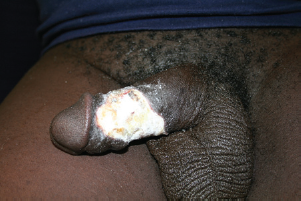
After failing to reattend he was seen 11 months later with worsening pain and an enlarging ulcer (Figure 1). The ulcer was again covered in crushed paracetamol (Figure 2). All swabs were repeated and were negative and syphilis serology was unchanged. A repeat biopsy reported ‘non-specific ulceration’. Twenty months after the initial presentation, and considerable discussion he consented to an HIV test, which proved negative.
Ulcer with poultice removed Ulcer covered with paracetamol poultice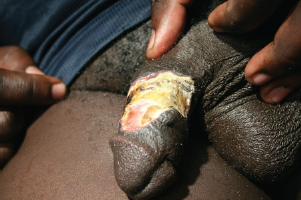
Hospital admission was arranged under joint care with dermatology for intravenous aciclovir. A third biopsy showed ‘extensive necrosis of tissues with plasma cells and lymphocytes in the surrounding dermis’. Special stains showed numerous spirochetes within the tissues, mainly in the dermis. He went on to have surgical debridement and skin grafting under plastic surgery and was then commenced on intravenous benzyl penicillin 1.8 g six times a day for 19 days on the basis of this latest report. T. pallidum PCR subsequently proved to be negative.
The debrided tissue sample showed ‘necrotic fibro-connective tissue diffusely infiltrated with bacteria and slender hyphal forms of fungus infiltrating into deep tissues’. Fungal culture was unobtainable following surgery but he was empirically treated with oral itraconazole 200 mg twice daily for seven days.
He has subsequently made a good recovery as can be seen from Figure 3.
Appearance of penis following skin graft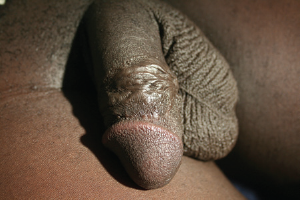
Discussion
Our case demonstrates that the diagnosis of chronic GUD can prove to be problematic. In unusual presentations, self-inflicted pathology (dermatitis artefacta) should be considered.
There was considerable debate as to the relevance of the spirochetes present on the third biopsy. As T. pallidum PCR was negative and serology was not consistent with primary syphilis, the most plausible explanation was contamination with spirochetes from the oral mucosa. The patient used his sputum to mix the paracetamol into a paste before application. Reluctance to consent to an HIV test delayed our ability to rule out immunosuppression as a contributory factor. We are uncertain as to the cause of the initial ulcer but suspect that the damage inflicted by the self-application of topical paracetamol as a poultice aggravated this.
To our knowledge, there are no similar case reports in the literature to date. There are, however, several case reports of rectal ulcers developing after use of suppositories containing paracetamol combined with various other analgesics.2–4
A psychiatric assessment revealed no abnormal beliefs surrounding the use of the paracetamol tablets topically in this patient. However, this case highlights how cultural beliefs clashing with First World medicine can prove challenging.