




Abstract
We explored a genetic detection method for Treponema pallidum (TP) in the peripheral blood of infected patients to compare the loads of treponemal DNA before and after therapy and to see if this new technique enabled assessment of therapeutic effect and detection of serum resistance. Polymerase chain reaction was used for a qualitative detection of TP DNA in peripheral blood and then a semiquantitative method was adopted to estimate the load of TP DNA in blood, both before and after treatment of syphilis. Among 30 untreated patients, three cases were TP DNA-positive. Among 42 treated patients with demonstrated serum resistance, three cases were TP DNA-positive. Five cases in which the rapid plasma reagin had become negative had no detectable TP DNA in their peripheral blood. The TP DNA load in blood after treatment was significantly lower than that before therapy. We conclude that the detection of TP DNA in peripheral blood of TP-infected patients is not yet sufficiently sensitive, but we observed that TP DNA load declines significantly after treatment.
INTRODUCTION
Recent global syphilis epidemiology reveals re-established endemicity, both in China as well as in many European and American countries. 1–3 Treponema pallidum (TP) invades all body systems during infection and can enhance the spread of HIV. Traditional monitoring of patients after therapy involves non-specific antibody tests, but a more objective approach would be to determine if TP antigen remains in the blood of syphilitic patients after therapy, and whether the existing load varies with time or treatment. In this experiment, samples with TP DNA detected on preliminary screening were quantified with realtime polymerase chain reaction (PCR) for TP DNA load in the blood. We wanted to investigate whether TP antigen exists persistently in the body of patients displaying serum resistance and to determine the effects therapy on TP DNA load.
METHODS
Clinical material was obtained from 77 TP-infected outpatients who visited the sexually transmitted infections (STIs) center of Peking Union Medical College Hospital (PUMCH) from December 2005 to June 2007. All patients were diagnosed with syphilis of various stages according to the National Center for Disease Control diagnostic standards. All selected patients signed written informed consent forms. The study was approved by the Ethics Committee of PUMCH in 2005.
Among the 77 syphilitic cases selected, all were diagnosed with syphilis on the basis of positive test results with Treponema pallidum particle agglutination (TPPA; Serodia; Fujirebio Inc, Tokyo, Japan). Of the 77 cases, 30 patients (men to women = 1.6:1 and average age = 32 years) were considered to have newly diagnosed active syphilis (untreated) with positive rapid plasma reagin (RPR) tests. After their blood specimens were collected, they were treated with a course of benzathine penicillin therapy 2.4 million units intramuscularly per week for three continuous weeks. Another 42 cases (men to women = 1:1.2 and average age = 39) were patients who still had serum resistance (RPR positivity) after therapy; they had received benzathine penicillin injections thrice weekly up to two years previously and after one year their RPR remained positive at low titres of 1:1–1:8. The remaining five cases (men to women = 2:3 and average age = 29) were patients whose RPR titres had become negative after therapy. In the experiment, two cases of healthy human blood specimens from uninfected donors were used as the negative controls (men to women = 1:1 and average age = 26). The study used the TP genome DNA extracted from the rabbit testes infected with standard TP strain as the positive controls.
Five-millilitre samples of venous blood were collected from each case and placed in an anticoagulant tube, then mononuclear cells were separated from the peripheral blood, and DNA was extracted and frozen at −20°C prior to testing. Agarose gel was used for the electrophoretic detection of PCR products to verify that the amplification products with required sizes had been obtained, and lastly six copies of DNA-positive blood specimens were prepared.
The specimens from the six patients who had DNA detected by pol-A gene amplification had TP DNA load measured by realtime PCR quantitation of the fla-A gene in blood.
RESULTS
The concentration of DNA extracts from blood samples were measured between 484 and 859 µg/μL. The ratio of optical density 260/280 = 1.6–1.8 indicated that we achieved ideal purity of the DNA samples. The product of pol-A gene amplification was 377 bp; 3% gel electrophoresis showed that all positive specimens produced product with the expected size (Figure 1). DNA specimens from the six syphilitic patients who were DNA-positive by pol-A gene amplification and one healthy adult (negative control) were amplified by realtime PCR for quantitation of the fla-A gene. The cycle threshold (C t) value for each sample was obtained and the specificity of amplification was confirmed with the melting curve. Furthermore, product electrophoresis showed segments of desired size in the gel without non-specific bands and primer dimmers.
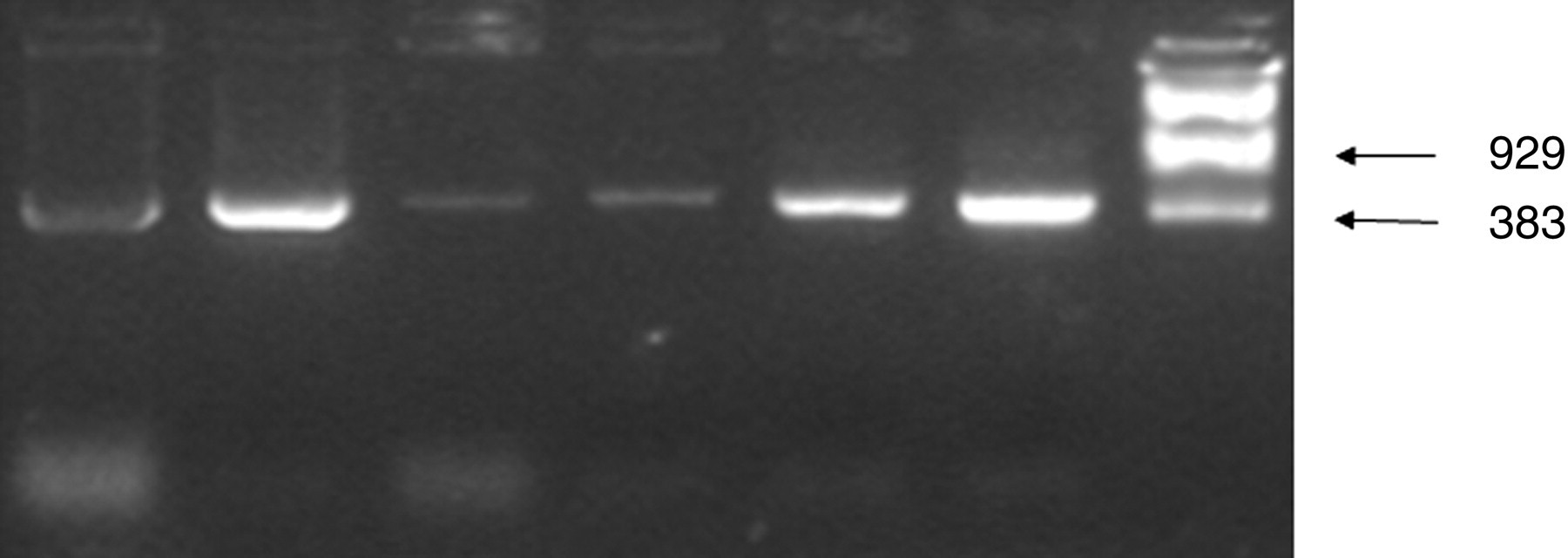
Positive results of electrophoresis for pol-A gene amplification for six specimens as well as the positive control specimen (marker)
The six DNA-positive patients were included in the quantitation substudy, detailed in Table 1.
Details of six patients who tested DNA positive in blood and underwent quantitation of Treponema pallidum DNA by realtime polymerase chain reaction
RPR = rapid plasma reagin
By realtime PCR amplification, the ΔC t values from the three post-therapy specimens were greater than those from the three pre-therapy specimens, suggesting that the number of copies of DNA in the post-therapy specimens was much less than that of the pre-therapy specimens. The values obtained in this study denoted the fold decrease in TP DNA copies of the three patients before and after therapy, which were 12.5, 4.4 and 142.9 times lower, respectively. This suggested that the pathogen load in syphilitic patients' blood after therapy was much lower than that before therapy.
DISCUSSION
The tests to diagnose and monitor syphilis infection have continued to develop for over 100 years. From darkfield microscopy to PCR detection, all methods have variations in sensitivity and specificity for patients with syphilis of different stages.
PCR is a sensitive and specific method for detecting nucleic acid, 4 which has continued to be refined for the last 20 years since its inception. In 2001, for the first time, Sutton et al. 5 detected TP DNA in the specimen of whole blood. Spirochetaemia has been demonstrated throughout the course of syphilis infection. 6
In this study, the feasibility of this method was verified, although we detected TP DNA in only 10% of patients before therapy. Among the 30 untreated syphilitic cases, three cases were positive in the DNA detection: two cases were primary syphilis and one was secondary syphilis. Among the 42 serofast cases, three cases were TP DNA positive (7.1%; one after treatment of secondary syphilis and two cases were late latent syphilis).
Based upon the published literature and the results of our experiment, we propose that the low positive rates of TP detection from whole blood may be related to the following factors:
The TP in most patients with latent syphilis may not be sufficiently numerous to allow detection in blood; The DNA load is undetectable because the patients have taken prior antibiotics; DNA quality was impaired due to poor preparation or storage; and False-positive diagnoses of syphilis.
In this study, although we tried our best to obtain reliable patient histories, accurate serological results and adequate storage conditions for specimens, these may have been suboptimal and this could have affected our results.
The primer sequences used in this study were obtained from the literature, 7 and were verified in the NCBI database. We compared the relative content of TP DNA in the blood of syphilitic patients, either pre- or post-therapy, to explore variations of DNA load according to treatment status. The results suggest that DNA load decreases significantly after therapy for syphilis. Nonetheless, it requires further investigation as to whether the decrease in DNA load is due to the natural course of disease over time or due to the therapy itself. The investigations made by Leslie et al. 8 revealed that the TP DNA load fell when the specimen was taken seven days after primary syphilis developed compared with the initial specimen. This result suggested that TP DNA load might depend also on the timing of specimen collection.
Our study shows that the application of realtime quantitative PCR might have potential value in the diagnosis of syphilis at various stages, and in the assessment of therapeutic effect of penicillin treatment.