




Abstract

Keywords
Introduction
Urethritis, or inflammation of the urethra, in men is characterized by discharge and/or urethral symptoms such as dysuria or urethral itching, but may be asymptomatic. Urethritis is mainly due to sexually transmitted pathogens. The diagnosis of urethritis is confirmed by demonstrating an excess number of polymorphonuclear leukocytes (PMNLs) in the anterior urethra. This is usually assessed using a urethral smear, but a first-pass urine (FPU) specimen can also be used. Urethritis is described as either gonococcal, when Neisseria gonorrhoeae is detected, or non-gonococcal urethritis (NGU), when it is not. Mucopurulent cervicitis is the female equivalent of male NGU with approximately 40% of cases being due to infection with Chlamydia trachomatis, 1 although female NGU due to C. trachomatis and Mycoplasma genitalium has been reported. 2
There are a number of uncertainties with NGU. There is significant inter-observer and intra-observer error in performing and reading urethral slides and counting PMNLs, especially in samples with low-grade inflammation. 3,4 In many men with urethritis, a known pathogen is not isolated.5–8 Up to one-third of men infected with either C. trachomatis or M. genitalium will not have an excess of PMNLs, 7,9–13 the sensitivity of smear (≥5 PMNLs) being far better in the case of an overt discharge, variations being furthermore dependent on populations and techniques of sampling. Indeed if a discharge is present, the isolation rate of C. trachomatis or M. genitalium reaches 50%.7,12,14,15 In 3–20% an undiagnosed C. trachomatis or M. genitalium infection is found in the partner of a patient with non-chlamydial, non-M. genitalium urethritis if he or she is tested.7,16–19
Aetiology
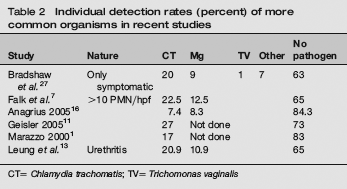
N. gonorrhoeae. The isolation rate varies enormously in different social settings and different European countries. N. gonorrhoeae is more common in inner city urban, deprived areas compared with more affluent neighbourhoods.20,21 The prevalence of the common organisms associated with NGU in more recent studies are listed in Tables 1 and 2. Reported isolation rates of pathogens is lower in more recent studies despite the use of more sensitive tests. The commonest organisms implicated are C. trachomatis and M. genitalium with the latter perhaps causing more symptoms;7,13 Chlamydia is more likely to be isolated in younger patients than M. genitalium
22
and the two organisms rarely coexist in the same individual;6,23 In 30–80% of the cases with NGU neither C. trachomatis nor M. genitalium is detected;5-8,11,24-27 The isolation of Trichomonas vaginalis is dependent on the prevalence of the organism in the community, being more common in non-white ethnic groups and Eastern Europe, and greatly increases with the use of more sensitive polymerase chain reaction assays.
28
T. vaginalis isolation is greater in men >30 years;
29
The exact role of ureaplasmas in NGU has been controversial, due to conflicting observations in clinical studies. Ureaplasmas are ubiquitous microorganisms which can be isolated from 30% to 40% of healthy sexually active young men. They have recently been divided into two species: U. parvum (biovar 1) and U. urealyticum (biovar 2) and in some studies U. urealyticum has been associated to 5–10% of cases of acute NGU;
30
A urinary tract infection may account for 6.4% (95% confidence interval 1.5–11.3%) of cases of NGU, although there is only one study evaluating this;
31
Adenovirus infection may account for perhaps 2–4% of cases of symptomatic patients and is often associated with a conjunctivitis;27,32 Herpes simplex viruses types 1 and 2 are less commonly associated with NGU (2–3%);27,33 N. meningitidis, Haemophilus sp., Moraxella catarrhalis, Streptococcus sp., Candida sp., urethral stricture and foreign bodies have all been reported in a few cases and probably account for a small proportion of NGU;
34
Urethritis, without an observable discharge, may have a different aetiology from symptomatic urethritis, with C. trachomatis12,35,36 and M. genitalium being detected less frequently,23,25,37 and in lower quantities.38,39 There is also a possible association between asymptomatic NGU and bacterial vaginosis.40,41 Prevalence of the most common pathogens detected from patients with NGU Individual detection rates (percent) of more common organisms in recent studies CT= Chlamydia trachomatis; TV = Trichomonas vaginalis

It is assumed that the aetiological agents of gonorrhoea and sexually acquired male NGU could potentially cause complications in the female partner. Gonococcal and chlamydial infection and possibly M. genitalium6,42–44 have been implicated in upper genital tract inflammation in women, in particular pelvic inflammatory disease (PID – level of evidence III). This remains to be substantiated for pathogen-negative NGU. Asymptomatic chlamydia-negative NGU was reported in male partners of women with PID, 45 but M. genitalium was not tested for in this study.
Clinical symptoms
Urethral discharge; Dysuria; Urethral itching; Penile irritation; Nil.
Clinical Signs
Urethral discharge. This may not have been noticed by the patient or may only be present on urethral massage (which should be done by the patient). The urethral discharge tends to be more profuse and purulent in gonorrhoea compared with NGU but this difference is not specific;
Normal examination.
Complications and Consequences
Epididymo-orchitis with the impairment of male fertility;
Sexually acquired reactive arthritis/Reiter's syndrome;
Increased genital shedding of HIV.
Diagnosis and Investigations
If microscopy is available, the diagnosis of urethritis can be confirmed by demonstrating PMNLs in the anterior urethra. This can be done by means of:
A Gram-stained urethral smear containing ≥5 PMNL per high-power (× 1000) microscopic field (averaged over 5 fields with greatest concentration of PMNLs) 35 (III, B);
A methylene blue-stained urethral smear containing ≥5 PMNL per high-power microscopic field7,46 (III, B);
Alternatively the FPU can be centrifuged and the pellet Gram stained. Urethritis is present if ≥10 PMNL per high-power (× 1000) microscopic field (averaged over 5 fields with greatest concentration of PMNLs) is found. (III, B);
Either urethral smear or FPU can be used: both tests will identify cases missed by the other test 12 (IIb, B);
The quality of the smear is heavily dependent on how the smear is taken and there is both inter- and intra-observer variation 3,4 (IIb, B);
Either a 5 mm plastic loop or cotton-tipped swab can be used and should be introduced 0.5 cm into the urethra (III, B). There are no published data comparing the two but the former is probably less traumatic to the patient (IV, C). A blunt metal curette may also be used 46 (III, B);
A leukocyte esterase test on the first void urine is too unreliable to be of use in clinical practice for diagnosis of urethritis (IIb, B). It remains useful for detecting urinary tract infection on the mid-stream urine;
In the presence of overt discharge, urethral smear is a better choice than FPU: it will check for diplococci and other bacteria and in most of the situations will confirm the excess of PMNLs. T. vaginalis is better seen on a wet-mount examination (IV, C);
There is controversy as to the value of microscopy in asymptomatic patients or in the absence of discharge. 10,12,47 A single nucleic acid amplification test (NAAT) for C. trachomatis may miss up to 3% of men with urethral chlamydia, 48 and a single NAAT for M. genitalium can miss 5–6% of asymptomatic men infected with M. genitalium. 7,10,16 But relying on microscopy alone to select patients in whom to perform NAAT would miss up to 37% of C. trachomatis and up to 62% of M. genitalium urethral infections,8,11,12,22,25 although in some hands the performance of microscopy may be better 23,38 (III, B). It seems wise unless the level of compliance of the patient population is very high and a reliable microbiological diagnosis is available, (chlamydia and ideally M. genitalium) to treat all symptomatic patients whatever the results of microscopy (IV, C). Microscopy remains an important test in symptomatic men for the diagnosis of gonococcal urethritis (IV, C);
The sensitivity of the smear test, but probably not the FPU 49 is affected by the period since last passing urine (III, B). The optimum time to ensure a definite diagnosis in a symptomatic man is not known. Two to four hours is conventional;
All patients attending should have a test for N. gonorrhoeae either by culture of urethral smear or by NAAT (IIa, B). If a NAAT is used a positive test should be confirmed by either culture or a different NAAT because of possible false positives in low-prevalence populations as well as establishing antibiotic sensitivity (see gonorrhoea guidelines);
C. trachomatis should also be sought (see guideline on chlamydia). It should be noted that even a NAAT will miss between 3% 48 and 10% of infections50–52 (III, B);
Commercial tests for M. genitalium are not widely available and the place of such tests in routine clinical practice needs to be determined;
A mid-stream urine should be taken if a urinary tract infection is suspected from the history such as, for example, if the patient complains of severe dysuria, haematuria (microscopic or macroscopic), nocturia, urinary frequency, urgency, or has not been sexually exposed. In one study, a dipstick incorporating nitrite and leukocyte esterase tests had a sensitivity and specificity for urinary tract infection of 83–90%, respectively 31 (III, B);
The traditional two-glass urine test adds little to the diagnosis and should be abandoned (IV, C).
Management
General advice (IV, C)
The following should be discussed and clear written information provided:
An explanation of the causes of urethritis, including non-infective causes, and possible short-term and long-term implications for the health of the patient and his partner;
The side-effects of treatment and the importance of complying fully with it;
The importance of their sex partner(s) being evaluated and treated;
Advice to abstain from sexual intercourse, or if that is not acceptable, the consistent use of condoms (also for oral and anal sex) until he has completed therapy and his partner(s) have been treated;
Advice on safer sex and consistent use of condoms;
The importance of complying with any follow-up arrangements made.
Treatment
Treatment should be initiated as soon as the diagnosis of NGU is made and without waiting for the results of tests for chlamydia and cultures for N. gonorrhoeae. Treatment should be given to all symptomatic patients even if the microscopy is non-diagnostic (IV, C).
In situations where microscopy is not available or results are unreliable, management should be syndromic with treatments that cover both C. trachomatis and N. gonorrhoeae, and in areas of high prevalence, T. vaginalis (for more details on syndromic management see World Health Organization guidelines http://www.who.int/reproductive-health/publications/mngt_stis/index.html). The inclusion of treatment for N. gonorrhoeae should only be routine if there is a discharge, because male gonorrhoea in the absence of discharge is uncommon. It would also depend on the prevalence of the infection in the community (IV, C). Ideally, treatment should be effective (microbiological cure rate for C. trachomatis >95%), easy to take (not more than twice daily), with a low side-effect profile and minimal interference with daily life (IV, C). However, assessing treatment efficacy is problematic, as no pathogen is identifiable in the majority of cases, and the inflammatory process may not reflect persistent infection. 34 It is important to note that the inflammatory exudate may persist for a variable length of time even when the putative organism has been eliminated. 53 Venereophobia is a classical cause of urethral discharge, induced by regular squeezing: in that particular case, the absence of PMNLs on examining the urethral smear or FPU must discourage giving recurrent antibiotic treatments.
Tetracyclines and azithromycin are generally effective against C. trachomatis though sporadic reports of treatment failure have been reported with tetracyclines. 54 While in general treatments that are effective against C. trachomatis appear to be also effective in NGU, tetracyclines and azithromycin in the doses used do not consistently eradicate M. genitalium55–58 (IIa, B).
All patients should be offered tests for HIV and syphilis.
Recommended Regimens for NGU
Choice of regimens depends on availability – both treatments are equally effective (Ib, A)
Azithromycin 1 g orally in a single dose (Ib, A);
or
Doxycycline 100 mg twice a day for seven days (Ib, A).
Alternative Regimens
Erythromycin 500 mg twice daily for seven days (
or
Ofloxacin 200 mg twice a day or 400 mg once a day for seven days (
Single-dose therapy has the advantage of improved compliance, although azithromycin has not been shown to be more effective in clinical studies than doxycycline (apart from M. genitalium infection) (
Sexual Contacts/Partners
All sexual partners at risk should be assessed and offered treatment without waiting for microbiological diagnosis, maintaining patient confidentiality. The duration of ‘look back’ for treating previous partners is arbitrary and should be tailored to the sexual history; three months is suggested (IV, C). If C. trachomatis or N. gonorrhoeae is detected, it is important to ensure that all sexual partner(s) potentially at risk are notified (IV, C). Partner(s) notification and management should be carried out with sensitivity, considering socio-cultural issues and avoiding stigma and violence.
Details of all contacts should be obtained at the first visit. Consent should also be obtained so that if C. trachomatis or N. gonorrhoeae is detected and the index patient does not re-attend, he can be contacted and/or provider referral can be initiated for sexual contacts (IV, C);
Female contacts of men with gonococcal or chlamydial urethritis should be treated empirically (IIb, B).
There is no direct evidence of treatment benefit to partners of men with chlamydia-negative NGU. There are, however, a number of issues that may influence decision-making.
NGU cohort studies have looked at the effect on response of urethritis and have produced conflicting conclusions; 59
There are reports of patients with persistent or recurrent urethritis being cured only after their sexual partner received antibiotic treatment; 60
Even newer NAATs may miss 3–10% of chlamydia-positive individuals;
There is also discordance in the isolation of chlamydia between partners;19,61
C. trachomatis can clear without treatment from the cervices of women,62,63 though much less frequently from the urethras of men; 64
Finally,65–67 M. genitalium accounts for approximately 20% of cases of NGU and probably causes disease in women.6,44
In the absence of randomized prospective studies it would be prudent to treat partners of microorganism-negative NGU concurrently to potentially reduce female morbidity (IV, C).
Follow-up for Patients with NGU
Follow-up after 2–3 weeks is important in order to assess compliance with therapy, ensure resolution of symptoms and to assess the risk of re-infection from an untreated partner, particularly in chlamydia-positive patients. The follow-up interview can be performed by phone or other means of communication or in person68,69 (III, B). Patients who remain symptomatic, who have not completed their medication or who have had unprotected sexual intercourse with an untreated partner should be asked to return to the clinic and re-treated with appropriate contact tracing (IV, C).
A test of cure in NGU in an otherwise asymptomatic individual is not recommended (III, B).
Persistent/Recurrent NGU
There is no consensus of opinion for either the diagnosis or the management of this condition. It is empirically defined as persistent or recurrent symptomatic urethritis occurring 30–90 days following treatment of acute NGU 70 and occurs in 10–20% of patients;70–73
Its aetiology is probably multifactorial.34,59,70 M. genitalium may be implicated in 20–40%57,70 and the current treatments for NGU do not always eradicate this organism.55,57,58 In a randomized study of 398 men, 1 g of azithromycin resulted in failure in 16% and doxycycline 100 mg twice a day for seven days in 64% of those who returned for follow-up. 56 In two small open-labelled studies azithromycin 500 mg stat followed by 250 mg daily for the next four days or moxifloxacin 400 mg daily for 10 days cured all patients.57,74 In a retrospective survey, Jernberg et al. 75 had a success rate of 79% with azithromycin (1 g single dose as effective as 5 days ‘course) and 100% with moxifloxacin 400 mg daily for seven days. Because of possible higher risk of resistance after a single dose of azithromycin, some experts recommend a five days’ course for treatment of M. genitalium (IIa, B). Recent report of severe hepatotoxicity and Stevens-Johnson syndrome in a minority of patients receiving moxifloxacin should also be taken into account. 76 A role for U. urealyticum in chronic NGU has also been suggested. 77 Although this organism may also exhibit tetracycline resistance, the therapeutic implications remain unclear. Any treatment of chronic NGU should cover M. genitalium 78 (III, B) and T. vaginalis (in areas where it is prevalent – IV, C). The only randomized controlled trial for chronic NGU showed that erythromycin for three weeks is better than placebo, 79 but the study did not test for M. genitalium, nor included treatment of partners;
In the absence of evidence of benefit, female partners of men with persistent/recurrent NGU do not need to be retreated if treated appropriately at first with any of the first-line treatments discussed previously (
Management of Persistent/Recurrent NGU
Ensure that the patient has completed the initial course of therapy and that reinfection is not a possible cause;
Only treat if patient has definite symptoms of urethritis, or physical signs on examination. Reassure asymptomatic patients that no further test or treatment is necessary.
Recommended Regimens
Patient symptomatic or an observable discharge present.55,70,79-81
First-line treatment
Azithromycin 500 mg stat then 250 mg for the next four days (IIa, B).
Plus metronidazole 400–500 mg twice daily for five days (IV, C).*
or
Erythromycin 500 mg four times daily for three weeks
7
(
Second-line regimens
Moxifloxacin 400 mg once daily for 7–10 days (
Plus metronidazole 400–500 mg twice daily for five days (IV, C).*
In areas where T. vaginalis is prevalent.
There are no trials comparing the three regimens and the situation may be quite different in different settings, depending on the microbiological resistance of M. genitalium to tetracyclines and macrolides. In general, it is advisable not to use a macrolide for second-line treatment if azithromycin 1 g stat was used for first-line treatment (IV, C).
Continuing symptoms
There is only limited evidence on how best to manage patients who either remain symptomatic following a second course of treatment or who have frequent recurrences after treatment.
Urological investigation is usually normal unless the patient has urinary flow problems 80 and is not recommended (IV, C);
Chronic abacterial prostatitis and psychosexual causes should be considered in the differential diagnosis but are rare79–81 (IV, C);
For men with persistent or recurrent urethritis, there is currently no evidence that re-treatment of an appropriately treated sexual partner is beneficial (see above) (IV, C);
Reassurance can be given that continuing symptoms have not been associated with serious long-term physical morbidity. (
Symptoms tend to improve slowly after many months. Simple analgesics, non-steroidal anti-inflammatory and anxiolytic drugs are sometimes helpful in relieving symptoms.
Auditable outcome measures
Symptomatic men should be offered microscopy of a Gram-stained urethral smear or first void urine (95%);
Men with NGU should be offered treatment with a recommended antibiotic regimen (95%).
Footnotes
Acknowledgements
We acknowledge the following: Jorgen Jensen, Copenhagen; Stephen Lautenschlager, Zurich; Nicolas Dupin, Paris; Raj Patel, Southampton and Willem van der Meijden, Rotterdam
The Cochrane library from 1970 to the present using keywords ‘Non-gonococcal urethritis’, ‘non-gonococcal urethritis’, ‘non-specific urethritis’, ‘NGU’, ‘NSU’. Hand search conference proceedings – BASHH (MSSVD), ISSTDR.