




Abstract
The aim of this review was to evaluate an ‘Email a Clinician’ link on a medically reviewed sexual health website, which was established to allow general practitioners (GPs) to communicate remotely with sexual health clinic specialists. The website was developed in consultation with GPs and extensively promoted throughout the relevant professional primary health-care networks. Despite this, the email link appeared to fail in its objective of facilitating GP access to specialist sexual health physician opinion within five working days. An audit examining use of the email link was conducted for a one-year period, during which time 324 emails were received. Results showed that the bulk of the emails (93.2%) were spam, and only 6.8% were genuine enquiries. Of the 22 genuine emails, 21 (95%) originated from the general public and there were no enquiries from the GPs, who were the target audience of the website, resulting in removal of the email link from the site. Direct survey of local GPs to evaluate reasons for non-utilization of the link was not possible. However, discomfort with the technology, time added to existing workload, lack of direct perceived benefit and lack of immediate response have been cited as contributing factors that may limit widespread adoption of other telemedicine services. As a new generation of recently graduated GPs enters the Australian workforce, who might be expected to be skilled and comfortable with electronic medical communication, the option of a direct email link to a sexual health clinic, with a faster turnaround time, may be worth re-visiting in the future.
BACKGROUND
The sexual health in Western Sydney website (see Figure 1) was developed as part of a two-year GP/Sexual Health Liaison project
1
and was consistent with the NSW health focus on developing partnerships and building capacity of general practitioners (GPs) to support their sexual health service provision.
2
The website (available at

Sydney West Area Health Service sexual health website Introduction page
The website also featured an ‘Email a Clinician’ link, allowing GPs with electronic access to email local sexual health specialists, and access opinion for management of sexual health issues in their practice. The email service was accessed from the Introduction page by clicking on a link on the contents menu, or alternatively, from links that appeared at the foot of each page of the site. Although the email link was available for the use of any person visiting the site, there was particular emphasis on GPs and other health-care workers in Western Sydney Area Health Service (WSAHS) and Wentworth Area Health Service (WAHS). Non-urgent enquiries could be directed via this link, with a telephone contact number given for more urgent enquiries. The emails were directed to, and triaged by, the Nurse Unit Manager at Parramatta Sexual Health Clinic, and answered within five working days by an experienced sexual health practitioner.
Promotion of the site occurred over a three-month period, with website launches being held across the two Area Health Services. Meetings and presentations were conducted with approximately 145 GPs from Nepean, Western Sydney and Mt Druitt. Details of the website also appeared in three editions of the Western Sydney Division of GPs Weekly Fax, distributed to over 550 GPs in the area. One thousand promotional stickers, sized to fit onto a computer monitor (12 × 4 cm), detailing the website features and address, were distributed to the GPs via the GP Divisions in Nepean, Blue Mountains, Hawkesbury and Western Sydney (see Figure 2). Presentations regarding the website were also held with NSW Sexual Health Medical Directors, HIV/AIDS and Hepatitis C Coordinators, and clinical and health promotion staff from across WSAHS and WAHS. Promotional material was also sent electronically via internal area health service newsletters and bulletins to staff across both area health services.

Original promotional sticker distributed to general practitioners
EMAIL AUDIT RESULTS
A retrospective audit of the email link to a clinician was conducted for a 12-month period from 10 March 2005 to 9 March 2006 (see Figure 3). Every email sent to the web-linked email account during this time was identified. Emails that were obviously spam emails were identified by title only; all other emails were re-opened, for determination of content and sender classification (GP, other health-care worker, general public, spam and other). During this time 324 emails were received via the link. Only 22 of these emails (6.8%) were considered to be genuine enquiries. Three hundred and two of the emails (93.2%) were spam, or unsolicited bulk emails, usually of either a commercial or sexually explicit nature. Of the 22 genuine enquiries, 21 were from the general public and one email came from an allied health-care (youth) worker, requesting clinic hours. The 21 general public enquiries consisted of three requests for information on topics not specifically related to sexual health (infertility issue, how to access circumcision, and contact details for a particular staff member). The remaining 18 general public enquiries requested location and business hour details for the sexual health and women's health clinics in the area, information that appeared elsewhere on the website. There were no emails from the GPs who were the target audience of the website, although during this time GPs continued to telephone the clinical staff of the sexual health clinics frequently with enquiries. Details of number of phone calls from GPs are not available. There were also no enquiries from clinical health-care workers across the area health services.
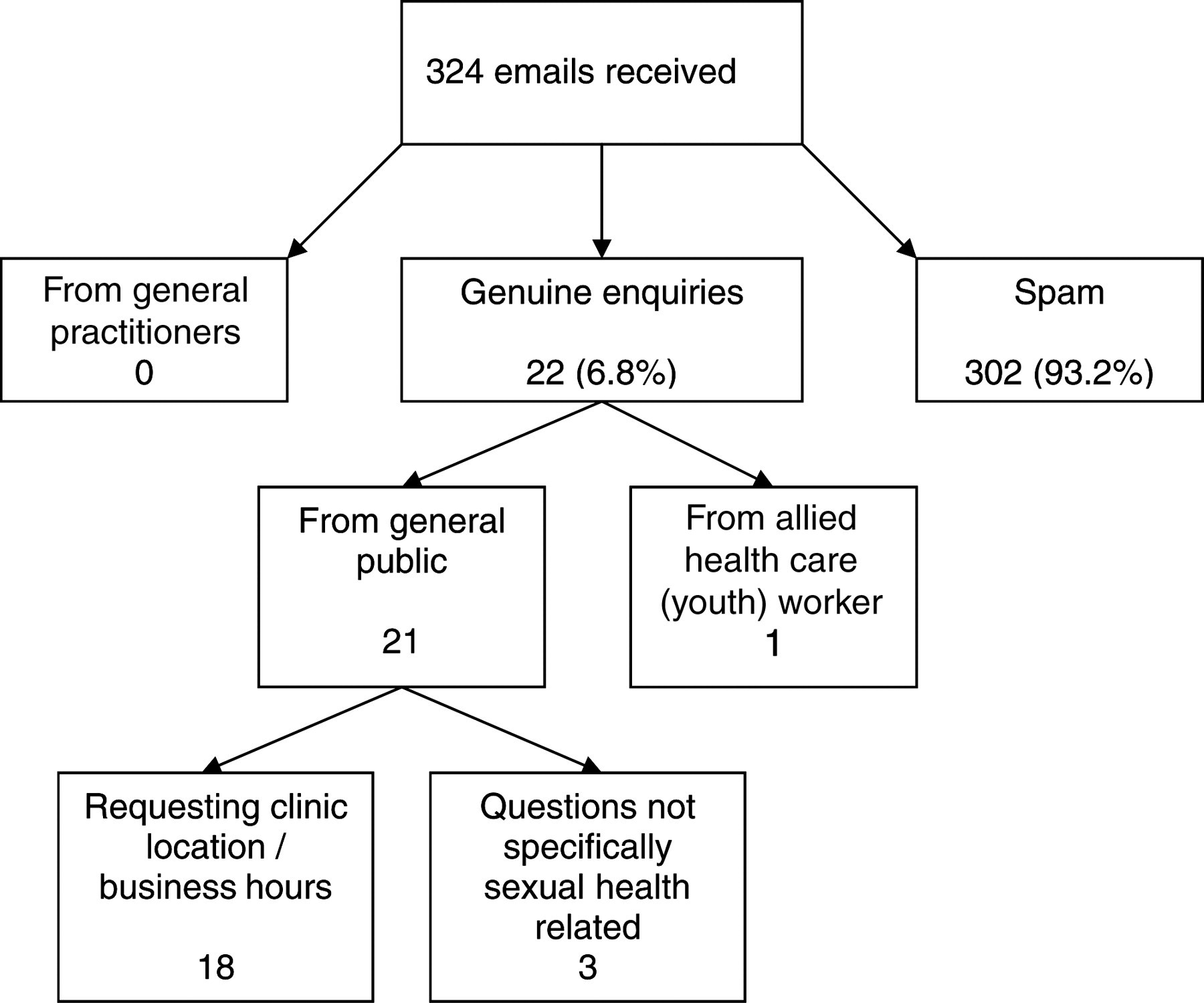
Analysis of 12 months of ‘Emails To A Clinician’ via website link 10 March 2005–9 March 2006
As a result of the audit and the amount of time spent by clinicians in sorting through the junk emails, the email link was removed from the site. Despite the absence of clear criteria on which to benchmark the audit results, it was still evident that the email link was unsuccessful in reaching the target audience.
DISCUSSION
Owing to the conclusion of the GP/Sexual Health Liaison project, it was not possible to survey the relevant GPs directly to determine why the email link was not utilized. It is indisputable that Internet-based services, in general, are increasingly popular with patients and the general public. 3 However, a literature search reveals no reports based specifically on the use of an Internet email link for GPs to access specialist sexual health physicians. Difficulties in reaching a targeted audience on a sexually transmitted disease service website have been noted before; however, the target audience in this South Australian report was a geographically based one. 4 Despite findings that indicate 96% of doctors use some form of information technology (IT), for various reasons they have been found to have low current use of this technology for clinical management, including disease management. 5 Discomfort with the technology, cost, time added to existing workload, patient privacy and unwillingness to alter clinical practice have been cited as contributing factors to widespread adoption of various telemedicine services. 5,6 As well, there may not be a perceived direct benefit, as there is for patients accessing web-based technology. 6
In the case of the email link on the sexual health website, the difficulty lies in determining whether it was the concept of the link or the site itself that may have been inappropriate. The GP/Sexual Health Liaison Project Officer consulted closely with GPs in establishing the site and the email link, and its launch/promotion covered all GP divisions across the area health services, with a mixed range of strategies including both face-to-face presentations and printed media. The website stickers were designed to be an ongoing reminder of the availability of the site and email link, as due to the conclusion of the two-year project, other promotion of the site was ceased. Once the site was accessed, navigation to the email link was a simple process, and not considered to be a probable deterrent to its use. Timeliness and the immediacy of a response are likely to be key factors in the uptake of an email consultation link 7 and a turn-around time of five days may have not have been deemed an efficient use of clinician time. The immediacy of a phone consult or the definitive outcome associated with a referral of the patient in person to the sexual health clinician may have been preferred by the GPs in western Sydney. A successful email system between doctors in the Middle East and specialists in the industrialized world had a median reply turnaround time of only 24.3 hours. 8 The case-mix for this email referral system included obstetric, radiology and other various medical specialties, not necessarily including sexual health, but doctors reported satisfaction with the service as well as improved patient management. 8
Reluctance to work in a different way may simply reflect a lack of incentive to change a mode of referral or consultation that has worked previously. This may change as the uptake of information technology continues to become more sophisticated, in particular with faster broadband uptake. In addition, the new cohort of Generation Y technology-savvy GPs, who are well versed with webcams and instant messaging, will complete their training and move into the community.
In the meantime the potential for most benefit perhaps lies in rural or remote areas, which do not have nearby physically accessible specialist services. Other forms of telemedicine, including interactive video, have been used to link remote far west New South Wales with a major inner-city sexual health clinic. 6
Our experience demonstrates that in 2006, email communication to specialist sexual health clinicians, as opposed to telephone or direct in-person consultations, cannot be seen as a useful or efficient tool to facilitate patient management for GPs in the western Sydney metropolitan area.
Footnotes
ACKNOWLEDGEMENTS
We acknowledge the contribution of Brenda Currie, GP/Sexual Health Liaison Project Officer 2003–2005; Jane Chivers, Health Promotion and Web Liaison Officer, WAHS; and staff from HIV/Sexual Health Promotion WSAHS and WAHS.