




Abstract
In the ongoing chlamydia epidemic, improving contact tracing is a priority. The aim of this research was to develop and evaluate contact tracing resources for chlamydial infection. We compared contact tracing outcomes before and during an intervention using information resources in the form of a wallet-sized ‘Make Contact’ card and a website. The notification index was similar in the pre-intervention phase and the intervention phase (1.83 versus 1.91, P = 0.74), as was the treatment index (0.94 versus 0.91, P = 0.89). Although the intervention did not demonstrate an effect, this study adds to the published data on contact tracing outcomes in Australia. Further research to evaluate contact tracing strategies, both in sexual health clinics and other settings, remains a priority.
Introduction
There is an ongoing epidemic of chlamydial infection in the Hunter New England (HNE) region of New South Wales, Australia. 1 Contact tracing of all sexual contacts from the preceding six months is recommended for all people diagnosed with chlamydia. 2 General practitioners (GPs) diagnose the majority of cases, 1 however, they may have difficulty providing sufficient information for effective patient referral 3 and may be unclear about their role in this process. 4
Improving contact tracing is a priority in the National Sexually Transmissible Infections Strategy. 5 Improving information provided to index cases and their contacts has been found to be as effective as patient-delivered partner therapy (PDPT). 6 Websites have potential utility for patients diagnosed with chlamydia and for their healthcare providers. Index cases have been found to prefer websites as a medium to aid informing contacts. 7 Internet-based partner notification systems for sexually transmitted infections (STIs) are acceptable to men who have sex with men. 8 Australian GPs considered a website supporting patients in partner notification for chlamydia would be useful. 9 The use of partner letters and brochures increased among GPs when a website link was included with positive chlamydia results. 10 A review of sexual health-related websites of organizations with a presence in HNE found few discussed contact tracing in any depth.
The aim of this research was to develop contact tracing resources for chlamydia, including web-based information, which would facilitate the contact tracing process, and to evaluate them in a sexual health clinic (SHC) setting.
Method
The study was of index cases diagnosed with chlamydia at an SHC located in Newcastle, a regional centre on the east coast of Australia within the HNE Area Health Service. The SHC staff included medical officers and clinical nurses. In 2007 and 2008, the SHC saw an annual average of 1705 clients, including 110 with diagnoses of chlamydial infection. This accounted for 10.8% of the chlamydia diagnosed in the regional centre each year (average total 1021).
Audit
A pre-study audit was conducted of the medical records of clients diagnosed with chlamydia from March to September 2007. The measures collected were the number of index cases diagnosed with chlamydia, the number of contacts identified for contact tracing and the number of contacts reported as notified and treated by index case report.
Study
The study compared contact tracing outcomes before and during an intervention using information resources about the contact tracing process for people diagnosed with chlamydia. The resources were a yellow, wallet-sized ‘Make Contact’ card and a website (www.chlamydiahelp.net), developed in conjunction with HNE Population Health. The ‘Make Contact’ card contained information for index cases printed on one side and information for contacts on the reverse, and also included the website address. The website provided general information about chlamydia, links to SHCs, contact tracing information, STI advice for young people and information for clinicians.
The HNE Health Promotion Unit developed a social marketing campaign, with the aim of increasing the prevention, early detection, treatment and contact tracing of chlamydia in young people aged 15–24 years, which was launched in November 2007. The campaign's posters, cards and print advertisements listed the website and were themed with the card (Figure 1).
‘Make Contact’ card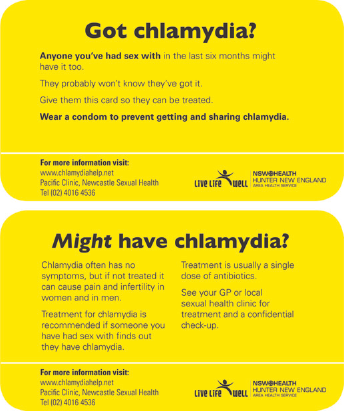
The study population included all male and female clients aged 18 years of age or over, diagnosed with microbiologically confirmed genital Chlamydia trachomatis infection at the Newcastle SHC during the study period. Recruitment was by clinicians consulting clients at the time of treatment for likely or confirmed chlamydial infection. Clients gave informed consent, a preferred contact number and preferred time for a follow-up phone call.
Clients with non-gonococcal urethritis, epididymitis, cervicitis or pelvic inflammatory disease, or reporting sexual contact with a person diagnosed with chlamydia or any of the above conditions were considered to have likely chlamydial infection. Clients were considered to have microbiologically confirmed chlamydia if C. trachomatis DNA was detected from urine or an anogenital swab specimen by a polymerase chain reaction-based assay. Those who were initially recruited but did not have microbiologically confirmed chlamydia were advised of their withdrawal from the study when they received their test result. Clients were excluded if they reported no sexual partners in the previous six months.
In the pre-intervention phase (PIP), usual contact tracing practice was conducted. Clients were advised verbally about the need for contact tracing and were offered letters for contacts’ doctors. During the intervention phase (IP), in addition to the usual practice, the clients were offered ‘Make Contact’ cards to read and to pass on to contacts.
During both phases participants were phoned by a sexual health doctor or nurse at least two weeks after notification of their confirmed chlamydial infection and invited to answer a questionnaire. Three attempts were made to contact each participant. The questionnaires for the PIP and IP had the same first eight questions, collecting contact tracing outcomes as for the audit and asking about the contact tracing method used and an assessment of difficulty. The difficulty was rated from 0, being not difficult at all, to 10, extremely difficult. The next nine questions in the PIP asked what contact tracing resources the client was given, their opinion of the resources and of four possible new resources. In the IP the corresponding questions included whether the client had received and used the new resources (‘Make Contact’ card and website) and their assessment of these.
Outcomes were analysed using a two-sample t-test. The study received ethics approval from the HNE Human Research Ethics Committee.
Results
Audit
There were 59 diagnoses of chlamydia in the audit period from March to September 2007. The mean age of these patients was 27.6 years. The majority were men (66.1%), reported only opposite sex partners (86.4%) and had a regular partner at the time of diagnosis (64.4%). The mean number of contacts per index patient for contact tracing was 1.57 (total 93, range 0–8). The mean number of contacts reported as notified, or notification index (NI i ), was 1.02 (total 59, range 0–4). The mean number of contacts reported as treated, or treatment index (TI ii ), was 0.64 (total 37, range 0–3).
NI is the number of contacts notified divided by the total number of index cases.
TI is the number of contacts treated divided by the total number of index cases. 11
Study
During the PIP, from November 2007 to May 2008, there were 56 chlamydia diagnoses; five people were excluded because they were aged less than 18 years and 35 (68.6%) eligible clients consented to and completed study participation. Four participants in the PIP withdrew or were unable to be contacted. During the IP, June 2008 to January 2009, there were 82 chlamydia diagnoses; seven people were excluded by age and 35 (46.7%) eligible clients consented to and completed the study. Five participants in the IP withdrew or were unable to be contacted.
The study participants were similar in age in both phases (mean age PIP, 26.2 years versus IP, 23.3 years). The majority in each phase were men (62.9% in both phases). In the PIP, fewer participants reported only opposite sex partners (PIP, 65.7% versus IP, 94.3%).
In the PIP, the mean number of contacts for tracing per index patient was 2.26 (total 79, range 1–5). In the IP, the mean number of contacts for tracing per index patient was 2.37 (total 83, range 0–6). The NI was similar in the PIP and the IP (1.83 versus 1.91, P = 0.74), as was the TI (0.94 versus 0.91, P = 0.89). No difference was demonstrated when the NI and TI for the regular or most recent partner and ex-partners were analysed separately (Table 1).
Contact tracing outcomes by study phase
PIP = pre-intervention phase; IP = intervention phase
Contact notification was done in person or by telephone for the majority of contacts in both phases (PIP, in person 51.4%, telephone 42.9%; IP, in person 45.7%, telephone 51.4%). One person in the PIP utilized provider notification. In the IP SMS, email and provider notification were used for five, two and one partners, respectively.
Perceptions about the difficulty of contact tracing varied widely. The mean rating was 5.03 for the PIP and 4.53 for the IP. In the PIP, approximately one-third of participants responded that they would have used each of the following if available: provider notification, a text message to forward on, a website to allow anonymous notification and a wallet-sized card to give to contacts.
In the PIP, eight (50.0%) of the 16 index cases that reported being given a contact letter passed this on to a contact. In the IP, eight (34.8%) of 23 participants who recall being given the ‘Make Contact’ card passed it on to a contact. Thirteen participants (56.5%) found the card useful and its two-sided design and information content were commented on positively. The two participants who accessed the website reported that it was useful. Some participants mentioned accessing the Internet for information before diagnosis and several volunteered that the clinician gave the most useful information verbally.
Discussion
The new resources were received positively by participants but we were unable to demonstrate improvement in contact tracing outcomes with the intervention. Our capacity to detect an impact from the intervention may have been constrained by a number of factors, including the small sample size, poor recall of the ‘Make Contact’ card, reliance on participant reports and high baseline levels of effective contact management.
The participation rate was lower in the IP compared with the PIP, which may have affected the results if those not participating in the study had different contact tracing outcomes. Lower participation in the IP may reflect study fatigue among recruiters or potential participants’ perception that use of the ‘Make Contact’ card would be obligatory.
Only 66% of participants in the IP recalled getting a card. Although the card was attached to the recruiting paperwork, the participant may not have been handed the card. Regardless, all participants in the IP were included in the analysis. It was also possible that some participants in the PIP became aware of the website component of the intervention as this was launched during the PIP. Both these potential misclassification biases would have reduced the ability to detect an effect of the intervention. Contact tracing outcomes were only evaluated by patient report. Patients may be differently motivated to report their contact tracing outcomes if they are aware that they are involved in a study and particularly if in the active intervention.
Another factor contributing to the inability to demonstrate an improvement with the intervention is that it may be difficult to increase further the high levels of contact tracing observed in SHCs. The audit results of a TI of 0.64 compares favourably to the UK standard of the verified management of 0.4–0.6 contacts per index case, 12 and to audits from Australian SHCs. In the Australian Capital Territory, a chlamydia contact tracing audit found 80 contacts were contacted from 98 index cases at an SHC giving an NI of 0.82, and 192 contacts were contacted from 293 index cases reported to a public health service, giving an NI of 0.66. 13 In a remote area of Australia, a TI of 0.88 was calculated from 192 index cases with an STL 14 In an audit of a regional SHC the TI for index cases with chlamydia was 0.69. 15
The NI and TI from the PIP were higher than the audit, reflecting the different methodology. They are considerably higher than the majority of NIs (range 0.52–1.49) and Tis (range 0.32–1.13) reported for partner notification interventions for men with chlamydia in the USA. 11 It may make it difficult to demonstrate the effect of a contact tracing intervention in settings where effective contact tracing counselling is already occurring. This explanation is further supported by interview reports that index cases felt confident undertaking contact tracing following information given by clinicians.
Despite the limitations of this study, it begins to address the question of what are effective contact tracing strategies in Australia, and its design is a possible way to evaluate new contact tracing resources. Ideally contact tracing interventions should be evaluated with a randomized controlled trial (RCT), but we identified only one comparative study in Australia, which was of GPs’ use of an intervention, 10 and no RCTs. Overseas, RCTs have shown that verbal counselling and additional follow-up can increase numbers of partners treated compared with standard treatment,16,17 and that practice-based partner notification is as effective as referral to a UK specialist health adviser. 18 PDPT has been shown to reduce the risk of recurrent or persistent infection in patients with chlamydia, compared with patient referral.19,20 PDPT has the disadvantage of contacts not being assessed, tested for other STIs, or given risk reduction counselling and contact tracing advice for their other contacts.
Both PDPT and supplemental information increase the index case's perception of the importance of treating contacts. Community-level strategies such as social marketing about contact tracing can increase the profile of contact tracing, improve the social acceptability of notifying partners and reach the general public, even before they are tested for chlamydia. In our study, few people accessed the ‘Make Contact’ website after diagnosis but several people had previously visited websites about chlamydia. Raising the profile of contact tracing for chlamydia may encourage people to instigate a contact tracing discussion with their GPs.
Conclusion
Comparative research to evaluate contact tracing strategies in Australia, including outside SHCs, is crucial. Strategies, including pre-diagnosis information, that increase awareness of contact tracing should be considered.