




Abstract
We report a case of Trichomonas vaginalis (TV) presenting as vulval ulceration in a 41-year-old woman. There was complete resolution of her symptoms only after oral tinidazole. The delayed diagnosis and importance of using the correct tests for the diagnosis of TV are discussed.
Keywords
INTRODUCTION
There were 6029 reported cases of Trichomonas vaginalis (TV) infection in the UK in 2007. 1 Approximately half of infected women are asymptomatic, but common symptoms include vaginal discharge, itch, offensive odour and dysuria and clinical signs include vulvovaginitis and strawberry cervix. 2 Rarer reported manifestations of TV infection include vaginitis emphysematosa, 3 local abscess formation 4 and ascending infection resulting in ascites 5 or perinephric abscess. 6 We present a case of TV presenting as vulval ulceration, in which the diagnosis was significantly delayed.
CASE REPORT
A 41-year-old woman presented with a 10-day history of a painful vulval ulcer. She had a five-year history of itchy vaginal discharge and recurrent fissuring at her posterior fourchette, for which she had been investigated elsewhere but no cause had been found. She had no dermatological history. Her only recent sexual partner was her husband of 16 years who had suffered with recurrent balanitis until circumcision one year previously. Of note is that a cervical smear taken the year before, by her general practitioner, had been reported as showing TV; however, this was not confirmed on a subsequent high vaginal swab.
On examination she had a deep ulcer on her left labium majus. Speculum examination was declined due to pain. Dark ground microscopy was negative. She was treated empirically for herpes with aciclovir and advised to return if her symptoms persisted. Herpes simplex virus polymerase chain reaction (HSV PCR) was subsequently negative.
She returned for review five months later. The vulval ulcer had not completely healed. She had gone on to have a Fenton's procedure to treat the recurrent posterior fourchette fissure. Again speculum examination was deferred due to pain. Blind samples were taken for vaginal microscopy and TV culture (Feinberg-Whittington medium), which were all negative, as was repeat HSV PCR.
Over the next month, she developed multiple deep vulval ulcers and the fissure at her posterior fourchette recurred (Figure 1). A limited speculum examination was performed, which revealed profuse vaginitis with frothy discharge. Phase contrast microscopy of a vaginal wet mount was positive for TV. Both she and her partner were given a seven-day course of metronidazole. Despite this her symptoms persisted and microscopy remained positive for TV and she and her partner were retreated with tinidazole. Her vaginal discharge resolved within 48 hours of re-treatment, microscopy for TV was negative and the vulval ulcers had healed after two weeks.
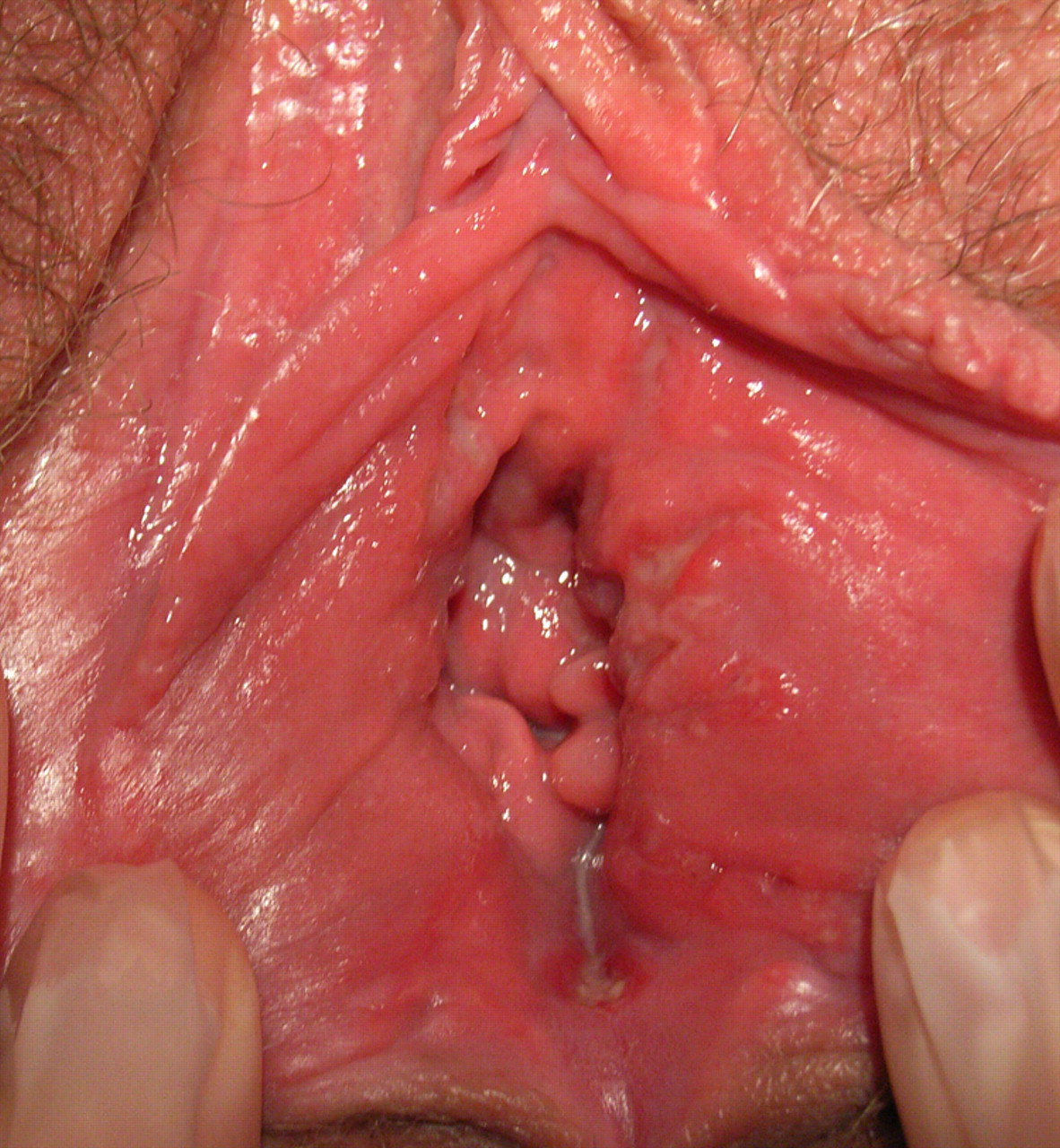
Vulval ulceration and posterior fourchette fissure prior to Trichomonas vaginalis eradication
DISCUSSION
Reports of anogenital ulceration attributable to TV infection are extremely scarce. One case report confirmed the presence of TV in chronic perianal ulcers, in a 61-year-old heterosexual man, and demonstrated resolution of all lesions after single dose oral metronidazole. 7 A second, less conclusive, case reported the isolation of TV from oral and rectal ulcers in a woman with Behcet's disease, who underwent complete regression of all of her symptoms after treatment with metronidazole; however, she was given concomitant steroid. 8 To our knowledge, this is the first report of TV causing chronic vulval ulceration.
Possible mechanisms by which TV could cause skin ulceration include superficial infection, 7 allergy 9 or the direct action of proteinases, which are shed by TV during growth and multiplication. 10
In this case, the delay in diagnosis led to both the patient and her partner undergoing surgery. Prior to the positive diagnosis being made, this patient had seven negative results from microbiology for TV and one negative wet mount microscopy reported in genitourinary medicine. Six of these negative results were charcoal swab specimens, from which wet mount preparations are made and microscopy is carried out. These were taken in primary care and the gynaecology outpatient department and the inevitable delay in them reaching the lab would have significantly reduced the sensitivity of microscopy which – even under optimal conditions – is only 70% compared with culture in women. 2 BASHH primary care testing guidelines advise swabs to be sent in transport media (Amies or Stuart's) if TV culture media are not used. 11 The other negative sample was sent in Feinberg-Whittington medium and cultured for a period of 72 hours. No TV culture system is 100% sensitive. 12 Newer nucleic acid amplification tests report significantly higher sensitivities than either wet mount or culture, but are not yet widely available. 13 In view of the low prevalence (<1%) of TV in the UK, current cervical screening guidelines advise microbiological confirmation of TV seen on a smear prior to treatment; 14,15 however, this is dependent on the correct microbiological test being chosen.
This case demonstrates the potential impact of a delayed diagnosis of TV and the importance of following current testing guidelines to optimize the chance of diagnosis. The differential diagnosis of genital ulceration is broad but should include infection with TV.