




Abstract
Sweden was the first country to introduce online Chlamydia trachomatis testing for both men and women and this article provides information about the user characteristics and which risk groups are reached with this method. During the years 2005–2007 a questionnaire was administered with a response rate of 86% (n = 6025) (62.5% women, 37.5% men). Over 60% of respondents were aged below 26 years and single. The average years of education for men and women was 14 (range 9.0–26.0). The mean Internet usage time was 22.4 hours/week among men and 15.5 hours/week among women. Only 22% men and 34% women had tested themselves for C. trachomatis at clinics previously. Respondents reported a higher frequency of previous sexually transmitted infections (STIs) compared with other Internet users (i.e. C. trachomatis: men 19%, women 24%). Eighty percent of online test users had engaged in sex with ≥2 partners without a condom during the previous year. Online C. trachomatis test users are mostly young people with high sexual risk behaviour.
INTRODUCTION
Home testing is part of the new strategy to increase the testing coverage of sexually transmitted infections (STIs). It has been proven to be a feasible and acceptable testing method in both low- 1 and high-income settings. 2 Home screening for Chlamydia trachomatis has been considered to be cost-effective and outcome measures such as the incidence of pelvic inflammatory disease (PID) has been shown to be half as common among high-risk women offered home testing for C. trachomatis versus conventional clinical testing. 2,3
The Internet, being a new health communication platform, has facilitated home testing and the development of new health services. The Internet is utilized to test for STIs 4,5 and also serve as a complement to ordinary clinical testing. The overall Internet usage is increasing yearly and currently the average time a Swede spends on the Internet is 15.5 hours/week. 6 Sweden was the first country to introduce home testing for C. trachomatis with the help of the Internet for both men and women in the year 2004. 7,8 Since the introduction in the county of Västerbotten it is now available for free to over half the Swedish population. Home testing by means of the Internet may be seen as a cost-effective, convenient and easily accessible complement to ordinary clinical testing and a service that may attract people who are embarrassed or not willing to visit a clinic for testing. 9–11 However, since this was the first online STI testing in the world for both men and women, and this is a medical service that most likely will expand in the future, this article aims at providing information about the characteristics of these online C. trachomatis test users and which risk groups are reached with this method.
METHODS
Swedish Internet users ordering a C. trachomatis home test from the largest publicly funded online testing service
The questionnaire that accompanied all ordered C. trachomatis tests contained questions regarding sexual activity, previous STIs and Internet usage along with sociodemographic background questions. Internet usage was evaluated by the question ‘how many hours per week do you use the Internet?’, which is believed to include both work and recreational usage. The variable sex with number of unknown partners without condom during the previous year was defined from a question which reads ‘during the previous year, how many times did you have sex without using a condom with a person who was unknown to you at the time of intercourse?’ The questionnaires were sent out during three consecutive years, 2005–07. Respondents were informed that answering the questionnaires was voluntary and that their decision would not alter the testing procedure. The local medical ethics committee approved the study.
RESULTS
Background characteristics of the klamydia.se users by gender
SMS = short message service (text message); STI = sexually transmitted infection; NS = non-significant
Note: The values presented in this table are percentages and number of subjects in parentheses unless stated otherwise
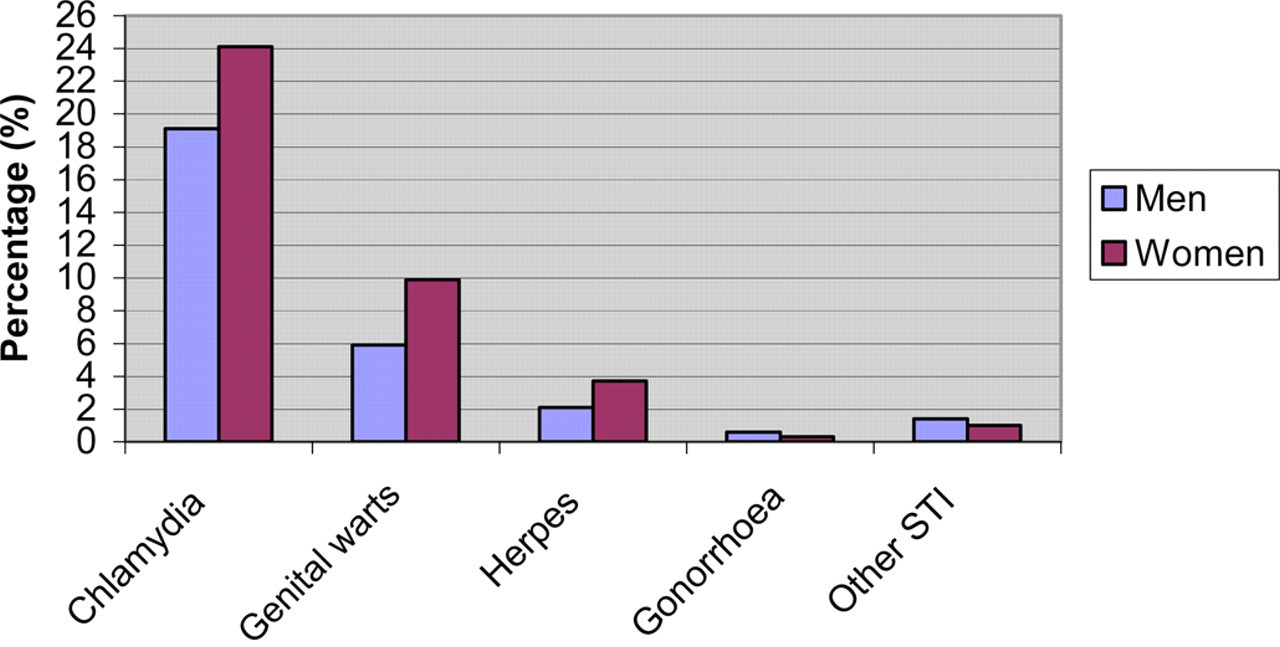
Frequency (%) of having sexually transmitted infections previously among the users of
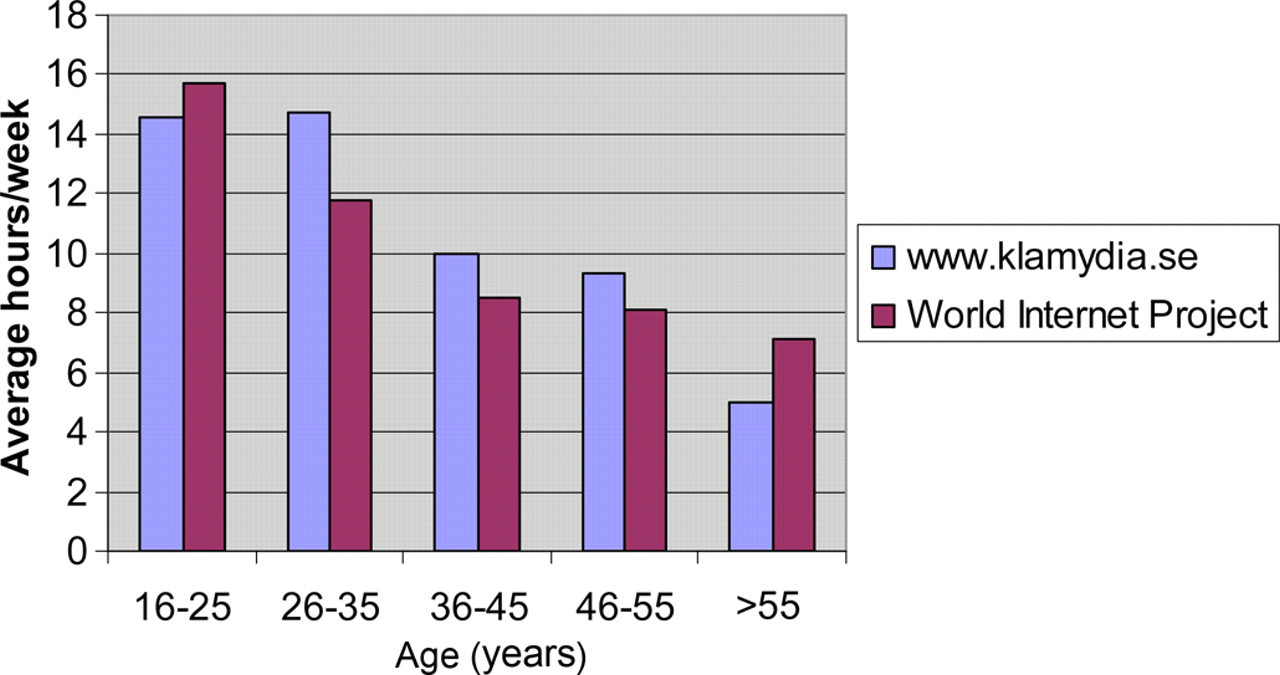
Average hours of Internet use per week among the users of
DISCUSSION
New online STI testing services are quickly emerging worldwide; some are publicly funded and offer free testing while others may be expensive and not regulated. 5,12 There are risks and disadvantages with online STI testing such as the lack of individualized care including lack of individualized information, counselling, and appropriate STI testing and management. Home testing for STIs by means of the Internet may seem like a convenient and appealing alternative to young adults, but there is yet little knowledge about the characteristics of these users. Since online STI testing is a new medical service that most likely will expand in the future, it is vital to understand who the users are and what groups are reached by this method and these are the key issues addressed by the present study.
Sexual risk behaviour and previous STIs
The vast majority of respondents in our study were aged below 26 years (63% men and 77% women), which correlates to the general testing trend of
Compared with other Swedish Internet users, our participants reported an overall higher frequency of previous STIs. In a recent study, Ross et al. investigated the STI history of 904 men and 931 women who visited one of the top Swedish Internet portals. A banner invited visitors over the age of 18 years to answer an Internet-based questionnaire and found that 8.0% of the men and 12.0% of the women had previously been infected with C. trachomatis, 3.9% of the men and 7.6% of the women had previously been infected with human papillomavirus (HPV), 3.1% of the men and 3.4% of the women had previously been infected with genital herpes, and 3.3% of men and 7.6% of women reported a previous gonorrhoea infection.
15
Compared with the Ross et al. study the users of
Study limitations
The response rate of 86% could have been higher if the online STI test users were resent questionnaires or reminded by telephone. The characteristics of the non-respondents could also have been evaluated with a follow-up questionnaire. Only one questionnaire was sent without any further action in order to minimize the risk of invading the users’ privacy. We believed that if a user experienced a privacy invasion, he/she might be less interested in future STI testing. A further limitation is that it is not known if condoms were used with a stable or temporary partner. The question was formulated to ask if a condom was used with a person who was known or unknown during intercourse. Internet usage was self-reported which may include a recall bias limitation with a possibility of an over- or underestimation of the Internet usage. Almost one quarter (25%) of all test orders were never returned (2382/9360). This is a limitation of the service itself but also a study limitation since we do not know the characteristics of these non-testers.
Gender aspects
Women answered more questionnaires than men (93% versus 77%), which is consistent with the overall Internet testing rate at
Previous testing for C. trachomatis was gender-related in the younger age group where fewer men than women mentioned the youth health clinic as a clinical testing alternative to the Internet. It is known that only 11% of the visits to the youth health clinics in Sweden are by men, thereby making Internet testing a comfortable substitute for this group. 17 This discrepancy in clinical testing among men and women in the younger age group is worrisome. Future studies need to evaluate if online STI testing services will completely replace the first clinical sexual health visit by young men, which would be unsatisfactory. A first supportive clinical visit for a young person becoming sexually active is extremely important from a preventive point of view.
Reasons for Internet testing varied between men and women. It was much more common for men to test themselves after recommendations from their partner than vice versa (18% versus 5.8%). From a heterosexual, gender, and preventive aspect this is an unequal distribution of sexual health responsibilities. The optimal scenario would be that both genders were recommended equally to test themselves; this was not achieved, possibly due to behaviour differences but also due to fewer sexual health-care visits for men than women. In Sweden, women seek care in youth and STI clinics more often than men 17 because of regular birth control measures and Pap smears. This is also shown in our study where previous clinical testing for C. trachomatis was much more common among women than men (34.1% versus 22.2%). Partner recommendation as a preventive measure would be more effective if it had an equal gender distribution since STIs most often involve both members of a relationship. Whatever the reason for the unequal distribution of partner testing recommendations, it would be improved by more sexual health visits and/or testing by men. Believing themselves to be infected was the most common reason for testing themselves on the Internet and our previous study showed that this was the strongest variable associated with chlamydia infection among men when performing an Internet chlamydia test, OR 9.10 (confidence interval [CI]: 2.80–29.5). 8 Therefore, easily accessible health clinics with a focus on attracting both women and men are recommended. On the other hand, the most common reason for testing themselves among women was having symptoms, which was also shown to be strongly associated with chlamydia infection in one of our previous studies, OR 2.94 (CI:1.70–7.38). 8
Internet usage and Internet activity
Sweden has one of the highest levels of Internet access in the world, second only to Iceland, where 87.7% of the Swedish population had access to the Internet during the year 2008. 19 While Internet access is high, Sweden does not have the highest Internet usage. The overall average Internet usage is only 15.5 hours per week compared with the USA at 19 hours per week. 6 The general Internet usage of our participants is best compared with the Swedish part of the World Internet Project, which investigates the Internet usage by a revolving panel design consisting of 2000 individuals, evenly distributed into different age groups, interviewed by telephone. 20 Figure 2 shows that average weekly Internet usage is approximately the same in the young age group as in the Swedish part of the World Internet Project, but slightly higher in the age group 26–35 years. Older age groups have too few participants whereby no conclusion can be drawn. The distribution of Internet activities of our participants is comparable to the general Internet usage in Sweden where the most popular activity among both young men and women is chatting (Instant Messaging) followed by watching movies and playing games. 20 The interest of playing games decreases with age and is replaced by other activities, especially chatting. Chatting becomes more important with age and among young Swedish adults aged 21–30 years almost half of the young Swedish population chat daily. 20 The respondents in our study show a similar trend where playing games decreases with age and chatting is the single most common Internet activity for both genders. Chatting and instant message services therefore act as a valuable daily meeting platform where new social and sexual networks are formed for young adults in Sweden. Among Swedish adults using the Internet, flirting by means of chatting was the most popular online sexual activity (OSA) among women and the second most popular OSA among men. 21 Viewing erotica was the most popular OSA among Swedish men in all age groups 21 and viewing erotica was also much more common among men than women in our study. Chat rooms and online communities should therefore serve as good platforms for STI preventive messages.
CONCLUSIONS
The users of the Swedish online C. trachomatis testing service were mostly below the age of 26 years, with no educational differences between gender, and they do not spend more time on the Internet than other general Swedish people. However, eight out of ten respondents had sex with two or more partners without using a condom during the previous year. Few have previously tested themselves for C. trachomatis at a health clinic and they also reported a higher frequency of previous STIs than other Internet users.
Footnotes
ACKNOWLEDGEMENTS
Gratitude to Professor Roger Karlsson, the co-founder of the online STI testing service, and for supplying the data material. Thank you also the virology laboratory at Norrlands University Hospital for collecting the questionnaires.