




Abstract
We assessed the acceptance of self-testing for vaginal pH in 344 Ugandan women in different clinical settings. Women tested themselves by insertion of a gloved finger into the vagina to test vaginal pH and provide a smear on a glass slide. None of the tested women found the test very difficult: 8% found it somewhat difficult, 16% rather easy and 76% very easy to do. Of the 20% who found it difficult to read the test result, more women were attending a family planning clinic or had a higher diploma (P = 0.001). Pregnant women were least likely to understand of the meaning of the test, while those visiting family planning clinics had the opposite experience. HIV-infected women were most motivated to accept: 95% would be happy to use the test more often if requested, and another 3.5% felt they might be better motivated to do repeat testing after extra explanation. Self-sampling of vaginal pH is well accepted by Ugandan women. Our new method also allows diagnostic work-up by formal microscopy. Before commencing large-scale population screening, unexpected reactions of different subpopulations should be taken into account.
Keywords
INTRODUCTION
Bacterial vaginosis (BV) and other types of abnormal vaginal flora (AVF) predispose women to several health risks. Increased intravaginal concentrations of bacteria and subsequent shift to more virulent bacteria may be associated with gynaecological consequences such as pelvic inflammatory disease, infertility, increased risk of ectopic pregnancy, 1 post-operative gynaecological wound infection 2,3 and postpartum endometritis. 4,5 At the same time the consistent association between BV and adverse pregnancy outcomes such as miscarriage, preterm delivery of low-birth-weight neonates and premature rupture of membranes 6–13 is of particular concern in contemporary obstetrics. Although BV is not considered a conventional sexually transmitted infection (STI), it is strongly associated with acquisition and transmission of STIs such as gonorrhoea, 14,15 chlamydia, 14,15 trichomoniasis, 15 genital herpes 16,17 and HIV-1. 18,19
BV is very frequently found in African women with prevalence rates of up to 50%, in part accounting for the high incidence of all the above complications in this part of the world. It is clear that an effort to reduce the prevalence of this risk factor, which is common to all these complications, could potentially not only save lives and reduce morbidity, but would also help to cut the already unaffordable health care expenses in third-world countries.
Coexistence of a vaginal epithelial inflammatory reaction is uncommon in BV, but is usually present in patients with aerobic vaginitis (AV). In this condition, like in BV, the lactobacillary flora is disrupted and pH increased, but the organisms found in AV are common enteric bacteria like Escherichia coli, enterococci, group B streptococci, Ureaplasma sp., etc., instead of typical anaerobes like Mobiluncus, Prevotella sp., Atopobium vaginae and Gardnerella vaginalis found in BV. 20 The typical inflammatory reaction in AV, recognized at microscopy by the presence of numerous leukocytes, including toxic leukocytes, 20 and sometimes of parabasal epithelial cells, is never found in uncomplicated BV. Both AV and BV, however, exhibit an increased vaginal pH, and both conditions may harm health in women before, during or after pregnancy. 4,10
Owing to lack of proper diagnostic tools and resources, routine laboratory-based testing is unrealistic in this setting, so most interventions have used ‘syndromic management’, employing simple clinical management algorithms designed to obtain maximum therapeutic effect for minimal diagnostic effort knowledge. 21,22 However, studies indicate that this approach is largely insufficient in Africa and saves neither time nor money. 23,24 Furthermore, besides high rates of overtreatment, syndromic management may lead to false diagnoses of STI, resulting in stigmatization of women, domestic disruption, violence and severe anxiety. 25
We studied the acceptance, comprehension and ease of use of self-testing with a disposable two-finger glove and a pH strip as a cheap, affordable means of detecting high-risk vaginal flora patterns in an unselected population of Ugandan women presenting for ambulatory care in an Obstetrics and Gynecology (Ob/Gyn) department in two hospitals in Uganda. It was essential to test the acceptability of this method, before commencing widespread diagnostic testing to clarify the reason for abnormal pH, and to test whether treatment could improve AVF and vaginal pH.
MATERIAL AND METHODS
Women presenting at different clinics (infertility, gynaecology, antenatal) at the outpatient departments of the Buikwe and Kampala hospitals from 15 July to 15 September 2009 were asked to participate in a study to self-test for vaginal pH. Kampala University hospital is a large inner city hospital, while Buikwe is a small ambulatory unit in the rural area north of Kampala. Women had to be between 18 and 50 years old and women with vaginal bleeding were excluded. They were told by a trained nurse that self-measurement of the vaginal pH could indicate that some disturbances are present, which could increase the risk of acquiring infections, including HIV, as well as complications during pregnancy. They were also told that further studies would be organized to test which therapy could be adapted to alter the high risk accompanying increased vaginal pH. The study was approved by the ethical committee of Kampala University Hospital and all patients signed informed consent before entering the study.
An interview was organized with a registered nurse to collect demographic and medical data on a standardized questionnaire form. Patients were given a two-fingered glove (index and middle fingers) and asked to insert the index finger deep into the vagina. They were then asked to press the tip of the gloved index finger on a pH strip (PH-Fix, range pH 3.6–6.1 Macherey-Nagel GmbH and Co, Düren, Germany), which was attached to a glass slide, and from there move the finger sideways over the glass slide (Figure 1). Finally, the gloved finger was rinsed in a vial containing liquid fixative (Cytorich®). By doing so we obtained a vaginal smear for microscopy and vaginal material in a liquid fixative for later diagnostic testing by molecular detection techniques.
After introducing a gloved index finger in vagina, the fingertip is pressed for 10 seconds on the pH strip which is attached to a glass slide, (a). Next the fingertip is spread lateral over the glass slide, (b). A colour scale showing yellow, orange and red is presented to compare the result obtained on the pH strip. Without additional fixative or colouring substance the slide is allowed to dry on the air and is placed in plastic holder that is prepared for transport to the microscopy lab, (c)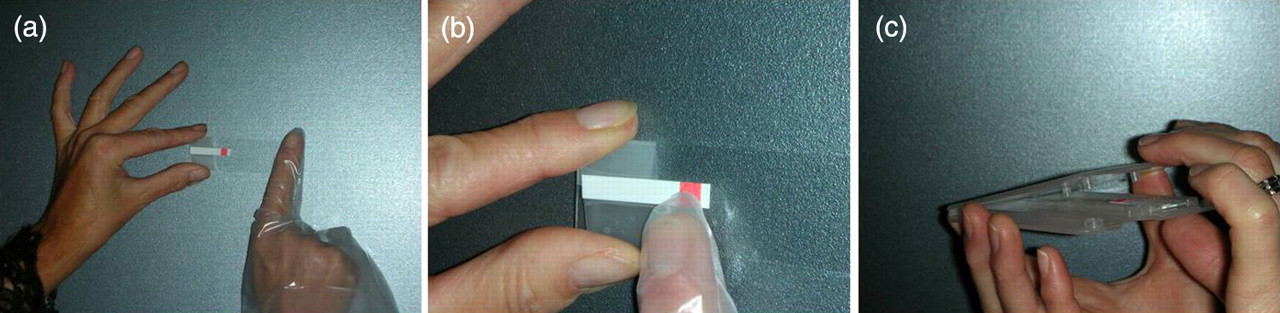
Patients were asked to assess their pH as: (1) normal (yellow), (2) intermediate (orange) or (3) abnormal (red) by comparing the strip with a colour card provided in the set. They were then asked their opinions about the test, rating any difficulty in taking the sample, reading the result or understanding the importance of the test. During this orientation study no follow-up testing or treatment was arranged.
Data were analysed by use of Instat 2.01 (GraphPad Software Inc, La Jolla, CA, USA). Statistical analysis was done by chi-square test and Fisher's exact test (for groups with less than 5 values) for stochastic variables. For continuous variables (e.g. age) Student's-t test was used.
RESULTS
Recruitment rate depended on time constraints of the medical staff, availability of suitable patients and extent of agreement of the women invited. Roughly one-fifth of the patients visiting the units were included, but no log was kept of the patients not approached or who refused. Of the 344 patients (7 Caucasian co-workers excluded), 30 (8.7%) attended an ambulatory gynaecology care unit, 144 (41.9%) a prenatal care unit, 18 (5.2%) an infertility assessment unit and the remaining 152 (44.2%) were seen at a family planning clinic. Data from 286 women presenting at four different ambulatory services in Mulago Hospital (Kampala) and 58 in Buikwe Hospital (100 km outside Kampala) were complete and eligible for analysis, totalling 341 patients, all of black African origin. The mean age was 28.2 ± 6.1 years and mean parity was 2.0 ± 1.6.
Sample taking
Ease of use of the self-test for pH among Ugandan women attending different services in Ugandan hospitals
Other contraceptive: intrauterine device, intrauterine hormonal system, depo medroxyprogesterone/Depo-Provera, Norplant
Continuous variables expressed as mean (standard deviation), discrete variables as numbers (percentage of total)
Only significant P values are shown
*Mean of semi-quantitative categories: ‘never’, ‘once’, ‘2–4 times’ or ‘more than four times’
†Calendar method, temperature method, coitus interruptus
Reading the result
Assessment of the proportion of women who find interpretation of the pH paper easy or difficult (two patients did not answer this question)
Other contraceptive: intrauterine device, intrauterine hormonal system, depo medroxyprogesterone/Depo-Provera, Norplant
Continuous variables expressed as mean (standard deviation), discrete variables as numbers (percentage of total)
*Mean of semi-quantitative categories: ‘never’, ‘once’, ‘2–4 times’ or ‘more than four times’
†Calendar method, temperature method, coitus interruptus
Understanding the result
Assessment of the proportion of women who understood the meaning of the test as follows: I fully understand (YES), I understand but would need more explanation (YES, BUT), or I don't understand the meaning of this (NO)
Other contraceptive: intrauterine device, intrauterine hormonal system, depo medroxyprogesterone/Depo-Provera, Norplant
Two patients did not answer this question. Continuous variables expressed as mean (standard deviation), discrete variables as numbers (percentage of total)
*‘Yes, but’
†‘No’ versus ‘yes’
‡Mean of semi-quantitative categories: ‘never’, ‘once’, ‘2–4 times’ or ‘more than four times’
§Calendar method, temperature method, coitus interruptus
Repeating the test
Assessment of the proportion of women who would repeat the test if asked to do so, assessed as follows: I would definitely do it again (YES, NO PROBLEM), I understand but would need more explanation (IF BENEFICIAL FOR HEALTH), after being explained more in detail (AFTER CONVINCING) or I would never do this again (NO)
Other contraceptive: intrauterine device, intrauterine hormonal system, depo medroxyprogesterone/Depo-Provera, Norplant
Continuous variables expressed as mean (standard deviation), discrete variables as numbers (percentage of total)
*Mean of semi-quantitative categories: ‘never’, ‘once’, ‘2–4 times’ or ‘more than four times’
†Calendar method, temperature method, coitus interruptus
DISCUSSION
For the majority of black Ugandan women in this study the self-test for vaginal pH was found to be easy to perform and well accepted. However, women presenting with more serious problems attending the gynaecology clinic, where oncology, severe infections, pain and surgical problems are addressed, seemed to perceive sampling and handling of the test as more difficult than women presenting to routine clinics (family planning, postnatal care). Also, previous experience with doctors’ practices and local hospitals increased the likelihood that the test would be perceived as more difficult, again indirectly indicating a link between having more serious problems and finding the test complicated. It is not clear as to whether factors other than disease severity play a role, as HIV-positive women and a history of previous operations found less difficulty with the test.
Interpretation of the results seemed to depend on the degree of schooling. Opposite to what we expected, women with the highest schooling had greater difficulty interpreting the test results than others. More highly-educated women might have a greater appreciation of the importance of the possible consequences of a positive test and hence looked harder for more sophisticated colour nuances than a simple recognition of yellow, orange or red. In an earlier study we tested different diagnostic strips for assessing vaginal pH and abnormal vaginal flora, and concluded that the Macharey–Nagel strip we used in this study was four times more easy to interpret than the green-blue shades of the Merck strips. 26 In that study, however, we did not take into consideration the degree of schooling. Similarly, it is difficult to explain why patients attending family planning clinics had a hard time recognizing the correct colour, while the trend was exactly opposite in pregnant patients, who almost never failed to recognize the colour with ease. It is possible that the greater acidity of the vagina in pregnant women made the vivid yellow colour of the test more obvious. The family planning patients, on the other hand, were more often postpartum: breastfeeding, vaginal atrophy (VA) and subclinical bleeding may have been more frequent, making recognition of an orange or red test result more difficult.
Pregnant women, although easily recognizing the colour change, seem to have a greater problem understanding the meaning of the test. Why this should be so, when family planning patients find it difficult to read but easy to interpret, is hard to explain. We speculate that pregnant women are more used to undergoing regular, passive antenatal visits, thereby transferring the thinking process to their care-givers, while family planning patients more actively seek medical advice and may be keener to try to understand how their body functions.
Interestingly, women who frequently visited gynaecological clinics or traditional healers were more reluctant to repeat this test. Women with HIV, on the other hand, were most keen to re-do the test if indicated. This may be because they are more aware of the need for timely detection of any possible risk that might undermine their health, understanding the importance of preventive care. Also, appreciation of an association between vaginal flora abnormalities and increased HIV transmission and the subsequent risks associated with this, may further increase their awareness and their increased interest in broader testing. 27,28 On the other hand, women with symptomatic genital disorders visiting gynaecological outpatient clinics might be less focused on preventive measures, as their primary concern is to sort out their presenting complaint.
We conclude that self-sampling of vaginal fluid, and pH measurement as a screening method for abnormal vaginal flora and risk factors for genital health problems, is well performed, well understood and well accepted by the majority of unselected Ugandan women presenting in different outpatient settings. This technique could therefore be used as a screening tool for larger populations. Furthermore, our method of combining pH testing with vaginal fluid microscopy allows refinement and diagnostic confirmation of the pH findings. However, before beginning large-scale population screening, biases in test interpretation by different subpopulations have to be taken into account: pregnant women had little problem reading the test results, yet did not understand its meaning, while women visiting family planning clinics experienced exactly the opposite. Women with HIV were most motivated to accept follow-up testing.