




Abstract
A 32-year-old HIV-infected man presented with an ulcerating skin lesion with indurated borders on the upper right arm. Both dark-field microscopy and syphilis serology confirmed the diagnosis of primary syphilis. Extragenital syphilitic chancres are uncommon but nevertheless have to be kept in mind as they often delay diagnosis.
CASE REPORT
A 32-year-old HIV-1-infected Caucasian man presented at our outpatient clinic with an ulcer on the upper right arm. It was painless, sharply demarcated, round, measured 17 mm across and had indurated borders (Figure 1a). The patient's history revealed existence of the ulcer for 10 days and unprotected sexual contact with another man four weeks earlier. The patient was an insertive partner and there was no penile or oral contact with the patient's arm described. He had unilateral painless and non-tender axillary lymphadenopathy with no involvement of mucous membranes and no signs of fever or other clinical signs. HIV-1 infection had been diagnosed in 2002, and the patient was on antiretroviral therapy (ART) following a history of cervical diffuse large B-cell lymphoma. In the previous month, the HIV-1 RNA level was 85114 copies/mL and the CD4+ T-cell count was 448 cells/µL. Therefore, his ART had been switched to maraviroc, darunavir and ritonavir due to virological failure with high-level resistance against reverse transcriptase inhibitors (K65R, M184I, Y181C, M230L).
Clinical presentation of the patient – chancre of the right upper arm at (a) initial visit, (b) four weeks and (c) three months after start of treatment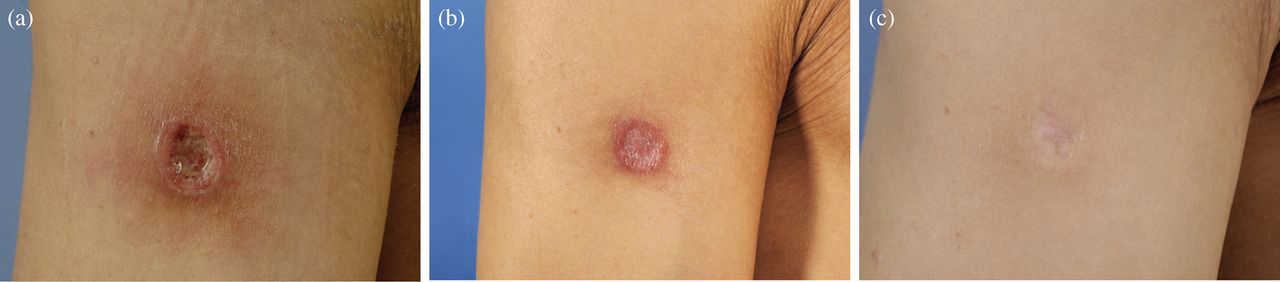
Dark-field microscopy was performed on exudate derived from the skin ulcer and multiple spirochetes were seen. Syphilis serology (which had been negative 3 months earlier) demonstrated positive treponemal IgM, a positive Treponema pallidum passive particle agglutination titre of 10,240 and reactive fluorescent treponemal antibody absorbed test as well as a reactive Venereal Disease Research Laboratory (VDRL) test with a titre of 32.
Thus, the diagnosis of primary syphilis was established.
The patient received benzathine penicillin G 2.4 million units intramuscularly three times in weekly intervals in line with the Austrian Society of Dermatology and Venereology guidelines for treatment of syphilis in HIV-1-infected individuals (available at:
DISCUSSION
Unusual presentations of primary syphilis have been described several times in the medical literature. 1–3 Extragenital syphilitic chancres may occur at least in 5% of patients with syphilis, 4 usually affecting sexually exposed sites of the human body including the rectum, lips, 5 oral cavity, 6 tongue 7–9 or nipple. 10,11 To our knowledge only three cases of syphilitic chancres have been observed on the arm, 12 hand 13 and finger, 14 respectively. Our case report however is the first to show an extragenital syphilitic chancre on the upper arm in a patient with HIV-1 infection.
In conclusion, extragenital localizations of primary syphilis are uncommon but nevertheless have to be kept in mind as they often delay diagnosis.
Footnotes
ACKNOWLEDGEMENTS
The authors would like to thank Florian Breitenecker, Jessika Weingast, Hans Skvara and Alexandra Geusau who were involved in the care of the patient.