




Abstract
We report a case of Kaposi's sarcoma (KS) in an HIV-negative man who has sex with men (MSM) that was successfully treated by topical application of imiquimod 5% cream (Aldara). Our case highlights a potentially effective and non-invasive method of treatment of Kaposi's sarcoma in the shortest timeframe yet recorded. The location of the lesions on the patient's penis also highlights the need for a non-invasive treatment.
Keywords
Introduction
Kaposi's sarcoma (KS) was, until the HIV epidemic, largely restricted to young men in Africa (termed ‘endemic’ form) or elderly men in Southern Europe (termed ‘classical’ form) where it was mainly located on the legs and feet. 1 Its incidence has now declined dramatically in men who have sex with men (MSM) with HIV with widespread use of antiretroviral therapy to restore immune function. 2
KS in HIV-negative MSM is rare despite seroprevalence studies showing that 15-30% have the causative virus, human herpes virus 8 (HHV-8)3,4 There are a number of cases of HIV-negative men presenting with genital lesions of KS, but only a small portion of these report homosexual activity and none have been reported to have been treated with imiquimod. We describe the case of an HIV-negative homosexual man presenting with KS lesions located on the penis that responded rapidly to treatment with topical imiquimod 5% cream.
Case Report
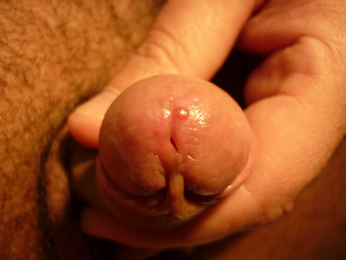
The 43-year-old Italian-born homosexual man presented with two fleshy granulomatous lesions on the glans and corona of the penis of two months duration, measuring 5-6 mm in diameter (Figures 1 and 2). He reported 10 male partners in the last 12 months and reported always using condoms for anal but not oral sex. He was born in Southern Italy but had lived in the UK for 15 years with no travel to Africa. He was not diabetic or on systemic corticosteroid therapy. He tested negative for chlamydia, gonorrhoea, but had a past history of syphilis. His enzyme-linked immunosorbant assay (ELISA) serology was positive for hepatitis A and hepatitis B surface antibody. HIV serology was negative by ELISA at presentation and again eight and 16 weeks after presentation. His CD4 lymphocyte count was 1806 cells/μL, four weeks after presentation (normal range 400-1630 cells/μL).
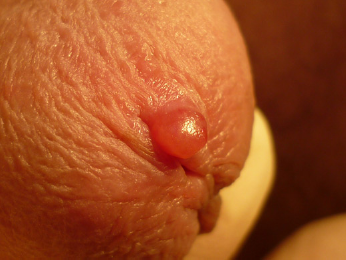
Kaposi's sarcoma lesion protruding adjacent to the urethral orifice

Kaposi's sarcoma lesion on the corona of the penis
The lesions were biopsied and showed squamous mucosa with underlying stroma containing spindle-cell proliferation. Biopsies also showed relatively high cellularity and mitoses with some infiltration by inflammatory cells. Vascular spaces and capillaries were seen with some red blood cells entrapped between spindle cells. A Steiner stain did not show spirochaetes and immunostaining was strongly positive for HHV-8, CD31 and CD34.
The lesions were initially treated using cryotherapy with liquid nitrogen freezing for 20 seconds; however, on review three weeks later (week 3) the lesions were unchanged. At week 8, the lesions remained unchanged and imiquimod 5% cream (Aldara) was prescribed, three times weekly for a month.
At week 13 (Figure 3), the lesions had shrunk by about 80% and the imquimod was continued but only weekly from this point because of local irritation. At week 16 the lesions had further reduced and by week 23 they were absent. Imiquimod was ceased at the beginning of week 15, giving a total of six weeks of treatment. To date, 15 months after initial presentation, the patient remains disease-free.
Post-treatment image of the lesions
Discussion
We report a case of penile KS in an HIV-negative homosexual man with a high CD4 count, that responded rapidly to local imiquimod treatment. To the best of our knowledge this is the first reported case of imiquimod treatment for a penile KS lesion in an HIV-negative MSM. Using the search terms ‘Kaposi sarcoma’, ‘HIV-negative’ and ‘imiquimod’ in the Medline and Scopus databases we were able to identify five publications involving 20 patients that describe the use of imiquimod for the treatment of local KS in HIV-negative patients. Three publications are single case reports of men aged 57-87 years whose lesions were all on the lower limb, either on the leg or on the plantar aspect of the foot.5-7 The fourth publication was an open label clinical trial of 17 patients with non-genital KS; 14 men and three women with a median age of 68.5 years (interquartile range Q1-3: 60-76 years). 8 Finally, one French trial describes the use of different forms of treatment for KS in 28 HIV-negative MSM, including imiquimod for one patient. 9
Complete resolution occurred after a median of 28 weeks (range 12-52 weeks) in five of 11 patients after a median of 22 weeks of treatment (range 12-52). One possible reason for the slower reported responses than we saw in our patient is the thickness of the skin in other sites compared with the genital skin in our case. It has been reported that non-keratinized warts respond better to imiquimod treatment than keratinized warts. 10 The rapid resolution of our patient's KS, after cryotherapy had failed, suggests that imiquimod had induced this response, although we cannot exclude spontaneous resolution.
Imiquimod cream works in two main ways. 11 Firstly by a poorly understood pathway it activates toll-like receptor 7 which modifies the innate immune response and induces cytokine secretion, as well as working via Langerhan's cells to activate acquired and antitumour immune responses. Clinically it has been proven to have anti-HSV activity and thus by activating both innate and adaptive immune responses it is postulated that it also has anti-HHV-8 activity. 11
The penile site of lesions in our patient raises the possibility that HHV-8 infection was transmitted through oral sex. The concentration of HHV-8 is much higher in saliva than blood or semen. 2