







Abstract
Perianal streptococcal dermatitis (PSD) is an uncommon superficial cutaneous infection of the perianal area, almost exclusively described in children and mainly caused by group A streptococci. We report here a case of PSD caused by Streptococcus dysgalactiae subsp. equisimilis, Lancefield group G, in an adult man due to heterosexual oral-anal sexual contact.
Keywords
Introduction
A previously healthy 26-year-old man presented with perianal rash, irritation, intense pruritus and discomfort for three weeks. His symptoms started 2-3 days after his last sexual contact with his female partner. He acknowledged that he had practiced protected vaginal intercourse, unprotected fellatio and received anilingus from her. Despite applying a nonprescription topical clotrimazole cream, his rash worsened. Interestingly, his female partner had a concurrent acute episode of exudative tonsillo-pharyngitis that was not either diagnosed microbiologically or treated at that time.
Physical examination revealed a sharply demarcated perianal erythema, which was approximately 5 cm in diameter around the anus (Figure 1). There was no palpable inguinal lymphadenopathy and his pharynx was normal. Rectal examination revealed no abnormalities and the remainder of his physical examination was unremarkable. Urethral microscopy and culture for gonorrhoea, direct immunofluorescence test for Chlamydia trachomatis and serological testing for human immunodeficiency virus antibody, syphilis and hepatitis B and C viruses were all negative.
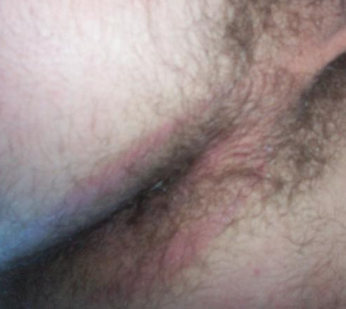
Clinical image taken by the patient demonstrates a bright red and sharply demarcated perianal rash
A heavy and almost pure growth of β-haemolytic Lancefield group G streptococci (GGS) was isolated and later identified as Streptococcus dysgalactiae subsp. equisimilis. Antimicrobial susceptibility testing confirmed susceptibility to penicillin, ampicillin, amoxicillin, vancomycin, erythromycin, clindamycin, tetracycline and linezolid. 1 No fungal elements were seen microscopically and fungal cultures were negative after four weeks. Throat and rectal swabs were negative for β-haemolytic streptococci (BHS) in our patient. Of note, a profuse growth of similar phenotype of GGS was isolated from his partner's pharyngeal culture taken three days after his first admission to our clinic.
Oral penicillin V was administered (40 mg/kg/day divided into 3 oral doses daily) for 14 days with a prompt resolution of symptoms within a few days of starting antibiotic therapy. His partner received treatment (amoxicillin 1000 mg every 12 hours) for her pharyngitis. Rectal, perianal and throat swabs taken from the patient three weeks after completion of his antibiotic therapy were negative for BHS.
Discussion
Human isolates of large-colony-forming BHS harbouring the Lancefield group C or group G antigens belong to Streptococcus dysgalactiae subsp. equisimilis, a novel species described in 1996. 2 GGS usually colonize the human skin, nasopharynx, and the genitourinary and gastrointestinal tracts 3 and share some virulence factors with group A streptococci (GAS) and group C streptococci. 4 GGS can cause various community-acquired infections such as soft-tissue infection, pharyngitis and otitis media; however, they can occasionally cause more serious infections including neonatal sepsis, bacteraemia, endocarditis, meningitis, peritonitis and arthritis. 5
Perianal streptococcal dermatitis (PSD) is a superficial cutaneous bacterial infection that predominantly affects younger children and is mostly caused by GAS. 6 PSD is usually confined to the immediate perianal area, though it can spread to the perineum and occasionally the genitalia. The typical clinical presentation of PSD shows various degrees of perianal erythema with mostly well-defined margins. Signs of inflammation, such as superficial oedema, infiltration and tenderness may be present. Differential clinical diagnosis includes candidiasis, oxiuriasis, seborrhoeic dermatitis, psoriasis, inflammatory bowel disease and sexual abuse. 7
PSD has rarely been reported in adults where GAS was the main causative agent. 8 Recently, PSD caused by GGS has been reported in two adults; 9 however, the precise route of transmission is not fully understood.
While the mouth and upper respiratory tract may form a reservoir of infection allowing the transmission of oropharyngeal bacteria such as Neisseria meningitidis, Haemophilus influenzae, Moraxella catarrhalis and oral Mycoplasma species to the genital area, oral-genital sexual contact is implicated as a major and plausible route of transmission. 10 There are case reports of balanitis or penile pyoderma caused by GAS after the patient has received fellatio.11,12 Thus, it is thought that oral-anal sex appears to have a role in transmission of GGS and predisposed our patient to PSD.
To the best of our knowledge, this is the first report of PSD incidence where anilingus was proposed as route of transmission. Although the clinical picture of a sharply demarcated perianal erythema is very characteristic, PSD is often misdiagnosed for long periods of time and patients are subjected to treatments for a variety of conditions that they do not have. Bacteriological culture from the affected area should always be performed in adults with persistent perianal erythema.
Footnotes
Acknowledgements
The authors would like to acknowledge the help of Clinical Microbiology Laboratory staff at Marie-Curie Medical Institute, Tehran, Iran, who performed laboratory testing on clinical samples.