




Abstract
Issues concerning our impact on the environment are constantly in the news and people are becoming more aware of the contribution of health care to the situation. This edition of ‘What's on the web’ reviews sites that provide information about the ways health care facilities can mitigate their effects on the environment.
If you would like to alert readers to useful web pages or suggest topics for this column, please send details to:
NHS Sustainable Development Unit
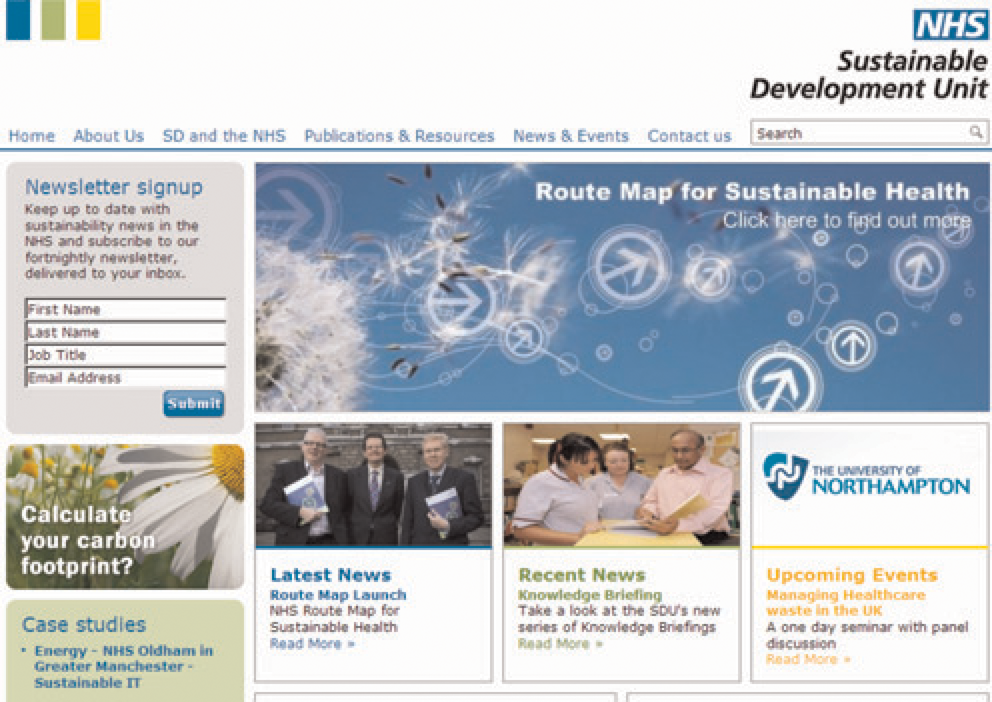
The NHS Sustainable Development Unit (SDU) was established in 2008 by the NHS in England. Its aim is to help the NHS fulfil its potential as a leading sustainable and low carbon health service. The SDU website provides access to a vast range of resources on general aspects of sustainable development, such as how to measure your organization's carbon footprint, how to reduce carbon emissions, and the health impacts of climate change. These focus not only on the role of the NHS in sustainable development but also have wider applicability.
There are resources such as the ‘Route map’, launched in February 2011, which is a collaborative effort across the NHS and its partners that describes a sustainable health system and the components that are needed to achieve it and provides a framework for action to develop such a system.
The NHS Carbon Reduction Strategy, produced in 2009 with an update in 2010, is available in full text on the site. It shows the scale of reduction in carbon required for the NHS to meet the Climate Change Act's requirements and recommends key actions for the NHS to become a leading sustainable and low carbon organization.
The website provides access to the full text of many publications on carbon reduction and sustainable development. Some of these are produced by the SDU, others by other national and international organizations. Also provided are case studies of NHS organizations that have successfully put sustainable development plans into practice and links to relevant news items and forthcoming events.
The site contains a wealth of information on sustainable development and includes a basic search function to make the content accessible. There is a monthly ‘online poll’ on a topic of interest and users can sign up for a fortnightly newsletter. There is a feedback form and readers can leave comments on some pages of the site. The site is easy to use and well-structured given the wide range of data contained within it.
Health Care Without Harm
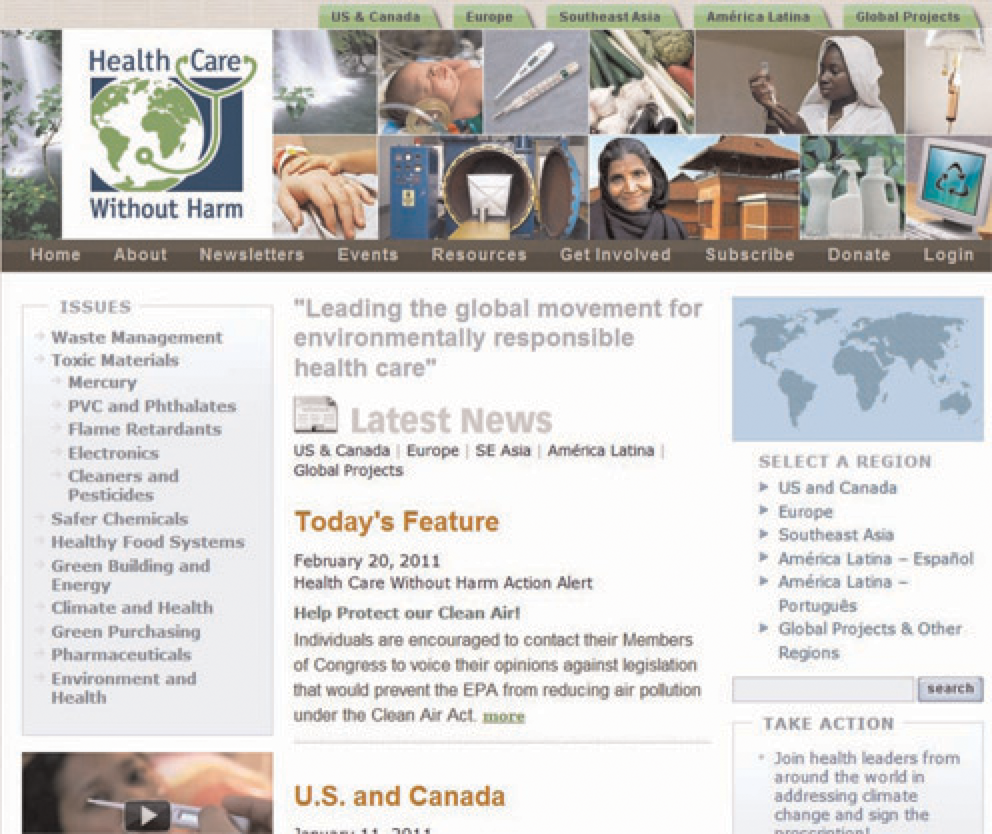
Health Care Without Harm (HCWH) is an international, not-for-profit organization, campaigning to reduce the adverse environmental effects of health care policies and practices around the world. Their vision is for health care to be sustainable, ecologically sound and promote the health of people and the environment. It began in 1996, in the USA, and has expanded with over 4000 organizations, representing 52 countries, joining the campaign.
The website content is aimed at a global audience and covers material relating to key issues in green health care such as reducing the use of toxic materials, green purchasing and clean energy. A current initiative for HCWH in collaboration with the World Health Organization (WHO) is the global reduction of mercury-based medical devices. Information on nine key issues can be accessed from the list on the left of the home page. Within each section there is an overview of the issue together with a list of key resources. For example, within the waste management section there are links to the full text of a HCWH report on alternative technologies, a waste audit self-assessment tool for health services, and a list of waste minimisation resources. Relevant video clips are also included for some sections.
Browsing by region is possible via the green tabs on the home page. This allows access to further resources, news, events, and publications of relevance to particular countries. For example, within the south east Asia section you can view relevant news as well as more general environmental news stories from local newspapers, such as the Jakarta Post. Under the Latin America tab, content can be viewed in either Portuguese or Spanish. An interesting feature within the USA and Canada section, under the events tab, is a series of webinars developed for clinicians on key topics in green health care. For example, there is a webinar with supporting educational material on organic foods, pesticides, and sustainable food production. There are plenty of options for users to keep up to date with news from HCWH: via the homepage and regional pages which highlight the latest news stories, by following the HCWH twitter feed, and by signing up for regional newsletters and digests. All of the downloadable documents contained in the various section of the site are available within a central library which can be found under the resources section. The library is organized by topic and can be useful for locating particular reports.
A general search box is located at the top of the homepage and within each regional page to allow users to search for specific content. Browsing could be made easier by allowing users to link back to the global overview homepage from the regional pages. At present this can only be done by retracing your steps using the back button or typing the website address into the browser. Overall, the HCWH website offers a global aspect to key issues in green health care, allowing access to a wide variety of international information, initiatives and resources, in many formats.
Carbon calculators
Carbon calculators provide a means of working out the impact your organization has on the environment. As the name suggests, the emphasis is usually on carbon emissions, but some measure other pollutants as well. Personal carbon calculators enable an individual to work out their own carbon footprint and may be useful to organizations who wish to encourage staff to participate in green initiatives (for example the reduction of car journeys to work). This section looks at two organizational carbon calculators. Further examples of both organizational and personal calculators can be found in the selected links section.
Carbon footprint calculator – Carbon Trust

The Carbon Trust is a not-for-profit company which supports businesses and the public sector in and beyond the UK to create a low carbon economy. The carbon footprint calculator is easy to use, with lots of drop-down menus to prompt for answers, though there are seven screens that have to be worked through, so it requires a little patience. The user must register to use the calculator but this is free and simple to do. More than one footprint can be produced by the same user and the results of your calculations are automatically saved. Results can also be exported to a pdf file which includes a breakdown of carbon emissions by scope; i.e. direct emissions (scope 1), indirect emissions from electricity usage (scope 2) and other indirect emissions such as travel (scope 3).
Healthcare Energy Impact Calculator (EIC) – Practice Greenhealth

Aimed primarily at health care organizations, but useable by businesses as well, the Healthcare Energy Impact Calculator enables organizations to work out the impacts of their energy use, both in terms of pollution (including carbon dioxide and sulphur dioxide) and in terms of health including asthma attacks, chronic bronchitis and premature deaths. An estimate of direct medical costs and societal value incurred is also provided. The results can be provided as a printable page. The combination of human and monetary costs provides a strong incentive for organizations to limit waste.
The calculator is simple to use and consists of only two screens. Regrettably this free calculator cannot be used by organizations outside the USA since required information includes the grid region that provides the organization's energy. Despite this it is a fascinating tool and hopefully will inspire similar calculators suitable for other countries.
Selected additional websites
An independent organization working to promote sustainable health care. UK-based with USA and European partners. Includes news, events, campaigns, etc.
Dedicated to encouraging resource preservation and the prevention of pollution across the Canadian health care system. Provides information on topics such as waste reduction and how to build a green hospital. Includes a free online magazine.
http://www.sustainablehospitals.org/cgi-bin/DB_Index.cgi
USA resource for cost-effective, environmentally friendly hospital products. Find everything from catheters to mercury-free barometers.
http://www.footprinter.com/toolkit/overview
Carbon calculators for businesses. The basic version is free, others require a subscription but offer free trials.
http://www.carbonbalanced.org/business/E4-carbon-audit.asp
Apply for a free energy audit for your company. The site also provides personal carbon calculators.
Measure your personal carbon footprint in terms of food, travel, home and belongings. Provides the results as tonnes of carbon or number of planets required to support your lifestyle.