




Abstract
‘A picture is worth a thousand words’ captures the idea that well chosen images can increase the successful dissemination of health care messages. This edition of ‘What's on the web’ explores sites that host images suitable for use in presentations and teaching. We have focused on sites that provide images that are in the public domain or have a creative commons license which generally allows non-commercial use. It is important to be careful, however, and it is recommended that you check the copyright situation before using any image from these sites.
If you have any comments on this column, please contact:
Wellcome Images
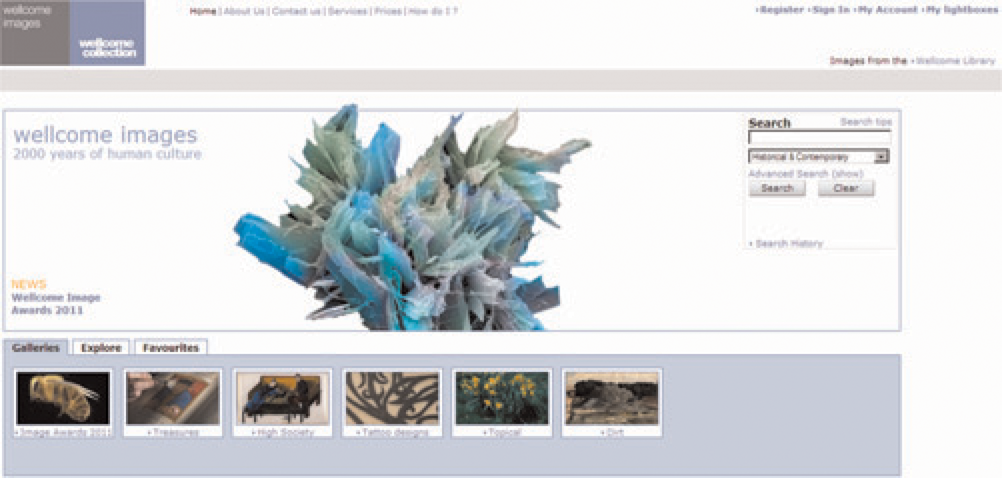
The Wellcome Images library is a collection of over 160,000 electronic images stored and managed by the UK's Wellcome Library. It includes illustrations, paintings, prints and photographs covering the history of health care and biomedicine. Within the collection are over 40,000 high-quality images.
All images on the Wellcome Images site are available free for use in non-commercial research, examination papers, criticism and review, student theses and personal use. In addition, images identified with the credit line ‘Wellcome Library, London’ can also beusedin academic publications, teaching materials, exhibitions by nonprofit making organizations and in Wellcome Trust funded projects. If images are to be used for commercial purposes, then they can be ordered online for a fee.
Clinical images of patients taken by professional photographers are also available on the site. Access to these images is however restricted to health care professionals only, and monitored by the site's registration procedure.
The Wellcome Images library offers both basic and advanced search facilities. Single word and phrase searching is available, and search terms can be combined using the Boolean operators ‘and’, ‘or’ and ‘not’. Search results can be limited to ‘historical only’ for images from the Wellcome Library collections, and ‘contemporary only’ for modern images. It is also possible to search within results to limit a search further. A search history facility is available to review previous search results. However, these cannot be combined or saved from one session to the next.
All users can view, download, email and print images published to the site without registering on it, but a simple registration procedure allows the additional benefits of being able to use folders or ‘lightboxes’ to store selections of images between visits, and the ability to place image orders online.
Picture Australia
http://www.pictureaustralia.org/
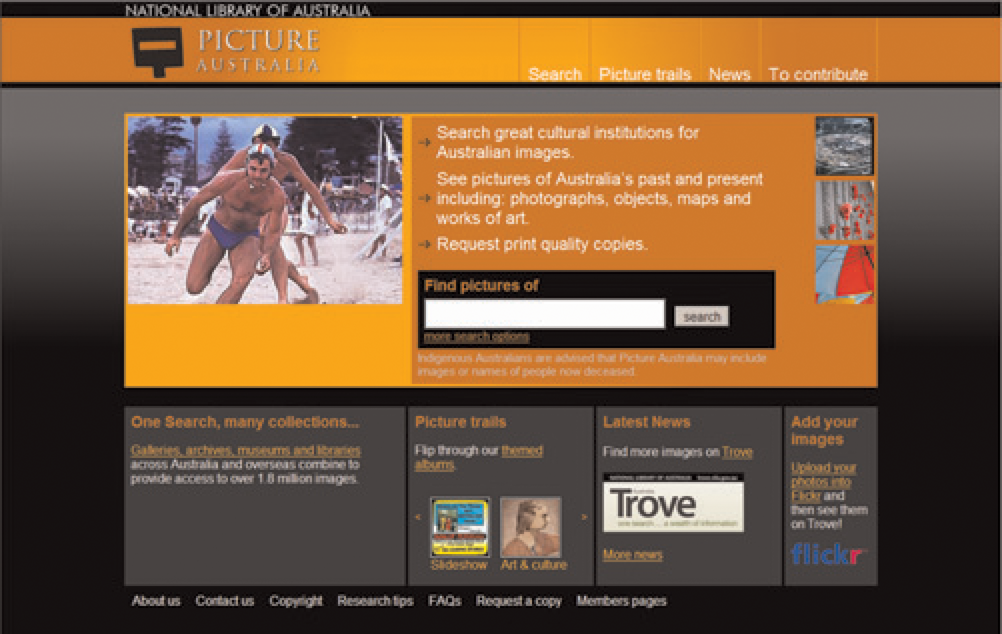
Picture Australia, hosted by the National Library of Australia, is a collection of over 1.8 million digital images relating to life in Australia. The images come from the collections of over 70 Australian and international agencies including museums, libraries, galleries, national archives and government institutions, allowing the public access to a wide range of image collections via one source. In addition, since 2006, Picture Australia has sought contributions from the public to add to its collection. People are encouraged to upload their Australia related images to the collection via Flickr.
Within the collection are a range of images relating to health and health services including, a wood engraving from 1881 showing some of the fever haunts for smallpox in Sydney; photographs from 1945 showing a healthy lunch campaign in schools; images of children from New South Wales receiving the first anti-polio vaccinations; a cholera camp in Egypt from World War I. Digital images of photographs, prints, drawings, paintings, cartoons, posters and maps are available. The collection includes historical and contemporary images, but has more historical than modern material for health-related topics.
The website has a simple structure and is well laid out allowing ease of use. Finding images on the website is straightforward with a basic search box provided on the homepage for quick and simple text word searching. A useful help button on the search page features all of the tips and tricks needed. Some advanced searching is possible such as limiting searches to a particular collection or by date. Results of a search are ranked by relevance, however, it is not possible to change this setting. It would be useful, particularly when searching for historical images, to be able to sort by date. When browsing through search results users can select and store any images to ‘my favourites’, which will keep the selected images for viewing for the duration of the session. Opening up an image gives access to the title, date, creator, description, a link to the original source and subject headings assigned to the image. The subject headings are provided as links so that clicking on a particular heading from within a record will bring up all images under that heading. This is another way to help users locate images.
Downloading or printing of the images from Picture Australia is permitted for personal or research use. However users should consult the copyright section and the using images section (see under FAQ) of the website for any use beyond this, such as reproducing or publishing the images, as permission will need to be sought from the copyright holder.
Picture Australia is a high quality digital image bank where users can find health care images with an Australian slant. A key feature is its breadth of coverage – a search here will search the collections of a wide range of sources, thus providing a one-stop shop for Australian images.
Public Health Image Library
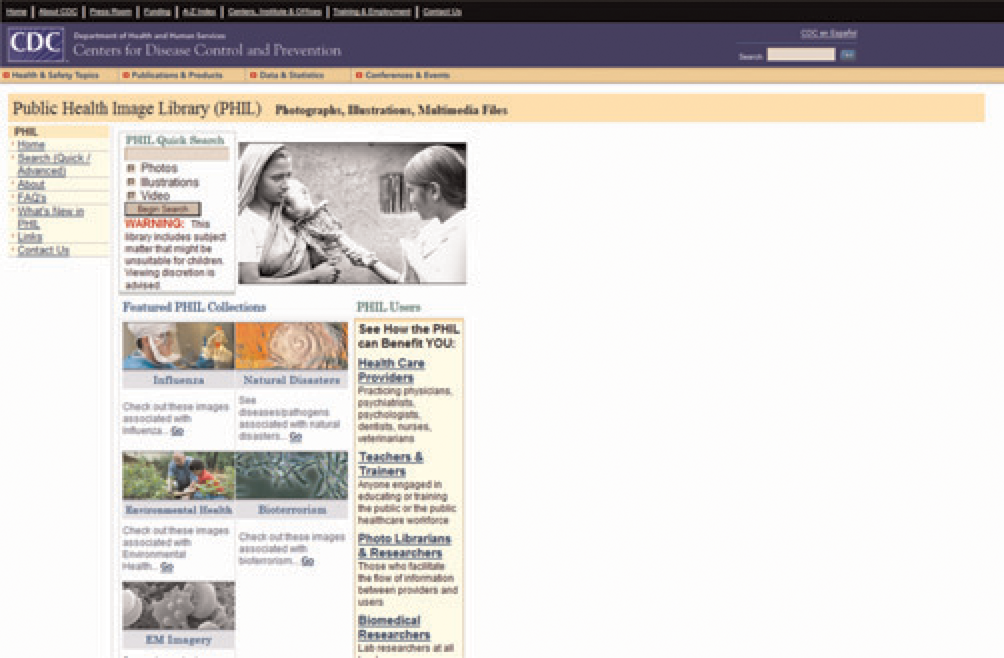
The Public Health Image Library (PHIL) is produced by the Centers for Disease Control and Prevention (CDC). It hosts a large number of photographs, illustrations and videos. Each image is accompanied by a descriptive paragraph which not only allows text-based searching but often includes useful background information.
Browsing the site is enabled by the use of picture galleries. The home page has a number of galleries that cover fairly broad areas, and further galleries, aimed at specific users, are also available. The section of most interest to health services researchers has galleries for ‘health monitoring’, ‘vector control’ and ‘public health officers’. Care must be taken not to use the tabs at the top of the screen to navigate, as these take the user to the main CDC site.
The site allows for both basic and more advanced searching. The ‘quick search’ will retrieve items where the specified words appear in the description of the image and if a single word retrieves too many images, then further words can be added using the ‘add to search’ facility. Searches can be limited by the image type. The advanced search includes the functionality of the basic search but also allows phrase searching and ‘category searching’ (using either Medical Subject Headings [MeSH] or special CDC categories). Other fields are available to search using this screen, and the ability to restrict a search to material available in the public domain is particularly useful.
Images can be saved in ‘my pictures’ where they are stored while other searches are conducted, though the items are not saved from session to session. This facility allows easy assembly of a range of personally picked items to browse without having to download them all. There is a series of FAQs on the site, one of which deals with the regulations regarding use of images, which states that ‘most of the images in the collection are in the public domain and are thus free of any copyright restrictions’. Others are copyright protected and the responsibility for obtaining permission to use them lies with the individual. Each image is clearly labelled regarding its copyright status.
The one potential drawback to this site is the fact that it times out after 20 minutes of inactivity and this can become rather trying. Despite this, for anyone looking for a wide range of high quality, copyright-free public health related images this is an invaluable resource.
Selected additional websites
http://www.flickr.com/commons/
Flickr is both a place where people can store and share their own photos and a huge resource for people requiring images. ‘The Commons’ on Flickr is a section of the site where people can search for images provided by institutions who have agreed to make them freely available to the public. Flickr describes this material as having ‘no known copyright restrictions’ but warns people to check ‘applicable law’ before reusing an image. Participating institutions include the Getty Research Institute and the Nationaal Archief (Netherlands National Archives). One of the benefits of the Flickr site is that multiple institutions can be searched at the same time.
http://ocw.jhsph.edu/imagelibrary/
A collection of images from the courses taught by JHSPH. The Image Library is browsable or searchable by keyword. Most images carry a Creative Commons Attribution-NonCommercial-ShareAlike license, and the site has an FAQ explaining what is meant by this.
http://digitalgallery.nypl.org/nypldigital/index.cfm
The nature and science collection includes galleries focusing on health care in the American Civil War, and a celebration of scientific and medical illustration from the 13th to the early 20th century.
http://secure.worldbank.org/photolibrary/servlet/main?pagePK=149932
Includes a gallery of over 1,000 health care photos. Also available on Flickr.