




Abstract
This paper describes the rationale and methodology for three exercises used to critically appraise the quality of the two main tools supporting implementation of the care pathway continuous improvement methodology. The Venture care pathway journey quality scorecard and the Venture care pathway paper-document quality scorecard builds a greater understanding of the value provided by different components of content and layout. In addition, the Venture paper care pathway document template provides a basic design guide for teams, based on 20 years of experience in developing, implementing and evaluating care pathway documents.
INTRODUCTION
The care pathway continuous improvements methodology comprises a wide range of tools to achieve its aims. These may include planning and change management tools, as well as tools to enable the successful selection and mapping of care pathway journeys. Specifically within the care pathway documentation toolkit we may find the classic care pathway document (Figure 1), but also ‘care pathway decision scorecards’ that use criteria and the outcomes and results from assessments to support evidence-based decision-making, and ‘care pathway guides to best practice’ that enable knowledge and information on the needs of a patient to trigger the selection of interventions such as the prescribing of medications or the selection of appropriate care packages. Other components of a patient's care pathway documentation (the content of patient notes) may also include signature sheet, patient details sheet, past medical history sheet, drug history sheet, service/episode details sheet, assessments, forms, questionnaires, trend sheets, test/other results slips, correspondence, information leaflets, etc.
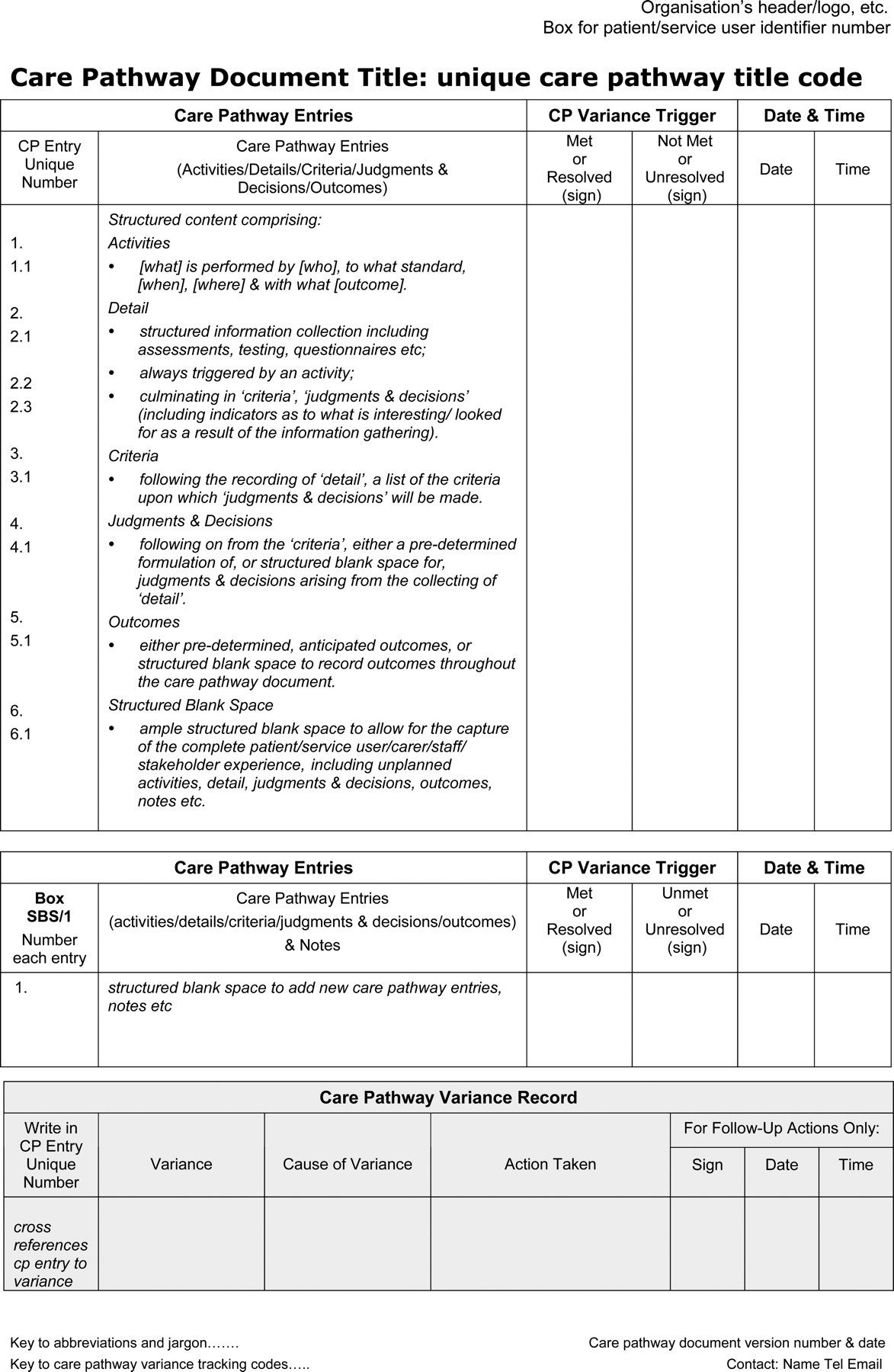
The Venture paper care pathway document template. CP, care pathway; CPD, care pathway document; SBS, structured blank space
However, the two tools most widely associated with care pathway methodology are the care pathway journey and the care pathway document.
RATIONALE AND METHODOLOGY: EXERCISE ONE
The Venture care pathway journey quality scorecard
Figure 2 sets out the Venture care pathway journey quality scorecard, which was developed and has been used as an exercise with teams over the past 15 years to raise awareness of the various approaches, quality and value of different care pathway journeys. Care pathway journeys involve mapping the patient-centred, end-to-end process and outcome, for e.g. a patient condition or procedure. Teams are provided with a range of care pathway journeys and asked to assess each one in turn against the standards listed in the quality scorecard. At the end of the exercise, the teams provide feedback and discuss the merits of each care pathway journey.
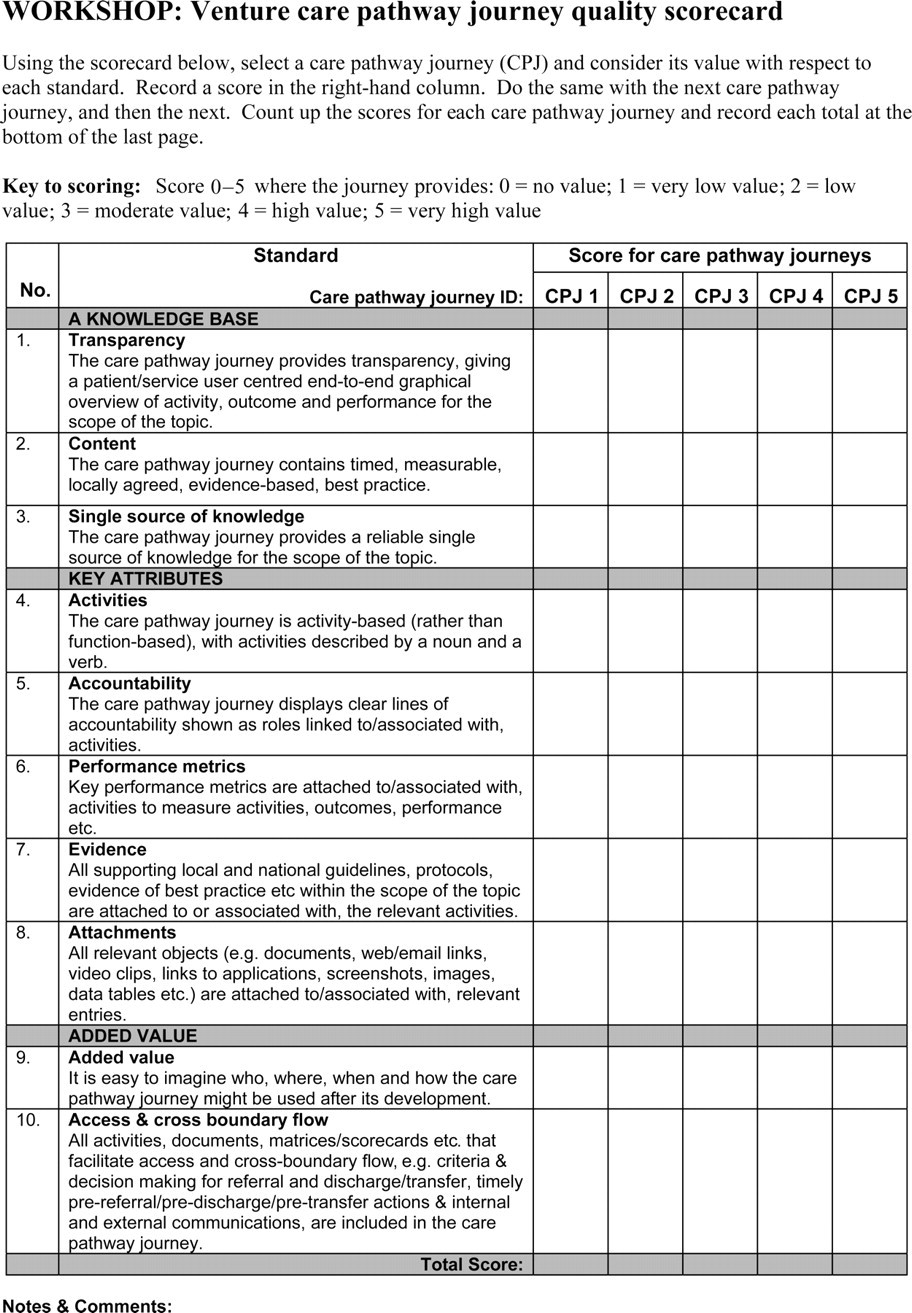
The Venture care pathway journey quality scorecard
With a better understanding of the issues, the team is then able to have an informed discussion and to agree what approach they would like to take locally to mapping the care pathway journey.
RATIONALE AND METHODOLOGY: EXERCISE TWO
The Venture paper care pathway document template
Figure 1 sets out the Venture paper care pathway document template. The classic care pathway document is an effective tool to ensure that all record-keeping meets legal requirements, while making note-taking as quick and easy as possible for staff and capturing all relevant information required to support the safe and effective care of the patient. The Venture paper care pathway document template has been designed to include all the main components of a quality care pathway document and to meet the key legal requirements of record-keeping. The structure incorporates a care pathway variance tracking mechanism that provides quick and consistent comparison between planned and actual process and outcome. It works equally well with structured (planned) entries and structured blank space (unplanned entries) providing real-time as well as retrospective audit. This approach ensures that the patient currently receiving care, as well as patients seen in the future, benefit from the highlighting of variations from planned or anticipated care.
The template has been developed and used over 20 years of care pathway design, implementation and evaluation. It has a proven track record of success in relation to adoption and positive feedback from staff, ratification by numerous committees and legal scrutiny. It can be tailored to meet local corporate image, clinical, practical and aesthetic needs. Most importantly, it contains plenty of carefully positioned structured blank space to encourage clinical judgement to be exercised in the best interests of staff and patients.
As part of the exercise, the paper care pathway document template is used to raise the awareness of teams with respect to the content and layout of a quality care pathway document. The rationale behind the various choices of component, language, layout, etc., is explained and the value that each choice provides is discussed. The logistical challenges of designing paper documentation that balances the various needs of staff recording notes, doctors requiring access to information for efficient and informed decision-making and audit staff wishing for convenient access to data, and in particular variance records, is always discussed at length. Once the issues have been considered, exercise three is undertaken.
RATIONALE AND METHODOLOGY: EXERCISE THREE
The Venture care pathway paper-document quality scorecard
Figure 3 sets out the Venture care pathway paper-document quality scorecard, which was also developed and has been used as an exercise with teams over the past 15 years to raise awareness of the various approaches, quality and value of different care pathway documents. As with the care pathway journeys in exercise one, teams are provided with a range of care pathway documents and asked to assess each one in turn against the standards listed in the quality scorecard. At the end of the exercise, the teams feed back and discuss the merits of each care pathway document.

The Venture care pathway paper-document quality scorecard
Having critically appraised a number of approaches to care pathway document content and layout and understood the benefits of a quality design (exercise two), the team is then able to have an informed discussion and to agree what approach they would like to take locally to designing care pathway documents.
NEXT STEPS
Based on the key criteria agreed following these three exercises, a subgroup (ideally with a cross-organizational brief) is then able to design a care pathway journey template, and a care pathway paper-document template that reflect a corporate style and quality, and which can be ratified locally by the various committees.