




Abstract
National Health Service (NHS) Scotland is taking a national approach to improving the quality and safety of mental health services. This programme relies on implementing integrated care pathways (ICPs) for people with mental health conditions across the whole journey of care.
This long-term improvement programme has started with the publication of national standards by NHS Quality Improvement Scotland (NHS QIS), setting out the framework of what needs to be developed in each local area.
The emphasis of development and implementation of the ICPs lies with local NHS Boards to ensure they are developed with local ownership and to meet the needs of the local population. However, to ensure accreditation by NHS QIS, the local ICPs must incorporate the national standards and evidence improvement to the quality of care provided.
A concerted effort has been made to ensure good involvement of service users, social work colleagues and NHS staff in order to get buy-in from all stakeholders.
NHS QIS is also supporting local boards and their partner agencies in their implementation of ICPs through a team of National ICP Coordinators and has developed a web-based toolkit to act as an electronic resource:
This is the beginning of a long-term improvement programme that has been carefully staged and is being facilitated in order to give it the best chance for success. In Scotland, ICPs for mental health are being used as a tool for service redesign and continuous quality improvement and a way to focus on meeting service user needs.
Background and goals
Background
In Scotland, the National Health Service (NHS) is a devolved matter with the Scottish Parliament deciding what its priorities are, setting policy, monitoring quality and allocating the health budget. Health care is free at the point of delivery and the NHS budget is £10.6 billion per year (2008/2009 figures, with 9% being spent on mental health) for a population of 5.1 million. 1 Health services are delivered by 14 geographical NHS Boards who are responsible for primary, secondary and other specialist care services in their area.
NHS Quality Improvement Scotland (QIS) is funded by the Scottish Government but is independent and has responsibility for publishing evidence-based guidelines and standards, for supporting implementation and improvement work and for quality assurance (see Figure 1). 2
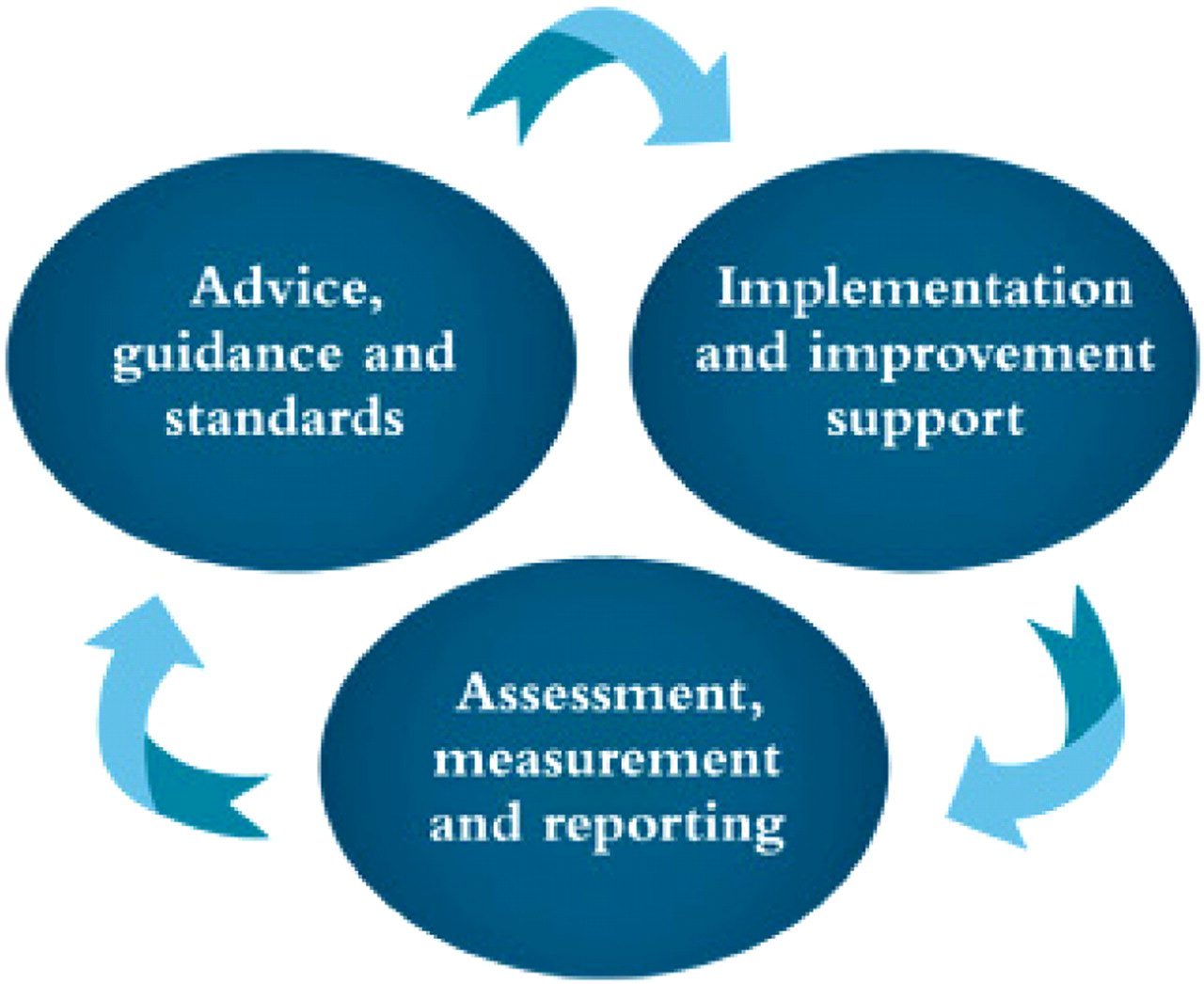
Main functions of NHS Quality Improvement Scotland
The situation for mental health services is further complicated by the need for coordinated care to be delivered by different arms of the NHS as well as the partner agencies of social work, voluntary organizations and the private sector.
The problem
In 2004, NHS QIS published a national overview of schizophrenia services in Scotland.
3
The key findings, which apply to mental health services in general, were the following:
There remain poorly developed continuous data collection systems, either paper or electronically based; There remains a lack of standardized multidisciplinary approaches to documentation; There continues to be wide variation across Scotland in the composition and skills within multidisciplinary mental health teams, leading to little or no progress in the ability of services to offer psychosocial therapies; There remains a need to improve on the range of assessments carried out with service users, and in particular the involvement of carers.
National strategy and goals
NHS QIS worked with the Scottish Government to develop a national approach to improving mental health services. This stated that care should be coordinated by means of integrated care pathways (ICPs) and the success of a service should be measured by the extent to which the needs of service users are actually met. This culminated in 2006 with the publication of Delivering for Mental Health, which marked a national commitment to a new style of working for mental health services. 4 This is a national and long-term strategy to improve the quality of mental health services. This strategy relied on ICPs as a tool for redesign and continuous quality improvement.
Our view of ICPs
We see ICPs as a comprehensive system of care. They are much more than a document of care. They describe how care should be organized, structured, coordinated and delivered. They allow for the documentation of care given and the comparison of planned care with actual care given. This means that a whole system approach needs to be taken in order to implement ICPs. Local NHS clinical staff, managers and leaders as well as partner agencies and service users all need to be involved in designing the local ICP system of care. When developed like this and implemented properly, they deliver a system of continuous quality improvement.
Delivery
This new strategy represents a transformational change from previous service structures and operating procedures; hence a long-term and supported programme was devised to help achieve these goals. The focus was initially placed on five key mental health conditions:
Bipolar disorder; Borderline personality disorder; Dementia; Depression; Schizophrenia.
During the consultation process, people delivering mental health services asked for a more generic approach to be considered because many people do not get an early diagnosis. This was accepted in order to encompass a common approach for anyone with a mental health disorder requiring a comprehensive assessment. A generic ICP framework was adopted as the basis for mental health care.
In order to deliver this aspiration, the mental health ICP programme comprised the following:
Communicating the new strategy to all stakeholders of mental health services to gain buy-in; Developing a comprehensive set of national ICP standards to guide local ICP development; Putting in place an implementation support package to assist local boards; National accreditation of local ICPs to quality assure the process; Leadership and coordination to ensure consistency of approach and sustainability.
Set-up
Engaging stakeholders
The top-down approach was present in this programme from the start, with the Scottish Government setting the strategy. For effective implementation, this needed to be combined with a bottom-up approach of local ICP development. In order to encourage local ownership, the ICP support team visited every NHS Board on a number of occasions and met with frontline staff to raise their awareness of the proposed work programme and to get commitment from them and their managers. Other stakeholders were also engaged, including social work colleagues and voluntary agencies.
Service user and carer participation
In order to get meaningful service user engagement, a public partners’ group was set up, made up of over 50 service users, carers and representatives of voluntary organizations. This group met on a regular basis and took part in overseeing the work programme. Members of the group were supported to take part in clinical groups, to contribute to standards development and to maintain a service user focus to the national programme.
How the standards were developed
An inclusive approach was used in order to develop evidence-based standards. Five condition-specific groups and one generic group were set up. Each group was multidisciplinary and multiagency and included service user participation. Guidelines published by the Scottish Intercollegiate Guidelines Network (SIGN) and the National Institute for Health and Clinical Excellence (NICE) have provided the main evidence-base for the ICP standards. These guidelines were supplemented by journal articles, reviews and national reports. Evidence tables were produced summarizing the guidelines and other published literature relating to each topic. Good practice, as defined by members of our development group and widely consulted on, was also used to set standards where no strong evidence-base exists. Draft standards were published in April 2007 and this was followed by a three-month consultation period. During this time, meetings were held with every NHS Board, with public partners, with social work colleagues and with primary care colleagues. In addition, three regional open meetings were held all over Scotland to get as wide a range of feedback as possible. The feedback from the consultation process was used to update the standards which were published in December 2007. 5
ICP Standards
The ICP standards for mental health have four main elements (see Figure 2)
5
:
Process standards: describe the key tasks that affect how well ICPs are developed in a local area; Generic care standards: describe the interactions and interventions that must be offered to all people who access mental health services; Condition-specific care standards: build on the generic care standards and describe the additional interventions that must be offered to people with a specific condition; Service improvement standards: measure how ICPs are implemented and how variations from planned care are recorded and acted on.

ICP standards for mental health. ICP, integrated care pathway
The full set of standards are available from
Process standards
The process standards are aimed at supporting NHS Boards and partner agencies to lay essential foundations on which to develop their ICPs. The standards could apply to anyone developing an ICP in any clinical field. These standards have deliberately been set as high level standards for organizations to consider as the essential building blocks before embarking on developing any ICP (see Table 1). They complement the more detailed quality assurance tools such as the Integrated Care Pathways Appraisal Tool. 6
Overview of the process standards
ICP, integrated care pathway
Generic care standards
People referred to mental health services often do not have a definitive diagnosis. It is important that carefully considered assessment, care planning and early intervention take place even in the absence of a diagnosis. A generic ICP was therefore suggested as a main framework for mental health care (see Table 2). Condition-specific elements can be added subsequently for service users with a specific diagnosis.
Overview of the generic care standards
Condition-specific care standards
A small number of additional condition-specific care standards apply for people with a diagnosis of bipolar disorder, borderline personality disorder, dementia or schizophrenia. These are mostly specific intervention standards based on SIGN or NICE guidelines. 7–14
In the case of depression, the service user's journey of care may occur predominantly in primary care. As such, the standards for depression are structured to reflect a journey of care based on both the service user's severity of symptoms and their complexity of need:
For service users with a diagnosis of depression whose complexity of need does not require specialist assessment and treatment, only the condition-specific care standards apply; For service users with a diagnosis of depression whose complexity of need requires a comprehensive assessment, the journey of care should follow both the generic and condition-specific care standards.
Service improvement standards
ICPs can have a significant impact on continuous quality improvement. There need to be mechanisms to collect and aggregate information on variations from the ICP. In doing so, such variances help to drive service review, identify stakeholder training needs and inform local governance arrangements.
The service improvement standards are designed to help ensure that ICPs are being implemented and actively used for variance analysis, service redesign, training analysis and, ultimately, demonstrating a positive impact on care (see Table 3).
Overview of the service improvement standards
ICP, integrated care pathway
Implementation support
The ICP standards are the national framework that local health-care providers need to use in their ICP development work. To help local areas use this framework effectively, a national support team was set up (see Table 4). This team is made up of three National ICP Coordinators, four National Clinical and other Advisers, three Programme Managers, three Project Officers and administrative support. Most of the team work part-time on the ICP programme. Most of the team is drawn from the NHS and is made up of people who have expertise and a great deal of experience in their field. This has given it the required status to influence local decision makers to improve the implementation work.
Support being provided by the national team
NHS, National Health Service
Toolkit
Additional support is also being provided by the national ICP toolkit (see Figure 3).
15
This web-based toolkit acts as a resource for anyone interested in ICPs. The primary audience of the ICP is the mental health community in Scotland. The toolkit is available at Practical advice about each standard; Supporting material for each standard; Links to other resources available; Information on evidence that may support each standard; Useful contact details; Examples of good practice; Latest news on local implementation work; Opportunity to share working documents from different areas; Discussion forum. ICP toolkit front page. ICP, integrated care pathway

Accreditation
NHS QIS has also been instructed by the Scottish Government to accredit locally produced ICPs. The aim of accreditation is to demonstrate that systems and processes that support delivery of person-centred care, reflective practice and continuous quality improvement are in place.
Due to the long-term nature of this programme, an incremental approach is also being applied to accreditation. The first part of this process was concluded at the end of 2009 with all NHS Boards in Scotland meeting the foundation level accreditation. This focused on the process standards to ensure that the building blocks are in place in all board areas for the development and implementation of ICPs.
The next stage of accreditation will focus on aspects of the generic ICP standards plus aspects of the condition-specific standards that link into national improvement themes. The Scottish Government has recently published its quality strategy which focuses on person-centredness, patient safety and effectiveness. 16 The main way in which mental health services can deliver this quality strategy is via ICPs. NHS QIS will work with the Scottish Government and local services to reflect these aspirations in the accreditation model being developed.
Discussion
The setting of the standards for ICPs for mental health was only the beginning of Scotland's national approach to improving mental health services. This first step was accompanied by a communication plan involving multiple visits to every NHS Board and partner agencies to deliver awareness raising and training sessions about ICPs. Initially, there was scepticism from the mental health community about the benefits of this approach. Many of the myths about ICPs kept emerging. The concerted effort of taking the time to listen to people's concerns and to explain what the ICP system of care is and the benefits this can bring proved successful. There is now general acceptance of this approach.
Scotland accepted early on that there should not be a ‘national ICP’. We have always believed that the benefit of ICPs, to a large extent, is due to the local groups that get formed to develop them. The links that get formed and the relationships that are forged drive the shared ownership of the care pathway. These activities contribute to the success of an ICP. Crucial to this process is the involvement of local service users and informal carers to ensure the new pathway meets the needs of the people using it.
Support is being offered to assist with local implementation. An expert national team has been set up and is offering training and awareness raising as well as hands-on support with ICP development. This team is facilitating national and regional networking to support the sharing of good practice. The ICP toolkit is another resource that has been developed to assist local ICP developers. This supportive approach has been welcomed and appreciated by the service. The fact that all NHS Boards have gained foundation level accreditation is a testament to the effectiveness of this support package.
This comprehensive approach, based on three strands of work, has acted as a template for NHS QIS in the way in which future work programmes will be supported and has led to the integrated cycle of improvement:
2
Setting evidence-based standards; Offering a comprehensive support package; Accrediting local services for quality assurance.
NHS Boards are adopting different approaches to take the ICP agenda forward based on their local circumstances. In support of this, the system for ICP accreditation is also incremental and recognizes development and good work carried out to date. The support package for NHS Boards will continue to be tailored to address any specific local issues to best support boards to move forward, with a particular emphasis on continuous quality improvement.
The ICP mental health improvement work is not being done in isolation. This is being coordinated with other national initiatives in mental health. For example the Scottish Government Mental Health Collaborative is supporting the delivery of performance targets in mental health. 17 These include the reduction of re-admissions and the provision of better services for people with dementia and people with depression. NHS Education Scotland is also running some national programmes in mental health, including the provision of training for psychological therapies and developing a competency framework for mental health nursing. There is ongoing close collaboration between all the national mental health programmes in Scotland to ensure consistency of approach, joint delivery and to avoid duplication of effort.
Joint facilitation and support is also being offered. This will encourage local adoption of the redesign and improvement techniques of the Mental Health Collaborative and the Patient Safety Programme (e.g. rapid cycle change implementation – PDSA). NHS QIS is also working with NES to identify common training issues and with the Scottish Government eHealth group to ensure that future eHealth procurements are fit for purpose and can collect the information associated with ICPs.
Local NHS Boards have been encouraged to combine all their mental health improvement projects and to ensure that their redesign work includes the various projects in the ICP system of care. The ICP approach is also likely to be the vehicle for delivering future quality improvements such as the new quality strategy. 16
Lessons learned
The mental health ICP work programme started in early 2006. One of the first things we have learned is the need to keep emphasizing the message about what ICPs are and are not. There is a widespread belief that an ICP is just a document. We have tried very hard to dispel this myth and to ask local services to consider them as a whole system of care. We continue to spread this message.
The need for engaging all stakeholders is also crucial. This includes frontline staff from every part of the service, leaders, partner agencies and service users. This has been essential in this case because the mental health community were initially sceptical about the benefits of ICP care.
Another important lesson has been that people do appreciate the support we offer. Providing a tailored support package has been very well received and is helping local services to develop ICPs that deliver the national standards.
Conclusions
NHS Scotland is taking a national and long-term approach to improving mental health services using ICP development and implementation. A bottom-up local ICP development and collaboration is being combined with top-down policy and national standards. This is being supplemented by a national team that is providing support and facilitating local implementation work. In addition, a web-based toolkit has been published to provide a resource for ICP developers. An accreditation process is being used to quality assure the local development work. ICPs are being used as a tool for service redesign and continuous quality improvement and the focus is on service users and meeting their needs.