




Abstract
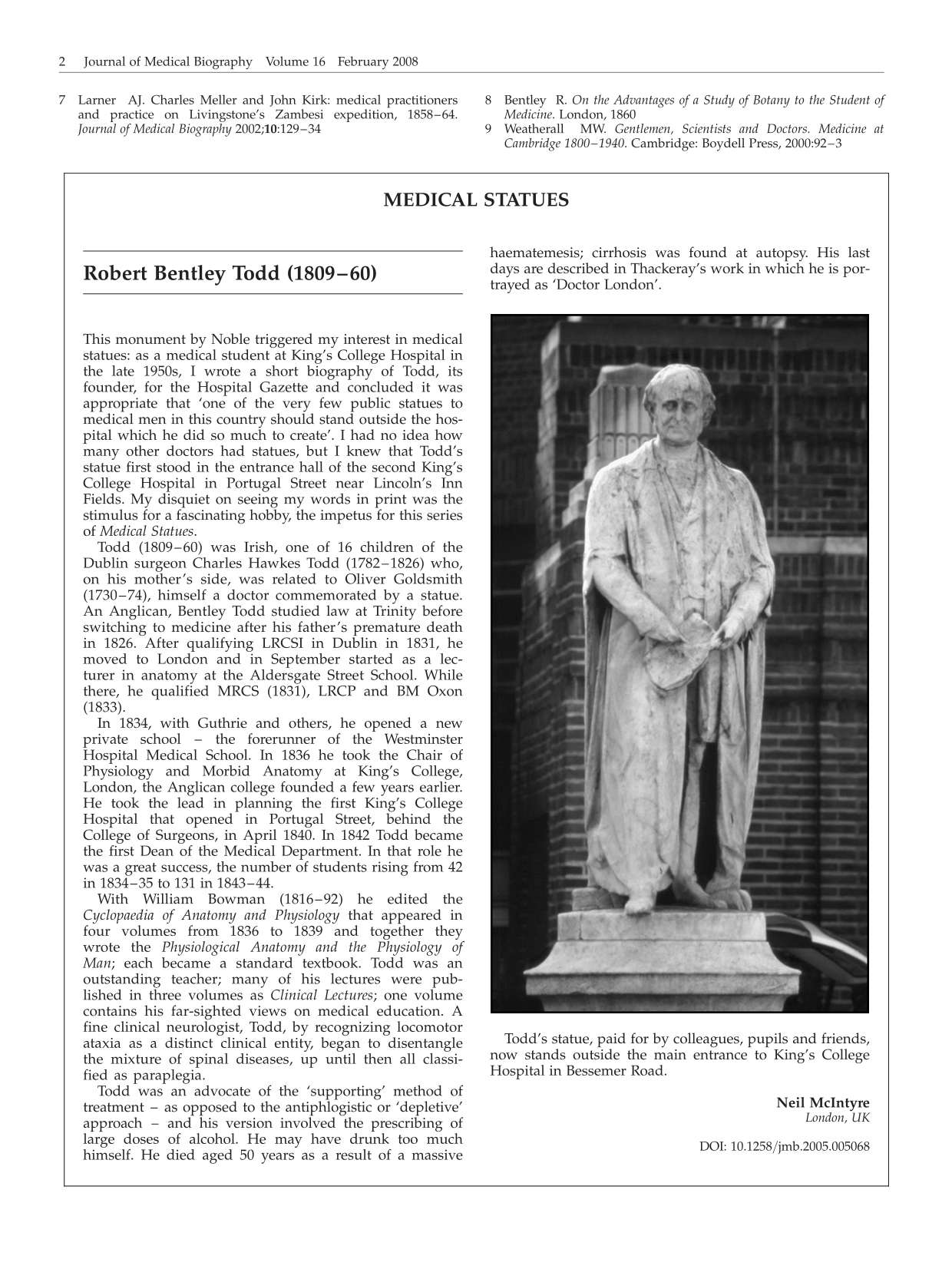
This monument by Noble triggered my interest in medical statues: as a medical student at King's College Hospital in the late 1950s, I wrote a short biography of Todd, its founder, for the Hospital Gazette and concluded it was appropriate that ‘one of the very few public statues to medical men in this country should stand outside the hospital which he did so much to create’. I had no idea how many other doctors had statues, but I knew that Todd's statue first stood in the entrance hall of the second King's College Hospital in Portugal Street near Lincoln's Inn Fields. My disquiet on seeing my words in print was the stimulus for a fascinating hobby, the impetus for this series of Medical Statues.
Todd (1809–60) was Irish, one of 16 children of the Dublin surgeon Charles Hawkes Todd (1782–1826) who, on his mother's side, was related to Oliver Goldsmith (1730–74), himself a doctor commemorated by a statue. An Anglican, Bentley Todd studied law at Trinity before switching to medicine after his father's premature death in 1826. After qualifying LRCSI in Dublin in 1831, he moved to London and in September started as a lecturer in anatomy at the Aldersgate Street School. While there, he qualified MRCS (1831), LRCP and BM Oxon (1833).
In 1834, with Guthrie and others, he opened a new private school – the forerunner of the Westminster Hospital Medical School. In 1836 he took the Chair of Physiology and Morbid Anatomy at King's College, London, the Anglican college founded a few years earlier. He took the lead in planning the first King's College Hospital that opened in Portugal Street, behind the College of Surgeons, in April 1840. In 1842 Todd became the first Dean of the Medical Department. In that role he was a great success, the number of students rising from 42 in 1834–35 to 131 in 1843–44.
With William Bowman (1816–92) he edited the Cyclopaedia of Anatomy and Physiology that appeared in four volumes from 1836 to 1839 and together they wrote the Physiological Anatomy and the Physiology of Man; each became a standard textbook. Todd was an outstanding teacher; many of his lectures were published in three volumes as Clinical Lectures; one volume contains his far-sighted views on medical education. A fine clinical neurologist, Todd, by recognizing locomotor ataxia as a distinct clinical entity, began to disentangle the mixture of spinal diseases, up until then all classified as paraplegia.
Todd was an advocate of the ‘supporting’ method of treatment – as opposed to the antiphlogistic or ‘depletive’ approach – and his version involved the prescribing of large doses of alcohol. He may have drunk too much himself. He died aged 50 years as a result of a massive haematemesis; cirrhosis was found at autopsy. His last days are described in Thackeray's work in which he is portrayed as ‘Doctor London’.
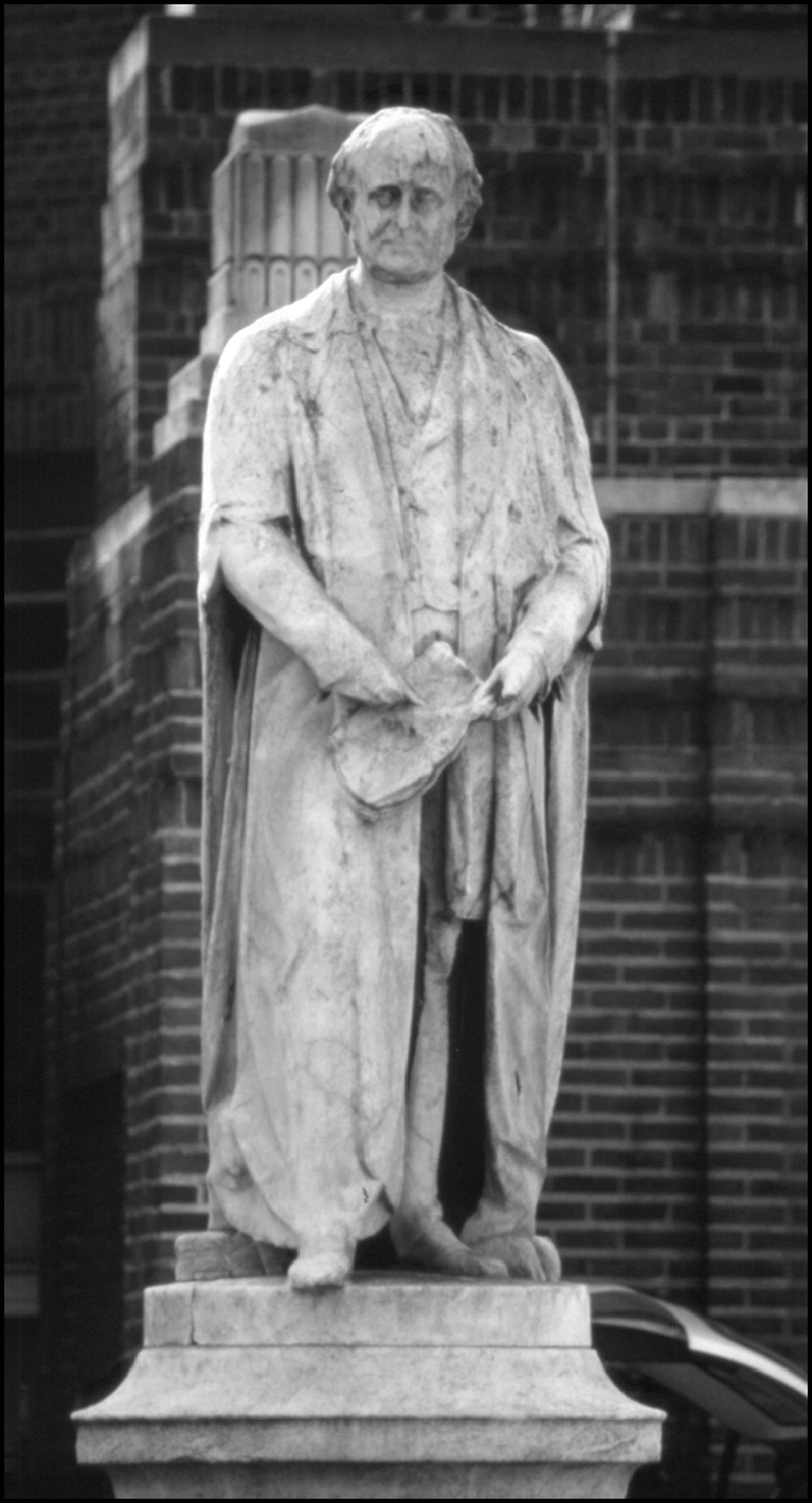
Todd's statue, paid for by colleagues, pupils and friends, now stands outside the main entrance to King's College Hospital in Bessemer Road.