




Abstract

Among the country practitioners who have produced work of national importance while leading active professional lives, Francis Adams of Banchory, in Scotland, is pre-eminent.
Born at Lumphanan on Deeside, his primary education was at King's College, Aberdeen although from the age of 15 years he spent up to 17 hours a day teaching himself Latin and Greek. It is unclear where he received his medical education although it was probably at Edinburgh. He qualified MRCS (London) in 1815 and set-up his plate in the village of Banchory where he was the sole practitioner in a large rural area.
The writings of Paul of Aegina (fl 630 AD) had given a complete view of ancient medicine and, in an attempt to make this knowledge readily available, Adams translated them into English. The Sydenham Society published the translation in three volumes 1844–47 as The Seven Books of Paulus Aeginata. Then the Society suggested he turn his attention to Hippocrates and The Genuine Works of Hippocrates was published in two volumes in 1849. The Extant Works of Aretaeus the Cappadocian followed in 1856. These translations were each accompanied by a full commentary and they remained the standard texts for many years. Adams’ further contributions to classical studies included notes to Dunbar's Greek and Latin Lexicon (1831) and Lemprière's Classical Dictionary (1838).
In medicine, his main interest was in obstetrics and he wrote several papers on postpartum haemorrhage and others on the structure of the placenta and on fetal auscultation. He also described a case of ruptured aortic aneurysm in a pregnant woman, including the autopsy report. Describing his surgery, in 1861 the Aberdeen Herald said ‘few surgeons not connected with a hospital have operated oftener, or done so with more boldness, coolness and success’.
To support this full life of medicine and literature, Adams only needed a few hours sleep each night and his long hours on horseback while visiting gave him ample time for reading and thought. It also produced much material for papers on the local flora and bird life.
In recognition of his work, the University of Glasgow awarded him an LLD in 1846 and the University of Aberdeen an MD honoris causa in 1856.
Adams died of a chest infection on 26 February 1861 caught while visiting a patient on a wet miserable night. He was buried in Banchory churchyard.
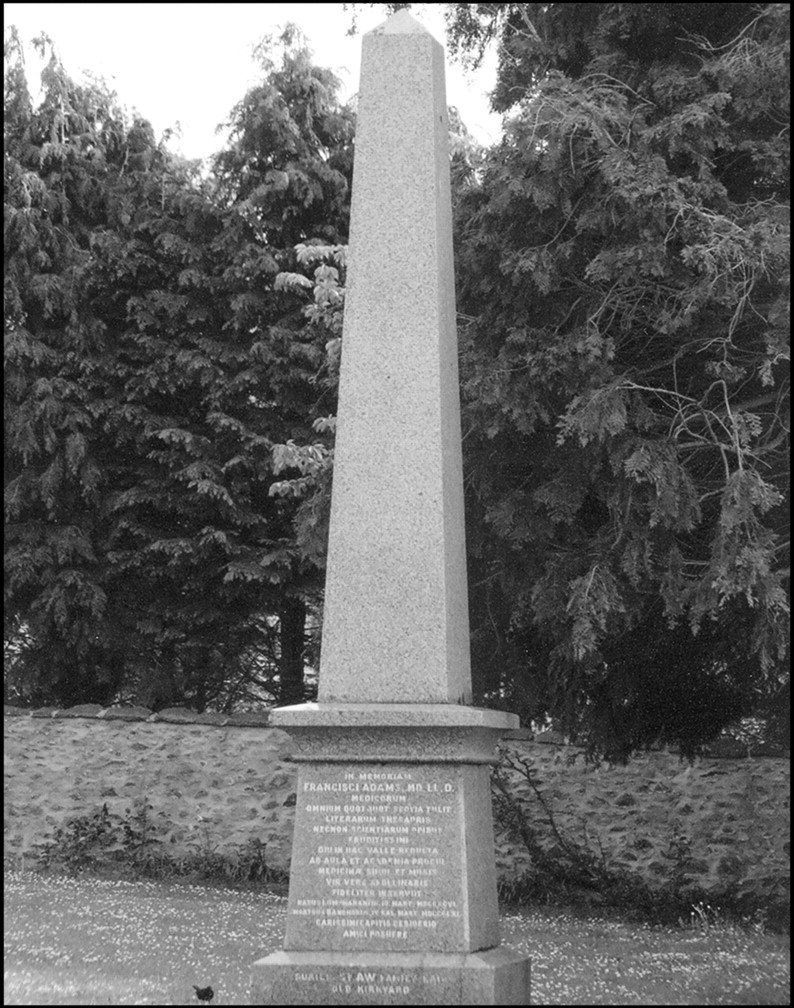
This memorial was erected in the middle of the town to commemorate the 200th anniversary of his birth. The inscription, identical with that on his grave, appropriately is in Latin; a translation reads ‘To the memory of Francis Adams MD LLD. Of all the physicians whom Scotland has raised, the most learned both in the treasures of literature and in the riches of medical science. For many years in this secluded valley a true votary of Apollo, far from Court and university, he devoted himself faithfully to the joint study of medicine and the muses’.
Undoubtedly he was also worthy of his other epitaph, Doctissimus Medicorum Britannorum 1 – The Most Learned of British Physicians.