




Abstract
Summary
Sir Walter Langdon-Brown, born of robust Puritan stock, was a distinguished physician, teacher, medical historian and humanist at St Bartholomew's Hospital, London, before becoming Regius Professor of Physic at Cambridge. His contributions to clinical medicine were wide in relating symptoms and signs of disease to physiology, putting therapeutics on a scientific basis, showing the close linkage of the sympathetic nervous system to the ductless glands, and being regarded as a founder of clinical endocrinology. He was the first English physician to relate the work of Freud, Jung and Adler to clinical medicine and a pioneer in psychosomatic medicine and the study of neurotic behaviour.
Walter Langdon Brown – he added the hyphen to his name at the time he was knighted in 1935 – was a highly distinguished physician, teacher and humanist, and Regius Professor of Physic at Cambridge. He was born at the Manse, Bedford of solid Puritan stock in 1870, the fourth child and eldest of the three sons of Reverend John Brown (1830–1922), a robust and militant non-conformist, and of Ada Haydon Ford (1837–1929). From 1864 to 1903 John Brown was the pastor of the Congregational Chapel in Bedford, known among Independent Chapels as Bunyan Meeting because it originated in a barn in Mill Lane where John Bunyan preached (when he was not in gaol for so doing). John Brown was the author of John Bunyan – His Life, Times and Work which was published in 1885 and long remained a standard work and, later, Pilgrim Fathers of New England in 1895. He made three extended visits to America in 1881, 1887 and 1905, and, during the 1887 visit, Yale University conferred on him the honorary degree of Doctor of Divinity, a doctorate which no English university would have been likely to have awarded him as he was a Congregational Minister. 1
Ada Ford's grandfather was Reverend David Ford (1763–1836), Pastor of the Dissenting Church at Long Melford in Suffolk from 1794 until his death in 1836 – in his sermon register it is recorded that he preached 7282 sermons between 1791 and 1835. Her father, Reverend David Everard Ford (1797–1875), author and musical composer, was also a Congregational Minister, at first at Lymington from 1836 to 1843 and then in Manchester until 1857 when he became a ‘supply’ preacher for all of Lancashire and Cheshire – his sermon register from 1816 to 1875 logs 8395 sermons. Her mother, Jane Elizabeth Down (1809–90), was a most capable teacher who ran a successful school on which the financial wellbeing of the family of seven children was dependent. Her mother's uncle was John Langdon Down (1828–96), Physician to the (Royal) London Hospital from 1859 to 1890, who was the first to recognize and describe the variety of mental deficiency in infants which he called mongolism, now Down's syndrome, in 1866. 2 The name Langdon came from his grandmother, Jane Langdon (1744–1806), with Walter her great-grandson, and Walter's nephew, Sir Geoffrey Langdon Keynes (1887–1982), Surgeon to St Bartholomew's Hospital from 1928 to 1952 and to the Royal Air Force during the 1939–45 War, her great-great-grandson and my [the author's] father.
Walter Brown was educated at Bedford Grammar School where he was later to become a governor (Figure 1). Besides being a ‘chapel’, he was a ‘swot’. Not only did he win the School Exhibition for natural science for four years running, but by winning the prize for an English essay, for the same years, confounded his masters who held that the ability to write good English depended on knowledge of the classics. Before going to Cambridge in 1889, he spent a year at Owens College in Manchester studying biology. At St John's, College, Cambridge, where he was a foundation scholar, he obtained a first class in both parts of the Natural Sciences Tripos and then spent a year as a Hutchinson research student working in physiology, a subject that he was later to apply so successfully to clinical medicine. In his inaugural lecture as Regius Professor 40 years later, he spoke of his joy on returning to a place that had coloured the whole of his subsequent life. He remembered how on one occasion, while walking through Pump Court in the Temple, he suddenly had a feeling of extraordinary happiness. Then he realized that the feeling was associated with the noise of a can being filled at a standpipe, and knew that it recalled the noise of the college servant at Cambridge wakening him when filling a water-can outside his room and he could anticipate another delightful day.
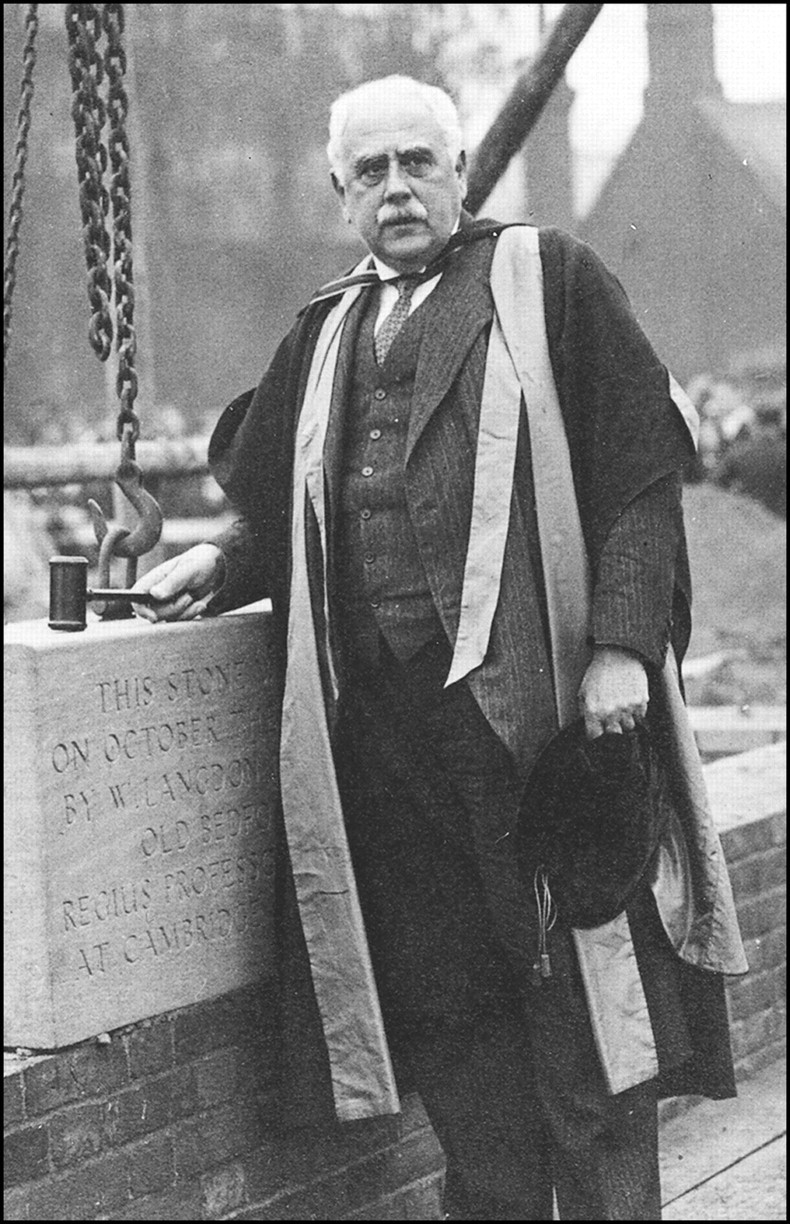
Walter Langdon Brown laying a foundation stone at Bedford School in October 1932
He entered St Bartholomew's Hospital with an entrance scholarship in 1894 and, on qualification in 1896, became house physician to the remarkable Dr Samuel Gee (1839–1911), now only remembered as the inventor of Gee's linctus. In 1901 he took the MD at Cambridge, gaining the Raymond Horton-Smith Prize on reading his thesis entitled ‘Pylephlebitis’ to, and first getting to know, the Regius Professor of Physic, (Sir) Clifford Allbutt (1836–1925). 3 He had a wide education in clinical medicine and, after his time with Dr Gee, was appointed senior resident medical officer to the Metropolitan Hospital for two years and then becoming, with the beginning of his consulting practice, assistant physician and pathologist in 1900, and from 1906 to 1922 full physician.
Meanwhile, at St Bartholomew's, his progress was slow; he was a demonstrator of physiology from 1899 to 1906, combining this with the post of casualty physician in 1900 and demonstrator in practical medicine three years later. In 1906 he became medical registrar and demonstrator of morbid anatomy until in 1913 when, at the age of 43 years, he was made assistant physician, becoming full physician in 1924. He retired from the active staff at Bart's six years later at the age of 60 years and was made Consulting Physician. He was elected Fellow of the Royal College of Physicians in 1908, Croonian Lecturer in 1918 and Harveian Orator on ‘The Background to Harvey’ in 1936, and he served as Senior Censor from 1931 to 1934. In spite of his great qualities, success came to him but slowly and he was sometimes a little impatient at the fate that seemed to hold him down. In fact, the opportunities to get elected to the Medical Staff at Bart's were very limited.
In 1900 Walter went to Pretoria and acted as senior physician to the Imperial Yeomanry Hospital during the South African War; in the 1914–18 War he was physician to a territorial force hospital, No 1 General Hospital based at Bart's, when he also worked on ‘war nephritis’ for the Medical Research Committee that had been formed in 1913 and which became the Medical Research Council only in 1919, and Director General of the Army Medical Service. He was president to no fewer than four sections of the Royal Society of Medicine – Urology, Therapeutics, Pharmacology, and History of Medicine before becoming the first President of the Section of Endocrinology. In 1932 he returned to Cambridge to succeed Sir Humphry Rolleston (1862–1944) as the Regius Professor of Physic, of which chair he was the 20th holder in 392 years, and to become Fellow of Corpus Christi College, retiring from the professorship three years later at the normal retiring age and being knighted in 1935.
Walter Langdon Brown's contributions to clinical medicine were wide and at times impressively innovatory. After the physiology at Cambridge, he worked at Bart's on the interpretation of the symptoms and signs of disease in terms of physiological reactions. His constant endeavour was to relate clinical observation to physiological knowledge and in fashioning a link between the laboratory and the ward. He was one of the first in Britain to apply the work of Pavlov on gastric secretion and the teachings of Lenharz to the treatment of patients suffering from gastric and duodenal ulcers. At the same time he began to put therapeutics, the treatment of disease, on a scientific rather than an empirical basis. In 1908 the first edition of his Physiological Principles in Treatment 4 was published, the last and eighth edition coming out 34 years later in 1942. In passing, it can be noted that (Sir) Archibald Garrod (1857–1936), Physician to Hospital for Sick Children in Great Ormond Street 1892–1920 and to Bart's 1903–20, had introduced biochemistry to clinical medicine only a few years earlier with his first paper 5 on the concept of inborn errors of metabolism in 1899 and his Croonian Lectures 6 at the Royal College of Physicians in 1908. 7 Walter was joint editor of The Practitioner's Encyclopedia of Medical Treatment in 1915, and for long was on the Council of the Pharmaceutical Society and a member of the Joint Formulary Committee and British Pharmacopoeia Commission. In 1941 in Cambridge he gave the Linacre Lecture entitled ‘From Witchcraft to Chemotherapy’.
At Cambridge, Walter had been particularly influenced by WH Gaskell (1847–1914) who he described as ‘one of the greatest minds that ever adorned British physiology’, adding that an account of the sympathetic nervous system written before Gaskell was like writing a description of the circulation before William Harvey. 8 Gaskell showed that the nerve fibres that flowed from the spinal cord into the sympathetic chain were of smaller calibre than the nerves to the skeletal muscles, and by this he was able to show there were fibres with visceral function in the cranial and sacral nerves. The successor to Sir Michael Foster (1836–1907) as Professor of Physiology at Cambridge, JN Langley (1852–1925), with (Sir) Hugh Anderson (1865–1928) showed that what he called the autonomic nervous system consisted of sympathetic and parasympathetic parts, while Gaskell showed that when these two parts were distributed to the same structure their function was antagonistic. In 1918, Walter noted in his Croonian Lectures 9 entitled The Role of the Sympathetic System in Disease the close connection of the sympathetic nervous system with the ductless glands. The close linkage between the autonomic nervous system and the physiology of the endocrine glands led to the better understanding and teaching of medicine.
From early in his career he was especially interested in endocrinology and he was one the first to draw attention to the similarity of the features produced by lesions of the anterior pituitary and the adrenal cortex some years before Harvey Cushing (1869–1939) described the syndrome associated with pituitary basophilism. Walter's book The Endocrines in General Medicine 10 (1927) later gave rise to the claim that he could be regarded as the founder of clinical endocrinology in England.
In his Horsley Memorial Lecture 11 on The Integration of the Endocrine System in 1935 he remembered, as an undergraduate at Cambridge in 1892, the excitement of hearing (Sir) Victor Horsley (1857–1916) give a paper on the function of the thyroid gland – endocrinology dates from 1891 when GR Murray (1865–1939), who had worked with Horsley at University College Hospital, first suggested and later showed that myxoedema was due to the loss of an active internal thyroid secretion. It was the close connection of the hypothalamus with the pituitary gland and the importance of the pituitary gland in its effect on the function of other ductless glands that led Langdon-Brown in the Horsley Lecture famously to name the pituitary gland as the leader of the endocrine orchestra. This was something he later modified in his inaugural lecture, his last when too ill to deliver it himself, The Birth of Modern Endocrinology 12 at the Section of Endocrinology, Royal Society of Medicine, in 1945 by recognizing ‘the hypothalamus as holding the still more important rank of conductor of that orchestra’. This now celebrated simile is an indication of his aptitude for exposition.
With the realization of the importance of emotional disturbance in causing physical disease, obviously more was required in the study of the whole patient than the simple physical examination taught by Dr Gee. From his experiences in the South African War, physiological principles could as well be applied to neuroses as to physical ills and Langdon-Brown, in adding his knowledge of the autonomic nervous system and the ductless glands to the elucidation of neurotic behaviour, became a pioneer in psychosomatic medicine and the study of the body–mind relationship. In this he was influenced by WHR Rivers (1864–1922) who had been brought from St Bartholomew's to Cambridge by Michael Foster in 1893 to lecture on the physiology of the special senses and had moved on as an alienist to the treatment of war neuroses in World War I. 13,14
In The Concise Dictionary of National Biography, published in 1982, it is stated that Sir Walter Langdon-Brown was the first English physician to relate the work of the three great experimental psychologists, Freud, Jung and Adler, to the practice of clinical medicine. In 1938, when President of the Medical Society of Individual Psychology, Langdon-Brown told of how he became interested in medical psychology. He referred to the way in which Adler linked psychoneuroses with organ inferiority, thereby enabling orthodox medicine to join hands amicably with the new psychology, and indicated that Adler's views on the early formation of a style of life, and the importance of knowing the goal towards which the individual is consciously or unconsciously striving, necessitated cooperation with general medicine. From Adler he passed to Jung with whom he was more in sympathy because ‘Jung of all men was best qualified to reconcile life with spiritual values’ with his wider and more far-reaching conception of the human mind. 15
Lord Horder (1871–1955), who became a clinical medical student at Bart's at the same time as Langdon-Brown in 1894, wrote in an appreciation of him in 1946 how: L.-B. was fond of cats and one day, when a psychasthenic patient came to see him, the cat showed that tiresome feline indecision as to whether it wanted to remain in the room or go outside. It went to the door and mewed. Curly rose automatically and let it out, continuing his questionnaire with the patient meanwhile. He was just seated when the cat mewed to be let in. Curly rose again, still talking, and let the cat in. When the sequence was repeated the patient became resentful and asked if it were his case or the cat's to which the great consultant was going to attend. ‘Both,’ said Curly, ‘you’ve both got the same disease’.
16
The collection of his lectures and addresses Thus We are Men 17 (1938) shows the breadth of Langdon-Brown's interests and learning in literary and scientific circles, both inside and outside medicine, as well as the quality of his writing. The book examines human nature and the problems of life in relation to philosophy and psychology. In a paper 18 entitled ‘Myth, Phantasy and Mary Rose’ he interpreted the whole genesis of Barrie's Peter Pan in terms of a mother–fixation complex. A special interest was in 17th-century literature, awakened it seems by his Puritan upbringing, but his first love was always for medicine. His inaugural lecture as Regius Professor in 1932, English Medicine and the Cambridge School, 19 was 40 years after he had listened to that of Sir Clifford Allbutt who was succeeded after 33 years, in 1925, by Sir Humphry Rolleston. In the lecture the contributions of both Allbutt and Rolleston are described, as are those of Langley and Gaskell.
His last book Some Chapters in Cambridge Medical History 20 was largely composed from a series of papers delivered before the History of Medicine Section of the Royal Society of Medicine. I [the author] ventured to review the book, which appeared a few months before he died, for the St Bartholomew's Hospital Journal as a junior medical student. Hesitatingly shown to him, it was in fact received with kindliness, appreciation and some amusement that I, his great-nephew, had done it. He gave the impression of wanting to know what I thought and carefully considered any opinion given. The ability to make the young feel of interest and importance is a rare quality.
Walter Langdon-Brown, like his grandmother, Jane Elizabeth Down and his mother, Ada Haydon Ford, was a born teacher and he had his father's pastoral sense of duty to his flock – in his case, patients and students at St Bartholomew's. This, quite apart from his professional dedication and brilliance, meant that when his students qualified and started up in practice, the consultant to whom they would send their patients was Langdon-Brown. When the War of 1914–18 was over, he was, therefore, able to buy a house in Cavendish Square, which ranked with Harley Street in the eyes of the public and the profession. For me that address has a historical association: I was taken to lunch there as a 12-year-old in December 1936 and as we left we saw Edward VIII drive past on his way to Broadcasting House to make his abdication speech.
Langdon-Brown was greatly involved in medical education and a most influential teacher of clinical medicine. Classical allusion, epigrams, satire, and wise and penetrating observations with a side glance at current events, followed one another quickly in his talk but did so without him being showy or leaving his audience bewildered. He was described by one of his students as ‘a thoughtful, experienced, observant doctor when confronted by a clinical problem, employing his senses, his wits, his imagination and his humanity in its solution … It was an inspiring picture. At the bedside of patients he exemplified his own teaching, combining humanity, philosophy, science and clinical art in a very rare degree.’ 21
Walter was a charming host with a great knowledge of good food and wine, a vast fund of anecdote and a gift for stimulating conversation. He is remembered as sitting in his combined consulting room and study in Cavendish Square surrounded by cats, or standing like a rock in a seethe of more mobile persons at some medical meeting. He said many good things, which he enjoyed as much as his hearers. 22 He was a man of huge bulk and on one occasion broke the springs when sitting in a ‘baby’ Austin motor car: the wonder was that he could get into it in the first place. Lord Horder noted that ‘Langdon-Brown was massive in his body but, unlike his Johnsonian prototype, the expression of his mind was not rough-hewn nor ponderous, but rather delicate and fine. It was like his gait, which was short-stepping and quick, with body bent forward – curiously anticipating the distressing disease which much later afflicted him.’ 23 This was Parkinson's disease which gave him increasingly great difficulty in moving and with which, still with an alert mind, finally he died in 1946.
His first marriage was a disaster. Frances Pressland was a nurse at St Bartholomew's and she, poor woman, was wholly incapable of keeping up with him. They used to eat at a restaurant in Great Portland Street and, at the end of a course, Frances would produce a bag into which their attentive, regular waiter would transfer scraps. Back at their house, she would sit on the floor, surrounded, like a witch, by 10 or a dozen cats that sat in a circle around her and they would come forward, one at a time, to be given a morsel from the bag. Alas, gin, as well as cats, sustained Frances, who died in 1931. Meanwhile Freda Hurry had become his secretary and she had tidied him up and polished him, as well as made him very happy. She married him immediately after Frances died and he came out from the shade with evident enjoyment. But becoming Lady Langdon-Brown rather went to Freda's head, for she became very grand and put on airs. She was very extravagant something which Walter did not seem to mind, but when he died she was lost, became ill from an unidentified illness and survived him by only three years.