




Abstract
The stethoscope has long been a powerful symbol of the physician. This article describes a stethoscope that was presented as a prize to an outstanding student, Mr Bampton, by his eminent teacher Dr James Hope (1801–41) in 1837. The extraordinary journey of this prize stethoscope that eventually found its way to North Wales and into the hands of the Liverpool physician, Robert Coope (1892–1972), is outlined. Its subsequent importance and symbolism to the Thoracic Society and the British Thoracic Society is emphasized.
On the evening of 11 October 1951, the eminent Liverpool physician Dr Robert Coope (Figure 1) became President of the Liverpool Medical Institution. In the splendid Victorian lecture theatre of this old Medical Society, he gave his presidential lecture entitled ‘Mr Bampton's Prize or The Tale of an Old Stethoscope’ and in the following year published his findings in The Lancet. 1 His introductory sentences set the scene and he went on to describe the life of James Hope (Figure 2):

Photograph of Dr Robert Coope, physician to the Liverpool Royal Infirmary, taken in the 1950s and provided by his former colleague Dr Colin Ogilvie

Etching of Dr James Hope reproduced from his biography published in 1844 in Hope A Memoir of Dr Hope. London: J Hatchard and Son 1844 (3rd edition)
Here it is – a monaural stethoscope made by Grumbridge, decorated in ivory, and bearing a neat band of silver which carries this inscription: Prize for Auscultation awarded by Dr Hope to GL Bampton, 1836–1837.
Of Mr Bampton I have been able to discover little. He came from Plymouth, and in May 1838, he received the diploma of the College of Surgeons. What happened to him then I do not know. His prize came into the hands of the late Dr Lethaby Heap of St Asaph, and on his death of his partner, Dr Austin Holmes, gave it to me. But I can tell you more of Dr Hope who presented the prize.
Dr Robert Coope had a country residence near St Asaph in North Wales and it was here that he met Dr Austin Holmes who presented him with Mr Bampton's prize stethoscope (Figure 3). Dr Coope, who had a particular interest in chest medicine 2 and auscultation, 3 derived considerable pleasure from owning this old instrument that was made only 17 years after the French physician René Laennec (1781–1826) had invented the stethoscope. However, he never managed to find out how Mr Bampton's stethoscope came to be in St Asaph.

The prize stethoscope presented by Dr James Hope to Mr Bampton
Mr Bampton's medical career
Mr Bampton qualified in medicine as a Licentiate of the Society of Apothecaries (LSA) in 1837 4 and in the following year became a Member of the Royal College of Surgeons. 5 This route to qualification in medicine was common in the nineteenth century and colloquially was known as ‘The College and The Hall.’
In 1815 the Apothecaries Act empowered the Society to develop one of the first structured medical courses and to award the medical qualification of LSA. The Society kept comprehensive records of all their students and those for George Bampton report that his Indenture of Apprenticeship to Mr William Patey Baldy (d. 1838), a Surgeon and Apothecary of Plymouth, started on 1 September 1831. 6 He commenced lectures at the Aldersgate School in June 1835 (Figure 4) and undertook courses in Chemistry, Botany and Materia Medica under Mr Jonathon Pereira (1804– 53); Anatomy and Physiology under Mr Frederic Skey (1789–1872); Anatomical Demonstrations under Dr Edward Furley (1812–1882); the Principles and Practice of Medicine under Dr Marshall Hall (1790–1857), followed by Dr James Hope; and midwifery under Mr Walford. He also attended clinical lectures by Dr John Elliotson (1791–1868); and Dr Theophilus Thompson (1807–60), and forensic medicine lectures by Dr Cummins. Practical training took place at the North London Hospital, which was founded in 1834 and became University College Hospital in 1837.

Engraving of Aldersgate Dispensary and Medical School 1831 by TH Shepherd (1793–1864)
The Aldersgate School was one of the many private medical schools that flourished at this time.7, 8 These were cheaper than the hospital schools and provided more personal teaching, and there was more systematic cramming. 9 In 1836 Dr James Hope 10 somewhat reluctantly took over Dr Marshall Hall's (1790–1857) lectureship at the Aldersgate School of Medicine 11 where he taught for three years and became a popular lecturer. In her husband's biography, Anne Hope (1809–87) describes how James Hope donated several student prizes: 12
Besides the two prizes which are generally given by every lecturer on the practise of Physics, Dr Hope gave a third for proficiency in Auscultation, which, as coming from him, was peculiarly valued and was contended for with greater eagerness than any of the others. It was a stethoscope, ornamented with a band of silver, on which was engraved the name of him who gained and of him who gave it, together with the date and all the usual particulars. Three of these were given at Aldersgate School during the three years that Dr Hope belonged to the school, and one at St George's. The total number being so small, owing to the premature fate of him who awarded them, their value is now very much increased.
Of the four stethoscopes awarded by James Hope only two are known still to be in existence: Mr Bampton's and that presented in 1839 to Mr Freeman (b. 1818) engraved ‘Prize for auscultation awarded to CJ Freeman by Dr Hope, 1839’, which is now in the hands of an American collector, Mr Erik Soiferman. All the stethoscopes ‘were made of cherry wood, with ivory banding and earpiece with a silver band for engraving the name of the recipient and were designed by Hope and produced by the English firm Grumbridge.’ 13 Anne Hope also mentions in her book that Mr Bampton, on receiving his prize stethoscope, gave a complimentary oration on behalf of the other students: 14
At the close of the first session, the unusual compliment of an Address of Thanks was paid to Dr Hope. It was signed by 96 names, and as it was not thought of till late in the session, when many of the pupils had left town, a still larger number would probably have signed it, had it been got up a few weeks sooner. This address was presented in form, at a very crowded meeting of pupils of the school, and a complimentary oration was pronounced on the occasion by Mr Bampton, the most promising student of his year, who had carried-off Dr Hope's prizes, besides several from the other lecturers.
She records Mr Bampton's oration as follows:
Aldersgate School of Medicine, Session 1836–1837
‘To Dr Hope,
‘SIR,
‘We, the undersigned pupils of your class, feel desirous of expressing the deep sense we entertain of your great and unwearied exertions in this session, and of the extremely useful knowledge we have thereby obtained.
‘We do indeed feel deeply sensible of your earnest anxiety to impart to us the results of your valuable researches, your great talents, and extensive experience. While we duly appreciate your generous solicitude to endeavour to render us acquainted with our profession, we feel likewise particularly anxious to express our fervent and unfeigned admiration of the gentlemanly affability, the urbanity and kindness which have so particularly distinguished your demeanour to us all.
‘In conclusion we beg to tender you the tribute of our most sincere regard, and to assure you, that your exertions, your courtesy and your talents will be remembered and appreciated by us to the latest period of our lives.’
At a quarter before four o’ clock hours on Thursday, 27 July 1837, Mr Bampton took his final examinations at the Society of Apothecaries (Figure 5). He stood before Mr Alfred Mayor Randall (1800–85), one of the 12 members of the Court of Examiners, in the Great Hall that is still used for examinations and essentially remains unchanged to this day (Figure 6). He was interrogated vigorously for at least one hour after which his performance at the examination and other records were approved and he was granted his Licence. 15 Mr Bampton would have had to pay ‘10 guineas to practise in London and within 10 miles thereof and six guineas for all parts of England and Wales.’ 16 He elected to pay only for provincial practice.
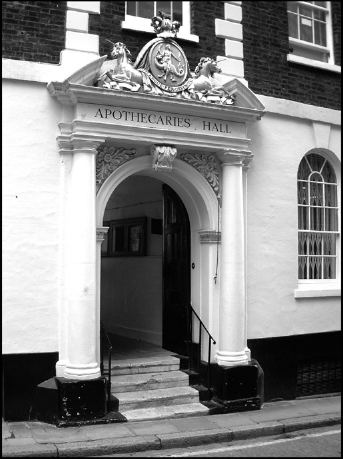
The Society of Apothecaries building at Black Friars, London

The Great Hall, Society of Apothecaries today (picture reproduced by kind permission of the Society of Apothecaries)
Little is known of Mr Bampton's training in surgery since the records of the Royal College of Surgeons are less comprehensive than those of the Apothecaries. 17 However, on Friday, 18 May 1838, Mr Bampton subjected himself to the ordeal of the MRCS and satisfied the examiners.
Mr Bampton's career after qualifying in medicine
What happened to Mr Bampton after qualifying as a doctor has up to now remained a mystery. He never became Free of the Society, that is to say he never became a member of the Livery Company. 18 His address on being granted his MRCS was given simply as Plymouth. Thus, it is reasonable to assume that he practised with Dr Baldy (d. 1838) in his Plymouth Dock and Stonehouse Dispensary. His name continues to appear in the College members’ lists until 1843 after which he was listed among ‘Members who have made no return of their respective places of residence, in accordance with the request of Council’. His name was finally omitted in 1853 19 and reference was not made to him in the Medical Directory, either in the London or in the Provincial section, from its inception in 1846. 20 After such a distinguished undergraduate career there must have been a good reason for him to not continue to practise medicine. Could he, like his teacher James Hope, have died of tuberculosis or could some other misfortune have ended his life prematurely? It is also possible that he might have emigrated, but it is inconceivable that he just disappeared.
Investigation into Bampton's family history solved this mystery. George Leopold Ewsters Bampton was born on 26 July 1816, the eldest son of William, a Stationer, and Elizabeth Bampton who lived close to Fleet Street at 23 Great New Street. He was christened on 4 November 1818 at St Bride's, Fleet Street. Bampton's siblings Mary (b. 1812), Sarah Findlay (b. 1815) and Augustus Hamilton (b. 1823) were also christened at St Bride's. 21 His younger brother Augustus (1824–57) became a surveyor in Plymouth and undertook various well-documented municipal contracts before his premature death in 1857 at the age of 33. 22 Although a Last Will and Testament has not been found for George Bampton's father, William, one was listed for Elizabeth Bampton of Plymouth in 1847. 23 This proved to be George's mother and he was mentioned once in the Will, indicating he was still alive. Intriguingly the reference was:
One equal forth part thereof upon trust for my eldest son the Reverend George Ewsters Leopold Bampton, his executors, administrators …
Thus George Bampton the physician had become the Reverend George Bampton. Crockford's Clerical Directory, which provides information of all Anglican clergy from 1858, does not include him. A chance reference to a Father George Bampton of Lauriston Street Sacred Heart Roman Catholic Church in Edinburgh from 1862–63 was the key to solving this mystery. Confirmation that this was indeed GEL Bampton was found in ‘Collections, Illustrating the History of the Catholic Religion in the Counties of Cornwall, Devon, Dorset, Somerset, Wilts and Gloucester’ referred to in an online database. 24 Here, his date of birth is given and the fact that he was converted to Catholicism by the Reverend Henry Riley (1794–1849). Following instruction at Prior Park near Bristol, he was ordained as a Sub Deacon by Bishop Peter Augustine Baines (1787–1843) on 18 December 1841 and Deacon on 2 October 1842. Seven days later, he was admitted to the Priesthood and on 21 October he became assistant to his friend Reverend Henry Riley at St Mary's Chapel, Stonehouse, in Plymouth.
In 1845 it was reported that the Reverend Bampton: 25
Full of zeal, talent, and tender piety, and desirous of greater perfection, his heart yearned for the religious state; and having at length received permission from the Holy See, to the deep regret of his congregation, he quitted Plymouth on 23 January 1845, to become a humble novice of the Society of Jesus.
He entered the Society of Jesus at Hodder on 4 February 1845 and took vows of poverty, chastity and obedience, and served in several communities 26 including Bristol, London and Stonyhurst, the Jesuit school in Lancashire. He was sent to St Beuno's College to repeat theology in 1852 and then in 1855 to Blackpool where he was closely involved in education. On 28 March 1857, he was made a Spiritual Coadjutor and the following year, at the request of Bishop James Gillis (1802–1864), he was sent to the newly established Jesuit community in the West End of Edinburgh, where he was involved in the development of the Lauriston Street Sacred Heart Mission and Church.
Reverend Bampton's final placement was in 1863 at New Hall near Chelmsford in Essex. This is the site of New Hall Catholic School and it is likely that he was also involved in education while he was there. He was said to be a most zealous man who did a great deal of good for the poor inspite of his poor health; he had already had two strokes of paralysis before coming to New Hall. However, two years later in 1865, near to the conclusion of his sermon on Sunday, 5 November, he was suddenly seized with paralysis and was supported by two bystanders until he had finished. His last words were ‘do good while you have time’. ‘He piously died a few days later, on 10 November 1865’ at the age of 49. 27 His death certificate cites the cause of death as Apoplexy Paralysis for 5 days, 28 probably a cerebrovascular event. He is buried in the convent cemetery (Figure 7). A full obituary notice did not appear.

Headstone at the grave of George Bampton at plov V2 in the cemetery at New Hall in Essex. Photograph by kind permission of the nuns at the convent
The fate of Mr Bampton's stethoscope
What of the fate of the prize stethoscope itself? It is intriguing to speculate that the connection that joins George Bampton, Lethaby Heap, Austin Holmes and Robert Coope is St Beuno's College where Bampton undertook his theology training. This Jesuit College is to be found near St Asaph in North Wales, the very place where, 100 years later, Mr Bampton's prize stethoscope found itself in the possession of a local general practitioner, Dr Lethaby Heap, and where Robert Coope had his country cottage. It seems most likely that after keeping his prized stethoscope for 14 years, Reverend Bampton gave or sold it to a local medical practitioner and it remained in St Asaph until Robert Coope discovered in the early 1950s.
But, what happened to Mr Bampton's prize stethoscope after it was given to Robert Coope? The clue is in an editorial footnote of the 1951 Lancet article: 29 ‘Dr Coope has presented the stethoscope to the Thoracic Society’. This society, inaugurated in 1944, was designed to foster informal discussion and interchange between thoracic physicians and surgeons. On becoming its first provincial President, Robert Coope presented Mr Bampton's stethoscope to the Society and it was placed, like a mace, on the table at all their council meetings and hence became the symbol of their organization. In 1982 the Thoracic Society joined with the British Thoracic Association (BTA, formerly the Tuberculosis Association) to become the British Thoracic Society (BTS). 30 The new society needed an emblem and it was decided to combine the Maltese Patriarchal Cross used by the BTA and Mr Bampton's monaural stethoscope used by the Thoracic Society to produce a new logo, the stethoscope being its most striking feature. Enquiries made to the Chief Executive of the BTS regarding the current whereabouts of the stethoscope immediately produced the positive reply: ‘Oh yes, there's one in the cupboard, do you know anything about it?’ A visit to the BTS headquarters showed the stethoscope was kept in a finely polished cabinet, still in pristine condition even after 160 years (Figure 8).
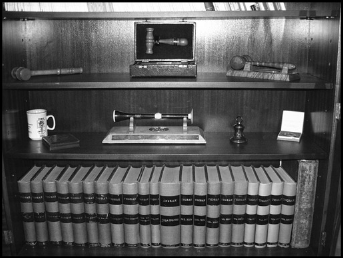
Mr Bampton's stethoscope in its presentation cradle at the British Thoracic Society Headquarters. Note the silver representation of the British Thoracic Society logo on the baseboard
Conclusion
The journey of this prize stethoscope has been extraordinary. It was presented by a brilliant physician and exponent of auscultation who, had he lived a little longer, would undoubtedly have been one of the foremost physicians of the 19th century. His outstanding student, Mr Bampton, turned his back on medicine for the religious life and almost certainly left his stethoscope near his theological college in St Asaph. One hundred years after the premature death of Reverend Bampton, the stethoscope turned up in the hands of the eminent Liverpool Physician, Robert Coope, who happened to have his country cottage in St Asaph. Today, the stethoscope is the symbol of the foremost respiratory society in the country. There is a little doubt that both Reverend George Bampton and Dr James Hope would have been surprised that after 160 years their prize stethoscope is still in perfect condition and has had such an eventful life.
Footnotes
Acknowledgment
We acknowledge the help of the library staff of the Liverpool Medical Institution, the archivists of the Royal College of Surgeons and The Society of Jesus. A particular acknowledgment is given to the help of Ms Dee Cook, the archivist of the Society of Apothecaries. We also thank the BTS, the late Dr Colin Ogilvie and the late Dr John Robertson for their kind help.