




Abstract

This tombstone memorial commemorates an un-named woman doctor (Medica) and dates from the first century AD in Gallo-Roman France (Figure 1). It is the best-preserved medical memorial for a female physician from antiquity. The inscription is minimal and, other than discerning from the nature of her attire that she was a freed person, there is no other biographical information.
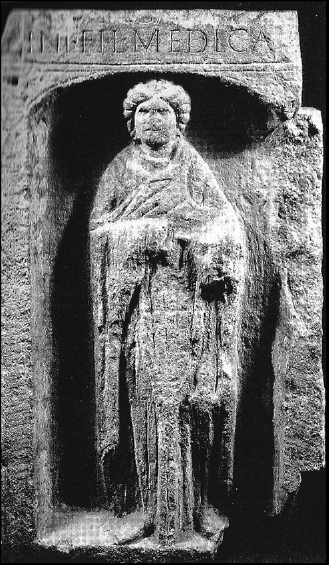
Funerary memorial for a female physician (medica), courtesy Musée Metz, France
Feminine forms of Greek and Latin words usually translated ‘physician’ or ‘doctor’ appear in the ancient epigraphic record. As well as Greek doctor iatroi, there are iatrinai and as well as Roman medica there are medicae. They appear to be separate from midwives, obstetrices, whose role in pregnancy and childbirth is outlined in the classic text Gynaecology by Soranus of Ephesus (98–138). 1 While midwives might deal with a range of women's conditions, there were also disorders where physicians were consulted and both the Hippocratic Corpus and works of Galen deal with separate women's diseases. Galen, for example, dedicated his work on the anatomy of the uterus to a midwife and it is evident that they were expected to read medical texts. Soranus stipulated that the requirement for an ideal midwife was that she should be literate.
There is a well-established corpus of funerary inscriptions related to female doctors mostly from the Roman imperial period but few from Greek Hellenistic and Classical periods. 2 Fewer than 30 inscriptions refer to women as medicae and many of the inscriptions have minimal content. Like most tombstones from antiquity they were erected by family members to record and celebrate domestic roles. Apart from this epigraphic data, there is little literary or other evidence that describes the activity of women doctors in ancient times. Their numbers were certainly fewer than men and notable figures of the stature of Galen and Soranus are lacking. It is likely their domain was primarily in treating women as it would be hard to imagine that a Greek or Roman man would submit himself to a woman doctor and allow authority over him. Nonetheless, the evidence is clear that, although the classical world was not associated with sexual equality, women were not excluded from becoming medical practitioners.