




Abstract
Recently an anonymous and unknown portrait of two renowned conjoined twins, the Hungarian sisters Helen & Judith (1701–23), was discovered. The portrait shows striking similarities with the representation of the twins in a popular work on cultural anthropology and medicine printed in Augsburg, Germany, in 1805.
Between 1794 and 1820, the Engelbrecht Press in Augsburg, Germany, published a prestigious encyclopaedic work in 27 volumes on the natural sciences entitled Unterhaltungen aus der Naturgeschichte. Volumes 13, 14 and 15, entitled Unterhaltungen über den Menschen, were authored by Gottlieb Tobias Wilhelm (1758–1811) and describe medical case reports and anthropological subjects. The section on conjoined twins contains an illustration of the Hungarian twin sisters Helen and Judith together with some biographical remarks. 1 The portrait of the twins demonstrates striking similarities with a recently discovered anonymous 18th century watercolour.
Helen and Judith
The Hungarian sisters, Helen and Judith, were born in Szony, Hungary on 26 October 1701. Their surname and biographical details of their parents could not be traced but their mother was a primigravida. Helen was born in the breech position up to the umbilicus and thereafter labour ceased. Some three hours later traction was applied to Helen's legs and the pygopagus conjoined twins were born. They were joined back to back in the lumbar region with all parts separate except the vagina and anus, situated between Helen's right thigh and Judith's left. Helen was the larger, the better looking, more active and more intelligent of the two. Judith became haemiplegic at the age of six and was rather delicate and depressed thereafter. Each menstruated at the age of 16 and continued regularly although not simultaneously. The sisters developed measles and smallpox, each simultaneously, although they were affected to a different degree with Judith being the more seriously affected. Between seven and nine years of age, these Hungarian sisters were exhibited all over Europe, including Holland, Germany, England, France, Italy, Poland and Russia. During their travels many prominent physiologists, psychologists and naturalists examined them.2–4
At the age of nine, the twins were placed in a convent in Petersburg, Russia where they remained until their death in 1723 at the age of 22. On 23 February Judith died ‘of cerebral and pulmonary affections’. Helen expired shortly after her sister.1–4 A certain Eccardus – Johann Christoph von Ettner (1654–1724) 5 – discussed the physical, moral and religious questions relating to the sisters including the advisability of separation, the admissibility of matrimony and, finally, whether on the last day they would rise as joined in life or separated. 4 In 1708 and 1751 letters were read to the Royal Society, authored respectively by William Burnet and Justus Joannes Tortos. 2 The latter obtained his information from observations made by his father-in-law, Carl Rayger, who was the attending doctor at the Petersburg convent where the sisters lived and died.2, 3
An unknown watercolour
The twins were portrayed numerous times but none of the authors give any measurements.1– 4 The 18th century anonymous watercolour (Figure 1) is of high artistic level with many similarities to known images of the twins.1–3 Gottlieb Tobias Wilhelm (1758-1811) described and portrayed the twins in the second part of his Unterhaltungen über den Menschen 1 , a popular work on cultural anthropology and medicine (Figure 2). The resemblances between the watercolour and the coloured engraving in Wilhelm's treatise are striking. The depiction of the twins in the watercolour and on the engraving is in reverse. This might well indicate that the watercolour was used as a model for the engraving. Helen is represented on the left in the watercolour but Judith on the left and vice versa on the engraving in Wilhelm. 1 Perhaps, the anonymous artist was a spectator in one of the public displays of the twins.

Helen and Judith. Anonymous watercolour, 30.5 × 50 cm, 18th century, published with permission from a private collection
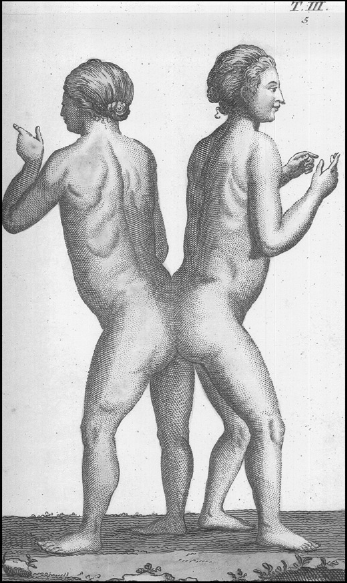
Helen and Judith. Hand-coloured engraving, 9 × 14.5 cm taken from Wilhelm GT 1
History adds to a man, giving him, as it were, a great memory of things – like a human memory, but stretched over a longer space than one human life. It makes him, I don't say wise and great, but certainly in communion with wisdom and greatness.
Belloc H. The Old Things. Cited by: Wilson AN.
Hilaire Belloc, a biography. London: Mandarin, 1997: 158