




Abstract
Professor Norman Exton-Smith was a highly respected, distinguished postwar consultant geriatrician with a worldwide reputation. He devoted his life to improving the medical care of elderly people and researching age-related decline in physical function, particularly thermoregulation and postural balance. He established thriving clinical and research departments at St Pancras Hospital, London. Many of his junior medical staff became well-known geriatricians. He published and lectured extensively, organized many meetings and conferences, and was advisor to the Department of Health and Social Security for many years. He was a valued authority on geriatric medicine within the Royal College of Physicians of London and a major influence in the British Geriatrics Society (BGS) of which he was Secretary and later the President.
Introduction
For many years the management of chronic sick patients presented a major neglected medical problem which was not tackled until after the Second World War. This was inspite of repeated criticisms and calls for change from numerous sources. In 1869 the Lancet Sanitary Commission stated: ‘the fate of the “infirm” inmates of crowded workhouses is lamentable in the extreme; they lead a life which would be like that of a vegetable, were it not that it preserves the doubtful privilege of sensibility to pain and mental misery’. 1 The 1909 Minority Report of the Poor Law Commission advocated the need ‘to break up the present unscientific category of the aged and infirm’ and ‘to deal separately with distinct classes according to the age and mental and physical characteristics of the individuals concerned’. 2 In 1943 Dr Marjory Warren, the pioneering geriatrician at the West Middlesex Hospital, condemned the current practice of confining chronic sick patients to bed because it caused pressure sores, disuse atrophy, postural deformities, stiff joints and contractures, and ‘in this miserable state, dull, apathetic, helpless, and hopeless, life lingers on, sometimes for years’. 3 A hospital survey carried out during the Second World War stated: ‘there has been widespread failure to treat the problem of the chronic sick as primarily a medical one and as such of the highest importance’. 4 The Nuffield Provincial Hospitals Trust in 1946 declared: ‘the care of the chronic sick requires complete and revolutionary change if these people are to be adequately cared for’. 5 In the same year two medical officers of the Ministry of Health asserted that ‘not only is the problem of the treatment of the chronic sick not being met, but also most people do not realise there is a problem’. 6 In 1949 a survey of the chronic sick hospitals in Birmingham found that the chronic sick patients were apathetic, seldom moved and were segregated by sex at meal times. 7 The majority had not been properly investigated before admission. The equipment on the wards was lamentable and the sluice rooms archaic. The nurses had a disproportionate heavy workload and recalled ‘in their quiet endurance and their efficiency … the virtues of their fathers in the rank and file of the county regiments who held the trenches in Flanders … in 1914–18’. 8 At night one nurse assistant was in charge of 70 beds.
The introduction of the National Health Service (NHS) in 1948 brought hope of improved medical treatment for older persons: ‘For the first time [the elderly] had access to consultant services’ and ‘it provided the less well off with a variety of forms of care to which previously they had only limited access’. 9,10 Pioneering geriatricians showed that many chronic sick patients, previously considered unfit to leave hospital, could be treated successfully and discharged. By 1956 it was acknowledged that ‘the National Health Service could not have begun without [the] achievements in geriatrics, since so many hospital beds would otherwise have been unavailable’. 11
However, newly appointed consultants in geriatric medicine in the late-1940s and 1950s faced enormous workloads with responsibility for hundreds of hospital patients, often in several old hospitals which frequently lacked any investigative facilities. Waiting lists were long, often containing hundreds of names. The danger was that the longer the person waited to be admitted, the longer it took to improve their health. Junior medical staffing was non-existent or very limited and investigative facilities left much to be desired.
Professor A N Exton-Smith
It was into this scenario that Dr (later Professor) Norman Exton-Smith began his life's work.
Norman Exton-Smith was one of two sons of Arthur Smith, a science master at Ilkeston Grammar School. He was educated at Nottingham High School, at Pembroke College, Cambridge, to which he won an exhibition, and at University College Hospital London (UCH). He qualified in 1943, passed the MRCP examination in 1948 and was awarded his MD in 1951 on the subject of The Ecology of Old Age, which was based on his experience of home visiting. 12 He married Jean Barbara (née Belcher) in 1951 and they had a son and daughter. He was elected FRCP in 1964.
In 1947 he was appointed registrar to Professor Sir Max Rosenheim at UCH who suggested he should assist Lord Amulree 13 at St Pancras Hospital and the following year he became Amulree's registrar in geriatric medicine. He stayed there until 1951 when he was appointed consultant geriatrician at the Whittington Hospital. When Amulree retired in 1965, Exton-Smith succeeded him as consultant at UCH/St Pancras Hospital. In 1973 he became the first Barlow Professor of Geriatric Medicine at UCH and stayed there until he retired. Thereafter he set-up a geriatric neurophysiology unit at the Whittington Hospital. Many of his senior registrars became well-known geriatricians, including Drs June and Philip Arnold, Roy Boyd, George Crockett, Peter Millard and Arnold Rosin.
He published extensively. He wrote over 100 papers and in 1955 published the first substantive British postwar textbook on geriatric medicine, Medical Problems in Old Age. This was followed by nine other books which he co-authored or edited. 14
He lectured widely in many parts of the world, seldom refusing an invitation to speak even when he had limited time available. On one occasion he flew to New York to lecture but did not stay to view the sights, returning in Concorde as soon as he had read his paper. He was an enthusiastic and prolific organizer of conferences and meetings in this country and abroad, including Belgium, France, Holland, Germany, Italy and the USA. He had firm links with the Medical Research Council and the British Council. He was a dedicated and successful ‘fund raiser’.
He was a key member of numerous committees and organizations. He had many roles within the BGS. From 1972 to 1985 he co-edited the Society's journal (Age and Ageing) with Professor HM Hodkinson. He was Secretary of the Society from 1958 to 1968, chairman of the Executive committee for many years and later its President from 1978 to 1981. For 15 years he was Consultant Advisor to the Department of Health and Social Security, a key member of the committee on Medical Aspects of Food Policy for 16 years and a governor of the National Council for the Care of Old People. He was the first geriatrician to be elected a Councillor of the Royal College of Physicians, serving from 1969 to 1972, and was the first secretary of the College's Sub Committee on Geriatric medicine where he instigated the College's first report on medication in old people. 15 He gave the College's FE Williams lecture in 1975 on the subject of Ecological Aspects of Old Age. He was an examiner for the MRCP examination from 1977 to 1983.
Exton-Smith's many awards demonstrate his eminence in geriatric medicine. He was presented with the Moxon Medal of the Royal College of Physicians, the Founders' Medal and the Dhole Eddleston prize of the BGS; the Henderson Medal of the American Geriatrics Society, the Lord Cohen medal of the British Society for Research in Ageing, and the Sandoz international prize for gerontological research. In 1981 he was appointed CBE and in 1984 was awarded an Honorary Doctorate of Medicine by the University of Nottingham (Figure 1).
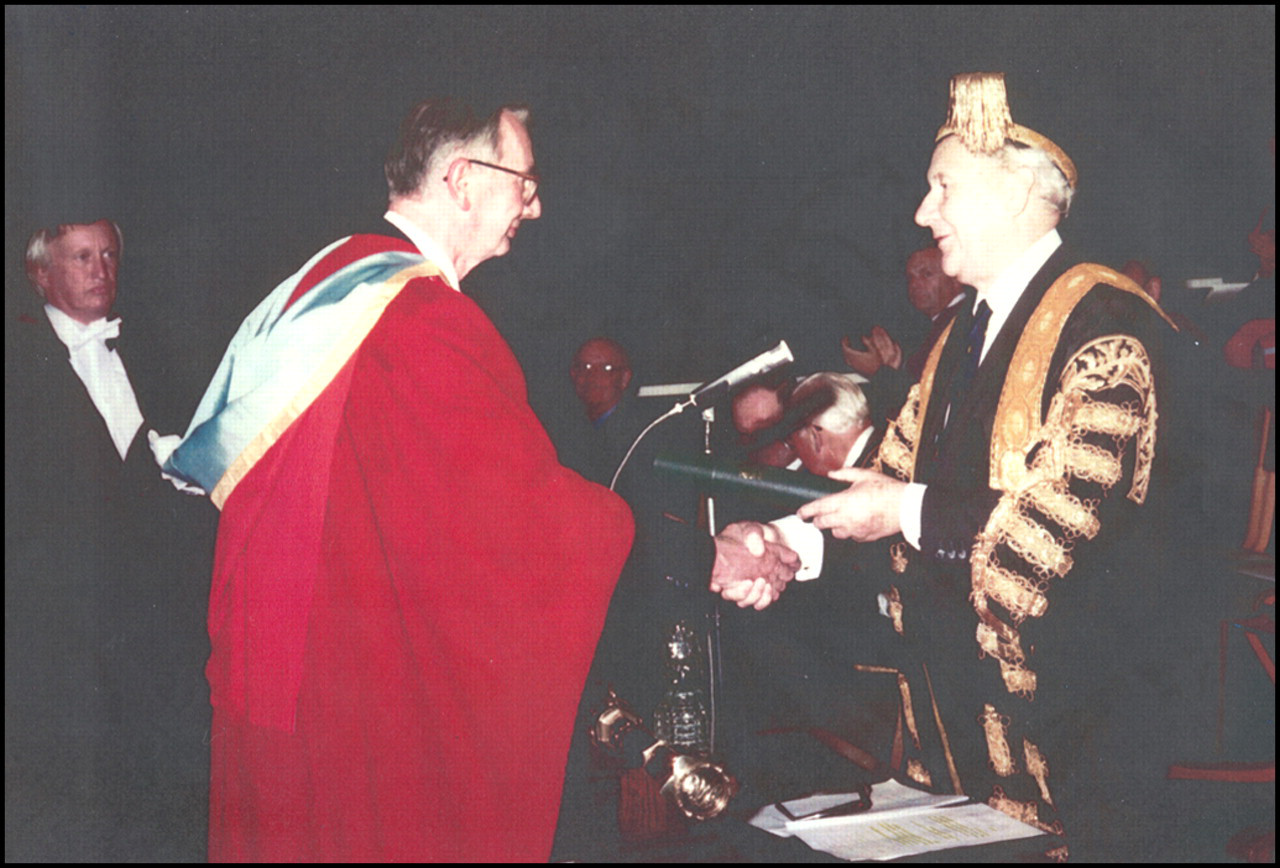
Professor Norman Exton-Smith (left) receiving the honorary degree of Doctor of Medicine at the University of Nottingham from the Chancellor, Sir Gordon Hobday (right). (Courtesy of the University of Nottingham)
Unhappily in 1981 he suffered a pathological fracture of the neck of the femur originating from a hypernephroma. It was followed by nine years of recurrent illnesses due to bone secondaries that were often associated with great pain. He underwent more than 20 operations to remove secondary growths. He talked about each incident with a wry, detached humour, bearing his tribulations with great heroism while all the time trying to help others. He endeavoured to maintain his independence as long as possible. In his latter days he walked on one and one half artificial femurs and went upstairs by means of a stair lift. He would demonstrate to visitors to his home the workings of his hydraulic bath seat and his Pegasus airbed. Eventually he became too ill to stay at home and died in Edenhall Marie Curie Home in North London. His wife died some months later. A celebration of his life held in the Royal College of Physicians emphasized that he was a private man with many interests previously unknown to those present, including a love of antiques, early English watercolours, Japanese prints and flying radio controlled model aeroplanes.
Exton-Smith's work embraces three areas: clinical geriatrics, clinical gerontology and a perceptive diplomatic influence on many organizations.
Exton-Smith as a geriatrician
Exton-Smith was determined to improve medical services for older people, extending the pioneering work of the early geriatricians, including Eric Brooke, Lionel Cosin, Trevor Howell and Marjory Warren. Since the late-1940s he described the turn around in the care of the elderly; first at St Pancras Hospital which had been a Poor Law Institution appropriated for public health purposes in 1937 and later at the Whittington Hospital. 16 The patients' medical diagnoses were vague, for example senility or hypertension. Although they were clean, well-nourished and without bedsores, almost all had painful, stiff joints resulting from prolonged immobilization in tightly made beds. The walls of the wards were painted in drab ‘institutional’ green with beds crowded back to back. Investigative facilities were limited; radiographers visited from other London County Council hospitals and pathology specimens were sent to a district laboratory. Modern treatment with antibiotics and diuretics meant fewer patients died, leaving the original condition to be treated. Improved access to toilet facilities often improved incontinence. Referrals for admission were frequently precipitated by illness or strain in the carer. 17 Home visits clarified the need for admission – indeed one-fifth of the patients need not be admitted because they could be managed at home, thus saving hospital beds. 18 Three months after returning home, half of the patients had maintained their improvement. 19 Effective management of the elderly depended on recognizing that socioeconomic, occupational, nutritional and clinical factors all played a role in the health of the elderly population. Medical students, especially those entering general practice, needed teaching on elderly patients. The scope for research into the diseases of old age was ‘wide open’ and unexplored.
In the 1970s Exton-Smith stated the requirements for effective geriatric units were an adequate number of beds for the service, both in total and in the District General Hospital (DGH); progressive patient care (PPC); adequate medical, nursing and rehabilitation staffing; consultations with other consultant colleagues including orthopaedic surgeons and psychogeriatricians; home visits; and a day hospital. 20 Up to two-thirds of all geriatric beds should be in the main hospital where patients could have the benefit of the main diagnostic and treatment facilities. The remainder should be in smaller units near the patients' homes. The overall size of the department should be related to its service catchment area and linked to the recommended Ministry of Health bed norms. 21 Ideally, a geriatric unit should have no more than 200–300 beds. Low-turnover units required more medical sessions. 22 Day hospitals, which should have 25-30 places, provided effective continuity of medical/rehabilitation care and helped patients to manage at home.
He was convinced of the value of PPC, which had been adapted from American nursing practice for use in geriatric medicine. 23 Elderly patients entered an admission ward for initial assessment, investigation and treatment. From there they could be discharged or transferred to continuing care wards for further rehabilitation or continued nursing care. From these wards patients could be discharged, moved to a halfway house to await a place in a welfare home or retained for continuing care. The disadvantage of PPC was loss of nursing continuity. However, he argued it was good for patients' morale for them to be moved on as they improved. 24 The concept of PPC became widely followed throughout the UK, although the actual procedure varied with local circumstances. 25
Exton-Smith emphasized that geriatric medical, nursing, rehabilitation and social work departments should be fully staffed. Teamwork was paramount. Although the number of consultant geriatricians and senior registrars had increased, the Royal College of Physicians remained concerned about poor recruitment into the specialty. Its report, of which Exton-Smith was an author, recommended the appointment of general physicians with an interest in geriatric medicine, increasing the rotation of junior medical staff between general and geriatric medicine, enlarging the experience of geriatric senior registrars in general medicine, and integrating general and geriatric medicine. 26 Concern about recruitment was reiterated two years later, particularly the shortage of suitable medical staff in geriatric training grades and the shortfall in the required number of 750 consultants in geriatric medicine. 27 Geriatricians were concerned that senior nursing staff did not recognize that active geriatric wards required the same nursing staff ratios as general wards. 28 Furthermore, rehabilitation and social work units were not always fully staffed. 29 Social workers were vital members of the geriatric unit. 30 Their assistance was essential in solving social problems and organizing community facilities to ensure successful discharge.
Exton-Smith publicized the achievements of geriatric medicine. 31 All but 10% of previously bed-ridden chronic sick patients could now be made fit for discharge, the median length of stay had fallen to 22 days and one in 10 geriatric units had achieved a patient turnover of 4.0–6.75 patients/bed. 32
Exton-Smith and clinical gerontology
Exton-Smith viewed the aim of gerontology as retarding the rate of ageing. 33 He established a thriving research unit at St Pancras Hospital and later at the Whittington Hospital. These examined the environmental and clinical factors that influenced ageing.
He investigated, in collaboration with the MRC, accidental hypothermia assessing thermoregulation, thyroid function and the environmental temperature. 34–36 He reasoned that it was due to impairment in thermoregulation, which deteriorated with age. He emphasized the importance of precipitating factors such as impaired mobility, nocturia, insomnia and postural hypotension. He emphasized the need for greater awareness of the condition, a realization that older people adjusted more slowly and less accurately to the ambient temperature, and he established the value of the low-reading thermometer and the Uritemp method of measuring the temperature of older people living at home. In response to a request from the Ministry of Health, the British Medical Association (BMA) set up a small working party into accidental hypothermia, chaired by Exton-Smith and it reported in 1964. This was followed by a College report on the same subject in 1966 and by another in 1977, also led by Exton-Smith. 37
Exton-Smith carried out extensive cross-sectional and longitudinal nutritional studies of the elderly that were sponsored by the King Edward's Hospital Fund for London. 38,39 A striking decline in the nutritional intake occurred with increasing age, particularly in those in their eighth decade. Those who maintained their health retained adequate intakes of nutrients but those whose health declined had evidence of a considerable fall in intake, probably related to physical disease. Those with a low-calorie intake tended to have deficiencies in other nutrients, including calcium and vitamin D. Provision of meals-on-wheels varied widely between local authority areas. 40 Most clients had meals five times weekly; many liked them but food wastage was high.
He investigated fractures and bone disease, especially osteomalacia and osteoporosis, establishing a correlation between X-ray appearances and the ash content of bone, which led to assessment by X-ray alone. 41,42 He emphasized the importance of Vitamin D in skeletal rarefaction in the elderly, which could be linked to poor diet and poor exposure to sunlight. This led to studies of falls in older people that he showed could be due to impaired physiological balance mechanisms with age. 43
He explored the neglected subject of pressure sores and, using a special device to assess patient movement in bed, concluded that long sustained localized pressure was more damaging to tissues than high pressure for short periods. 44 He strongly supported Doreen Norton in her study of nursing older persons, obtaining a research grant for her from the National Council for the Care of Old People. Her work resulted in the Norton pressure sore assessment scale which is still used today. 45,46 He conducted the only controlled trial of large celled ripple mattresses in the prevention of pressures ever carried out in this country and was involved in their design. 47
He carried out other studies including predicting mortality where the best factors were sex, higher age and proteinuria. 48 He devised an automated learning device to assess the effect of drugs given to patients with mental impairment. Together with colleagues he set up a memory clinic and a geriatric neurophysiology unit where visual- and auditory-evoked potentials were measured. 49 He believed that longitudinal studies were required to differentiate the decline in function due to physiological ageing due to disease, and the effects of the environment and social factors. 50
Exton-Smith's perceptive influence within organizations
Exton-Smith had considerable influence in the Royal College of Physicians of London and the BGS. He was the first secretary of the College Geriatrics sub-committee, when it began work in May 1967, and later became its Chairman until 1985. 51 Initially the sub-committee discussed topics, including the role of geriatric departments within hospitals, scarcity of consultant posts in the specialty, training in geriatric medicine, research into ageing and preventive medicine. Later it promoted a diploma in geriatric medicine; published a report on the specialty in 1972, which the DHSS agreed to send to every final year medical student; discussed integration between general and geriatric medicine; medication for older people and guidelines for College regional advisors on consultant appointments in geriatric medicine. 52
He had a major input into the deliberations of the BGS. Over a long period he influenced decisions on subjects such as facilities for geriatric units in district general hospitals, the essential requirements for a geriatric service, the classification of geriatric beds, the training of medical and nursing staff in the care of older people, recruitment into the specialty, requirements for consultant appointment in geriatric medicine, community hospitals, psychogeriatric services and discussions with the Ministry and DHSS on a range of topics.
Conclusions
A review of geriatric services concluded that it lacked consultants of high calibre and academic standing. 53 Exton-Smith was an outstanding exception. He greatly extended knowledge of medicine in old age and standards of care. He became a world-renowned figure for his work on acute geriatric medicine and for his gerontological research, which was often supported by the Medical Research Council and the Nuffield Foundation. He inspired many to follow his footsteps.
He worked tirelessly on behalf of the specialty and was much in demand as a speaker. 54 He was a wise, shrewd diplomat in his efforts to influence views within the Royal College, the Ministry of Health and the Department of Health. All in all he was a kind, approachable, humble man: a gentleman and a gentle man.