




Abstract

Dr Henry Jephson was born on 4 October 1798 in Sutton-in-Ashfield, near Mansfield, Nottinghamshire. His interest in science as a youth caused him to blow off two fingers of his left hand while experimenting with fulminating silver. After a pupilage with Mr Alcock he entered St George's Hospital where he met a young assistant surgeon, Brodie (later Sir Benjamin); their friendship continued until Brodie's death. Chambers, a retired naval surgeon, required an assistant for his practice in Leamington Spa. On Alcock's recommendation, Jephson started work there in 1819. He made himself so useful that he was made a partner; when Chambers retired he left the practice to Jephson. Wishing to improve his qualifications, Jephson left Leamington with his new wife in 1827 for Glasgow, where he obtained his MD.

The Statue of Henry Jephson
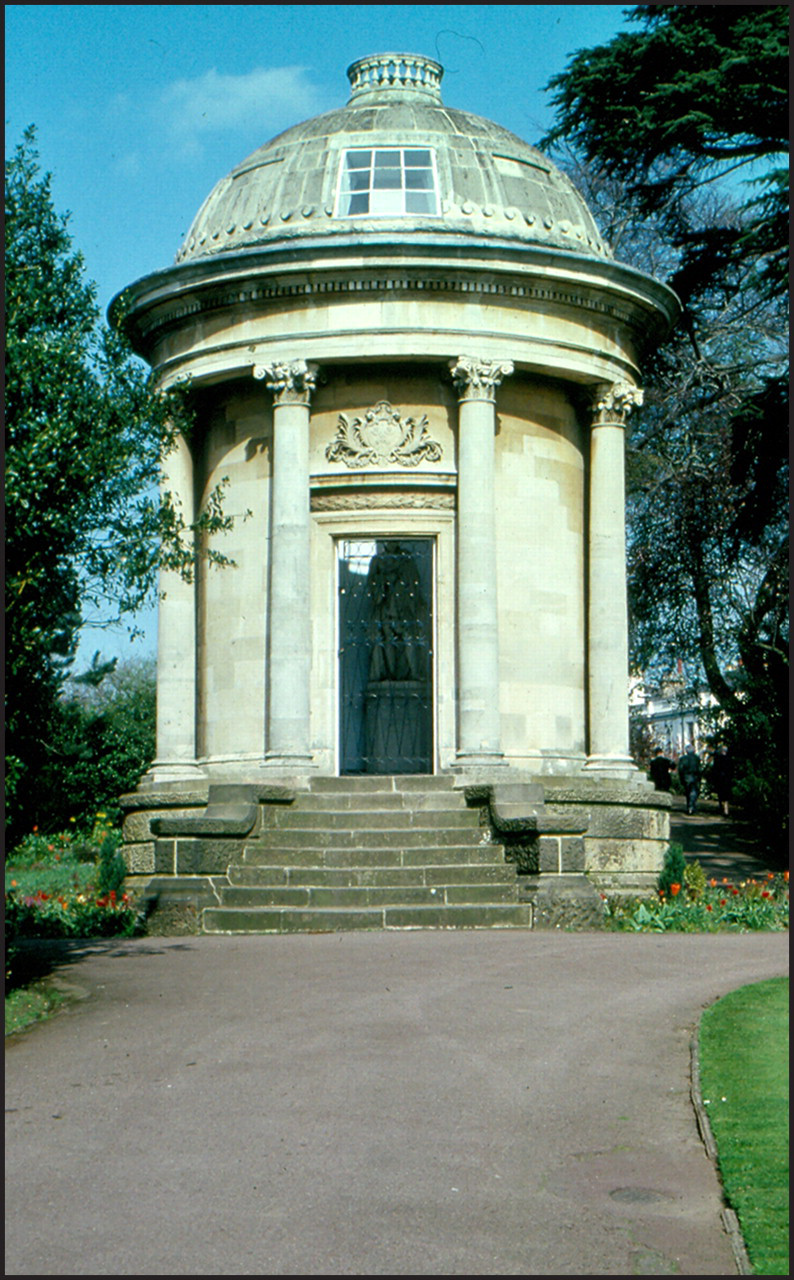
The Rotunda in Jephson Gardens, Leamington Spa
In 1828 he went to practise in Cheltenham but a deputation of old friends and patients persuaded him to return to Leamington. He paid back the purchase money to the person to whom he sold his former practice and built a large new practice at 7 York Terrace; in 1831 he moved to Beech Lawn, a fine house in Warwick Street (now the site of the Warwickshire County Fire Brigade). His patients included George IV, Princess Victoria, Florence Nightingale and John Ruskin.
According to his obituaries in the Lancet and British Medical Journal (25 May 1878) he had, until 1848, what was probably the most extraordinary success ever achieved by any physician. Patients from Britain, the colonies and Europe flocked to Leamington. He was summoned to consultations all over the country and had a special travelling carriage made for the journeys. For several years his annual income exceeded £20,000, and once reached £24,000.
Jephson's health began to fail in 1846. His vision started to deteriorate in 1847 and from 1848 he was totally blind; his blindness was attributed to ‘gouty amaurosis’. During his enforced retirement he remained active in local business matters. He died on 14 May 1878 and was buried at Old Milverton, near Leamington, beside his wife who died in 1874.
The Willes family of Newbold Comyn owned a large plot of land in Leamington. It became a pleasure garden for public use in the early 1830s and included the Newbold Archery Ground. Jephson contributed to Leamington's prosperity by promoting the healing properties of its spa waters and he was a local philanthropist who helped the poorest residents. In 1846, to honour Jephson, at a public meeting it was decided that the garden was ‘to be hereafter dedicated to the use of visitors and inhabitants … the Gardens [to] be called the Jephson Gardens and a statue of Dr. Jephson placed therein’. The Memorial Committee had already negotiated a 2000-year lease from the owner, Edward Willes, for only £30 a year.
The seven foot high Carrara marble statue (Figure 1) stands on a Sicilian marble plinth which cost £1000. The sculptor was Peter Hollins of Birmingham who exhibited it at the Royal Academy in 1848. It was unveiled in Leamington in May 1849. To protect it from the weather it was enclosed in a rotunda (Figure 2), designed by DG Squirhill, in the form of a Corinthian temple; built of Bath stone it has a domed roof supported by eight pillars. Jephson's coat of arms is over the doorway. Sadly the statue within the rotunda is virtually invisible to the casual observer.
Dr John Hitchman, another Leamington practitioner and philanthropist, was a member of the Jephson Memorial Committee. In 1869 a fountain bearing his name was erected in the Gardens, near the boundary with the town's main street. Jephson Gardens, now considered one of the finest public gardens in Britain, also contains an obelisk in memory of Edward Willes, donor of the land; it was erected in 1875.