




Abstract

Norman Bethune was born on 13 August 1822 in Moose Factory (Ontario) Canada, the son of Angus Bethune (1783–1858), an important trader of fur in the Northwest Company and Hudson's Bay Company, and Louisa McKenzie (1793–1833 [Figure 1]). 1 The family moved to Toronto in 1840 and Norman attended King's College for his arts degree and in 1845 entered King's College Medical School in Toronto, from whence he went to London and graduated at King's College and Guy's Hospital in 1848 as a surgeon. On returning to Canada in 1849 he joined four other doctors to set up the Upper Canada Medical School, the third medical school in Toronto (the others were King's College and John Rolph's Toronto School of Medicine). In 1850 he moved to the Trinity Medical School (Toronto) and there, under Bishop John Strachan (1778–1867), he became Professor of Anatomy and Physiology. He contributed papers (anatomy, medical pathology, monstrosity in medicine) to the Upper Canada Journal of Medical and Surgical and Physical Sciences during the period 1851–54. 2
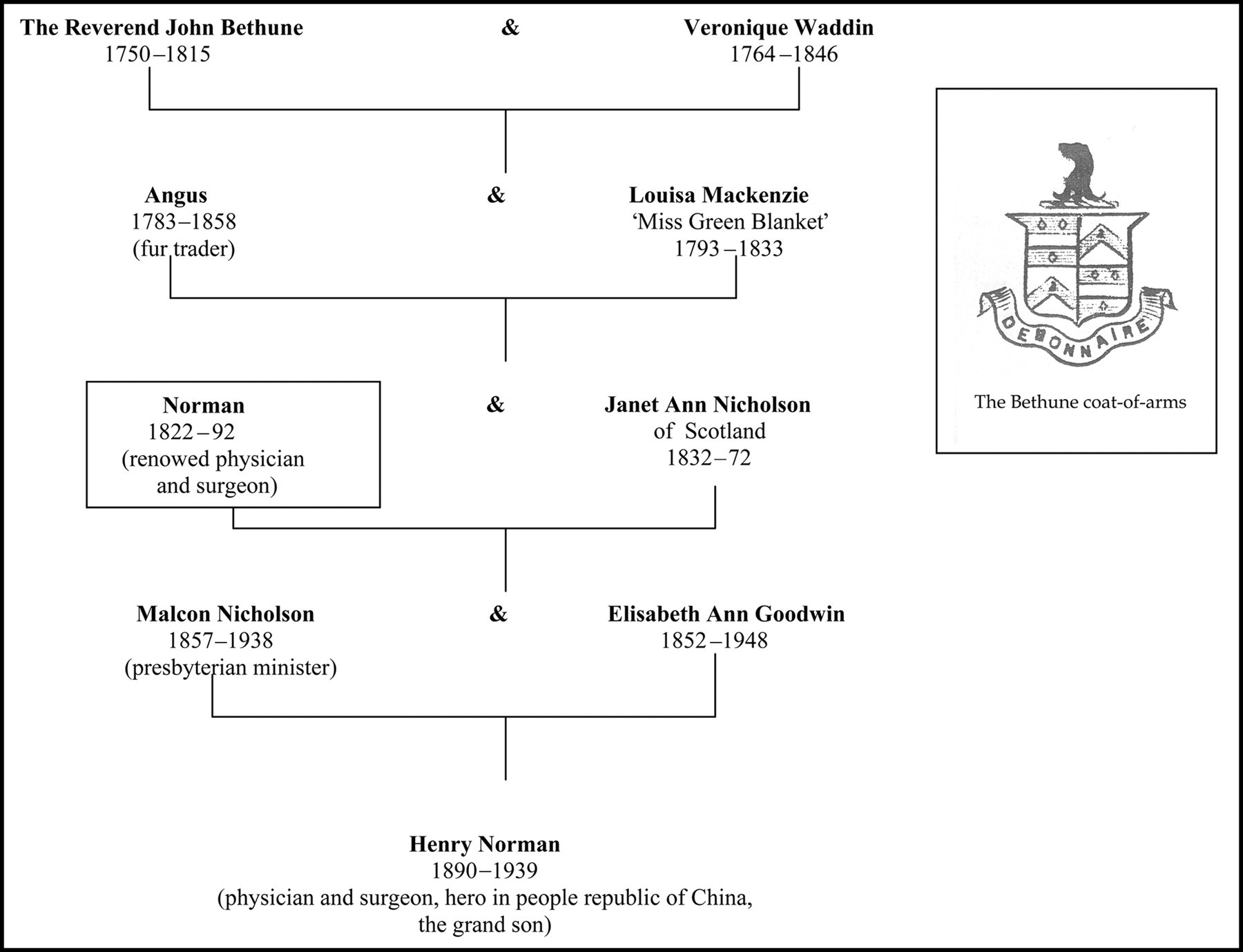
Bethune Canadian family genealogy4
In the academic year 1855–56, while Dean of the Faculty and at a time when the Trinity Medical School was short of students and funds, Bethune and his colleagues placed a notice in the local newspaper to exempt applicants for the MD degree from subscribing to the Anglican Church's 39 Articles. Dr Strachan objected strongly to this position and the staff resigned (Figure 2). Hence in October 1856 Bethune joined the Toronto School of Medicine, Victoria University, and taught Anatomy.
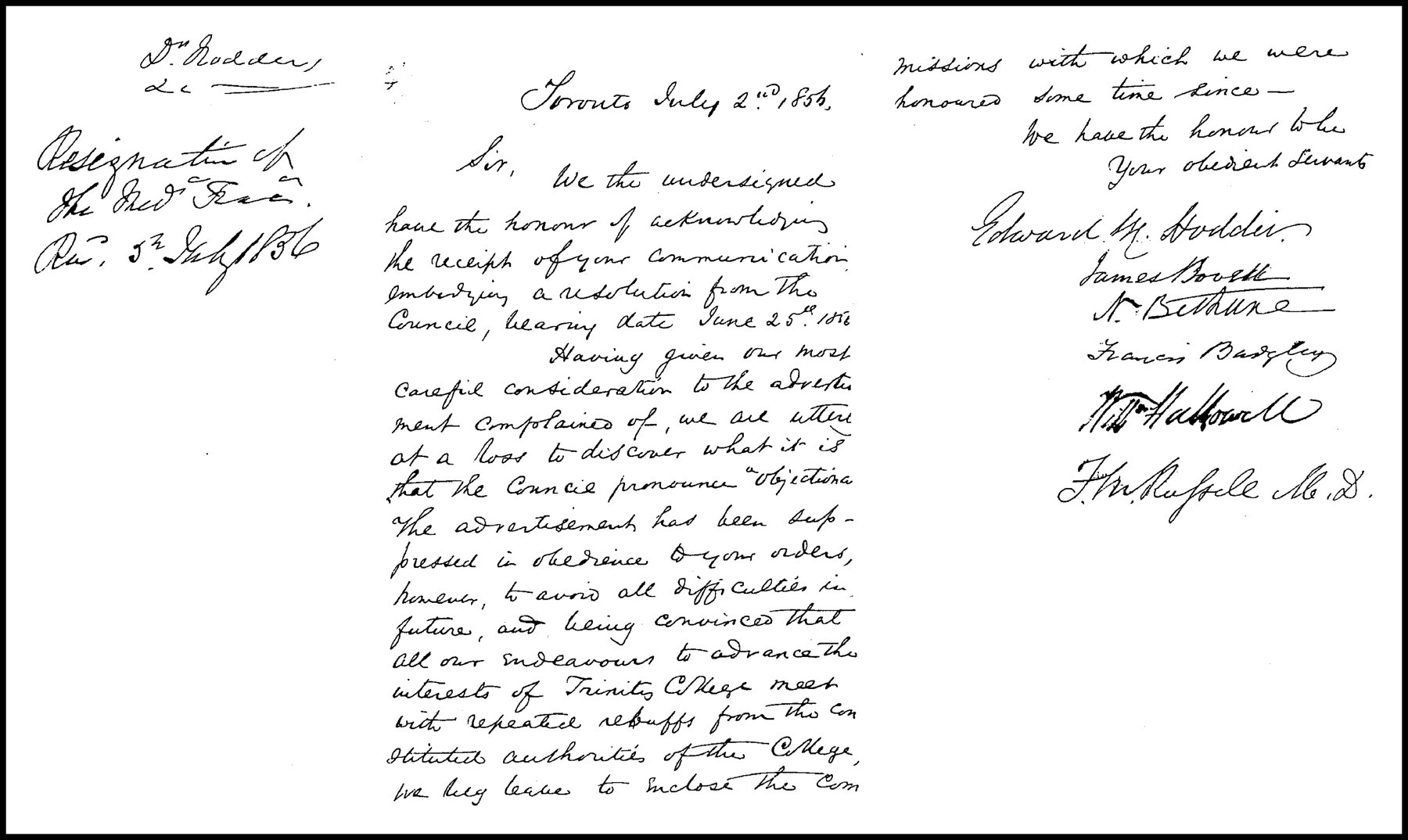
Resignation letter Bethune, Dean of the Faculty, published courtesy of H Pilon, archivist of Trinity College, Toronto, 2001
Bethune successively went to Edinburgh and qualified as a surgeon in the Royal College of Surgeons in 1860. Next he went to Strasburg to specialize and then, on 24 June 1859, to Solferino (Mantova, Italy) where Henry Dunant, Founder of the International Red Cross, wrote in Solferino Memory
3
:
Un chirurgien anglo-américain, le Dr Norman Bettun, professeur d'anatomie à Toronto, dans le Haute Canada, vint exprès de Strasbourg apporter son concours à ces hommes dévoues.
Bethune returned to Toronto in 1860 and joined Victoria College Faculty as Professor of the Principles and Practice of Medicine (Figure 3). When the Trinity Medical School removed the religious barriers, Bethune returned to Trinity College and accepted the post of Professor of Surgery and he held this until 1881. In his later years he was also Consulting Physician to the Toronto General Hospital (Figure 4) where he worked with Dr George Ansel Stirling Ryerson (1855–1925), founder of the Canadian Red Cross. Ryerson was also Professor at Trinity College University. The final years of Bethune's life were very sad for he became an alcoholic and was reduced to misery; at first his son Malcolm looked after him but he later entered a home for incurables.
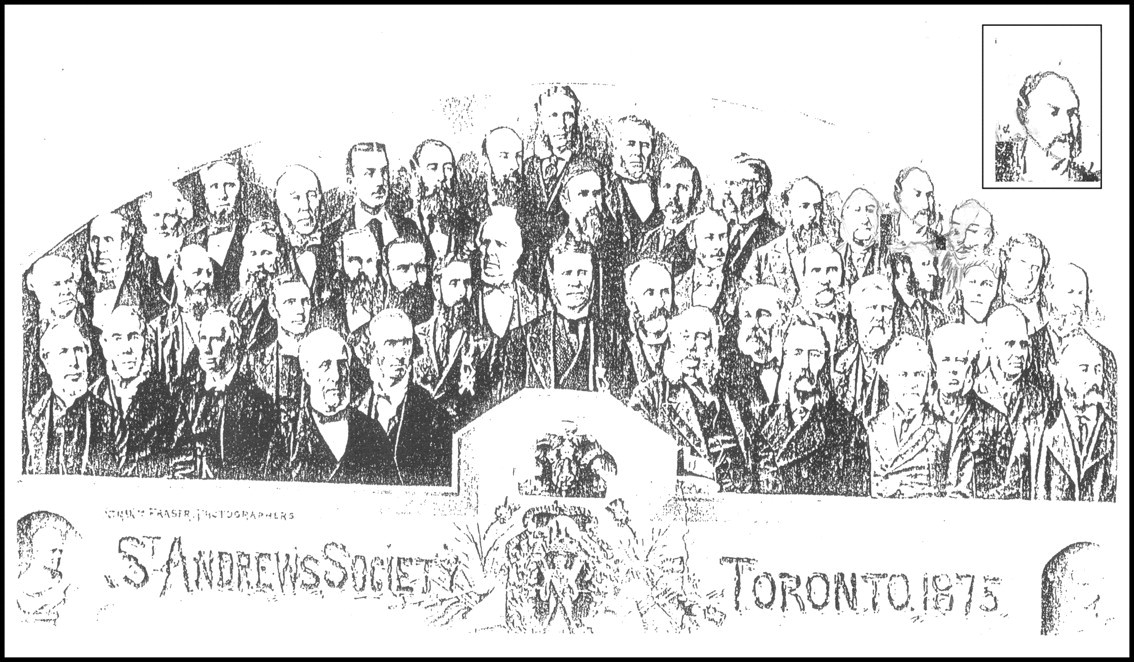
Norman Bethune, member of St Andrews Society, published courtesy of Miss F Pope, Toronto, 2001
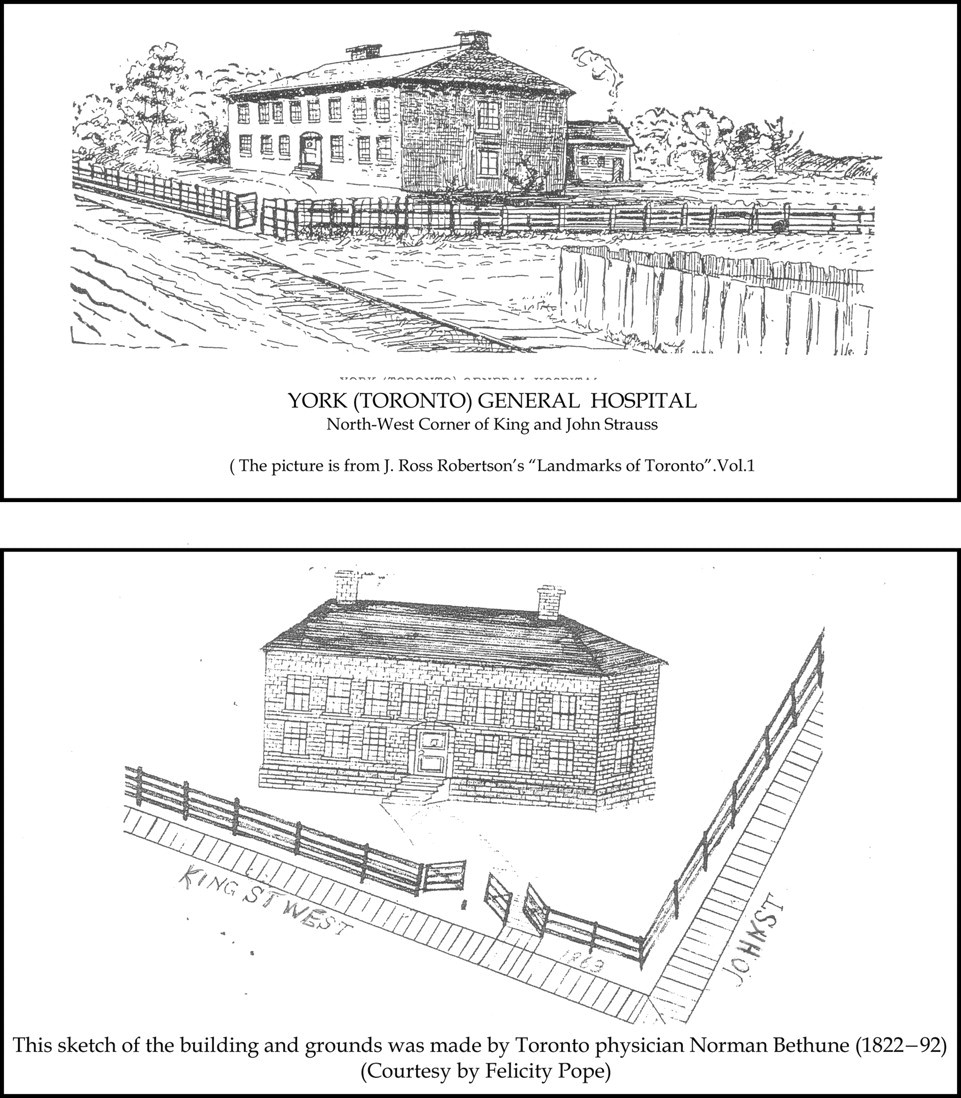
Comparison between JR Robertson's picture of Toronto Medical Hospital (1829–56) and that of Norman Bethune. This Hospital site is no longer active, published courtesy of Miss F Pope, Toronto, 2001
His grandson, Norman Bethune II (1890–1939) was better known for he became physician and surgeon with an active part as surgeon in Mao's Red Army for which he became a hero in the People's Republic of China. He always spoke of his grandfather with great admiration. 4 Norman Bethune II left Canada for the last time in 1938 to join the 8th Route Army in the Shanxi-Hobei border region China. There he was a tireless and inventive surgeon, teacher and propagandist, and he adopted the cause and the people as his own. He died in 1939 from septicaemia. 5