




Abstract

W Russell Brain (Figure 1) was born in Reading on 23 October 1895, 1–4 the son of Walter John Brain, a solicitor, and Edith Alice Smith. He went to Mill Hill School on an Entrance Scholarship and entered New College Oxford in October 1914. Originally he was destined for law and at Oxford read history, taught by JBS Haldane and Julian Huxley.
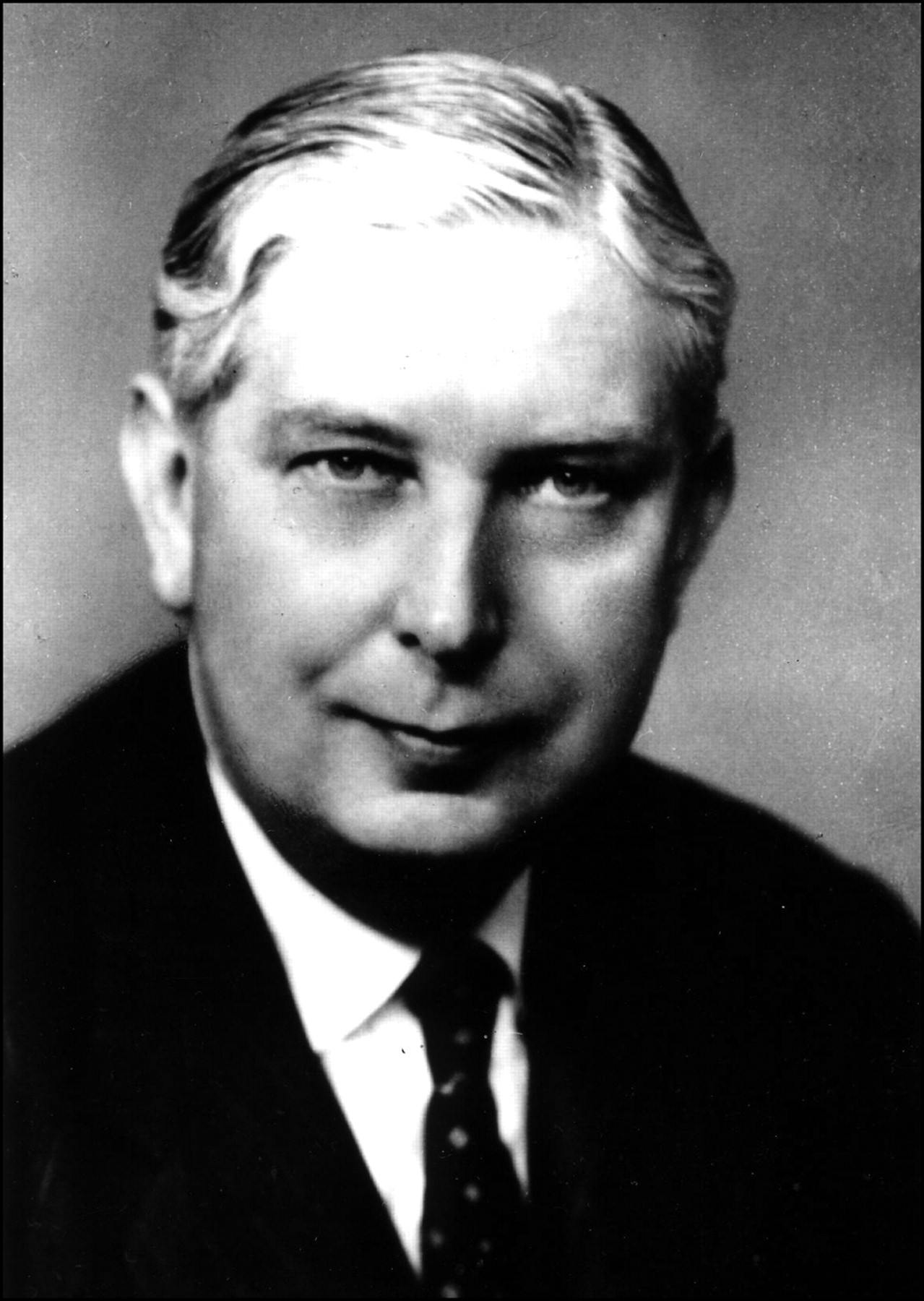
Lord Brain (reproduced courtesy of The Royal London Hospital)
As a young man he joined the Quakers and, in January 1915, the Friends' Ambulance Unit in the First World War, finding himself in the military hospital in York in charge of the X-ray department. He went, as a radiographer, to King George Hospital in London. Here he met his future wife, Stella Langdon-Down, who was a VAD in the hospital. With her encouragement, he returned to Oxford in January 1919 as the Theodore Williams Scholar in Physiology to study medicine and, in October 1920, he entered the London Hospital. He intended doing psychiatry but was persuaded by his teacher, George Riddoch (1888–1947), to ‘learn some neurology first’. He said later, ‘I never got to do psychiatry though I never lost my interest in it’. Others who influenced him were Hugh Cairns (1896–1952), Eric Strauss (1894–1961) and his own father-in-law, Dr James Langdon Haydon Down (1828–96). He was elected to Maida Vale Hospital for nervous diseases in 1925 and to the staff of The London Hospital in 1927.
Brain's reputation as a neurologist was increasing and he developed his private practice in Harley Street, treating both Winston and Clementine Churchill, the former from 1949 to 1965. He started writing at an early age and wrote several essays including Ancient and Modern Warfare (1912), Wounded Heroes (1914), Can we believe in God's Omnipotence (1918), The English Revolution (1920s), The Limit of Thought (1920s) and Galatea of the Future of Darwinism 5 (1927). He published Recent Advances in Neurology 7 with EB Strauss (1927) (Figure 2), the seventh edition of which in 1962 was edited by Lord Brain alone, his co-editor having died. Brain published Diseases of the Nervous System 8 in 1933 (6th edition in 1962), Clinical Neurology in 1960 and Speech Disorders in 1961 9 and he also edited the journal Brain (1954–66).
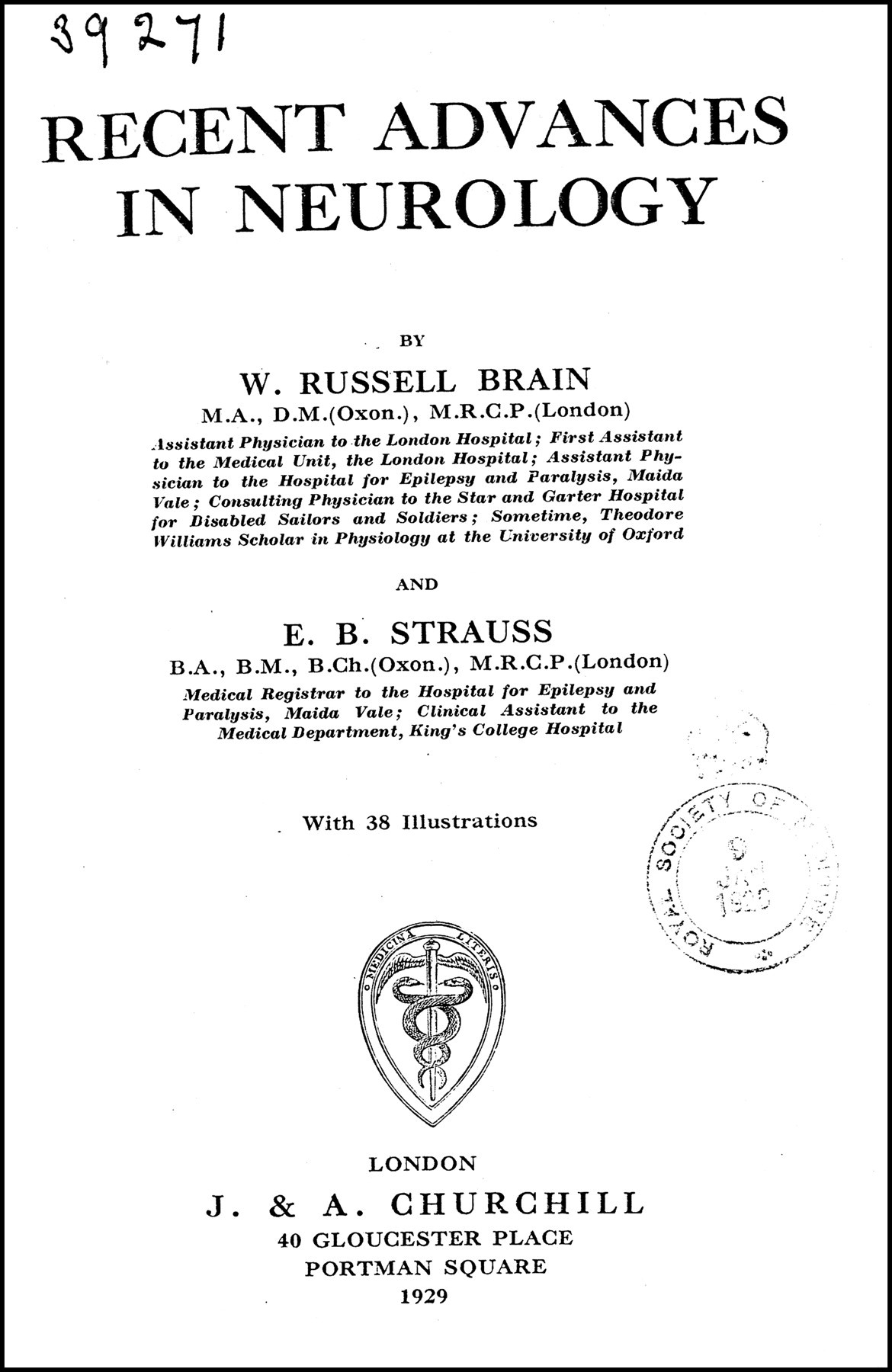
Recent advances in Neurology (1929) by W Russell Brain and EB Strauss
He published many neurological papers and wrote about the relationship between neurology and psychiatry, 10 his great interest. He wrote particularly on cerebral circulation, 11 epilepsy, 12 aphasia, 13 exophthalmic ophthalmoplegia (with HM Turnbull), 14 cervical spondylosis, 15 carpal tunnel syndrome, 16 carcinomatous neuropathy 17 and Parkinsonism. He was a major figure in increasing the knowledge of multiple sclerosis, 18 being the first to collect statistical data concerning the incidence and course of the disease. He became involved in many committees, particularly after his appointment as President of the Royal College of Physicians in 1950, becoming a public figure. He sat on the Royal Commission on Marriage and Divorce in 1952 and in 1954 was a member of the Royal Commission on the law relating to mental illness.
He was chairman of the Interdepartmental Committee on Drug Addiction in 1959 and, in 1956, became President of the Family Planning Association and a member of the Brook Advisory Committee. After his elevation to the Baronetcy in 1960, he spoke in the House of Lords on abortion and was in favour of reform of the law governing homosexual relations. He also voiced the belief that medical advice on contraception was often needed outside marriage.
For many he seems to have been the automatic choice of lecturer, particularly after his appointment as President of the Royal College of Physicians in 1950, although he had started lecturing before then. He delivered the Swarthmore Lecture to the Society of Friends (Quakers) in 1944 on Man, Society and Religion. 19 He was the Mason Lecturer to the Eugenics Society in 1948 and, in 1945, he gave the Bradshaw Lecture at the Royal College of Physicians on Speech and Handedness. Following his election as President he spoke in Leeds on Aphasia in 1950 and gave the Rede lecture in Cambridge in 1951 on Mind, Perception and Science 10 (Figure 3). In 1955 he addressed the Enfield Group Hospital Management Committee on Medicine and Administration. He delivered the Hebenden Oration on Spondylosis, the Known and Unknown in 1953 and was made an Honorary Member of the Heberden Society in 1957. 20 He chaired a committee which recommended that special centres should be established for the treatment of rheumatic diseases, staffed by trained specialists. In 1956 Brain spoke at the opening of the new department of psychological medicine on Public Opinion and Mental Illness. 21

Mind, Perception and Science (1951) by W Russell Brain
He gave the Hunterian Lecture in 1958 on Consciousness and Unconsciousness 37 and spoke at the 50th International Congress in Philadelphia in 1958 on Carcinomatous Neuropathy. He also delivered the Riddell Memorial Lecture at Kings College, University of Durham, in 1958 on Nature of Experience 22 and in 1959 he spoke on Science, Philosophy and Religion at the Arthur Stanley Eddington Memorial Lecture in Cambridge. He gave the Savill Oration at the West End Hospital for Nervous Diseases in October 1958 on Pathogenesis and Treatment of Endocrine Exophthalmos 23 and the Bryce Lecture on Status of Mind in Oxford in 1964; he spoke to the Reading Pathological Society on Cervical Spondylosis in 1964. He delivered the Findlay Memorial Lecture in 1957 on Medicine and Fitness and in 1959 he spoke at The Athenaeum on Has the NHS justified itself?
He seems to have enjoyed writing about individuals and particularly about those he had met (Figure 4), for example Epstein in Some Reflections on Genius 24 (1962), Walter de la Mare in Tea with Walter De La Mare 25 (1957) and Charles Sherrington in Conversations with Sherrington 26 (1957). Although his meetings with Sherrington and de la Mare reveal little about himself, his discussions, with Epstein, whom he met while his bust was being sculpted, illustrates his knowledge and interest in the Arts. 24 He spoke about Epstein at the Royal College of Physicians in 1958 on the completion of the bust, which still may be seen there. He used his address to pay homage to Santiago Ramon Y Cahal (1852–1934) to advance his views on the Future of Neurology (1953) 27 and his Harveian Oration of 1959 to review the early developments in neurology in William Harvey's time. 28

Bust of Lord Brain by Jacob Epstein (Courtesy of The Royal College of Physicians)
He used the Purvis Oration of 1955 at the Centenary of the West Kent Medico-Chirurgical Society to discuss Charles Dickens (Dickensian Diagnoses 1955) 29 and to discuss the accuracy of Dickens' psychological description of his characters.
Brain had a particular interest in Dr Samuel Johnson, collecting a great deal of information about him and becoming President of the Johnson Society of Litchfield. In 1957 Brain also addressed the Osler Club at the Royal College of Physicians on Thomas Lawrence (PRCP 1711–83); Lawrence was a friend of Johnson. He wrote essays on George Bernard Shaw (in the 1920s), the neurology of John Hunter's last illness 30 (1952), Henry Havelock Ellis (1958), Sherlock Holmes (1960), Shakespeare and medicine (1960), Socrates on the health service (unsigned in the Lancet, 1961) 31 and John Clare (1964).
Medical education
Brain was concerned particularly about medical education and his Presidency was notable for providing the principles embodied in the curriculum and the foundation of the Association for the Study of Medical Education. He was the first president and spoke in 1958 at the opening of the first conference 32 on the need for experiment. He was supposed to have delivered a lecture at the Royal College of Physicians on Medicine and Government 33 on 28 October 1966 but his final illness intervened (Figure 5).
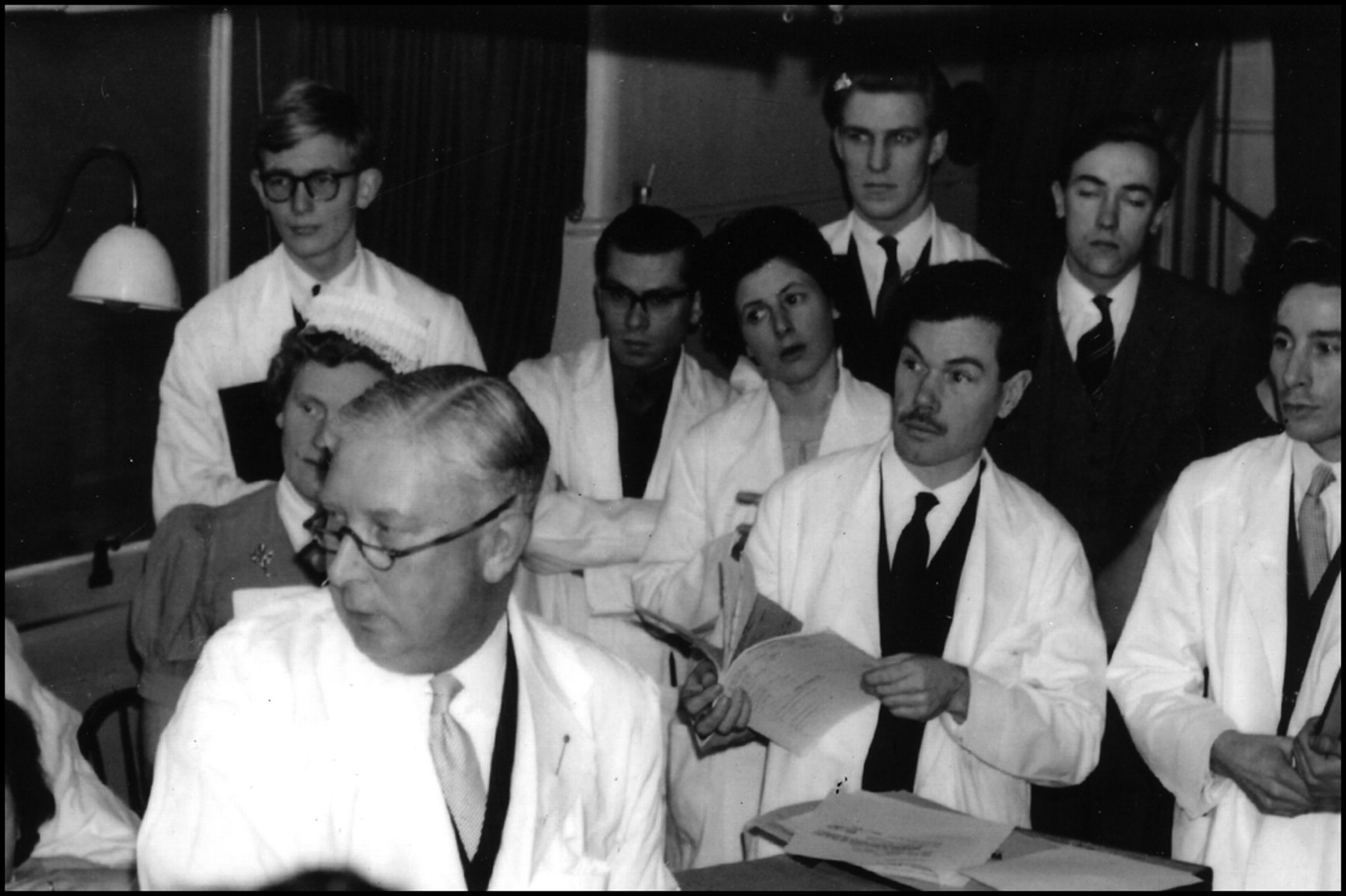
Lord Brain's last teaching ward round as Physician at the London Hospital 1960 (courtesy of the Royal London Hospital)
Travels
Brain travelled a good deal. He visited Cairo, Sudan and Rome in 1950–51 and Ceylon, New Zealand and Australia in 1955, where he spoke on Medicine and Society to the Royal Australian College of Physicians. He travelled to Spain in 1956 and to the USA in 1958. He attended the first Pan African Psychiatric Conference in Nigeria in 1961 and went to Greece in 1964. He attended the Psychosomatic Research Conference in Athens in 1964 and spoke on Psychosomatic Medicine and Brain and Mind Relationship. The Canadian Government appointed him commissioner to survey the medical services and hospital facilities of Newfoundland and Labrador; he was determined to meet as many Newfoundlanders as possible and ‘that only the best would be good enough for Newfoundland’ in 1960.
Brain received honorary degrees from the Universities of Oxford, Durham, Manchester, Southampton, Belfast and Wales, and he was elected honorary fellow of many colleges and societies. He was very active in the Royal Society of Medicine and was President of the Neurological section in 1950. The script of the lecture he was supposed to have delivered at the Royal College of Physicians in October 1966 33 gives an idea of how his mind was working at that time, for he reviews the past relationship between the Government and Medicine. He points out that he had been Chairman of the Joint Consultants Committee (1950–8), a Member of the Central Health Services Council (1950–65), Chairman of the Advisory Committee on Distinction Awards since 1962 4 and in 1965 he was appointed Royal Commissioner to the Medical Services of Newfoundland, which had ‘enabled him to get a view of another countrys’ health problems as well as close contact with the problems of this country'. Since he was to be critical of some aspects of the National Health Service he makes it clear that ‘whatever the defects and drawbacks, the Health Service [is] one of the greatest social revolutions ever accomplished’. ‘The National Health Service is something magnificent in scope and almost breathtaking in its implications’ and it ‘cannot very well be excluded from any list of notable achievements of the 20th century’. Nevertheless he recognized that there was much unhappiness among doctors and a need for improvement. He considered that much of the trouble lay in the tripartite division of the health service into consultant and hospital doctors, the general practitioners and the public health division. He felt the main victim of the division was the isolation of the general practitioner, since the increase in investigations required in modern medicine made it inevitable that consultants should undertake the treatment of patients. He discussed ways of overcoming these difficulties and of providing additional financial support for the inevitable rise in the financial needs of medicine, and suggested there was a need to collect more information on the future of the health service and the establishment of a standing parliamentary committee on the health service with wide-ranging powers to question ministers. This would develop an informed opinion on many aspects of the health service.
Those who knew and worked with him spoke of Brain's ‘habit of hard work attending tidily to one thing at a time regardless of fatigue or distraction’ and his devotion to The London Hospital and medical school and his ‘exceptional contribution to The London's fame’. Other comments include his ‘exceptional clinical skill, originality of thought, wide culture and remarkable literary talent … one delightful feature of his life was the way in which he continued to grow intellectually, receptive of new ideas … the eminence of this quiet, rather shy, scholar were his methodical handling of facts and his implacable industry … his ability to read quickly and constructively’ which underlay his skill in committee; he worked as well in his car as at home; ‘He did not fatigue greatly … There was a week in which he delivered three eponymous lectures and an alteration in his programme of responsibilities’; he had a ‘frailty of expression for he could marshal his thoughts and then write lucid English as quickly as his pen would go … His greatness is apparent, its basis through reticence less evident’; his true qualities ‘among these I would put very high his amazing (intuitive it almost seemed) grasp of a situation and of the possible consequences of action … the scholar physician in the best and highest tradition … his services to the profession and the public have been far greater than either has realised’ with all the public and profession functions ‘he has still been the leading neurologist of his generation’; he had ‘the attributes of a great physician and a great public figure’; he regarded ‘psychiatry as a bridge between mind and brain’ and in his Maudsley lecture he gave good evidence of his understanding of the extent of psychiatric progress in the last half century.
Brain was a quiet, shy man; you had to know him well before he would open his mind to you, although later in his life he became more outspoken in his opinions. He was a master of the spoken and written word. His handwriting was as legible as his diction was lucid. James Howie 34 recollects his meeting with Russell Brain – it was cancelled three times – but when they met Howie was impressed by Brain's knowledge on ‘merit and distinction in the medical’ and that he was ‘a much warmer man than was generally realised’. Another colleague spoke of his excellence as a chairman, judicial and fair-minded. He was an ideal colleague, helpful and dependable. His wide range of interests and his sense of humour made him an excellent colleague; his ready wit could relive many situations. It was remarkable that he ‘always fulfilled his clinical obligations to The London and Maida Vale Hospitals’. It is clear from his talk with Epstein that he had a knowledge and an interest in the arts and he was the author of Poems and Verses, which was printed privately in 1961 (he would also produce limericks on occasion). He wrote Dialogues for Today but this was printed anonymously and cannot be traced. He was fond of music and was a keen gardener and birdwatcher. In the last years of his life not only did he continue his private practice, edit Brain and keep his textbooks up to date, but he also produced new books. Brain's book Doctors Past and Present 35 and his Poems and Verses 36 are less well known.
Footnotes
Acknowledgements
I am most grateful to the Royal Society, The Royal College of Physicians and The Royal Society of Medicine for help with their records and to Jonathan Evans of the Archives Department of The Royal London Hospital, and also to Denis Gibbs, James Rogers, Marcia Wilkinson and Josephine Viney for their help.
The Royal College of Physicians holds a great deal of material MS313-3296 which contains, among others,published and unpublished work: Lord Brain. The concept of hysteria at the time of William Harvey. Proceedings of Royal Society of Medicine 1963;