




Abstract
Kaethe Kollwitz was a 20th century German artist who grew to fame for her sociopolitical impressions of Germany during World Wars I and II. In her diary Kollwitz self-described symptoms of Alice in Wonderland Syndrome during her childhood. She complained of episodes where objects appeared to grow larger or smaller and perceptual distortions where she felt she was diminishing in size. This may explain why Kollwitz's artistic style appeared to shift from naturalism to expressionism, and why her artistic subjects are often shaped with large hands and faces. The distortion present in her visual art may have less to do with a deliberate emphasis of the artist's feelings and more to do with her perceptual experience.
Introduction
Kaethe Kollwitz was a 20th century artist known for her social and sociopolitical impressions of Germany both before and during the Nazi regime and who became a ‘symbol for resistance to oppression’ (Figure 1). 1 Kollwitz has been deemed the foremost graphic artist of the early 20th century. Her work became famous throughout Europe and gained considerable attention in North America when she became a symbolic figure for the feminist movement. 2
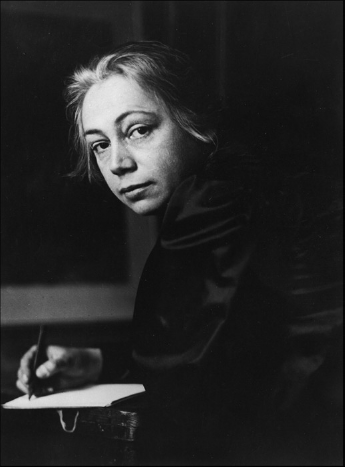
Kaethe Kollwitz, 1906.
Death and motherhood are pervasive features of her work, often blending into a bleak picture of child mortality. Kollwitz experienced a great deal of loss and grief during her life. She was the fifth of seven children. Her mother lost her first, second and seventh children as babies - the first and last died of meningitis. 3 This left an impression on Kollwitz who later suffered her own maternal loss. The death of her son, Peter, on 22 October 1914 changed her life dramatically and as a result she spent many years working on a war memorial to commemorate her son and ‘… the sacrifice of all the young volunteers’ in World War I. 4 On 22 September 1942 she lost her grandson, Peter, in World War II. 5 Consequently she resisted war, embraced idealism and invited Germany's youth to reach beyond pacifism and pursue socialism. 6, 7
Kollwitz's father was very supportive of her artistic endeavours and when she turned 14 she was sent to study in Germany, at Koenigsberg. Aged 17 she was refused admission to the Academy and was sent to the girls’ art school in Berlin. In the same period of time, she became engaged to Dr Karl Kollwitz and her father, fearing this engagement would interfere with her artistic pursuits, sent her to study in Munich. 8 Kaethe and Karl married years later and moved into their home in Berlin in 1891. She had her first son, Hans, in 1892 and her second, Peter, in 1896. 9 When her father fell ill the same year, she travelled to see him and presented him with The Revolt of the Weaver's, a collection of prints that she dedicated to him. Her father passed away almost a year later and the collection was awarded the Gold Medal from the Royal Academy at the Great Berlin Exhibit of 1898. The Medal initially was vetoed by the Emperor as her art portrayed social dissatisfaction but it was eventually reinstated in 1899 by the King of Saxony. 10 She became one of the most famous artists in Germany and in 1919 the first woman to be elected a full-time member of the Berlin Academy of Arts. 11
Among several themes in her work, Kollwitz drew, etched and sculpted the social welfare of Germany's common worker. Her work provides a glimpse into the poor living and working conditions of the time (unemployment and suffering). When Hitler came to power in 1933, the outspoken Kollwitz was forced to resign from the Academy. Her artwork was labelled ‘degenerate’, she was no longer allowed to exhibit her work, dealers could not purchase it and her work was abolished in 1936, never to be shown again publicly during her lifetime. Her husband was removed from his medical practice and he began treating his patients in secret.
In 1936 Kollwitz and Otto Nagel were interviewed by a Russian journalist and it was inferred they had discussed Hitler and the Third Reich. 12 On 13 July Gestapo officers entered her home and threatened to send her and her husband to a concentration camp unless she retracted her comments. They also demanded to know the name of the second, unnamed artist present in the interview. Kollwitz refused to name Nagel but she did write a retraction. Later she told Nagel she would never go to a concentration camp and as she affirmed her stance she revealed a ‘tiny bottle’ in her pocket. 13
In 1943 the home in which Kollwitz had lived for most of her life was bombed and, a week later, the home of her second son Hans was destroyed, leaving Kollwitz and her son's family homeless. 14 She was invited to Morintzburg Castle as a guest of the Prince of Saxony, Ernst Heinrich, where she resided until she died on 22 April 1945 at the age of 78. She was buried next to her husband in the Central Cemetery in Friedrichsfelde, Berlin. 15 She left behind a diary documenting her life at the request of her son Hans, which he assembled in The Diary and Letters of Kaethe Kollwitz. 16
Miller 17 examined Kollwitz's diary to identify traumatic childhood experiences that influenced her creativity. She believed Kollwitz's depressed drawings and woodcuttings of mothers, their children and death originated from her mother's loss of two babies. Quoting from Kollwitz's diary, Miller concluded she was suppressing desperate feelings with regard to her mother's wellbeing and this was evident in her physical and psychological symptoms:
I don't know just when I began to suffer from nocturnal frights … Nights I was tormented by frightful dreams … Then there was a horrible state I fell into when objects would begin to grow smaller. It was bad enough when they grew larger, but when they grew smaller it was horrifying.
I experienced such states of unfounded fear for many years; even when I was in Munich [in her early twenties] they occurred, but in far feebler form. I constantly had the feeling that I was in an airless room, or that I was sinking or vanishing away. 18
It has been suggested her recurrent nightmares and hallucinations were caused by feelings of powerless-ness, a fear of failure and anxieties caused by her father's expectations that she become a great artist. 19 However, her recollection mirrors a symptomatic description of Alice in Wonderland Syndrome.
Discussion
The symptoms of Alice in Wonderland Syndrome (AIWS) were first categorized by Lippman in 1952 in his description of hallucinations preceding migraine. 20 The term Alice in Wonderland Syndrome was coined from Lewis Carroll's novel by Todd in 1955 21 because the author's descriptions and drawings portray the symptoms experienced by those afflicted by the syndrome. It is suspected Carroll himself suffered from the syndrome. The most common symptoms include ‘… illusory changes in the size, distance or position of stationary objects in the subject's visual field; illusory feelings of levitation; and illusory alterations in the sense of the passage of time’. 21 Kollwitz's sensual and perceptual distortions are classic symptoms. The syndrome can distort an individual's senses, in particular vision and sense of time, touch and sound. 22 An object in the line of vision, such as a teapot, may suddenly grow or shrink in size and remain that way until the attack subsides, usually within minutes. An individual may perceive the body or body parts as being disproportionately large and, less commonly, disproportionately small even though visual or self-examination will reveal nothing abnormal. Common complaints are of disproportionately large heads or upper appendages. 23 Miller's quote reveals the artist's symptoms dwindled during her early twenties. Although it is rare and can strike at any age, it appears many will outgrow the syndrome as it is exhibited most often during childhood. 24
Alice in Wonderland Syndrome has been attributed to classic migraine, temporal lobe epilepsy, hypnotic states, drug use, hyperpyrexia, cerebral lesions and schizophrenia. 25 More recently, it has been described as a presenting symptom of infection with the Epstein–Barr virus that can cause infectious mononucleosis.26–28 There is slim (if indeed any) evidence that Kollwitz was subjected to drug intoxication during her childhood in the late 19th century; she does not describe further symptoms suggesting schizophrenia and the syndrome passes within days or months after infection by the Epstein– Barr virus. Thus, it appears Kollwitz suffered from either classic migraine or, as her parents feared, epilepsy.
There are many examples of artists and writers who, upon examination of their diaries or artwork, reveal signs of sensory distortion or trauma that may have inspired their work. For example, visualizations of migraine aura can be found in the work of many artists and patient studies of migraine art.29–32 Art therapists use patient art to identify disorders including psychological trauma since emotion sometimes can be easier to express visually. 33
Details of Kollwitz's psychological experiences can be found in her diary. 34 When she was a child, her father gave up his business to become a preacher and the family moved to Prinzenstrasse. Kollwitz recalled her nightmares:
I don't know just when I began to suffer from nocturnal frights, but it must have been around this time. These states of mine alarmed my parents; they feared epilepsy … Nights I was tormented by frightful dreams. The worst one I recall is the following: I am lying in my bed in the semi-darkness of the nursery. In the next room Mother is sitting in the chair under the hanging lamp, reading. I can only see her back through the half-open door. In one corner of the nursery lies a large coil of rope such as is used on ships. The rope begins to stretch out and unroll, silently filling the whole room. I want to call Mother and cannot. The grey cable blots out everything.
This is a common hallucination for sufferers who see objects grow and fill the room in front of them. This may not be classified as AIWS because she was asleep and sufferers have been documented experiencing visual hallucinations while they are conscious. 35 However, this suggests the hallucinatory state was not foreign to her and she went on to describe the same disturbance while conscious: ‘Then there was a horrible state I fell into when objects would begin to grow smaller. It was bad enough when they grew larger, but when they grew smaller it was horrifying’. This is a textbook description of the visual distortions experienced by AIWS sufferers.
In her next paragraph Kollwitz describes her sensations of distorted body image and the accompanying fear experienced by so many with this syndrome:
I experienced such states of unfounded fear for many years; even when I was in Munich they occurred, but in far feebler form. I constantly had the feeling that I was in an airless room, or that I was sinking or vanishing away. I cannot say whether my parents’ alarm over these states was altogether justified. In any case, they were very much concerned about me at the time. Later on I was to be more capable and energetic than my brothers and sisters.
The sensation of sinking or vanishing away is indicative of microsomatognosia which usually affects the entire body as opposed to macrosomatognosia which typically affects parts of the body, most commonly the head and upper appendages. 36 According to Miller, Kollwitz was in her twenties when she lived in Munich, so it appears she was outgrowing the syndrome. Save for a description of her twin granddaughters: ‘Joerdis’ and Jutta's faces are just the same, except that Joerdis’ looks as if seen through an elongating mirror, Jutta's through a mirror that makes everything wider' 37 and a description of her orientating herself by fingering a mask of Goethe during her final days, there is little indication she actively experienced symptoms of AIWS during adulthood.
Although known as an expressionist, Kollwitz's style has been described as a shift from naturalism to expressionism. 38 Expressionism was a 20th century aesthetic movement that expressed the artist's emotions through distorted imagery. This is contrary to naturalism where objects or people are portrayed in their real form. This expressionistic label may have had more to do with politics and less to do with art:
As the war continued, and more and more artists became disaffected, the term “expressionism” in Germany came to be used broadly to apply to any artist holding non-establishment sociopolitical views and working in a non-formalist style. Because of this broad definition, and because of her own marked inclination toward self-expressionism, Kollwitz was often mistakenly called an expressionist. In fact Kollwitz sometimes found herself opposed to expressionism as “pure studio art”. 39
She was trained as a realist but ‘Kollwitz did not classify herself as a realist. Rather as she had done with naturalism, she used some aspects of realism, finally transcending it to form her style’. 39 This style deviated from naturalism and may have been influenced by her experience with AIWS.
There is a lifelong preoccupation with hands and faces in her diary and artwork that hints at her perceptual reality. As a child she viewed her grandfather in the same way as she drew her subjects:
Whenever he entered the low, white door he seemed very tall and awesome … I do not really know whether or not he was tall; at any rate he seemed so to me: tall, thin, dressed in black up to his chin … Grandfather's hands were very beautiful; my mother's hands took after his. They were large and expressive in shape … 40
Kollwitz remembered her grandfather as very tall and awesome but was conscious he was not. She always had difficulty recreating the folds and textures of her subjects’ clothing and focused instead on their hands and faces because she felt the subjects’ attitudes, faces and hands spoke to her. 41 A cursory review of her work will reveal human subjects with disproportionately large hands and heads on bodies hidden in dark clothing. Examples abound. The stolid central figure in The Survivors resembles Kollwitz's impression of her grandfather – tall, thin, dressed in black with large, expressive hands (Figure 2). The women in Women with Bowed Head and Woman with Child in her Arms are portrayed with disproportionately large heads. Large, all encompassing hands surround the downtrodden man in Help Russia. Most figures in her work are enshrouded in dark clothing; her subjects are ominous in the dark background of The Weaver's Revolt 42 collection and starkly contrasted in her War collection 43 with the focus placed on their hands and faces.

The Survivors (Die Uberlebenden), 1923, lithograph
Kollwitz created over 100 self-portraits during her lifetime and many focused exclusively on her face (Figure 3) 44 . Her first self-portrait with her husband portrays her sitting with her ‘… very large hands close to one another, some fingers touching, over the great folds of her black, ankle length dress’. 44 She also embodied herself in many of her subjects as she ‘often gave them her own expressive features, hands and body movements’. 45
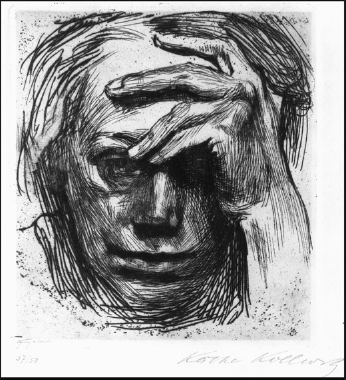
Self-portrait with Hand on Forehead (Selbstbildnis mit der Hand an der Stirn), 1910, etching
She focused on their hands throughout her lifetime. During the first years of her marriage she ‘drew numerous studies of hands’ 46 and by 1922 ‘Kollwitz’ creation of large-knuckled, muscled hands had become so dominant in her work that the image had become known as the “Kollwitz hands'” 47 which is clearly evident in Woman with Dead Child (Figure 4).

Woman with Dead Child (Frau mit totem Kind), 1903, engraving and soft-ground etching retouched with black chalk, graphite, and metallic gold paint on heavy wove paper
Deutsch psychoanalysed her creative passion from the ‘early conflicts’ described in her diary and related them to the artist's focus on hands and faces. 48 He believed she developed death fantasies from two separate events as a child where children her age had died. He also believed her abdominal pains were a manifestation of oral birth fantasies and resembled labour pains. He blamed her nightmares on ‘disguised sexual fantasies’. Deutsch examined her drawings and sculptures and concluded one's attention is drawn immediately to the subjects’ hands which communicated his or her internal dialogue. He believed her creativity was deeply affected by childhood events that provoked death wishes and rebirth fantasies. He saw her grief and feelings of revenge in the hands of her subjects.
Miller believed Kollwitz suffered from physical and psychological pains because she was suppressing her true feelings, namely her love for her mother and fear that her parents would pass away. For example, she developed abdominal pains and vomiting during her childhood: ‘These stomach aches were a surrogate for all physical and mental pains. I imagine my bilious trouble began at that time. I went around in misery for days at a time, my face yellow and often lay belly down on a chair because that made me feel better’. 49 She would snuggle close to her mother for comfort. Miller reasoned this is why Kollwitz focused so sharply on mothers, their children and shadows of death. She expressed her deep feelings for her mother through imagery because she was not allowed to express her love. However, if Kollwitz's hallucinations were caused by migraine, it raises suspicion that her abdominal pains could have been migraine equivalents. Lippman described migraine equivalents where ‘… the headache attack is replaced by a period of melancholia, paroxysmal tachycardia, or attacks of abdominal pain, etc.’ He also stated ‘there are a great number of cases in which the hallucination constitutes the entire attack. No headache follows’. 50 This suspicion cannot be resolved from her diary alone and she did require a hysterectomy later in life. 51 Either way, her physical and psychological health brings into question arguments regarding oral birth fantasies, sex fantasies and suppressed emotion.
Assuming Kollwitz suffered from AIWS, her creative style takes on a new light. Kollwitz complained of symptoms of microsomatognosia, of shrinking and vanishing away. The disproportionately large heads and hands in her work may indicate she was also affected by macrosomatognosia, most commonly affecting the head and upper appendages. If she were traumatized by this experience as a child, she may have felt it consciously or subconsciously and expressed it through her work. She may have continued to suffer from the disorder during her adulthood and kept it a secret. Many individuals afflicted with this syndrome keep it a secret for fear of being labelled insane. This is a reasonable assumption considering the disorder was not identified in the literature until 1952 and not given a name until 1955, 10 years after Kollwitz passed away. The origins of her artistic style may have had less to do with her feelings and more to do with her distorted perception.
Conclusion
Rather than conclude Kaethe Kollwitz merely used distortion to communicate her feelings, artists may wish to reconsider her artistic creations utilizing the notion that the distorted figures in her drawings, lithographs, etchings, woodcuts and sculptures may have resembled her perceptual reality. The distortion present in her drawings may have less to do with a deliberate emphasis of the artist's feelings and more to do with her perceptual experience. It has been said Kollwitz's style shifted between naturalism and expressionistic distortion. Is it possible her episodes of expressionistic creativity were in fact episodes of AIWS brought on by migraine aura or temporal lobe epilepsy?
Art critics and psychoanalysts have analysed Kollwitz's work from the perspective of childhood trauma and her view of social welfare. Scholars may wish to revisit her work under the auspices that Kollwitz suffered from this syndrome and, if not during her entire lifetime, then at least during her childhood and adolescence. This syndrome may have influenced her artistic style.
Footnotes
Acknowledgements
The author thanks his friend and mentor, Dr David Cruise Malloy, for encouraging him to travel down the rabbit-hole.