




Abstract
London in the first half of the 19th century was a centre of scientific and medical interest. For example, the Royal Society, the Linnean Society, the Geological Society, the Chemical Society and the Royal Astronomical Society were all centred on Burlington House and, not far away, in Berner's Street was the Medical and Chirurgical Society, which in 1834 became the Royal Medical and Chirurgical Society and later the Royal Society of Medicine. It was also in this period that Edward Meryon became a member of the latter society and subsequently a Council Member, Librarian and Vice-President. His research led to the clear identification for the first time of the disease Duchenne muscular dystrophy and he published his results in the Transactions of the Royal Medical and Chirurgical Society in 1852.
Evolutionary ideas of the time
Charles Darwin was the grandson of Erasmus Darwin (1731–1802), an acknowledged philosopher and scientist in his time, and who in fact made a special study in the late 18th century of the evolution of the nervous system. 1
Subsequently there was growing interest in the origins of life as revealed by studies of natural history. For example Vestiges of the Natural History of Creation was published anonymously in November 1844 and led to a great deal of debate and controversy because of its ideas on the origins of life, man and the universe. 2 It was very popular; the English edition was read by Benjamin Disraeli and the American edition by Abraham Lincoln. To Charles Darwin, however, this volume had important omissions and seemed hardly credible. 3 Furthermore Darwin was concerned it might have compromised his own ideas because in the spring of the same year he had written a draft of On the Origin of Species by Natural Selection. The definitive work was not published until much later in 1859. 4 There was virtually no mention of human origins in Darwin's work, probably because this might well have focused a debate on this particular item and away from his general concept of the origin of species. Also the possible application of his ideas to human social problems may have been of serious concern to him. 5 At this time essentially he was interested in natural history.
Edward Meryon and Charles Darwin
It was also around this time that Edward Meryon
6
(Figures 1 and 2) became a member of the Medical and Chirurgical Society, and, subsequently, a Council Member, Librarian and Vice-President.
7
His research led to the clear identification for the first time of the disease Duchenne muscular dystrophy
8
and he published his results in the Transactions of the Royal Medical and Chirurgical Society in 1852.
9
Dr Meryon (1850) by John Linnell. Oil on canvas (private collection) Plaque on the site of Edward Meryon's former home at 13 Clarges Street, Piccadilly, London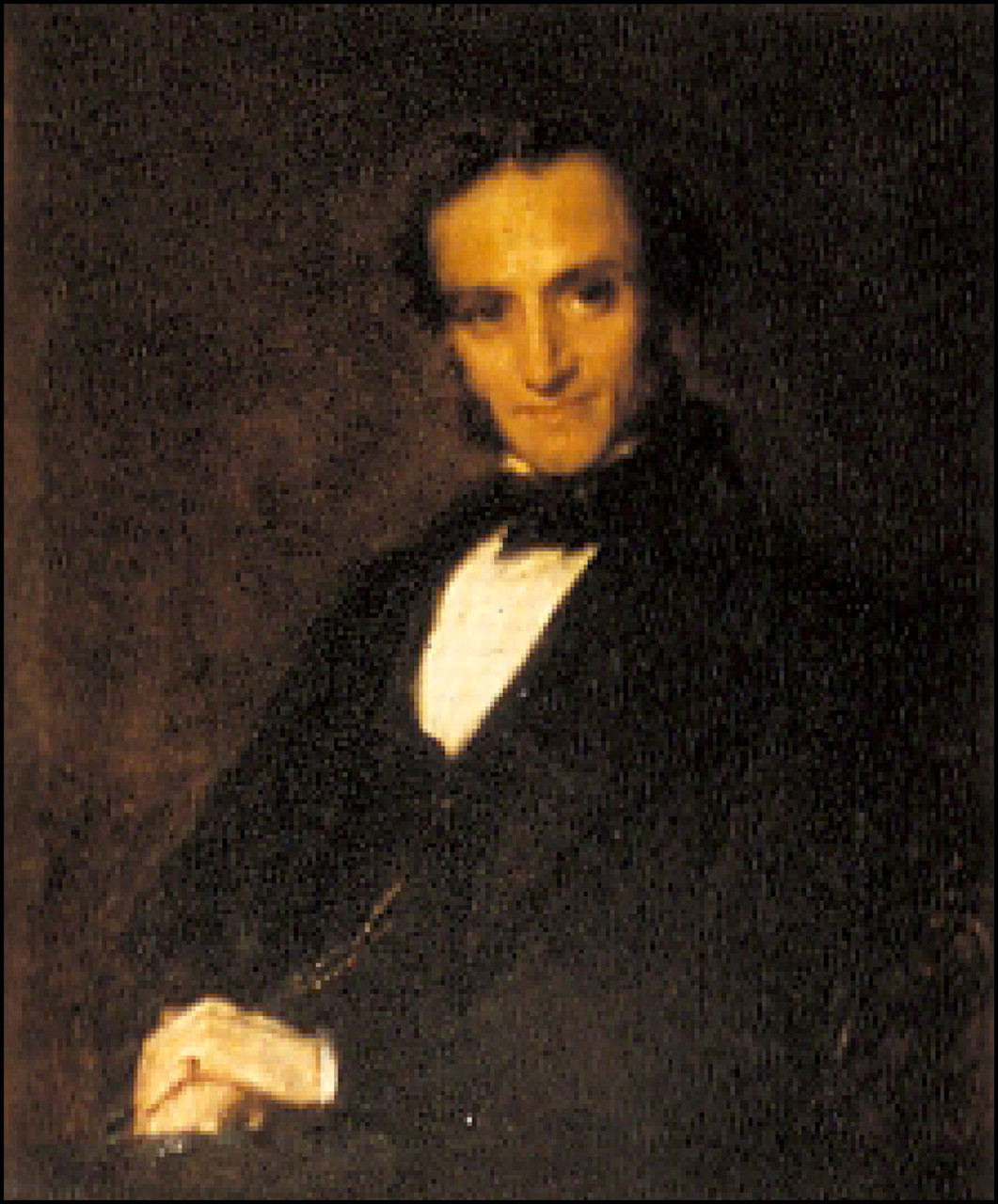

Meryon clearly met and knew Darwin because they both belonged to the Geological Society (where Meryon supported a proposal by Darwin for George Maw [1832–1912] to become a member in 1863), the Ethnological Society, the Royal Medical and Chirurgical Society, and the Athenaeum. Interestingly Meryon became a member of the Ethnological Society in 1845 because of his interests in human races and, following the publication of his On the Origin of Species, Darwin was made an Honorary Member of this Society in 1861.
Furthermore in 1868 it was Meryon, as a Member of Council, who proposed Darwin for Honorary Fellowship of the Royal Medical and Chirurgical Society (Figure 3). On the same day Thomas Huxley (1825–95) and Joseph Hooker (1817–1911) were also proposed for fellowship. Meryon and Darwin were also related through the same family: Darwin married a Wedgwood and Meryon's grandson also married a Wedgwood.
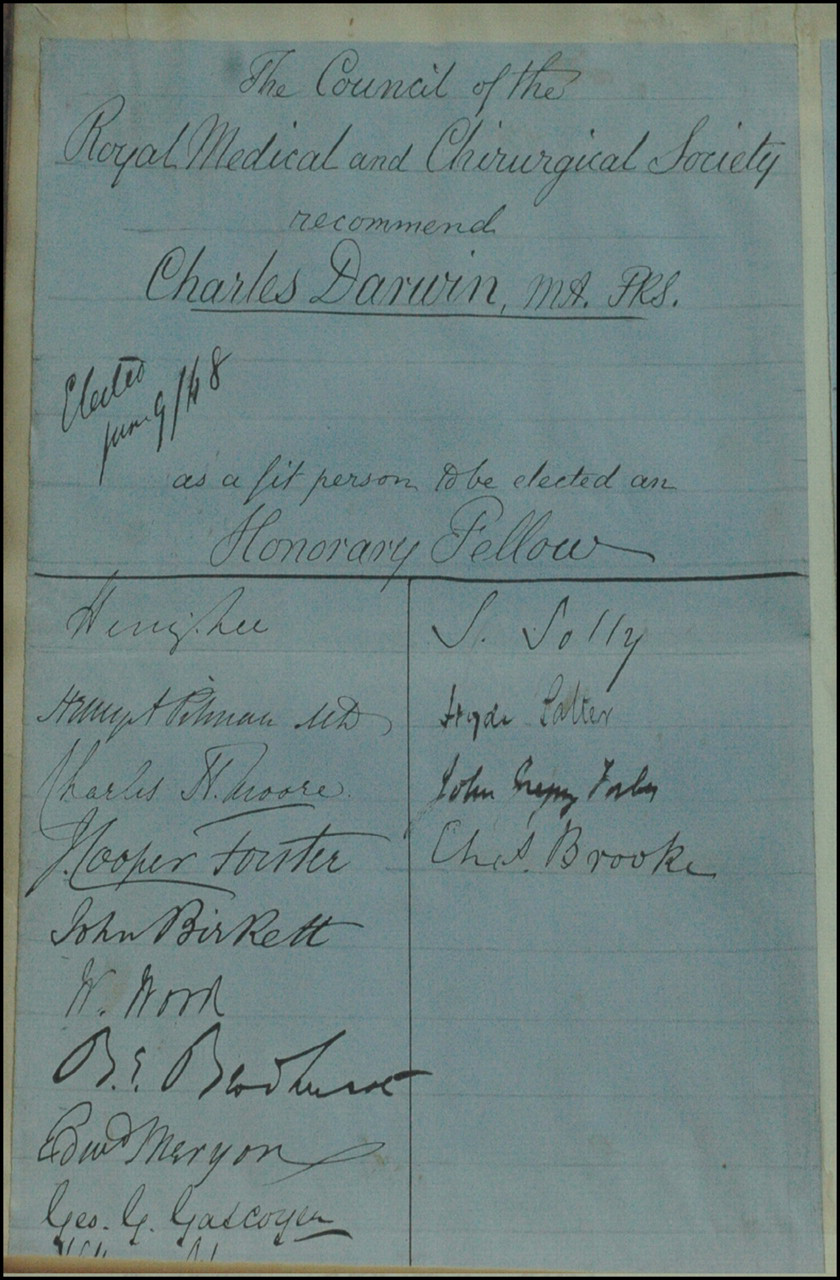
Signatories of the proposal, including Edward Meryon, for Charles Darwin to become an Honorary Fellow of the Royal Medical and Chirurgical Society (1868), reproduced courtesy of the Royal Society of Medicine
Edward Meryon's contribution
In 1836 Edward Meryon published his book The Physical and Intellectual Constitution of Man Considered. 10 It is a slim volume of only 240 pages in six chapters. However, there are many topics that would no doubt have been of interest to Darwin. Darwin was a voracious reader and very likely studied Meryon's book. According to Darwin's son, his father ‘… was methodical in his manner of reading all books and pamphlets bearing on his own work’. 11
The first chapter of Meryon's book concerns geology and the fossil evidence of the succession of life forms from the simplest to the most complex and that Man appeared relatively recently.
In the second chapter Meryon considers the animal world and in particular their various adaptations to the environment. But though some of his views resemble those of Darwin, he offers no explanation for how such adaptations may have arisen. But he is very clear, like Darwin, that the inheritance of acquired characteristics was totally unsupportable.
In chapter three he considers the varieties or races of the human species. He believed strongly, as many at the time may not have, that these all had a single origin and that any differences could be explained by differences in diet and adaptations to climate. His ideas on these adaptations are developed in detail in the three remaining chapters.
It is clear throughout the book that Meryon was very well-read not only in comparative anatomy, in which he was later to become the Lecturer at St Thomas' Hospital Medical School, but also in natural history. He makes reference to no fewer than 80 sources ranging from the Greek classical period (Theophrastus, Aristotle) to contemporary material including Lyell's Principles of Geology of 1830–33, 12 which was also an important influence in Darwin's work. Meryon even refers to statistical data (on mortality rates).
It is clear on reading Meryon's book that he was very much attracted to the idea of the diversity of animal species and how this may have occurred through adaptations to the environment. He did not, however, consider the mechanism through natural selection, which Darwin had clearly developed by 1844.
Meryon was particularly interested in the races of man, a subject Darwin avoided until later when he became aware ‘… that many naturalists fully accepted the doctrine of the evolution of species it seemed to me advisable … to publish a special treatise on the origin of man’. 13 The Descent of Man was published in 1871, following which he was awarded the Baly Medal of the Royal College of Physicians in 1879. In a revised 2nd edition published in 1883, 14 Darwin refers to the many contemporary theories concerning the origin of human races but he believed, as Meryon had, that all shared a single common origin.
Conclusion
Charles Darwin's evidence and ideas of plant and animal variation resulting from natural selection were formed clearly by 1844. This was just eight years after Edward Meryon, a contemporary, had published his own book concerning variations in animal and human populations. The two men clearly had much in common both in their scholarly interests and in their shared membership of the same professional organizations at that time. However, Meryon was unable to explain how familial muscular dystrophy was transmitted and Darwin was unable to explain how natural selection was possible. These ideas would have to await the emergence of Mendelian genetics in 1900.
Footnotes
Acknowledgements
We would like to thank Mr Robert Greenwood and Ms Mira Gogova of the Library at The Royal Society of Medicine, and Mrs Rosemary Clarkson of Cambridge University Library for much helpful advice. Also the Devon & Exeter Institution for providing much useful background information.