




Abstract

Although Louis Jurine 1 spent almost all his life in Geneva, his parents were from Lyon, which meant that although classed as a ‘native’ he did not have full civic rights. Having finished school he was admitted in 1767 to the Académie des Beaux Arts where he spent two years, intending to take up a literary career. However, his parents had different ideas and apprenticed him to a surgeon. Thus in 1773 he was accepted as Maître en Chirurgie, an imposing title that carried little in the way of prestige since surgeons were regarded as tradesmen rather than true professionals. Good fortune then came Louis' way as he married the daughter of Pierre Bonnet, a prominent local citizen. Mlle Bonnet brought with her a large dowry, which enabled the young couple to travel to Paris where he studied for two years and came back with the Degree of Docteur en Chirurgie; this greatly increased his professional status (Figure 1).
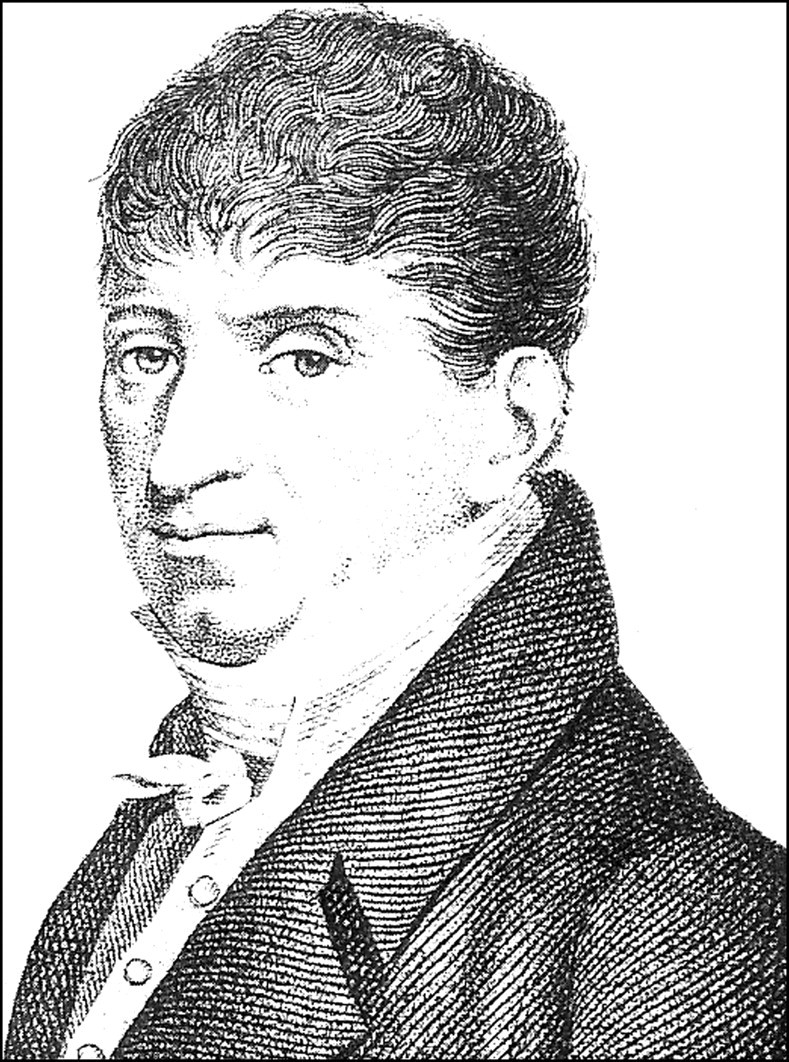
Louis Jurine
There was at that time a shortage of surgeons in Geneva so that in spite of not being a citizen he was appointed as one of the three chiefs at the General Hospital and was able to open his own barber-surgeons' shop in the Rue de la Poissonnerie. The shop did well and Jurine was able to delegate much of the work and pursue his developing interest in natural history. His reputation in the surrounding district grew and he was frequently called in for difficult private cases as far away as Basel or Berne. Among his famous patients were Madame de Stael (1766–1817) and members of the Napoleonic Royal Family.
Given the primitive surgery of the time, without antisepsis or anaesthetics and involving gruesome and painful procedures which even in the best hands frequently ended in mutilation or death, it is understandable that a kindly disposed young man should turn to the world of nature. At first Louis spent the day in surgery and the evenings and nights in the accumulation of his collection of plants, birds, insects and minerals from the area around the Lake of Geneva but eventually, having accumulated a considerable fortune, he was able to abandon surgery altogether. His status as a naturalist was greatly enhanced by the award of two gold medals from Paris – one on ‘eudiometry’ (the study of natural gases) and the other on artificial milk.
The normally staid and placid town of Geneva was shaken by the Revolution of 1789 when the city was briefly annexed by France. Politics became polarized and Jurine seems to have been inclined to the revolutionary cause and was expected, as a prominent citizen, to take part in local committees and councils. However, he disliked political struggle and refused most of the positions offered him apart from membership of the National Assembly. In 1793 he was awarded 800 louis to establish and equip a school of anatomy but managed to divert the sum to charitable causes.
Over the next 10 years Jurine produced a definitive study of insect wings, beautifully illustrated by his daughter Christine, followed by a monograph on the comparative anatomy of water fleas, of which he discovered several new species. He produced a complete classification of the minerals found in the Alps around Geneva, and classified and illustrated every variety of fish. A devout Christian, he saw natural diversity as firm evidence of a guiding spirit – ubi materia – ibi mens! His immense collection of specimens was examined by many noblemen as part of the World Tour. Inevitably he came into conflict with the other famous naturalists of the day, including the redoubtable Baron Cuvier (1769–1832).
Jurine and Cuvier had a common interest in the navigational abilities of bats. How could this tiny creature catch flies from the air in a dark room, never touching a single object? Some authorities held that the bat had exceptionally acute sight, others that it was a function of hearing and others were of the opinion that the bat had a ‘sixth sense’ not shared by any other species. In attempts to resolve this mystery, Cuvier blinded several bats while Jurine blocked their ears with wax. Each accused the other of unwarranted cruelty, although Jurine conceded that a degree of cruelty was justified if it advanced knowledge. He drew the line, however, at Baron Cuvier's removing the larynx from a living goose in order to investigate its respiration. In fact the bat's secret was not revealed for another 150 years when, following the discovery of radar, it was realized that bats had been using this system of echolocation for millennia.
Jurine maintained his interest in mineralogy and in particular in the origin of mountains. The view at the time was that irregularities of the Earth's surface had been produced by varying degrees of precipitation from the sea that at one time had covered the entire planet but since receded. From his studies of Mont Blanc and surrounding alpine chains, from 1797 to 1804, Jurine and his associates demonstrated that, far from lying in horizontal layers, the different rocks and minerals were arranged in a vertical fashion that could only have been the result of events beneath the Earth's surface such as volcanoes and tectonic slips. They postulated a huge subterranean ‘oven’ fuelled by an unknown gas.
Eventually, Jurine began to record pains in his chest, extending up into his neck and down his left arm, accentuated by effort or exercise. It was one of the first subjective descriptions of angina pectoris, from which he perished peacefully in the town of his birth on 17 September 1819. The convulsions of the Napoleonic Wars had entirely passed him by.