




Abstract

To relieve strangulated inguinal ruptures Astley Cooper (1768–1841) illustrated a special bistoury to divide the constriction ring, having a much reduced blade and amplified blunt tip. 1 His bistoury is better depicted in a later instrument catalogue (Figure 1) and is described in his Lectures, edited by Tyrrel in 1827:
Cooper's folding hernia bistoury (herniotome) (reproduced courtesy of Arnold's catalogue, 1876)
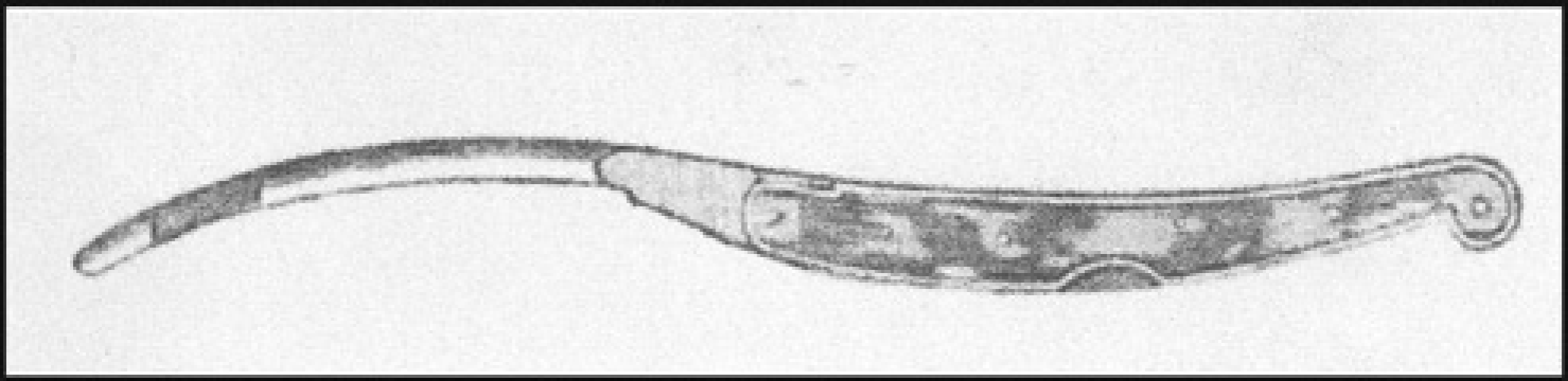
The knife best adapted for dividing the stricture is blunt at its extremity for about quarter of an inch, sharp for half an inch, and then again blunt, only cutting so far as is necessary to divide the stricture … 2
Earlier herniotomes for this purpose are described in 1756 by Percival Pott as ‘a narrow-bladed, curved knife, with a bold probe point’ 3 and figured in 1798 with a short straight blade and a tiny blunt tip, ascribed to AG Richter. 4 No early illustration of Pott's herniotome is known and subsequent confusion between Pott's and Cooper's instrument is evident in catalogues; a probable Pott's herniotome is illustrated (Figure 2). Responding to thermal sterilization in the later 19th century, Cooper's herniotome acquired a straight metal handle (Figure 2).
Probable Pott's herniotome, with ebony handle, late 18th century (private collection); Cooper's all-steel herniotome, after 1895 (private collection)

Sir Astley Cooper FRS, Sergeant-Surgeon to three monarchs, twice President of the Royal College of Surgeons of England and Surgeon to Guy's Hospital, was born in Brooke, Norfolk. Said to be no scholar, he was apprenticed in 1784 briefly to an uncle, William Cooper, surgeon at Guy's Hospital, before becoming a pupil of the talented Henry Cline, surgeon to the adjacent St Thomas’ Hospital. Attending John Hunter's lectures, he was enthused to pursue anatomical studies with great zeal; indeed he dissected before breakfast almost every day of his career. Appointed lecturer in surgery in 1791, he proved an extremely popular teacher with students. His detailed knowledge, caring personality and fine physical presence enhanced his reputation and he succeeded his uncle as surgeon to Guy's in 1800. Despite a prodigious practice, he published several important monographs, all beautifully illustrated on hernias, joint dislocations and fractures, the breast, the testis and thymus, most having American and foreign language editions. In addition he pioneered the ligation of major arteries for aneurysm, performed amputation through the hip joint and published many papers. He retired from Guy's in 1825 to continue writing and research at the Royal Society and the College of Surgeons. 5
As with many named instruments, several individuals contributed towards a final form. However, it is clear that Cooper was the first to illustrate this specialized herniotome, still advertised for sale in 1983. Its gradual demise is probably due to the introduction of muscle relaxation anaesthesia, enabling standard scalpel blades to be applied safely.