




Abstract
Summary
Krebs was born in Hildesheim (North Germany) and graduated (MD) from the University of Munich in 1923. He was assistant to Otto Warburg (1926–30) who taught tissue slicing and manometry which Krebs used to complete his three great works: The Detoxification of Ammonia (Freiburg im Breisgau 1933), The Degradation of Foods to provide Energy for Life (Sheffield 1937) and Gluconeogenesis (Oxford 1963). He was elected Fellow of the Royal Society of London (FRS) in 1947, Nobel Laureate in 1953 and KBE in 1958.
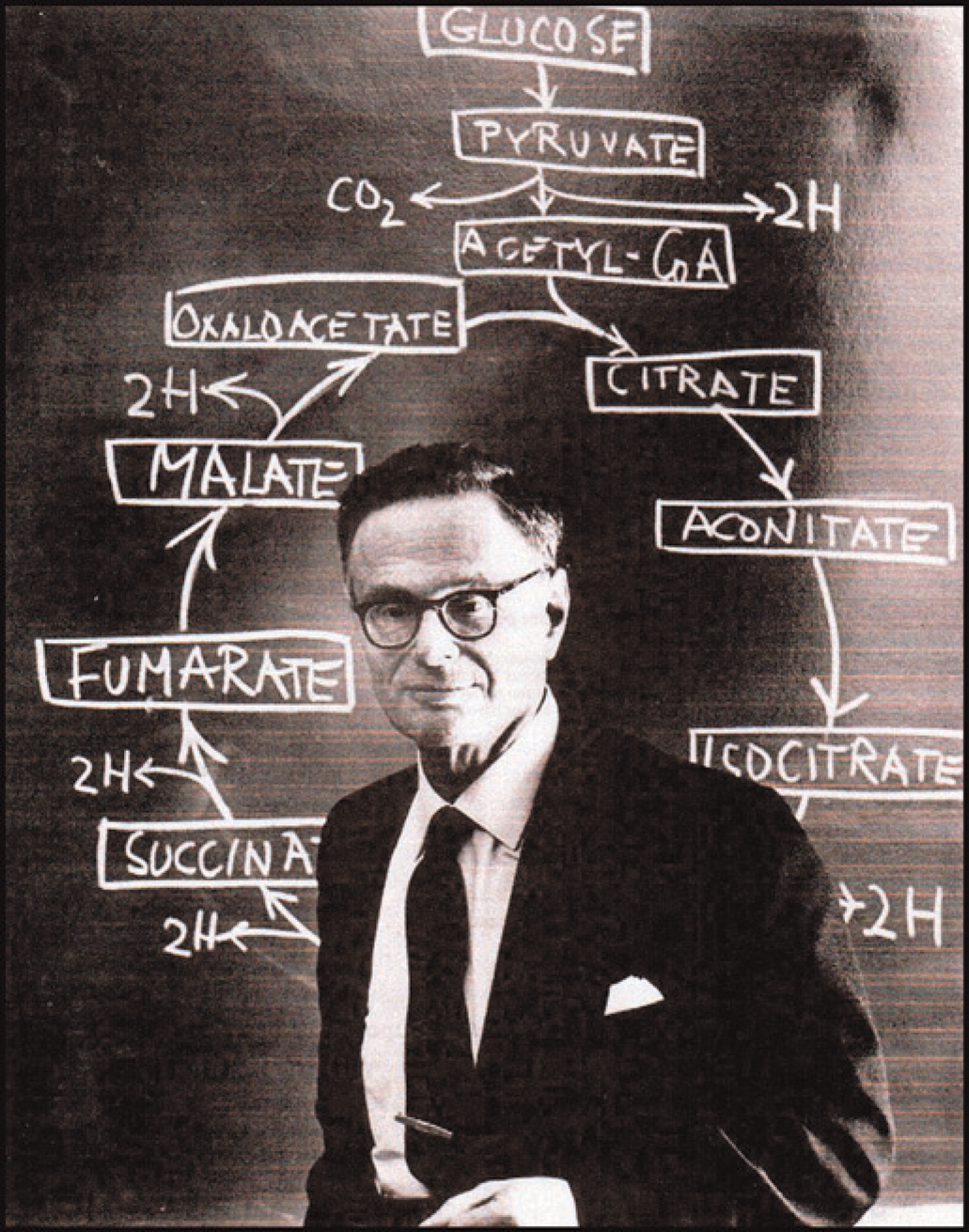
Hans Adolf Krebs (Figure 1) was born on 25 August 1900 in Hildesheim (North Germany), a town he loved and which he described as uniquely beautiful. To counter any accusation that this view might be simply parochial, Krebs quoted a French visitor, del Monte, who in 1883 stated ‘Hildesheim is like a dream, a tableau such as not to be seen except in Venice or Nuremberg. It is a triumph of colour, a triumph lacking in Paris where the sandstone cries out for something to enliven it’. 1
Sir Hans Krebs in his lecture room – on the blackboard is his metabolic cycle (reproduced courtesy of Kreb's Archives at the University of Sheffield)
Krebs enjoyed walking in the streets and squares, admiring the architecture and exploring the surrounding countryside which was equally beautiful. Sadly the town was totally destroyed by the allies on 22 March 1945, two days before the crossing of the Rhine. 1
Krebs was brought up in the strict Spartan tradition of middle-class Germans. The emphasis was on thrift, saving for education and retirement. Excellence of character was fostered by self-denial. Punctuality, responsibility and reliability were second nature. Krebs’ father, Georg, was a cultured, highly respected and successful ENT surgeon. Georg and his wife Alma gave their three children, Elisabeth, Hans and Wolfgang a love of learning and of the countryside. They were taught to recognize the local flora which were given their German, Latin and English names. 1
Although both parents were nominally Jewish, Judaism was barely mentioned in the home. They thought of themselves as patriotic Germans. Krebs went to Lutheran schools and although he did not receive a science education at school he was taught Latin which later greatly facilitated his learning of English and characterized the lucid style in his publications. At 14 years he decided he would become a doctor, following in his father's footsteps, having learned from Homer's Iliad that ‘a doctor is not one life but the lives of many’. 2
Medical education
In 1918 students about to be conscripted had their schooling rushed to matriculation. This included Krebs who, having matriculated in September 1918, joined the Signals Regiment in Hanover. Two months later he returned home and was honourably discharged, leaving him free to fulfil his wish to study medicine. He registered at Gottingen University because it was close to home and so avoided the chaotic transport situation in postwar Germany but after only one semester he transferred to the more academically excellent school at Freiburg im Breisgau. It was common for students to transfer between universities in Germany. 1
In Freiburg, Mollendorf taught embryology and in these classes Krebs completed his first research project ‘The use of aniline dyes to reveal tissue structure’ which was published in 1923. Franz Knoop taught physiology and he introduced his students to the concept of intermediary metabolism. Lavoisier had already shown that one molecule of glucose required six molecules of oxygen to produce carbon dioxide and water (C6 H12 O6 + 6O2 → 6 CO2 + 6 H2O) but the principles of chemistry teach us that a reaction can only take place between two individual molecules: there must be stages between and those stages are intermediary metabolism. Ludwig Aschoff taught Krebs pathology. Aschoff is remembered for his descriptions of rheumatic nodules and phagocytosis.
In 1921 Krebs transferred to Munich for his clinical studies. Among his teachers in Munich were Friedrich von Muller, Professor of Medicine; Ferdinand Sauerbruch, Professor of Surgery; and Emil Kraeplin, Psychiatrist. Krebs graduated with honours in December 1923. Despite the massive devaluation of the German mark between July 1920 and November 1923, the thrift practised by Georg enabled Krebs to obtain his degree and his licence to practise.
Obtaining a licence
Krebs obtained his licence after working for one year in an unpaid post in Professor Alfred Goldscheider's clinic in Berlin. Goldscheider had discovered that the sensations of heat, cold, touch and pain were felt at different points on the skin. He was a gifted clinician, a good teacher and encouraged his juniors to engage in research. Krebs had noticed that while Salvarsan was an effective treatment of primary and secondary lues, it was ineffective in neurosyphilis. This was thought to be due to the inability of Salvarsan to pass the blood–brain barrier. Krebs decided to investigate the distribution of substances between the blood, tissues and cerebrospinal fluid, assuming that physical and chemical factors had a role.
Krebs discovered, by injecting synthetic dyes, that only anionic dyes reached the cerebrospinal fluid and cationic dyes did not. As a consequence he decided to increase his knowledge of physics and chemistry, believing this would greatly improve his clinical ability. Krebs had learned that Professor Peter Rona at La Charité Hospital in Berlin ran courses in these subjects for medical graduates. Krebs joined the course that began in January 1925.
In Goldscheider's clinic Krebs witnessed an upsetting academic intrigue. His immediate chief was Anneliese Wittgenstein who was promoted as university teacher in preference to Bruno Mendel. Wittgenstein had submitted a thesis based on work that Krebs had done in her department and which she did not fully understand. Mendel, however, had already published major papers. Albert Einstein heard of this and wrote to Goldscheider pointing out the error of judgement. Goldscheider's lame response allowed Einstein to reply ‘Dixi et animam meam’ (‘I have spoken and saved my soul’). 2
Working with Otto Warburg
Krebs began work as a research assistant in Warburg's laboratory in the Kaiser Wilhelm Institute in January 1926; he was recommended by Bruno Mendel who also raised some money to help Warburg pay Krebs’ salary. Also working at the institute in other divisions were Meyerof, already a Nobel Laureate, Lohman who later discovered adenosine triphosphate, Lipmann who later shared the Nobel Prize with Krebs, Blaschco who became a FMRS, and Ochoa and Theorell who both became Nobel Laureates. They would meet for a sandwich lunch and Krebs found the conversations very stimulating. The association with Warburg, more than any other, influenced Krebs’ life and his attitude to colleagues and students. Krebs learned tissue slicing (which preserved the mitochondria and prolonged the life of the tissue). The slices contained 10–20 layers of intact cells, permitting diffusion of gases and nutriment from the ambient fluid. He was also taught manometry. Krebs frequently acknowledged the immense debt he owed Warburg; years later he wrote a biography of Warburg and presented him for an honorary degree at Oxford, which Warburg valued highly.
In 1929 Warburg persuaded the German Physiological Society to make a grant so that Krebs could attend their International Congress in Boston, USA. He also arranged for Krebs to give a three-week course in manometry at Harvard and to visit Professor Detlev Bronk in Philadelphia. During his visit to the USA Krebs received numerous offers of posts but he returned to Germany.
Warburg then began to hint that he did not wish to retain senior scientists and in March 1930 he gave Krebs formal notice to leave. There were those who knowing that Warburg gave Krebs lukewarm references to find another position, believed that Warburg had a very poor opinion of Krebs’ abilities. It seems likely, however, that Warburg's efforts to arrange Krebs’ visit to Boston, Harvard and Philadelphia demonstrate that he had a very high opinion of Krebs’ ability and was urging Krebs to escape the growing anti-Semitic attitude to the employment of Jews in German universities and university hospitals.
Towards the end of his time with Warburg, Krebs could not decide whether his career should be in research or clinical medicine. He consulted Warburg who said that as a biochemist seeking a mortgage he would not be regarded as a professional but as a clinician he would be so regarded and would get his mortgage. 1
Clinical appointments and research: the ornithine cycle
Despite Warburg's lukewarm references, Krebs was appointed assistant to Professor Lichtwitz at the Municipal Hospital in Altona in April 1930. He had charge of 40 beds with some time and space for research. Warburg had given him apparatus and chemicals but specified they had to be used for projects set by Warburg (which is evidence of Warburg's interest in Krebs).
In Altona Krebs missed the university environment and when Thannhauser offered him a post in Freiburg he left to begin work in Freiburg in April 1931. Krebs still had onerous clinical responsibilities but he was free to pursue his own research. He decided to study the synthesis of urea by the liver, using liver slices in a modification of Ringer's solution. To optimize tissue survival, the ambient fluid had to approximate to plasma.
Krebs added carbon dioxide, magnesium, sulphate, phosphate and bicarbonate in physiological concentrations. Glucose was added to provide energy. It was this Krebs–Ringer solution that was responsible for the very many citations of the ornithine cycle rather than the cycle itself. Liver slices suspended in this medium did produce urea, thus detoxifying ammonia by the reaction CO2 + 2NH3 → CO(NH2)2 + H2O. The urea was measured by adding urease from ground-up jack beans which catalysed the reaction from right to left. The ammonia is neutralized when the solution is buffered to pH5 and the amount of CO2 as a gas is measured manometrically and equates to the amount of urea. Krebs found that the amount of urea formed increased when ammonia and various amino acids were added and, when the amino acid ornithine was added, the amount of urea synthesized was the greatest. In fact one molecule of ornithine resulted in the production of more than 20 molecules of urea and the ornithine did not disappear; hence it must be acting as a catalyst. It was known that arginine produced urea by the action of arginase; hence Krebs reasoned that the ornithine must be converted to arginine which then produces urea. At that point the intermediary between ornithine and arginine was unknown. Krebs, using what he called ‘paper chemistry’, decided that it must be citrulline. He obtained citrulline that had been produced from melons and demonstrated it was the intermediary. This closed the cycle, the very first metabolic cycle. 1
At the time of Krebs’ death in 1981, more than a hundred such cycles had been discovered. The work received international acclaim and Krebs had numerous invitations to lecture in other German centres. Sir Frederick Gowland Hopkins, Cambridge Professor of Biochemistry and President of the Royal Society, described it in his address to that Society as ‘work brilliantly carried out by Krebs of Freiburg’. Its clinical importance was demonstrated later when it was shown to explain five inborn errors of metabolism. 2
Hitler and the Nazis
In 1920 Hitler formed the National Socialist Party and thereafter anti-Semitism became extremely vicious. The Jews reacted in various ways. The Zionists advocated a return to the Promised Land. Others publicly demonstrated against Hitler, a dangerous reaction. Most believed that assimilation into the mainstream of German life would make them invisible and immune. This was the view of Krebs’ father who, in that year, 1920, encouraged each of his three children to make a formal attestation that they had abandoned the Jewish faith. This they did. On 30 January 1933 Hitler was elected Chancellor and within days Nazi uniforms appeared everywhere. Krebs found that many of his colleagues had been members of the party for years. In the media strong anti-Semitic feelings were aroused. A law was passed prohibiting Jews from teaching in German universities and practising in university hospitals. The Dean, who only a few weeks earlier had recommended Krebs for promotion, placed him on leave of absence, followed quickly by a formal dismissal. All Jews, irrespective of their religious practice, were dismissed; hence the public declaration made by Krebs was useless and the policy of assimilation could not provide protection. 1
Cambridge 1933–35
The plight of academic German Jews aroused international concern. In England an Academic Assistance Council was formed in May 1933, dedicated to helping scholars find suitable posts in the UK. Sir Frederick Gowland Hopkins had, as early as April, written to Krebs offering him a position in Cambridge, provided finance was available. In the event the Rockefeller Foundation promised funds and on 19 June Krebs left Freiburg by train for Strasburg. He took 16 wooden boxes and some suitcases containing 24 manometers. He had German banknotes worth about £20 hidden in the pages of a book.
He arrived in Cambridge on 24 June and was offered a position in the department. He received much help from colleagues to improve his English, beginning with nursery rhymes and progressing to Lewis Carroll, Oscar Wilde and George Bernard Shaw. Early in 1934 he felt able to publish his first paper in English; in that year he replied to the toast for visitors at the William Dunn Annual Lecture and the following year he gave the toast to the visitors. While in Cambridge, Chaim Weizmann, later to become Israel's first President, urged Krebs to emigrate to Palestine. Krebs visited Palestine but returned to Cambridge; he wrote that the Cambridge laboratory contained people of differing persuasions and abilities, yet they could argue without quarrelling, quarrel without suspecting, suspect without abusing and praise without flattering.
In May 1935 Krebs met Edward Wayne at a British Pharmacological Society meeting. Wayne was Professor of Pharmacology in Sheffield and he offered Krebs the post of lecturer in his department. Wayne had already spoken with Hopkins and learned that in Hopkins’ opinion ‘it would be difficult to say too much in praise of Krebs’. Believing that a similar post would not arise in Cambridge and impressed with the research possibilities in Sheffield, Krebs moved there in October 1935. 3
Sheffield 1935–54: the citric acid cycle
Krebs had two of the five rooms in the department and shared equally with Wayne the faculty's budget of £200 per annum. Ironically, within the year Hopkins did offer Krebs a similar position in Cambridge, which caused Krebs much heart searching. Hopkins was very pressing: he offered more money and the title of Lecturer and Director of Research. Wayne then increased Krebs’ salary. The result was that Krebs decided to stay in Sheffield, believing that to leave so soon after all the effort the university had made would reflect badly on German Jews. It was a difficult decision that he never regretted. The Cambridge versus Sheffield ‘tug of war’ is an example of the numerous head-huntings that Krebs experienced.
In 1936, with a grant from the MRC, Krebs appointed William Johnson (an honours chemistry graduate) as his research student. The citric acid cycle was published in 1937 under the names Krebs and Johnson. The paper was offered to the journal Nature but was rejected for lack of space; it was then published in Enzymologia. The rejection hurt Krebs and he referred to it frequently, saying that it was the first time in his career, having published more than 50 papers, that he had had a rejection. In 1953 after his Nobel Prize award, Nature asked him to review a paper. He reminded them of the rejection and he received an apology. The truth is that Nature rejected only a letter outlining the research. One wonders whether their response would have been different had he submitted the whole paper.
In 1938 Krebs was appointed Lecturer in Biochemistry and in that year he married Margaret Cicely Fieldhouse. It was Margaret who allayed the feelings of inferiority that children of the famous sometimes develop. She told their children that in many areas of human activity their father did and said many stupid things.
It is not possible to overestimate the importance of the citric acid cycle. It defines the chemical changes that carbohydrates, proteins and fats undergo when burned (oxidized) to provide the energy for every activity associated with life. Without energy life cannot exist; it is needed for movement, growth, secretion and the synthesis of cellular material. The cycle is common to all forms of life, including plants and microorganisms that use it to provide energy. It also demonstrates that carbon dioxide can be incorporated into tissues and is not just a waste product. The end result of the combustion of food is the production of adenosine triphosphate, which is the carrier of energy. London, a Russian biochemist, and Earl Evans disputed that citrate was the intermediary. They believed that aconite was the tricarboxylic acid to arise from oxaloacetate and pyruvate.
As a result of these studies, Krebs widened the title to ‘The Tricarboxilic Acid Cycle’. It is still known more popularly as the Krebs cycle. Later, radioactive carbon demonstrated that citrate indeed is the intermediary. 3
The war years, 1939–45
The British and the French declared war on Germany on 3 September 1939. Three days later Krebs became a British subject. The Sorby Research Institute in Sheffield housed 20 conscientious objectors who had voluntarily agreed to be subjected to disease, discomfort and the dangers of an unhealthy diet in order to advance medical science and benefit humanity. These aims had to be stressed repeatedly as the volunteers would not do anything to further the war effort. Krebs committed a serious faux pas when he explained the work to be done on high extraction flour, its digestibility and its calcium content. He admitted that if the work was successful it would save shipping space and the volunteers interpreted this as indicating more space for arms. Fortunately, matters were soon resolved. Much of the wheat, which was our staple diet, was imported under armed escort.
Krebs was able to demonstrate that high extraction flour (85% wheatmeal) was as digestible as the normal 75% extraction flour (white flour); its nitrogen content was absorbed but the phytic acid in the high extract combined with the calcium, thus preventing its absorption. Calcium salts were added. Shipping space was saved! Deprivation of vitamins A and C and prolonged thirst were also studied. This required much organization as all the intake and excreta had to be weighed and analysed and the volunteers were not kept in prison. Many of the experiments had to be conducted over long periods. It took a year to deplete the body of vitamin A and a diet of only one milligram per day of vitamin C produced scurvy in six months. The minimum daily intake of vitamin C was set at 30 mg.
The mode of transmission of scurvy was also studied. In 1944 a thoracic surgeon whose oesophagectomy patients died three days postoperatively consulted Krebs who found that the patients were dehydrated and hypokalaemic. The need to monitor fluid and mineral levels was established. Despite these endeavours on behalf of the war effort, routine laboratory work continued and in all some 40 papers were published between 1939 and 1945.
In 1945 the Medical Research Council (MRC) established a research unit in Sheffield with Krebs as director. Unfortunately the stationery was headed ‘THE UNFIT FOR RESEARCH IN CELL METABOLISM’; one of the volunteers commented ‘I note with much satisfaction that you describe yourself as unfit for research’. Krebs was promoted to professor and a chair of biochemistry created. An old cinema, The Scala, was converted into his department and funds were made available to recruit staff. At this time Harvard tried to tempt Krebs to emigrate but he stayed in Sheffield. Krebs was elected a Fellow of the Royal Society in 1947. 2
Nobel Laureate in 1953
The two years preceding the award of Krebs’ Nobel Prize were a comedy of errors. Krebs met Professor Hammarsten at a Ciba conference in March 1951 and learned that Hammarsten was a member of the Nobel Prize Committee; Hammarsten told Krebs that he was reading over and over his publications. Krebs was embarrassed and in trying to steer the conversation to other matters said that he had never visited Sweden. Hammarsten replied that he would try and arrange it but it was not in his hands alone. More embarrassment! The following year, at another Ciba conference, Gerty Cori, a Nobel Laureate, whispered to Krebs ‘I hope you get the Prize this year’. In October 1952 Krebs received a telephone call from a Swedish journalist asking for an interview, saying he knew Krebs was to receive the Prize. Krebs wanted to wait for the official notice but the journalist insisted his information was never incorrect. Krebs was reassured and agreed to be interviewed. The announcement was due on 23 October and on that day reporters arrived at his home and at the university. The laboratory was seething with rumour. Many newspaper editors rang offering congratulations and some newspapers even printed that he had won the Prize. At 11 pm the Daily Telegraph rang and apologized. Waksman got the award, Krebs was runner-up. Krebs received many letters of congratulation, causing him much discomfort. His team gave him a dinner for being the runner-up.
The following year there was the familiar round of telephone calls and visits from reporters and photographers. On 20 October 1953 the news that Lipmann and Krebs had shared the prize was reported widely. On 22 October the official announcement was made and at 9.30 pm Krebs received telegrams from the Caroline Institute and the Swedish Ambassador in London. He and Lipmann shared $33,840. Paul, Krebs’ elder son, was greeted at school by a friend who said ‘I see your dad has won the pools’. The Krebs family arrived in Stockholm on 7 December and there was much press interest. Krebs was asked how he intended spending the money and he said ‘buy a good fountain pen’. Paul was asked about his favourite pastime to which he replied ‘football’. The following day Krebs and his wife each received a Mont Blanc pen and Paul received a football.
At the ceremony on 10 December the Laureates received a citation, a medal and an illuminated document recording the award which was individually designed. Krebs’ document had a watercolour of a lemon tree bearing fruit, symbolizing the citric acid cycle, with a background of Hildesheim's marketplace. A banquet and ball followed. The next day Krebs delivered his Nobel Lecture. There were many autograph hunters and one asked Krebs for five. He asked ‘why five’ and was told ‘for exchanges – five Laureates are worth one good movie star’. Krebs was frequently asked how one becomes a Nobel Laureate. Conscious that there were far too few awards for all who deserved recognition, he would reply that a better question would be ‘how does one attain excellence in science?’ His answer was that one needs an outstanding teacher with high standards against whom to measure oneself. For Krebs that outstanding teacher was Otto Warburg. 2
Oxford 1954–67
The Whitley Chair of Biochemistry in Oxford would become vacant on 30 September 1954 and this was announced in the Oxford University Gazette. Hugh Sinclair and Kits von Heyningen, both of Oxford, sent copies to Krebs encouraging him to apply. Krebs consulted the incumbent, Sir Rudolph Peters, who told Krebs that one of the most important tasks for the new professor would be to improve the status of science in the university. The colleges govern the university and in each of the 30 colleges non-scientists were in the majority and every major committee had a non-scientific majority. Peters believed Krebs was not the man to help science achieve appropriate recognition and that only an Oxford don could improve the status of science in Oxford. One can only wonder whether Peters had his own preferred candidate and whether he had any idea that the challenge he had posed would only serve to strengthen Krebs’ desire to succeed Peters. Krebs revelled in a challenge and applied. He received assurances that his team could accompany him and that the MRC, the Rockefeller Foundation and the US Public Health Department would continue to support the research. The team began work in Oxford on 1 October 1954 with Krebs as Professor.
Krebs quickly realized that the university had two classes of lecturer, the privileged with both college and university incomes, many perquisites and enhanced status and those without college association and only a university income. This was manifestly unfair to the members of his team. Science departments were represented poorly on the grants committee and so received less funding. On one occasion at dinner Krebs was seated next to the wife of an arts don who justified this disparity by claiming ‘any classical scholar could get up to speed in science in two weeks’. Krebs replied that it was a pity her husband had never had two spare weeks. Krebs’ transparent honesty, his devotion to excellence and his willingness to learn began to correct these injustices. His ability to attract financial support was of enormous benefit to the university as a whole. He became adept at university politics.
In 1957 the third metabolic cycle, the glyoxylate cycle, was completed in his department. He received the highest honour his adopted country could bestow when in 1958 he was appointed KBE. The Association of Jewish Refugees who had settled in the UK raised £90,000 to be given to the British Academy to express their gratitude. Krebs was chosen to make the presentation. He said ‘this sum is a small token of the gratitude we feel for being given a true home … We came to realize home is not always where one is born but where one strikes roots, carries out one's life and brings it to a close as is ordained … The only proper way to repay our debt is to strive to be useful citizens … From an atmosphere of hate, oppression, persecution and violence we found here friendliness, humanity and tolerance. Which other language uses phrases such as benefit of the doubt, gentlemen's agreement? This is what we fell in love with’. 3
Retirement 1967–81
The Whitley Chair had to be vacated on 30 September 1967. Krebs felt fit and anxious to continue working. As early as 1965 many academic institutions here and in America began to headhunt him. He and his wife visited the USA to explore opportunities but they returned convinced they would remain in Oxford. Paul Beeson, Professor of Medicine, offered space in the Radcliffe Infirmary, the MRC provided continuing support and the team moved in and was still there 14 years later when Krebs died. He was now back to the clinical environment he loved, daily contact with clinicians, conducting Grand Rounds and able to demonstrate his considerable clinical acumen. He developed an interest in socio-biology and criminality. He advocated teleological thought in the biological sciences (the doctrine of design and purpose in the material world) believing that teleology is a lady without whom no biologist can live but is ashamed to be seen with.
Between 1961 and 1982 his work received more than 11,000 citations. From the days in Freiburg Krebs had been a magnet for students. At one time his former students occupied 12 British and various American Chairs. Humanity has profited vastly from the work of this giant. His works have given us an understanding of inborn errors of metabolism, altitude sickness and oxygen debt, metabolism of foods, endocrine, hormone and metabolic disorders, vitamin requirements and metabolism of microorganisms. 3
Krebs was a kind, gentle, encouraging and unassuming person. One can sympathize with the man who saw him at a scientific meeting and was unable to reconcile the immense reputation of the name on the lapel badge with the man before him and he asked ‘are you the Krebs?’ Krebs attributed his success to luck but that is too facile. The golfer Gary Player, who won a major golf title by holing out from a bunker, overheard a spectator say ‘Player was always lucky’. Player turned and said ‘Yes, I find that the more I practise the luckier I become’. Krebs practised thousands of times before arriving at his revolutionary cycles.
Krebs was admitted to the Radcliffe Infirmary in Oxford with what he believed to be a trivial gastric problem but unfortunately he died within two weeks of admission.
Footnotes
Acknowledgement
Apart from my personal experience of Sir Hans Krebs as Professor of Biochemistry, leader of the research team and an inspiring teacher, I have drawn extensively from three biographies.