




Abstract
Born and raised in the Orkney Islands, Dr John Rae joined the Hudson's Bay Company and rose to be Chief Factor. Unusually tough and intelligent, he explored much of northern Canada, mapping the north eastern shore and finding controversial evidence of the lost Franklin expedition of 1845. A talented botanist, geologist, anthropologist and cartographer, he was northern Canada's most distinguished explorer.
John Rae was indeed a great pedestrian. Tough, enduring, an expert backwoodsman, he was also a cultured explorer, doctor, naturalist, anthropologist, geologist and cartographer. He travelled over 10,000 miles of Canada's frigid north, walking much of it and making controversial discoveries about the missing Franklin expedition which were not confirmed until a hundred years after his death.
Rae was born in the Orkney Islands off the north coast of Scotland. His father managed a large agricultural estate which John remembered as a ‘paradise for boys’. Wild moorland reached to the door of his home and, in the hard landscape and climate, he learned to shoot and to fish in the lake and sea. He enjoyed the worst of weather and ‘cared nothing for and felt no harm from being soaking wet either with salt or fresh water all day long’. 1
Father encouraged outdoor sports and taught his sons careful seamanship in his 18-foot yawl, Brenda. He taught them so well some that years later John was able to cut sails and rig two boats in difficult conditions on Great Bear Lake in readiness for Spring break-up, skills not easy to discover for oneself.
When John Rae was six years old the Hudson's Bay Company empowered his father to recruit suitable employees and so began a long family tradition with this company. The Orkneys already had a tradition of supplying reliable men in Canada. Indeed, William Tomison had risen from labourer in 1760 to Inland Master by 1786.
Education at home in the comfort of the Big House together with sporting activities inspired self confidence and resourcefulness, equipping young John to study medicine at Edinburgh when he was 16. He graduated in 1833, aged 20 (Figure 1).

Dr Rae as a young man in academic robes, reproduced courtesy of Hudson's Bay Company
Dr Rae joined the Hudson's Bay Company and sailed immediately on their ship The Prince of Wales to Moose Factory near the southern tip of James Bay. The ship wintered in port and gave Rae opportunity to fall in love with the land and work. He decided to stay, watched his ship sail away and looked forward to the wild life in the service of The Company.
He remained for 10 years as surgeon and trader at Moose Factory, so called because the factor, the man in charge of the Hudson's Bay Company Region, lived there. Like David Thompson (1770–1857) before him, John Rae thrived on the rough outdoor life, travelling with the Cree natives and readily learning their methods of survival in the wilderness.
The author R M Ballantyne (1825–94) was also a Hudson's Bay Company man at this time and wrote that John Rae ‘was very muscular and active, full of animal spirits and had a fine intellectual countenance’. He was an excellent rifle shot and one of the best snowshoe walkers in the service, able to stand prolonged fatigue. This superb physical fitness brought him to the attention of Sir George Simpson (1792–1860), probably the greatest governor of the Company of all time. Since amalgamation with the North West Company in 1821, Simpson had established a firm Company presence across Western Canada to the Pacific coast but still felt his northern flank remained exposed. To correct this he wrote to Rae in 1844: An idea has entered my head that you are one of the fittest men in the country to conduct an expedition for completing a survey of the Northern Coast. As regards the management of the people and the endurance of toil, either in walking, boating or starving, I think you are better adapted for this work than most of the gentlemen with whom I am acquainted.
3
During the next 15 years Rae led four expeditions to the Arctic, walking an astonishing 10,000 miles to become the Company's most distinguished northern explorer, charting almost 2000 miles of northern coastline. He was an enthusiastic solo traveller also, having a youthful zeal about his work and able to live off the land in severe conditions, a skill learned from Eskimo and Cree.
These journeys moved the frontier of the Company northwards away from the denuded population of beavers. Rae's mapping of the eastern part of the North West Passage is meticulous and his method proved to be a more satisfactory type of exploration than that followed by sailors who pitted their skill and ships against wind and ice with such disastrous effects.
He continued to practise his surgical skills when needed and became an expert naturalist, an authority on the birds of the north and publishing several papers about them. He wrote too about natives and about exploration in general, and he studied icebergs and how rocks and boulders moved under the influence of ice. These academic pursuits culminated in election as a Fellow of the Royal Society. He also achieved Fellowship of the Royal Canadian Institute and of the British Society for the Advancement of Science. John Rae was recognized as outstanding both in high academic circles and among expert backwoodsmen of his time. Truly one of the great all rounders.
During these years he continued with his trading career and in due course was promoted to Chief Factor though he readily admitted he was not interested in this work and his more exciting explorations of the north took pride of place.
In April 1854, whilst at Pelly Bay, an Inuk told him of a group of white men who died of starvation far to the west about four years earlier. A little later, at Repulse Bay, an Inuit gave him more information and sold him a few pieces of silverware which confirmed his belief that the white men were members of Sir John Franklin's (1786–1847) expedition in 1845 in search of the North West Passage. The Inuit had kept close watch on the sailors and indicated the last survivors had practiced cannibalism in a despairing attempt to stay alive. 2,3,6
This was the first information about Franklin since his disappearance five years earlier, but when news reached England the ‘civilized’ world was shocked. Cannibals in the Royal Navy? Never!
Instead of praising Rae for his skill and success, Victorian England heaped abuse on his head, disparaging him as unworthy and impertinent. He gave some ammunition to his detractors by not double-checking the Inuit information and by going back to England with unseemly haste to collect the £10,000 reward for his Franklin discoveries. 4
Many called him a cad and criticized his method of travelling and living off the land, rejecting the expensive luxurious habits of the time that so often ended in calamity. The Royal Navy treated him with disdain but he did not think much of them, either. 5
It was not until the 1980s that Dr Owen Beattie of the University of Alberta found knife marks on some human bones he had recovered from the Franklin expedition. He suggested human arms and legs were ‘easily transportable’ and could be ‘carried along as a food supply’. So John Rae's information now appears correct 7 (Figure 2).
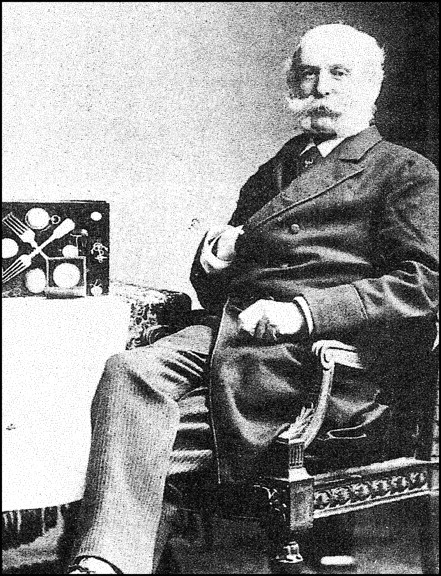
Dr Rae in later life with relics of the Franklin Expedition he discovered in the Arctic, reproduced courtesy of Hudson's Bay Company
In spite of controversy Rae's survey journeys in the Canadian arctic will stand always as his great memorial. Two years after his discovery of Franklin's fate Dr Rae retired from the Hudson's Bay Company, almost worn out by his efforts. He lived for a while in Hamilton and once walked 40 miles to a dinner party in Toronto!
Eventually, in 1860, he married and settled down in England again, returning once to Canada to help a survey for an overland telegraph line. For the next 30 years he wrote and published papers on his exploits and became an expert advisor on northern affairs.
John Rae died in 1893 and was buried in St Magnus' Cathedral at Kirkwell, in the Orkney Islands where his skills and enthusiasms had been so well nurtured as a lad.