




Abstract
James Joyce, considered one of the pre-eminent novelists of the 20th century, attained international renown with his work Ulysses. Its lack of standard punctuation makes it difficult to read. An example would be the famous non-punctuated ‘Molly Bloom soliloquy’ in the last chapter of Ulysses. Why is Joyce considered so difficult to read? He wrote and proofread Ulysses and Finnegans wake, his last works, during his battle against glaucoma, when his vision was seriously blurred. The distracting and confusing diacritical marks might be explained by Joyce's reduced visual acuity. Could Ulysses and Finnegans wake have been different if Joyce's visual problems had begun in the second rather than the first half of 20th century?
Since Joyce experienced the triad of urethritis, polyarthritis and uveitis, Reiter's disease seems the most probable explanation. Severe eye problems, caused by recurrent bilateral iritis attacks, secondary glaucoma and cataracts led him almost to blindness.
It is not easy to imagine the course of modern literature without the Dublin-born James Joyce. 1 After publishing Chamber Music (1907), Dubliners (1914) and A Portrait of the Artist as a Young Man (1916), Joyce attained international renown with Ulysses, considered the major imaginative work in English prose of the 19th century. 2 This unusual and controversial book, written over a period of eight years, was published in Paris in 1922.
As a student, Joyce and his friends frequented Dublin's swarming red-light area, where he contracted a venereal infection in 1903/04. 3 During the summer of 1907, following a night spent in the gutter after drinking, he suffered a possible reinfection and was hospitalized for an episode wrongly described as rheumatic fever. It was in association with this illness that his first attack of iritis occurred in his left eye.
According to Lyons 4 , as Joyce at one time or other experienced the triad of urethritis, polyarthritis and uveitis, Reiter's disease seems the most probable explanation. This follows a chlamydial infection that might have been acquired during a carousel to celebrate the publication of Chamber Music. At the date of Joyce's illness this clinical entity was as yet unknown and, although it was described in 1916, it became a common research subject in the 1960s. 5 Therapies against the disease, easily treated today, were not efficient because of his poor compliance as well as the state-of-the-art of medical science during his life time. 6
Early in 1917 he suffered his fourth attack of iritis in the left eye complicated by synechiae and secondary glaucoma. On 24 August 1917 Joyce's first iridectomy was performed on that eye during an acute attack of glaucoma. Professor Ernest Sidler, in Zurich, was the surgeon. A haemorrhage occurred postoperatively and Joyce suffered a nervous collapse lasting three days. 4 The right eye became involved in 1918 when bilateral iritis and glaucoma occurred. Since 1907 repeated attacks of iritis occurred in both eyes. He often wore a black eye patch because of his painful eye condition and his declining eyesight (Figure 1). He became almost blind. 7 He underwent a total of 13 different major operations on his eyes to preserve what eyesight he had.
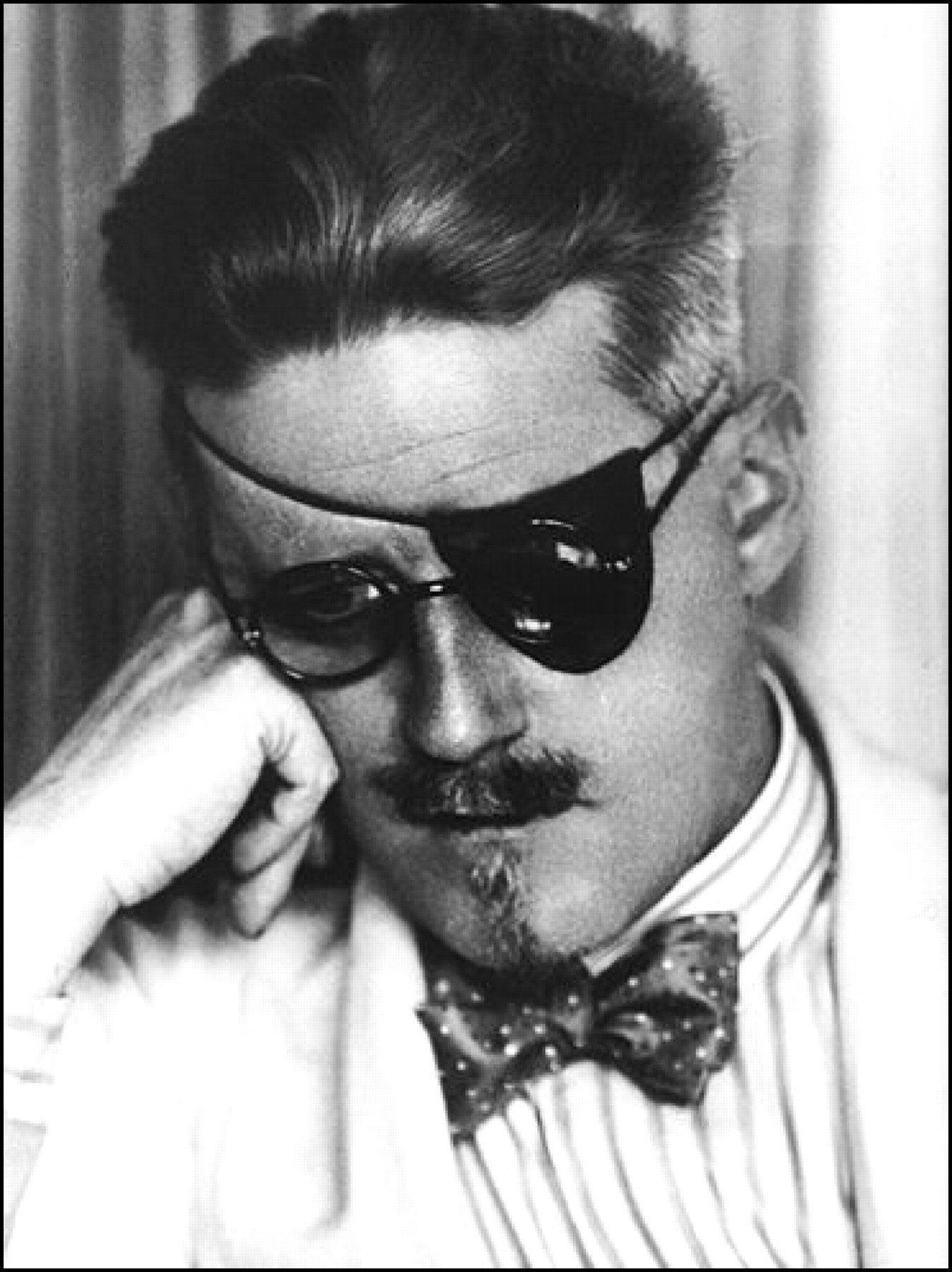
James Joyce, Paris, 1926, with his classical eyepatch. Berenice Abbott (American, 1898–1991). Gelatin silver print; 9 1/8 × 6 3/4 in. (23.2 × 17.3 cm). Purchase, Gifts in memory of Harry H. Lunn Jr, and Anonymus Gifts, 1999 (1999.406). Berenice Abbott/Commerce Graphics Ltd., Inc
Complications of the iritis
Secondary glaucoma is a common and potentially devastating complication of intraocular inflammation and may even lead to blindness. 8 Several mechanisms are involved in the pathogenesis of uveitic secondary glaucoma including obstruction of the trabecular meshwork by inflammatory cells and proteins, trabeculitis, the formation of anterior and posterior synechiae, pupillary block, neovascularization and anterior rotation of the lens-iris diaphragm. 9,10 Treatment is essentially medical, based on antiglaucomatous medications and anti-inflammatory therapy. 10 Nowadays, despite the availability of many medical treatments, the control of intraocular pressure remains challenging. 9 Filtrating surgery should only be performed when medical treatment of the underlying disease or ocular inflammation does not lower the eye pressure level. 10,11
Joyce was treated with dionine and miotic eye drops and with cocaine, arsenic and phosphorus injections. He also received the cutting-edge treatment of the time: leeching. Little bloodsuckers were often used to extract blood from the anterior chamber of his eyes. From 1917 to 1930, to preserve what eyesight he had, Joyce underwent a total of 13 different major operations on his eyes (including iridectomy, sphinterectomy, cataract extraction and capsulotomy), becoming ‘an international eyesore holder of the world amateur record for eye operations’. In spite of everything, his eyes grew steadily worse. Flare-ups of the iritis were exacerbated by alcohol. His fear of operations was intense and he would seek any excuse to delay a procedure. He frequently refused to follow medical advice, postponed appointments and changed doctors in the hope of finding a magical cure.
Text size
According to Professor Richard Ellmann, 12 Joyce's biographer, nobody reading Ulysses from 1922 to the present can have been unaware that the text was faulty. It was difficult to be sure whether a given extravagance was a flourish of genius or an aberration of the typist or typesetter. Sylvia Beach, the first publisher of Ulysses, was conscious of its mistakes: ‘The publisher asks the reader's indulgence for typographical error unavoidable in the exceptional circumstances’ – Joyce's deteriorating eyesight. Soon after Sylvia Beach published the first printing of the first edition on 2 February 1922, Joyce gathered together a list of errata. It was by no means complete. There is a long history of publishers with varying degrees of conscientiousness trying to correct misprints and quite often adding more. A famous instance is the final dot at the end of the penultimate chapter. This was assumed to be a flyspeck and dropped, when in fact it was the obscure yet indispensable answer to the precise question, where?'
Joyce would write passages many times over in many drafts and would add new material whenever he got a chance. Friends would notice how he carried small notebooks with him wherever he went and, when he heard a funny word or a little phrase that he liked, he would write it down (Figure 2). Sometimes he would stuff little pieces of paper in his coat jacket. When he got home he would get them out and use what he needed, adding this found material to drafts as he revised them. Because of his poor eyesight, he was subject to copying his drafts incorrectly when he acted as his own scribe, making it very difficult at times to discern whether variants created in this process were purposeful or unintentional. As a result the manuscript is a palimpsest with significant lacunae.

Reproduction of one page from the Finnegans Wake Notebooks at Buffalo. Reproduced from the website of Brepols, publishers of the Finnegans Wake Notebooks at Buffalo, ed. Daniel Ferrer, Geert Lernout & Vincent Deane
Low vision aids
Joyce's iritis required him to use a magnifying glass to enlarge words, separating them out of context and distorting simple letters. Reading difficulty is present in patients having an absolute scotoma within three degrees of the central visual field when the scotoma involves more than two adjacent quadrants. 13 Gottfried examined Ulysses much as Joyce must have tried to see it, in close readings of many small portions of the text and with quizzical eye. He speculates that the reader is disoriented by the confusion of letters. 14
In April 1923 in Paris, Dr Louis Borsch performed a sphincterectomy on the left eye after the ninth attack of iritis in that eye. For a few months after the surgery Joyce could see well enough to read large handwriting. However, vision decreased gradually and was not improved by another iridectomy performed on 19 June 1924. The developing cataract in the left eye progressed rapidly and was removed by Dr Borsch on 29 November 1924. There was no real improvement because of a secondary membrane. The last two operations resulted in vitreous loss and haemorrhages resulted. Joyce's right eye had now been damaged by iritis attacks in 1918, 1923 and 1925 and was of little use to him because of developing cataract. 7 During 1925 and 1926 the same doctor performed four capsulotomies on the same eye, trying to cut through the membrane.
Finnegans wake
Shortly after finishing Ulysses, Joyce began Finnegans wake, his last major novel, published in 1939. It took him more than 17 years. Finnegans wake – ‘sheer madness’ in George Bernard Shaw's opinion – generally is regarded as Joyce's most complex and unreadable masterpiece whose lacklustre reception in the literary world left Joyce deeply disappointed. 14 More than a few academics have dismissed Finnegans wake as an ‘impossible work’. This novel has earned itself an undeserved reputation for being incomprehensible and indeed totally unreadable. HG Wells, author of The War of the Worlds, said ‘Who the hell is this Joyce who demands so many waking hours of the few thousands I have still to live for a proper appreciation of his quirks and fancies and flashes of rendering?’ 12 Three decades later, Vladimir Nabokov would call it a ‘cold pudding of a book’. 15 In 1966 Clive Hart, a devoted ‘Wakie’, doubted whether there were a dozen people apart from professional Joyceans anywhere who had in good faith actually read Finnegans wake from beginning to end. 16
Like Ulysses, Finnegans wake uses innovative punctuation throughout in order to represent the stream of consciousness. The book begins with the uncapitalized ‘riverrun, past Eve and Adam's, from swerge of shore to bend of bay … ’ and ends with ‘Finn, again! Take. Bussoftlhee, mememormee! Till thousensthee. Lps. The keys to Given! A way a lone a last a loved a long the’. There is no final punctuation to the book, suggesting either a pause at a void or an affirmative cyclic return to the beginning – the symbolic beginning of new life, or the literal beginning of the work: ‘riverrun’.
Joyce carried his linguistic experimentation to its furthest point in Finnegans wake, in part by combining English words with parts of words from various other languages. Joyce's inventive use of language also shows the way in which many words slip and slide in amusing directions. Nevertheless, the distracting and confusing diacritical marks might be explained by Joyce's reduced visual acuity. He had certain very strong opinions about diacritical marks. In fact, he hated them and considered them an offence to the eye.
Large letters
As he needed to write and to read what he had written, Joyce was only able to write in exaggeratedly large letters. William Bird, an American journalist, suggested he use a typewriter but Joyce was not interested in this kind of instrument. In August 1929 Joyce was in London to consult an ophthalmologist and whilst he was there he met his friend and admirer CK Ogden, an authority on the influence of language upon thought and the founder of the Orthological Institute. Ogden persuaded Joyce to come to the Institute to record the last pages of the chapter Anna Livia in Finnegans wake's. The text had been prepared for Joyce in letters half an inch high but the lighting in the studio was so poor that he still could not read it easily. The recording was undertaken nevertheless, with Joyce prompted in a whisper throughout. The same year, in a letter to Valery Larbaud – one of the translators of Ulysses – Joyce averred ‘I cannot see a single word of print’. He managed to write in large black letters with a black pencil and could decipher pencilled words using a magnifying glass. Thus equipped he prepared a fragment of Finnegans wake for the press. Today we know that print size is the most important factor on reading speed in those with sight problems. 17
Professor Alfred Vogt
Before Joyce met Professor Vogt, the most noted ophthalmic surgeon in Europe, he had already endured the agony of eight previous operations on his left eye, which had rendered him nearly blind. According to Vogt's records, in June 1930 (following the ninth operation on his left eye Joyce had a visual acuity of 1/800 in the left eye and 1/30 in the right eye although the right vision was decreasing because of the developing cataract.
Often Joyce could not work and he dictated letters to his wife Nora and son Giorgio who was not very good at spelling: ‘I spent several sleepless nights partly in fier and partly wrighting which I dictated the next morning. The page you [?] histories will be of course yous with the manuscript when and if ever completed. The passage is towards the end of the book, but only the brief draft written without nots’. 18 Occasionally he would also ask friends or assistants to take dictation if he needed to meet a deadline and so it took him longer to complete his last books.
In July 1932 Vogt told Joyce ‘The right eye has now a total cataract, unfortunately complicated by secondary glaucoma, partial atrophy of the retina and optic nerve. You were wrongly advised to put atropine in it and it was pure poison’. To this day, no one has been able to learn who suggested the atropine. 19 It is possible Joyce tried self-medication. That year Joyce said to Jacques Mercanton, a Swiss writer who worked with him on several occasions, ‘Writing costs me a great effort and I am only able to do it very slowly’. 20 By May of 1933 the right cataract had calcified and all that remained was the perception of light. 7
Joyce the unwilling patient
Joyce was not a good patient. Although he maintained relatively long-term relationships with several ophthalmologists, he hopped around between some 30 others, seeking and following their advice sporadically. None could halt the visual deterioration that plagued him for more than half his lifetime. 7
Joyce's experimental use of language and his exploration of new literary methods in the last works came at great personal cost. Under nourishment and irregular eating, great anxiety and alcoholism undoubtedly led to the perforated peptic ulcer that caused his death in Zurich on 13 January 1941. 14
Unavailable to Joyce were steroids to decrease the severity of the recurrent iritis attacks, surgical microscopes to allow the precise use of vitrectomy instruments and neodymium YAG lasers to volatilize the cyclitic and tertiary membranes. 7 Might Ulysses and Finnegans wake have been different if Joyce's visual problems had begun in the second rather than the first half of 20th century?