




Abstract
The Bo (meaning ‘ox’ in the Venetian dialect) is the historic seat of the University of Padua, founded in 1222. A full-length portrait of Thomas Linacre stands in its prestigious Sala dei Quaranta (Hall of the Forty), so called because of the portraits of forty great foreign scholars of the University, painted by Giacomo dal Forno in 1942. Thomas Linacre came to Italy in 1485, following an embassy by Henry VII to the Vatican. Linacre visited Bologna, Florence, Rome, Venice, Vicenza and Padua, where he took his degree in medicine in 1496 with great distinction. During his stay in Italy he met illustrious humanists and physicians, including Poliziano, Hermolaus Barbarus and Aldus Manutius Romanus, and Nicolaus Leonicenus who further stimulated him to the translation of classic works by Hippocrates and Galen. In 1518 Linacre played a pivotal role in the foundation of the Royal College of Physicians in London which, as first President, he organized on the basis of Italian models. With his portrait, the University of Padua celebrates the life and work of an astonishing figure linking the Italian and English medical cultures.
Thomas Linacre depicted in the ancient seat of the University of Padua
The University of Padua, founded in 1222, is one of the oldest universities in Europe. The Bo is the ancient seat of the University. The word Bo, which in the Venetian dialect means ‘ox’, derives from the ox skull that was painted on the sign of the famous Paduan inn called Hospitium bovis, which was acquired by the University at the end of the XV century. One of the most prestigious rooms in the Bo is the Sala dei Quaranta (Hall of the Forty) containing the desk which, according to tradition, was especially constructed by his students for Galileo Galilei (1564–1642) to allow him to be seen and heard during his crowded lessons in the Great Hall of the Bo. On the walls of the hall are portraits of forty prestigious foreign scholars of the University of Padua, painted by Giacomo dal Forno (1909–89) in 1942. Over the entrance is the inscription Universitas Patavina, quot, vel ex ultimis orbis finibus, ad hauriendas iuris civilis et atrium disciplinas adfluxere, tot, homines lingua doctrina humanitate latinos factos, in patria demisit (The many who converged from the far borders of the earth to attain the doctrines of civil law and of the arts, were restored to their countries by the University of Padua with Latin values in language, science and civilization). The Hall of the Forty includes the portraits of English, Scottish and Irish savants including Johan Ruthven (XVI century), Oliver Goldsmith (1728–74), William Harvey (1578–1657), Francis Walsingham (1532–90) and Thomas Linacre (c. 1460–1524) (Figure 1). Linacre was one of the first men linking the University of Padua with England.
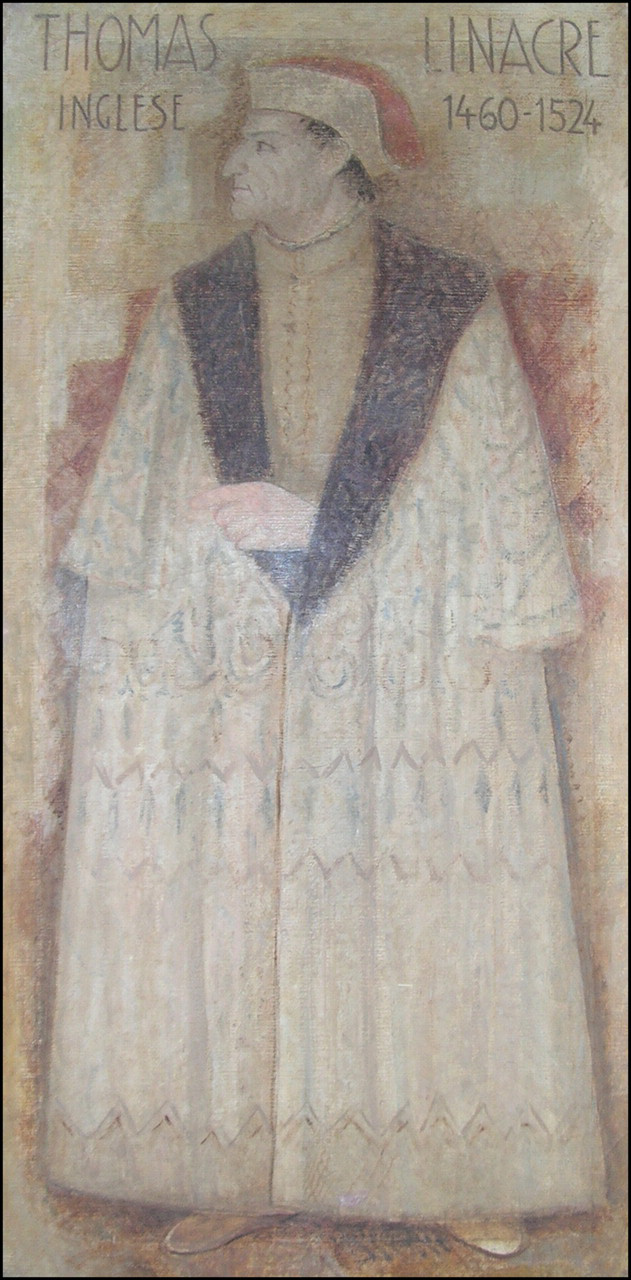
The full-length portrait of Thomas Linacre in the ‘Hall of the Forty’ in the Bo, University of Padua
The portrait of Linacre by Giacomo dal Forno probably derived from two other more famous portraits that are frequently reported in the literature on Linacre, conserved at Windsor Castle and in the British Museum. In the portrait at Windsor, Linacre holds a letter bearing the date 1527, three years after his death, thus arousing doubt about its authenticity. Good copies of this portrait may be seen in the Royal College of Physicians in London and in All Souls’ College, Oxford. 1 In the British Museum portrait, Linacre is shown in profile wearing a doctor's cap. In the Paduan portrait Linacre is shown as a full-length figure, as are all the other portraits in the Hall of the Forty. His profile, as in the British Museum portrait, shows his long nose and prominent lower lip, also apparent in both the other portraits. He wears a hat with red top that is quite similar to the one in the portrait at the British Museum. Linacre is shown in profile, wearing a long cloak, and his left hand, extending from the cloak, points in the same direction as his gaze.
Linacre's early education
Thomas Linacre (or Lynaker) was probably born in Canterbury around 1460. Nothing is known of his parentage. He first studied Greek and Latin in Canterbury in the Monastery of Christchurch that was presided over by William Tilly of Selling († 1494). In 1480 he moved to Canterbury Hall in Oxford where he became a Fellow of All Souls in 1484. At Oxford he probably studied Greek under the supervision of Cornelio Vitelli (c. 1450–c. 1525) and met people who were to play a fundamental role in English humanism, including Grocyn (c. 1446–1519), who was the first Greek lecturer in Oxford and London, William Latimer (c. 1467–1545), John Colet (1467–1519), who was the future Dean of St Paul's, and Thomas More (1478–1535), the future author of Utopia and Henry VIII's Chancellor. 1–4
Sojourn in Italy and medical degree in Padua
In 1485 Linacre went to Italy with William Tilly who had been sent by Henry VII as ambassador to the Vatican. During his Italian stay, Linacre travelled to Bologna, Florence, Rome, Venice, Vicenza and Padua. In Bologna he met Poliziano (1454–94) who probably introduced him to Lorenzo de Medici (1449–92) in Florence. During his stay in Florence, Linacre was educated together with the two sons of Lorenzo, Giovanni (1475–1521), who was to become Pope Leo X, and Piero (1472–1503). Here he also met Demetrius Chalcondylas (1423–1511). In Rome, Linacre met Hermolaus Barbarus (1454–93 or 95) who had translated the Materia Medica by Dioscorides, a first-century pharmacologist, and probably stimulated Linacre to study medicine and the works of Galen. 1–3,5 Linacre then visited Venice where he met Aldus Manutius Romanus (1449 or 1450–1515), a scholar and printer who probably helped him with translations from Aristotle. 5 Linacre also met Nicolaus Leonicenus (1428–1524) of Vicenza, one of the most distinguished physicians and humanists of the period. 1
The year of his arrival in Padua is unclear but in 1496 Linacre was awarded the degree of medicine from the University. Some authors suggest he studied in Padua for several years before taking his final examination, 6 but most agree he may have been in Padua for a brief period to take his degree directly, after having received his medical education in other Italian cities. 5
In that period Alessandro Benedetti from Legnago (c. 1450–1512) was one of the most illustrious professors at the University of Padua. He was not only a physician but also a humanist and published many non-medical works. He made the first anatomical wooden theatre, which was removable. His masterpiece was the Historia corporis humani sive anatomice (1493), which was the first work after the Anothomia by Mondino de Liuzzi (1275–1326) to be entirely dedicated to anatomy.
The records of Linacre's examinations preserved in the Ancient Archive of the University of Padua contain important information about his degree. 7 At that time the board of examiners was made up of members of the Sacrum Collegium of doctors in medicine and arts. In the Statutes of 1433, this Collegium was composed of 20 doctors who were required to be Paduan or Venetian doctors who had taken their degrees in Padua and who had to pass a specific examination. No limitation on the number of members appears at the end of the XV century. The Collegium was headed by a prior who was elected by lots drawn by the members and who remained in office for four months. At the moment of Linacre's examination, the prior was Bernardinus de Bonarigiis. Students could choose up to five members of the Collegium as their promotores, who had the task of presenting and assisting their students in the final examination. They also took responsibility for preparing the students and had to test their knowledge before the final examination by means of informal meetings, frequently held in their own houses. Linacre's promotores were Lorenzo da Noale, Giovanni dell'Aquila, Gabriele Zerbi of Verona, Nicolò Teatino and Pietro Trapolin (‘… sub promotori bus d. mag. Laurencii de Anovali, d. mag. Iohanis ab Aquila, d. mag. Gabrielis Cerbo, d. mag. Nicoleti et d. mag. Petri Trapolini’). Lorenzo da Noale taught practical medicine and had been a member of the Collegium since 1468. Giovanni dell'Aquila († 1507) taught first ‘extraordinary’ practical medicine (1463–72) and then theoretical medicine (1487–93) and ‘ordinary’ practical medicine (1493–1506). During his career he was promotor of more than 200 students. Gabriele Zerbi (1445–1505) first taught philosophy in Padua from 1467 to 1475 and then ‘ordinary’ theoretical medicine from 1494, after a period spent in Bologna and Rome. His publications include Quaestiones metaphysicae (1482), Gerontocomia scilicet de senum cura atque victu (1489), De cautelis medicorum (1495) and Liber anathomie corporis humani (1502). Zerbi was a renowned humanist who contributed to the preservation of many medieval manuscripts. Nicolò Teatino also taught philosophy. At the moment of Linacre's degree, Pietro Trapolin (1451–1506) taught theoretical medicine in secundo loco. He published a treatise, De Morbo Gallico, and was also a philosopher, Pietro Pomponazzi (1462–1525) being one of his pupils.
The first official phase of the final examination in medicine was the tentativum in which students were called upon to present and discuss two puncta, drawn by lots some hours previously. After the presentation of these puncta, each member of the Collegium asked questions and discussed the puncta. The members of the Collegium then decided, by means of a vote, whether the student had passed the examination or not. The ballot was secret. The promotores were present but could not intervene in the discussion and had to leave, with the student, before voting took place. Thomas Linacre's tentativum was held in the church of St Urban (‘in eccl. S. Urbani’) on 25 August 1496 in the presence of the following members of the Collegium: ‘domini magistri Laurentius de Anovali, Hieronymus de Musatis, Antonius Costa, Iohanespetrus de Carariis, Simon Estensis, Hieronymus de Polcastris, Philipus Storlato, Nicolaus de Zanotis, Hieronymus de Felicibus, Felix de S. Sophia, Victor Malipetro, Aleander Porcelinus, Iohanes ab Aquila, presbiter Iacobus de Curte, Franciscus de Pasinis, Hieronymus de Ianua, Hieronymus de Catanis, Matheus de Gadio, Bernardinus de Bonarigis prior, Franciscus Estensis, Iohanesbaptista Novelo, Hieronymus a Mulo, Bernardinus Speronus, Petrus Trapolinus, Gieorgius Sambugo, Hieronymus de Libertis, Bernardinus de Anovali, Paulus de Montagnana’. 7
The second part of the final examination was the examen privatum, which was also held in the presence of the Collegium, on two new puncta. In the examen privatum the promotores could intervene but not vote. The examen privatum was held in the Bishop's Palace, in a special room built in 1488 (the expression in loco solito in the record of Linacre's examination means this particular room), also in the presence of the Bishop (or his Vicary, as in Linacre's examen privatum: ‘Leonardo Contareno d. episcope Pad. Vic.’) and the Rector (‘assistente d. Antonio de Personis Romano univ. artistarum rect.’). Lastly, there was the examen publicum (or conventus) that was usually held in the Cathedral but at the end of the XV century most students asked for exemption from the public ceremony. Thomas Linacre also asked for this exemption, and took the examen privatum and doctoratus (privatum examen & doctoratus) together on 30 August 1496.
These records make it clear that Linacre was granted a degree in medicine with great distinction in both the tentativum and the examen privatum: ‘On 25th August 1496, the Englishman Thomas was examined in Medicine; since he answered most excellently to all the questions which he was asked, … he passed his examination without any contrary opinion being expressed, and was judged qualified …’. ‘On August 30 1496, the Englishman Thomas was diligently and rigorously tested in Medicine and, as he responded well and elegantly to this rigorous examination … and he replied, resolving clearly and evidently all doubts and debatable points raised [by the judges] … his examination was approved’. 7
Linacre's return to England
Soon after taking his degree in Padua, Linacre returned to Oxford, where his degree was confirmed as DM by an act of incorporation. It has also been reported that Linacre was nominated MD by the University of Cambridge through a similar act of incorporation, 3,8 although some authors note the absence of convincing proof of this. 2 During his stay in Oxford, Linacre became a teacher of Greek and a friend of Erasmus of Rotterdam (1466–1536). At the beginning of the new century, Linacre became the tutor, preceptor and private physician to Henry VII's son Prince Arthur, who died unexpectedly in 1502. Linacre then moved to London to become domestic physician to Henry VII (1457–1509) and, in 1509, to Henry VIII (1491–1547). He was probably ordained in 1520, although he had already held some clerical benefices before this date. In 1523 he was made Latin tutor and physician to Princess Mary (1516–58). He suffered from cystitis during the last few years of his life and died on 20 October 1524. He was buried in St Paul's Cathedral, in front of the rood screen of the west door, as he himself had requested. John Caius built a monument to his memory about 30 years later, but this was destroyed in the Great Fire of 1666. 2
Linacre's works
As regards medicine, Linacre's greatest endeavour was to translate works by classic authors, first of all Galen, from Greek into Latin. These works were mainly in the form of frequently incomplete translations from Arabic. Linacre's translations of Galen's works include De sanitate tuenda (Paris, 1517), Methodus medendi (Paris, 1519), De temperamentis (Cambridge, 1521), De naturalibus facultatibus (London, 1523), De pulsuum usu (about 1523) and De symptomatum differentiis (London, 1524). 9,10 It is possible that the Paduan anatomical theatre and studies by Alessandro Benedetti stimulated Linacre's interest in anatomical works. Translation of the ancient anatomical texts by Linacre gave new impulse to the study of anatomy in England and influenced the views of subsequent physicians. It is significant that, in the frontispiece of a translation from Galen, a dissection in an anatomical theatre is represented. It has also been noted that the revival of Hippocrates’ ancient texts by Linacre helped to recall the attention of physicians to careful observation of clinical details that were essential for the future development of modern medicine. 8,11 Linacre also translated some of Aristotle's works (for instance, some meteorological works) although they have not survived, and the astronomical treatise De sphaera by Proclus dedicated to Prince Arthur. 1 Linacre also wrote texts of Latin grammar: Linacri Progymnasmata Grammatices Vulgaria and Rudimenta Grammatice Thomce Linacri diligenter castigate denuo, Londini in Aedibus Pynsonianis are elementary grammars in English; and De Emendata Structura Latina Sermonis is a manual of prose composition in Latin, published in six volumes in 1524. 1,2,9
Linacre and the Royal College of Physicians
Linacre also played an essential role in the foundation of the Royal College of Physicians in 1518. In the XV century, little control was exercised over the general practice of medicine in England. In 1511 a new Act established that examination and licence by either the Bishop of London or the Dean of St Paul's, with the assistance of four expert physicians or surgeons, was necessary to practise physic or surgery in the City of London or within a distance of seven miles around it. In 1518 King Henry VIII constituted a corporate body, the Royal College of Physicians, to which the authority to admit persons to practise medicine in London and within seven miles of it was transferred. In 1522 this licence was made necessary in order to practise medicine throughout the country. The 1518 Act was a limitation of ecclesiastical privilege which was only possible thanks to Linacre's influence over the royal and ecclesiastical authorities, as he was physician to Henry VIII and a friend of the Dean of St Paul's, John Colet, the Bishop of London, Cuthbert Tunstall (1474–1559), and the Cardinal of St Cecilia and the Archbishop of York, Thomas Wolsey (1471–1530), to whom he dedicated his translation of Galen's On the use of the pulse. 1,3,5,8,12–14 The Paduan model of the Collegium of doctors in medicine and arts probably influenced Linacre's conception of the Royal College of Physicians. In Padua, only members of the Collegium could confer degrees; in London, only members of the Royal College of Physicians could authorize the practice of medicine. Ecclesiastical authority was greatly limited in both cases, the presence of the Bishop in the Paduan examen privatum being devoid of any real decision-making power. Linacre was also the first President of the Royal College of Physicians. The early meetings were held in the so-called Stone House in Knightrider Street, which belonged to him. 2 Linacre organized the Royal College of Physicians on the basis of Italian models. 1,15 He believed that members of the Royal College should be professionally competent, conform to professional standards and have a sound knowledge of natural sciences relating to medicine. 3 Before his death he established two lectureships at Oxford and one at Cambridge (the Linacre Lectures).
Between 1471 and 1500, only one other English student took his medical degree in Padua apart from Linacre (whereas 29 German doctors graduated from Padua in the same period). English students in Padua were more numerous in the following centuries. In this sense, Linacre was the forerunner of other illustrious English physicians who studied at the University of Padua and became benefactors of the Royal College of Physicians. For instance, Linacre has been called ‘the intellectual grandfather of Harvey’, 16 ‘through Caius’. 13 John Caius (1510–73) took his medical degree at Padua in 1541, a friend and colleague of Andreas Vesalius (1514–64). He introduced anatomical dissections to Cambridge and is usually regarded as the first to initiate the study of anatomy in England. In 1552 he published what is considered the first medical work written in English, A Boke or Counseill against the Disease commonly called the Sweate or Sweating Sicknesse. William Harvey (1578–1657) studied in Padua under Hieronymus Fabricius Ab Acquapendente (1533–1619), and took his medical degree in 1602. He was the first to describe the systemic circulation of the blood correctly in his Exercitatio Anatomica De Motu Cordis et Sanguinis in Animalibus (1628).
Footnotes
Acknowledgements
The authors are grateful to Dr F Piovan (Centre for the History of the University of Padova) for help with references and to the anonymous referees.