




Abstract
Golitsynsky Hospital is one of the oldest Moscow clinics founded by the Russian Aristocrat Count Golitsyn in 1802. A prominent Russian surgeon and Professor at Moscow University, Efrem Mukhin became the first senior medical doctor at this hospital and played a crucial role in its development. Six hundred and eighty-eight operations were performed at Golitsynsky Hospital between 1802 and 1807 including obstetric, gynaecological, eye and ear interventions. Mukhin performed 444 operations himself. The hospital continued functioning when Napoleon's troops occupied Moscow in September 1812. The French surgeons D Larrey, Degenet and De la Fliz worked there during this period, assisted by their Russian pupils A Migachev and V Sherbakov.
By the end of the 18th century hospitals operating in Moscow and Petersburg could no longer satisfy the needs of the evolving population of both these Russian capitals. The first who responded to this situation was Prince Dimitry Mihajlovich Golitsyn (1721–93), famous in the diplomatic field from 1761 to 1792. He was the Russian ambassador in Vienna and helped strengthen the international authority of Russia. He was also known as a connoisseur of painting, a patron of the arts and a philanthropist.
Golitsyn decided to grant Moscow a really princely gift – to construct one more hospital in Moscow. He decided to sell the unique and rich collection of pictures he had collected during his lifetime and to direct the money to the construction of the hospital. This was written in his Will in 1792. Moreover, he also transferred 850,000 roubles, a great deal of money at that time, together with the income from two ancestral lands with 2000 peasants. After the death of Golitsyn, Empress Ekaterina II (1729–96) approved his Will in her decree of 1794.
This hospital was intended to accommodate 50 patients in a quiet yet strong stone house with premises for officials and rooms for servants, a chemist shop, a laboratory, a kitchen and other essential structures. The Hospital would be supplied with linen, beds, furniture, drugs, surgical instruments and much more. To supervise and manage all of this would require an inspector, a book-keeper and clerks, servants, cooks, watchmen and others, each of whom would have an apartment near the hospital building and be provided with firewood and candles.
A site on the coast of the Moscow River was chosen and the foundation stone laid on 20 July 1796. It is no wonder the construction of the new hospital took several years. A well-known Russian architect, VI Bazhenov (1737–99), conducted it and after his death another, no less well-known, architect MF Kazakov (1738–1812) continued the work. The hospital became one of the most beautiful in Moscow. Two two-storey wings joined the three-tier main building, with a church dome in the middle. Six two-storey and seven one-storey stone wings were added with 14 additional wooden structures. In the autumn of 1801 the church was consecrated and exactly six years after the beginning of construction, on 22 July 1802, the main hospital building received the first patients. AM Golitsyn, Golitsyn's cousin and executor, became Chief Director of the new hospital. Originally the hospital had 50 beds but in 1805 it was enlarged to 100 beds and became one of the largest in Moscow (Figure 1).
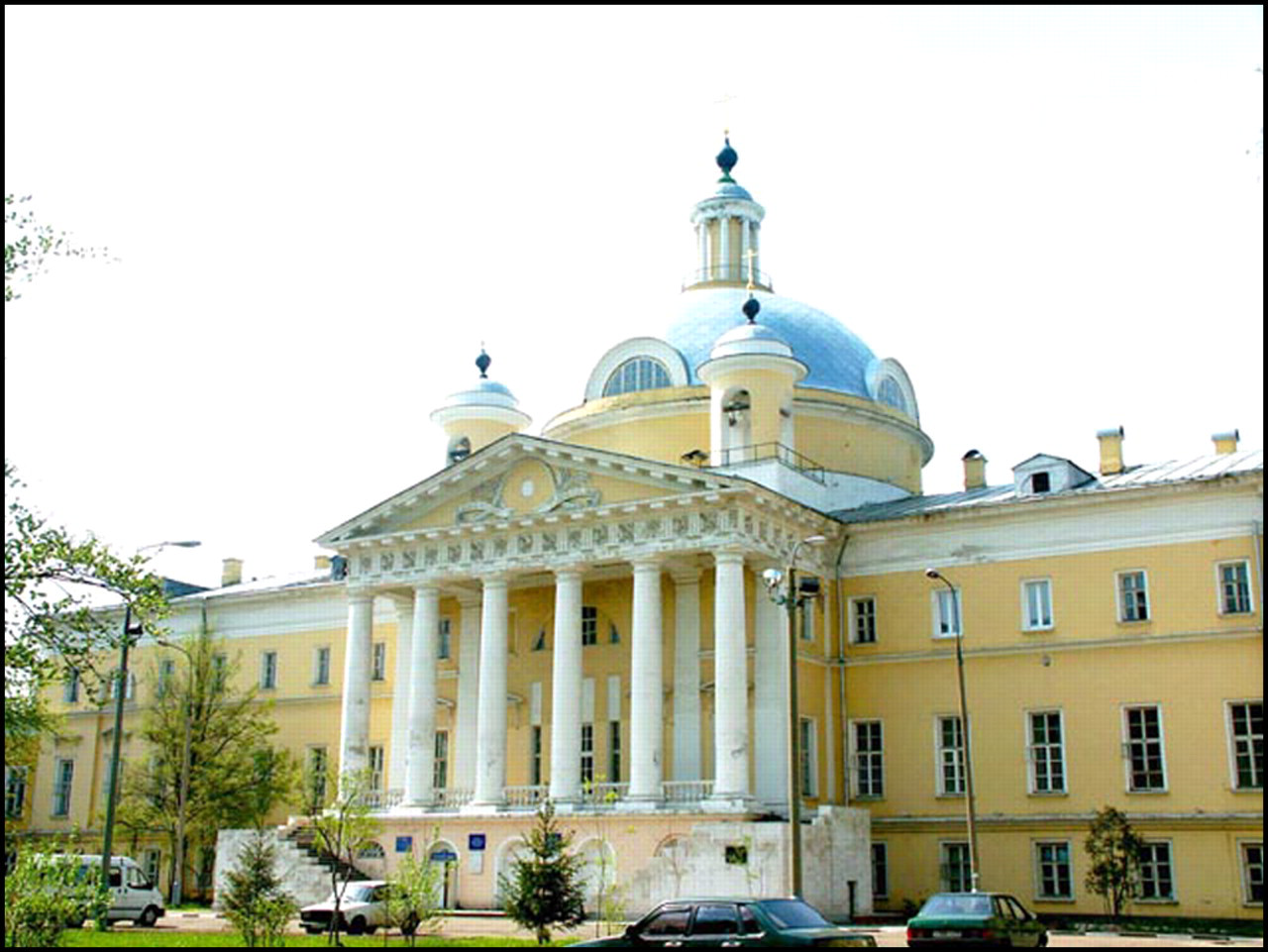
The Golitsyn Hospital today (author's own photograph)
When Ekaterina II (Catherine the Great, reigned 1762–96) approved the plan of the new hospital it was envisaged that ‘all poor and deprived people of both sexes are accepted and treated in this hospital free of charge, both foreigners and people of monastic and spiritual rank, except prosperous and wealthy people who proceeding with the example of other hospitals, should pay for using it’. 1 However, at the opening of the hospital these initial intentions were changed – possibly, following the example of other Moscow hospitals, for example the Hospital of Pavel and the Hospital of Ekaterina; originally wealthy patients should pay five or six roubles by bank note each month and landowners should pay for serfs. However, this order did not hold out for long and it was decided to switch to the initial plan.
On 22 July 1803, AM Golitsyn cancelled a payment for treatment because he thought this compromised the idea of Christian charity, laid as a foundation of the activity of the Hospital. Calculations had shown that ‘the monthly payment does not make the fifth share of what every patient costs, but only eclipses that good intention’. Moreover, he deemed it wise to show respect for those in need and to give them priority over the wealthy.
The chief director also looked after employees of the hospital. At the opening ceremony he announced his hospital regulations. In particular, it was specified that ‘All hospital officials including: the inspector, economy with his assistants, the bookkeeper and the clerk, the doctor, the doctor's assistant, the priest, the assistant of priest sextons, the midwife and the main laundress receive salary each third of the year … that the lower attendants of the hospital were not in need of money – make it paid every three months; but for poor people give the salary every month so as not upset them.’ 2 On 1 February 1802, even before the official opening of the hospital, the rules for admission had been formulated: ‘Accept only the patients who appear capable of treatment, giving priority to those in need of emergency care and then those who can wait, but those unable to respond to treatment should not be accepted at all’. 3 The rules for admission tried to provide, first for the principle of medical emergency and, second, an attempt not to turn the hospital into an almshouse.
In Russia in the first half of the 19th century the Moscow Military Hospital, the Hospitals of Pavlov, of Ekaterina and of New-Ekaterina, of Sheremetev, and the Gradskay (the Foundling Hospital), the Military-Overland and Admiralty Hospitals, the Obuhov and Mariinsky Hospitals in Petersburg, and hospitals elsewhere operated in similar fashion. The foreign doctors who visited these institutions approved strongly. New and more radical specific methods of therapeutic and surgical nature born by scientific progress were being developed. 4
The primary goal of the executive director of Prince AM Golitsyn was to select for the hospital doctors who would know and were able to apply theoretical and practical achievements in their practice. First of all, it was necessary to choose the senior doctor and he in his turn should select for himself efficient assistants and organize all medical activity in the hospital. It is not known how Prince AM Golitsyn carried out his selection and who were the applicants to whom he gave his preference. He invited EO Mukhin, Professor of the Moscow Medico-Surgical Academy, a well-educated doctor and scientist who creatively owned all achievements of medicine. Mukhin held this post from 1 January 1802 and certainly participated in all preparations for the opening of the hospital.
Efrem Osipovich Mukhin (1766–1850)
Efrem Mukhin (Figure 2) was born in the town of Chuguev in the Kharkov province (now Ukraine). In 1789 he graduated from the hospital school at Elisavetgrad Military Hospital, becoming the doctor assistant. He was appointed anatomist at Elisavetgrad Military Hospital: in two years he became the doctor and the teacher of anatomy and desmurgy (dressings and bandages) at the hospital school from which he had graduated recently. He operated and he delivered a course of student lectures entitled ‘Concerning bones, dislocations, fractures and doctors bandages’.
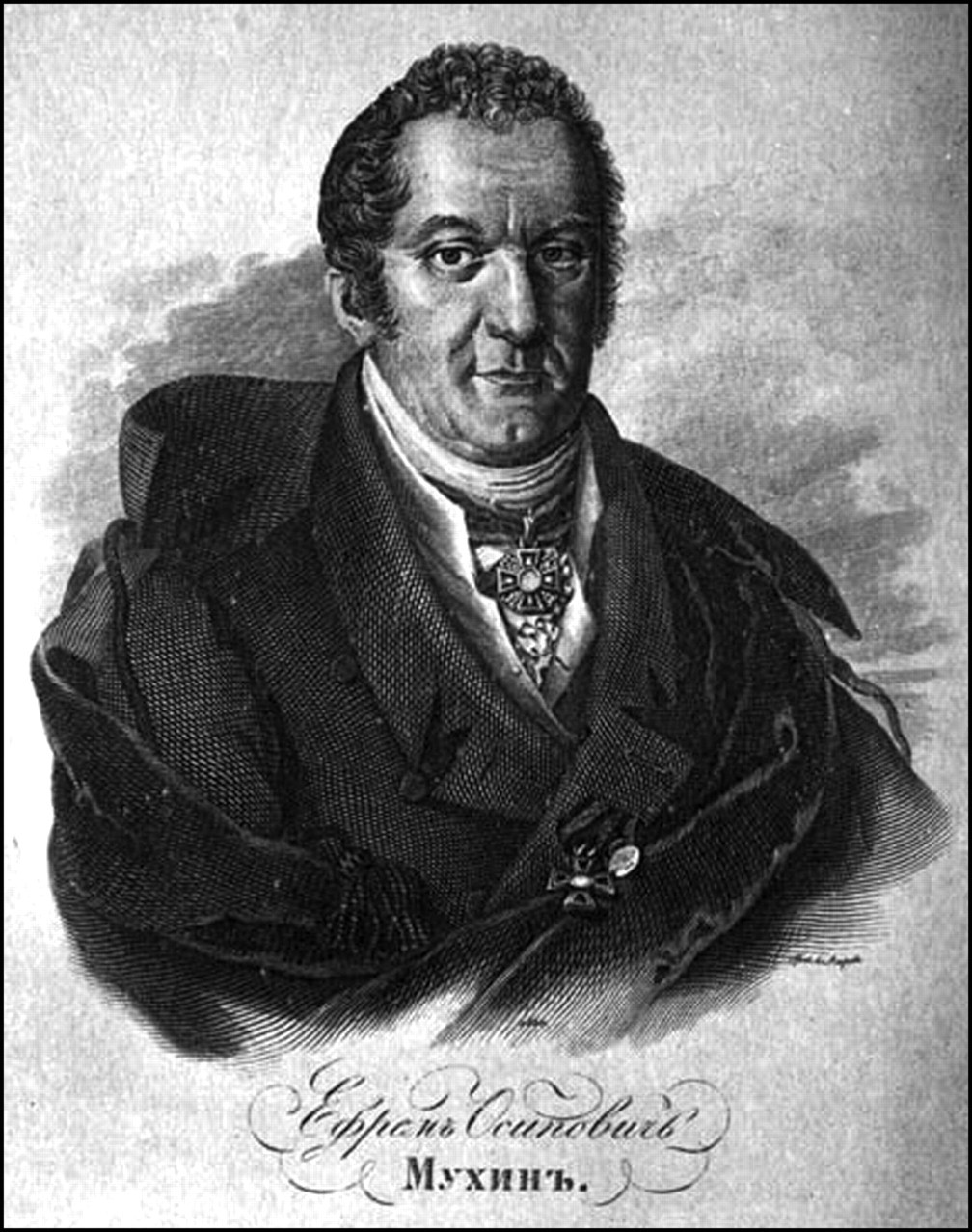
Efrem Mukhin portrait, reproduced courtesy of Bol'shaya meditsinskaya entsyklopedia , Moscow, 1981, t. 16, p. 35
Seeking to improve his knowledge in the field of medicine, in January 1795 Mukhin again became a student at the Moscow University. Capable and already experienced in medicine, the doctor-student attracted attention: he was given an opportunity to prepare and deliver two trial lectures – ‘Concerning major current inventions in all areas of medical science’ and ‘Concerning the successes in medical sciences in the Russian state’ – and these lectures confirmed the young Mukhin's maturity. In December 1795 at the instigation of the Moscow University he was appointed Assistant Professor of Pathology and Therapy (and the Anatomist) at the Moscow Medico-surgical School.
Mukhin also continued scientific research. In 1800 he wrote a thesis ‘De kentrologia’ in which he stated the foundations of his doctrine about the stimulus influencing the manifestation of life in an organism; in October 1800, after defence of his Thesis, he was awarded the Doctorate of Medicine and Surgery. He read a professorial course of lectures in the Moscow Medico-Surgical Academy on pathology and therapy, and simultaneously a course of lectures on the first principles of medical science in the Moscow Slavonic-Greek-Latin (Spiritual) Academy. In 1809–16 he held the Chair of Anatomy and Physiology at the Moscow Medico-Surgical Academy and in 1813–35 the Chair of Anatomy, Physiology, Forensic Medicine and Medical Police of the Moscow University.
In the capacity of professor and teacher of anatomy, Mukhin wrote manuals including in 1812 the textbook Svjaseslovie and mishzeslovie, in 1813–15 The Course of anatomy, and also valuable scientific studies on anatomy and he developed the doctrine of the ‘sputum bursas’. He experimented on animals and later this gained wide dissemination in medicine and surgery.
Mukhin proved himself to be the adherent of an anatomic direction in surgery. As he wrote in the foreword to his 1831 book: ‘A brief manual on how to heal from the bite of mad animals’, it was he who ‘indefatigably has laid the path of anatomy and operator's work’. This, Mukhin's most important work on surgery, in 1806, is illustrative of this – the book The first principles of bonesetting science was the first national guide on that important part of surgery that subsequently became a separate speciality – traumatology and orthopaedics.
Bonesetting science
‘Bonesetting science’ was defined by Mukhin as ‘an art to correct the bones that have changed their position’ and, he divided it into two parts, dislocations and fractures. Though in the foreword to his manual Mukhin also mentioned anatomists and surgeons of whose experience he made use – including his Russian colleagues Nikon Karpinsky (1745–1810), Fedor (Fridrich) Hiltebrandt (1773–1845), Josias Weitbreht (1702–47), Christian Loder (1753–1832), Yakov (James) Willye (1768–1854), Christian Pecken (1730–79), Nestor Maximovich-Ambodik (1744–1812), Petr Zagorsky (1764–1846) and Ivan Dvigubsky (1771–1839) – although the basis of his recommendations was his own experience.
His own practice prompted Mukhin to develop methods of treatment for a combination of dislocation and fracture. For fractures it was required to undertake five procedures, namely bone setting, retention of the corrected bone, knitting, reduction and destruction of the fracture, and prevention of further fracture; he noted: ‘the purpose of the bonesetter is to secure proper knitting. If there are fragments, absolutely separated from soft parts and periosteal ‘plevi’, or harming the position, they should be removed before bandaging’. Mukhin, again referring to his own experience, in fracture of the hip advised the use of the sand bag he invented: this consisted of two lateral and one underlaid sand bag with cross-section tapes.
Mukhin's scientific work ‘The first principles of bonesetting science’ became the first Russian manual on traumatology and orthopaedics which subsequently was separated from surgery; together with the works of JV Willie (1806) and IF Bush (1807) it became the basis of training and improvement of the professional skill of Russian surgeons in the first decades of the 19th century.
In April 1802 Mukhin accepted Prince Golitsyn's offer and entered the newly opened Hospital of Golitsyn ‘with a title of first-rate doctor’ – speaking the modern language, he became the senior physician. He remained until 1812 but continued to be engaged in practical medicine: in 1813–17 he was the senior doctor at the Moscow Foundling Hospital and commercial School and in 1830 of The Tagansky Cholera Hospital.
The Golitsy Hospital, 1802
On 22 July 1802 on the great day of the opening of the hospital, Prince Golitsyn handed over to Mukhin ‘the Instruction for the doctor’ which stated ‘To doctor Efrem Osipovich Mukhin, the Golitsyn Public Hospital … Taking into account your valuable experience, special abilities and your own wish, I select you for the hospital founded by me in the capacity of medical chief-doctor with a salary of six hundred rouble per year, where you already receive sufficient for life in your apartments, including servants, services, a kitchen, a cellar, a shed and stable, fire wood and candles, with submission to you for your medical post medical attendants, including: doctors, pupils of doctors, medical assistants and midwife, who must fulfil their duties according to their posts’. 6
The doctor himself was obliged to visit the hospital at seven in the morning in summer and at 8 o'clock in winter and after dinner at 5 o'clock (at this time other attendants should be at their places and wait for the doctor). After a tour of the hospital wards and examination of all patients the doctor should appoint treatment according to the nature of the disease: the instruction was entered into the special book (actually the case history) and the recipe for the medicine was then written and sent to the drugstore. Duties of the doctor also included: watch over patients' food – whether ‘all is fresh and good that is bought, whether it is prepared according to the instructions and in what quantity’. Special attention should be given to patients suffering from ‘catching illnesses’: they should not be placed in hospital since it was necessary to avoid any contact with them. Ill patients should not trouble other patients, it was necessary to place them in special rooms.
Mukhin's medical and surgical practice
Mukhin's medical and surgical practice was extensive. ‘At this time – testified Professor Armfeld, i.e. right at the beginning of the present (XIX–MM) centuries – he has already taken one of the first places between the known and glorified doctors of our capital: it is difficult to believe, the respectable contemporary the late G Vygotsky used to say, what a large number of persons of all ranks addressed him for the grant and advice; and it is even more difficult to explain how he found time and an opportunity to be on time everywhere, not depriving any of his patients of the attention and sympathy the patient has the right to expect from the doctor … Almost every medical consultation required him; his patients were everywhere in Moscow’. 7 He treated NI Pirogov's older brother and at that time became acquainted with the future great surgeon; subsequently the 14-year-old Pirogov became a student of Moscow University.
Mukhin's surgical practice at the Golitsyn Hospital led to interest not only from his colleagues but also from the wider public. Thus in 1804 the magazine Vestnik Evropy (Bulletin of the Europe) published information about ‘operations performed in the Public Hospital of Golitsyn by the doctor-surgeon Efrem Mukhin’.
During the four months from 1 April until 1 August 1804, 16 operations were performed at the Hospital of Golitsyn Mukhin: ‘the captured bone of the hand after St Anthony's fire was sawn off; pterygium was removed … the leg above the knee was removed; bags tumour affected by cancer on the bend of the elbow with hand was removed and another – on the breast of deliberate size; the stone was removed from the bladder through (section lateralis), size about a big walnut … Operation performed on the anal fistula’. Some operations were performed by his assistants, doctors M Davydov and I Kirilov. 8
During the first four or five years of its existence, at the Public Hospital of Golitsyn (1802–7), 688 operations were performed: surgical, obstetric, gynaecological, eye and ear, and Mukhin performed 404 operations himself, and his employees 284, under supervision, and sometimes with his participation.
Information about this early emergency care service organized by Mukhin appeared in the newspaper ‘Moskovskie Vedomosti’ sold on the Moscow Streets. Patients were being attracted to Mukhin ‘the concourse of suffering men from year to year was numerous – Mukhin pointed out – not only the inhabitants of Moscow but even from the remotest vicinities of Moscow … sometimes from the remotest places of Russia’. It is no wonder the number of operations was increasing and it became difficult for Mukhin to cope with this task so he invited his assistants to participate in the surgical activity: ‘I, wishing to execute this assumption, performed surgical operations by hand almost every day in the Hospital’ he wrote ‘while at last I trained one after another to do easy cases, operating with their hands’ but under his supervision.
The Chief Director met his request and in September 1804 ‘took one more doctor as assistant to doctor Mukhin’, the Staff doctor Johan A Gendelius who was instructed to ‘supervise and care’ for all women staying at the hospital and for the men placed on the top floor of the main building. Dr Mikhail Davydov and three doctor's pupils were under his stewardship and also a feldsher and a midwife. Gendelius should visit the hospital twice a day: in the morning at 7 o'clock (in winter at 8), and in the evening at 5 o'clock. He should make rounds, examine all patients and appoint treatment and necessary medicines: in the case of ‘dangerous and important illnesses and operations’ it was necessary to consult the senior doctor EO Mukhin. It was emphasized that Gendelius was obliged to watch and ‘supervise’ so that patients never remained without the doctor or his pupil.
As a help to Mukhin a young but already skilled Doctor II Krylov was appointed. He, as determined by Mukhin, should treat under the guidance of the doctor ‘all external illnesses demanding special skill – perform operations and bloodletting, treat fractures and dislocations, bandage significant wounds, make use of electricity’ and so on. He should accept and examine new patients and decide the treatment needed; when on duty doctor Krylov was obliged never to leave the hospital and to make rounds several times a day. Mukhin performed many and varied operations in the presence of his colleagues – professors and doctors from other hospitals of Moscow, Petersburg and other cities who showed great interest in his surgical practice. ‘Well-intentioned and compassionate doctors were invited by me to the best fulfilment of “uncomfortable” operations’ Mukhin wrote in his book – Opisanija chirurgicheskih operatsiy (Descriptions of surgical operations) – not only always willingly gave useful advice in the course of these operations but others were present too, particularly doctors Keresturi, Shumljansky, Popov, Bagrjansky and Dvigubsky’. 9
Mukhin willingly shared his surgical experience with colleagues. He presented at one of the sessions of the Moscow Medico-Physical Society his comments on a complicated operation in May 1803 – ‘an interesting case of fracture of the top of the head and a fracture of the forehead as a result of the trauma in 33-year-old man’. Mukhin operated at the Golitsyn Hospital in the presence of his assistants and demonstrated to Drs IK Kirilov, MD Davydov and others. While extracting the splinters the surgeon noted their ends pierced the brain and under the firm membrane of the brain ‘sediment’ blood might be found. Therefore he cut this membrane crosswise and the sediment under the blood was taken out by a rake and then, having washed the cut with a solution of ammonia, he placed the cut edges together. Finally, the wound was washed with a solution of ammonia and a prepared birch ‘lekarsky’ tinder was placed on the wound and above – the curtailed compress wetted by the same solution. About a month after the operation Mukhin noted ‘the surface of the tegmentum of the head, newly grown, became covered with much skin, the wound was the size of the Russian copper copeck coin and from it two little bones protruded’ and later ‘the wound has started to heal much faster’. Three months after the operation the patient ‘was discharged home to live an active life again’. 10
Mukhin supported radical methods of treatment. Thus, contrary to the opinion of the physicians A Kallizen and I Frank, in 1811 he considered it possible to cure water illness of the ovaries only by operation with a happy outcome. Mukhin often applied his own methods. When amputating the extremities he preferred the methodus panniculata – to tie the bleeding vessels and then to cover the wound in order to compress the ends of the cut off fighting and sensual veins [vessels and nerves] and prevent the bleeding, irritation, the pain and so forth’. 11
Mukhin often used ice, applying it to wounds and naming it ‘Northern Moscow means’: ‘I have found … a simple and cheap method of treatment of those wounds that exist after operations’. His method of treating postoperative wounds consisted of ‘applying a resin plaster all around the wound, the daily washing of wounds with cool water, sprinkling with grated rosin and, after decent dressing, placing a piece of snow or ice on top of the wound and applying canvas tapes to the edges of the wound smeared with white ointment, and sometimes removing the growth of superfluous (luxurient) material. For internal use, the calming powder made from two gran sleape juice (opium) and a half-zolotnik of saltpeter 12 was used. Recent practice has confirmed the effectiveness of Mukhin's methods.
In 1810 Mukhin, Chair of Anatomy and Physiology at the Moscow Medico-Surgical Academy, left his post of ‘the priority doctor’ at the Golitsyn Hospital but he continued his surgical activity. In the early 1820s, having concentrated on his primary activity as the Professor of Physiology, Forensic Medicine and Medical Police of Moscow University, Mukhin departed from practical surgery. In the 1830 cholera epidemic Mukhin, who headed the Tagansky Cholera Hospital, devoted several works to the problems of recognition and treatment of this disease. During his work he contracted cholera twice, once in the grave form, but recovered and started work again on the original method of steam baths he developed.
Mukhin was active in introducing vaccination, at first in children: ‘I firmly hope that when the preventive inoculation of smallpox in all provinces and villages is introduced into the public use and to every newborn baby, not later than in half a year or at least in about one year in a few years human smallpox will absolutely disappear’. However, it took one and a half centuries but finally it seems Mukhin was right and in 1977 the World Health Organization declared smallpox had been eradicated.
The Russian historian MP Pogodin wrote a good review of EO Mukhin's great services: ‘The Life of Professor Mukhin is a continuous circuit of works written for the benefit of his fatherland. He commanded several hospitals, published many works both his own and others, was the first to promote the education of Russian doctors, he supported many of them and assisted in every possible way in their initial introduction in the field, and by his successful treatment and operations has gave power to the Russian name’. 13 After Mukhin it was difficult to choose another Executive Director of the Golitsyn Hospital but finally AA Albini took up the post which he held from 1810 to 1825.
Napoleon in Moscow in 1812
The greatest changes at the Golitsyn Hospital took place in 1812 during the Patriotic war with Napoleon's army. When in September 1812 the French Army entered Moscow, the hospital was overcrowded with wounded Russian soldiers from The Battle of Borodino (7 September 1812), and it never stopped work and its wards were never closed. True, there were no doctors at the hospital: Doctor AA Albini, Staff Doctor MD Davydov and other employees had left Moscow after Prince S Golitsyn; Dr IV Klementovsky accompanied the wounded Russian officers to Yaroslavl and Kazan. Only ‘ekonom’ Tsynger, his assistant Ankudinov, druggist Vinter, doctors' and druggist's pupils, and servants remained.
Later the senior hospital clerk, FN Scherbakov, recalled that the day after the French marched into Moscow, druggist Winter and ‘ekonom’ Ankudinov's assistant, when trying to rescue the hospital from plunder, went to the Kremlin where the main French Staff was situated with a request to use the Golitsyn Hospital for wounded French officers and to place a military guard there. The French liked the idea of occupying this first class hospital and they took the hospital under protection; Napoleon's stepson Evgenie Bogarne, Viceking of Italy, sent soldiers to attain this and the hospital was saved from plunder and ‘no stone suffered from the enemy invasion’.
By the evening of that day wounded officers started to arrive: Foreign doctors, the druggist with his drugstore, interns and medical assistants arrived. Medicines were brought from Poljansky and Pjatnitskoy drugstores, everything that could be found. Soon there were about 300 wounded men and patients, including 50 Russian officers and soldiers at the Golitsyn Hospital. All were treated by the French doctors – D Larrey, Degenet, de la Fliz and others: Russian doctors' pupils, including A Migachev and V Scherbakov, helped them. The famous Larrey was the most successful operating surgeon and he operated on both the French and the Russians. Thus he amputated the leg of the wounded man at Borodino – the Artillery Officer AS Norov who later became the Minister of People's Education of Russia.
Many doctors from the Napoleonic Army visited the Hospital of Golitsyn and other hospitals of Moscow and were greatly impressed by what they saw. Larrey wrote ‘hospitals that attracted me most would have honoured the most civilized nation. They were divided into the military and urban. We have found just a few patients at the large military hospital … Civil hospitals are no less remarkable. The four main ones are the Sheremetevsky, Golitsynsky, Ekaterininsky and the “Foundling Hospital”’. 14 Larrey's assistant, Dr De la Fliz, held similar views.
When at the beginning of October 1812 the French hastily left Moscow, they could not evacuate all their wounded. At the Hospital of Golitsyn there remained 27 Frenchmen and 14 Russians, and all were taken care of by the Russian doctors who came back: the main doctor AA Albini (who later was decorated for it with the award of the Honourable legion), Staff-Doctor MD Davydov and also the doctors from the Pavlovsky Hospital came to help them.
The ‘econom’ Hospital of Golitsyn, H Tsinger, informed that all hospital buildings were intact ‘except the window glasses which were broken from the explosion of the Kremlin’; as for the property (linen, mattresses, pillows) part was gone, taken ‘at the departure of French wounded officers’ from Moscow; that ‘our Hospital of Golitsyn was called the main one of all the Moscow hospitals in which there was a sentry and in which generals, staff and subaltern officers, with a small number of their private soldiers, were hospitalized [100–160 died], there were also the Russian Service Staff and subaltern officers with private soldiers’ but there were no medical hospital officials – ‘the observation and the use were French’. 15 The Hospital of Golitsyn appeared among those few medical establishments in Moscow that actually suffered from military action and fire. Moreover, as all Moscow drugstores plundered, the executive director SM Golitsyn in August 1813 organized the sale of medicines to the inhabitants of Moscow at the hospital and he wrote ‘the distribution of medicines with fixed price in no way contradicted that charitable intention with which the institution’ was founded. Since that time, for many decades the drugstore at the Hospital of Golitsyn was the only one of all hospital drugstores in Russia that utilised the right of free sale of medicines.
After the war of 1812 Moscow suffered from the great fire and robberies but was quickly built up again. The need to expand the Hospital of Golitsyn was more and more urgent, and at least a hundred beds had been developed before the war. In 1813, 50 beds were developed and then another 25 beds were added such that by the following year the general number of beds was once more increased and simultaneously hospitalized 115 patients. SM Golitsyn took the maintenance of 10 of the 115 of beds and these beds were assigned to his serfs to whom each month he paid 20 roubles in bank notes for each patient. With the aim of further improvement in hospital business in 1815, detailed rules and instructions for all employees were published: the basis of these was the desire ‘to achieve the best order in every respect at this institution and to complete the good intentions of the bequest’.
Then at the start of the 19th century a new large city hospital was opened in Moscow that quickly became one of the best medical institutions of the city. The peculiar feature of the Hospital of Golitsyn was free treatment of the poor and deprived. The Hospital of Golitsyn from the first years of its existence has proved to be an advanced medical institution and this is in large part due to Professor EO Mukhin. The remarkable scientist and the doctor-expert, the author of the first national manual on traumatology and orthopaedics, proved himself to be the greatest surgeon of his time. Here at the Hospital of Golitsyn he performed complex surgery that aroused the constant interest of his colleagues and the wider public. In 1835 Mukhin retired and spent his last years in the manor of Koltsovka of the Smolensk Province where he died in 1850. 5