




Abstract
From the second half of the 18th century, Japanese physicians incorporated concepts of European medicine in their publications. Dutch physicians had a pivotal role in this process, facilitated by their trade relations in Deshima, near Nagasaki. This paper focuses on the influence of later Dutch editions (probably the 1765 edition) of Hendrik van Deventer's pioneer work Nieuw Ligt (a New Light) on Japanese obstetrics, especially on Katakura Kakuryō's publication in 1799 of Sanka Hatsumō (Enlightenment of Obstetrics).
The absorption of Western medicine into Japan in the Edo period (1603–1867)
Japanese adaptations of Chinese texts still formed the backbone of Japanese medical practice in the 18th century notwithstanding the contact with Dutch medicine via the small trade settlement at Deshima, the artificial island near Nagasaki, established in the early 17th century. Japanese interpreters attached to the Dutch settlement were allowed to acquire a limited knowledge of the Dutch language and gradually Western medicine began to affect native practice. Although several of the rulers of Japan who held the shogunate before the middle of the 18th century were sufficiently aware of the superiority of Western medicine to employ Dutch-trained native physicians and even to permit the Dutch doctors of Deshima to give short courses of instruction to the court physicians at Tokyo, it was not until 1720 that shogun Yoshimune repealed the edict against the possession and reading of foreign books. This marks the beginning of an era of systematic study of the Dutch language and medical texts. 1–3 As a consequence of earlier rules against the use of Western books Japanese physicians had never developed the custom of making acknowledgements to the original author, for such reference had been the admission of a crime. Therefore, difficulties arise in disentangling elements taken directly from Western, mainly Dutch, authors or other European authors translated into Dutch, and those elements that might have been part of the intellectual property previously assimilated by Japan. 1
Changes in obstetric practice in Europe in the early 18th century – a ‘New Light’
In Europe obstetrical practice changed in the beginning of the 18th century, due among others to the Dutch physician Hendrik van Deventer (1651–1724) who published several works on obstetrics, all of which have in common the referral to a ‘New Light’, a new insight on obstetric practice. In 1701 the first part of Nieuw Ligt was published in 1701 in Dutch at The Hague and as Novum Lumen in a Latin edition at Leiden. It was considered to be the most lucid, useful and practical book for midwives at that time, and the work was translated into German (1704), English (1716) and French (1733). Van Deventer's work went through many editions and had a great influence on the practice of midwifery in Europe and thus van Deventer truly can be considered a European pioneer in the field of obstetrics and gynaecology. 4
Changes in obstetric practice in Japan from the second half of the 18th century – the first works on obstetrics in Japan
It was not until the second half of the 18th century that Japanese physicians began to take an active interest in the practice of obstetrics or sanka, which until that time had been largely in the hands of midwives whose methods, although based on Chinese precepts, did not differ greatly from their European colleagues.
The first Japanese work on obstetrics, San Ron (or Treatise on Obstetrics) was published in 1765 by Kagawa Genetsu (1700–77). It was based primarily on actual experience. Japanese adaptations of Chinese texts must have been the basic element of the training for Kagawa Genetsu. The material contained in the San Ron was elaborated later, in 1774, by Kagawa Genteki (1739–79), a pupil and adopted son of Kagawa Genetsu in an explanatory treatise entitled San Ron Yoku (or Explanation of the San Ron). 1,5,6
Influence of European obstetrical pioneers on Japanese obstetrics – ‘Enlightenment in Obstetrics’ in the Empire of the Sun (Katakura Kakuryō, 1799)
Another Japanese physician and pupil of Kagawa Genetsu, Katakura Kakuryō (1750–1822), 7 in his turn attempted to correct the works of the preceding two Kagawa's. This resulted in the publication of Sanka Hatsumō (Enlightenment in Obstetrics) in 1799, a treatise on obstetrics described by the author in his preface as a ‘collection of medical science based on actual experience’. 6,8 Several authors erroneously mention 1774 1 and 1795 9,10 as the year of publication of Sanka Hatsumō. Sanka Hatsumō describes the delivery of children in abnormal positions, twin pregnancies and their delivery, and the correction of transverse positions. Katakura stated that 27 of his illustrations were inspired by the Oranda-Ryu-Geka, the ‘Surgical School of Orange’, as the Japanese called the Dutch medical group. In keeping with the Japanese practice of his time, as mentioned earlier, Katakura failed to specify which of the books of the ‘School of Orange’ served as his model with one exception: Hendrik van Deventer. A comparison of the first 29 plates in Katakura's treatise with figures in Dutch medical books then extant reveals beyond doubt that he derived 27 of them from Nieuw Ligt by Hendrik van Deventer (Figure 1) and two plates, depicting forceps delivery, from the Dutch translation of William Smellie's Anatomical Tables published in 1765 in Amsterdam by Jan Morterre (Figure 2). In the same year Jan Morterre published the fourth Dutch edition of Hendrik van Deventer's Nieuw Ligt. Dutch merchant ships heading for the Dutch East Indies and Japan in the 18th century departed mainly from the port of Amsterdam. Katakura might well have made use of both 1765 Amsterdam editions. Unfortunately it was not possible to trace any 18th century copy of van Deventer's Nieuw Ligt in Japanese on-line libraries (Nacsis, The National Diet Library) and libraries known for their rangaku collections, studies on Dutch and Western science and medicine (for example The Archive of Western Learning in Tsuyama, near Okayama).

Nearly identical illustrations of a twin pregnancy by Katakura, edition Edo, circa 1830 (1a) and van Deventer, edition Amsterdam, 1765 (1b)
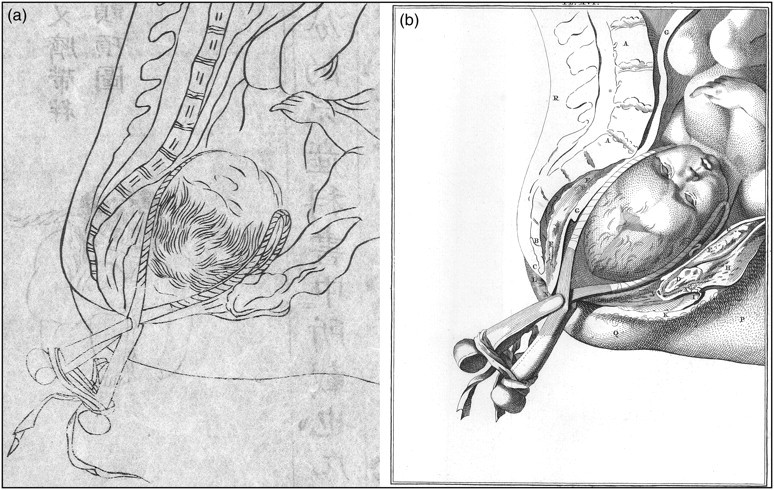
Nearly identical illustrations of a forceps delivery by Katakura, edition Edo, circa 1830 (2a) and Smellie, edition Amsterdam, 1765 (2b)
A substantial part of Katakura's text, and even the title of his work, is based on the work of van Deventer. 1,6,11 The 27 woodcuts after Hendrik van Deventer were redrawn in a more or less random sequence (Table 1).
Concordance between woodcuts in Katakura's Sanka Hatsumō (edition Edo, circa 1830) and engravings in Van Deventer's Nieuw Ligt (edition Amsterdam 1765) and Smellie's Anatomical Tables (edition Amsterdam, 1765)
Several textual passages and plates illustrate the fact that this Japanese physician also sometimes had difficulty in applying independently the anatomical knowledge gained through the study of Western books and the teaching of Western doctors.
By contrast with van Deventer, Katakura's treatise, like the works by the Kagawas, was directed at the physician rather than at the midwife; contemporary writings for midwives do not mention these works. 10 Although the illustrations occasionally show a woman helping the physician, the person in charge is the physician himself. 1 The role of midwives fundamentally changed in the Meiji era, the era of rapid Westernization and ‘enlightened rule’ (1868–1912). 5
Katakura's assimilation of traditional Japanese medical thoughts with European influences, made accessible by the Dutch ‘Surgical School of Orange’, prepared Japanese obstetrics to evolve along the path to greater Westernization. Works by the European pioneers of obstetrics, Hendrik van Deventer and William Smellie, most likely the Dutch editions from 1765, played a pivotal role in this process.