




Abstract

Stephane Tarnier was born on 29 April 1828 in France, at Aiserey in Burgundy. His father was a general practitioner. Following in his father's footsteps, Stephane went to Paris in 1845 to study medicine. The following year, he came back home briefly to help his father during a cholera epidemic. He was accepted as an Interne des Hôpitaux de Paris in 1852. He was deeply distressed by the fatal infections of women who had just given birth and, in his thesis in 1857, he dared to declare that puerperal fever was contagious. He presented his work about the cause and the prevention of puerperal infection to the Académie de Médecine. He was then appointed Chef de Clinique in the Maternity Hospital of Port-Royal where he became Chief Obstetrician in 1867. The story of this modest but hard-working, imaginative and determined man could now begin.
First, he fought puerperal infection by taking preventive measures that caused a significant fall in the mortality rate. The importance of these measures had already been demonstrated 20 years before by the Hungarian Ignàc Semmelweis (1818–65) while he was working in Vienna, but they had been rejected by the conservatism of the practitioners of the time and, driven to despair, Semmelweis finally died in a Budapest mental hospital. With Louis Pasteur (1822–95) and Joseph Lister (1827–1912), Tarnier subsequently demonstrated that this visionary man had been right.
Then he devoted himself to the art of instrumental delivery and, in 1877, introduced a new pair of forceps. Indeed, he was aware of the mechanical drawbacks of the forceps introduced by André Levret (1703–80) of Paris that were widely used in France. His forceps were designed to enable the obstetrician to pull at all times in the axis of the pelvis and to allow the baby's head sufficient mobility to follow the curve of the pelvis. He claimed these specific advantages in a report that produced major repercussions. He was awarded the honorary degree of Doctor honoris causa of the University of Edinburgh and his ‘French forceps’ have survived to the present day.
Tarnier was also interested in the care of premature infants. He had understood that the preservation of a constant temperature was not sufficient for the survival of a premature baby. He realized that isolation, perfect hygiene and a warm environment were also necessary. In 1880 this ingenious man experimented with the prototype of the first incubator. Initial experiments with it were not very successful because, in trying to get chicken eggs to hatch, all he managed to produce were hard-boiled eggs! However, by the end of 1881 the first incubator for premature babies had indeed been put into service in his Maternity Hospital.
Tarnier published numerous papers and held the Chair of Clinical Obstetrics. An examination to obtain the title of Hospital Obstetrician was created in 1882 and by 1892 the Société Obstétricale de France had been founded. Several maternity units were opened in public hospitals, including La Charité, Tenon, Lariboisière and Saint-Louis, and the rate of hospital deliveries in Paris tripled within ten years. Under the influence of this uncontested leader, the art of obstetrics took an unprecedented leap forward, foreshadowing modern practice. The tireless activity of this indefatigable man earned him many honours. Not only did he become head of a new maternity hospital erected in the Rue d'Assas in Paris and was elected President of the Académie de Médecine but he was also made a Commander of the Légion d'Honneur.
This pioneer died on 23 November 1897. His students carried his coffin to the Cimetière des Péjoces in Dijon, to the final resting place that he had bought in 1886 while living in Paris. Pierre Budin (1846–1907) said that his death marked the demise of ‘one of the greatest medical figures of our time’. The Maternity Hospital in the Rue d'Assas became the Tarnier Hospital and a bas-relief by the sculptor and painter Denys Puech (1854–1942) was erected in 1905 in the wall of the building on the corner of Rue d'Assas and the Avenue de l'Observatoire (Figure 1) depicting Tarnier with a mother, her newborn child and an incubator (Figure 2).
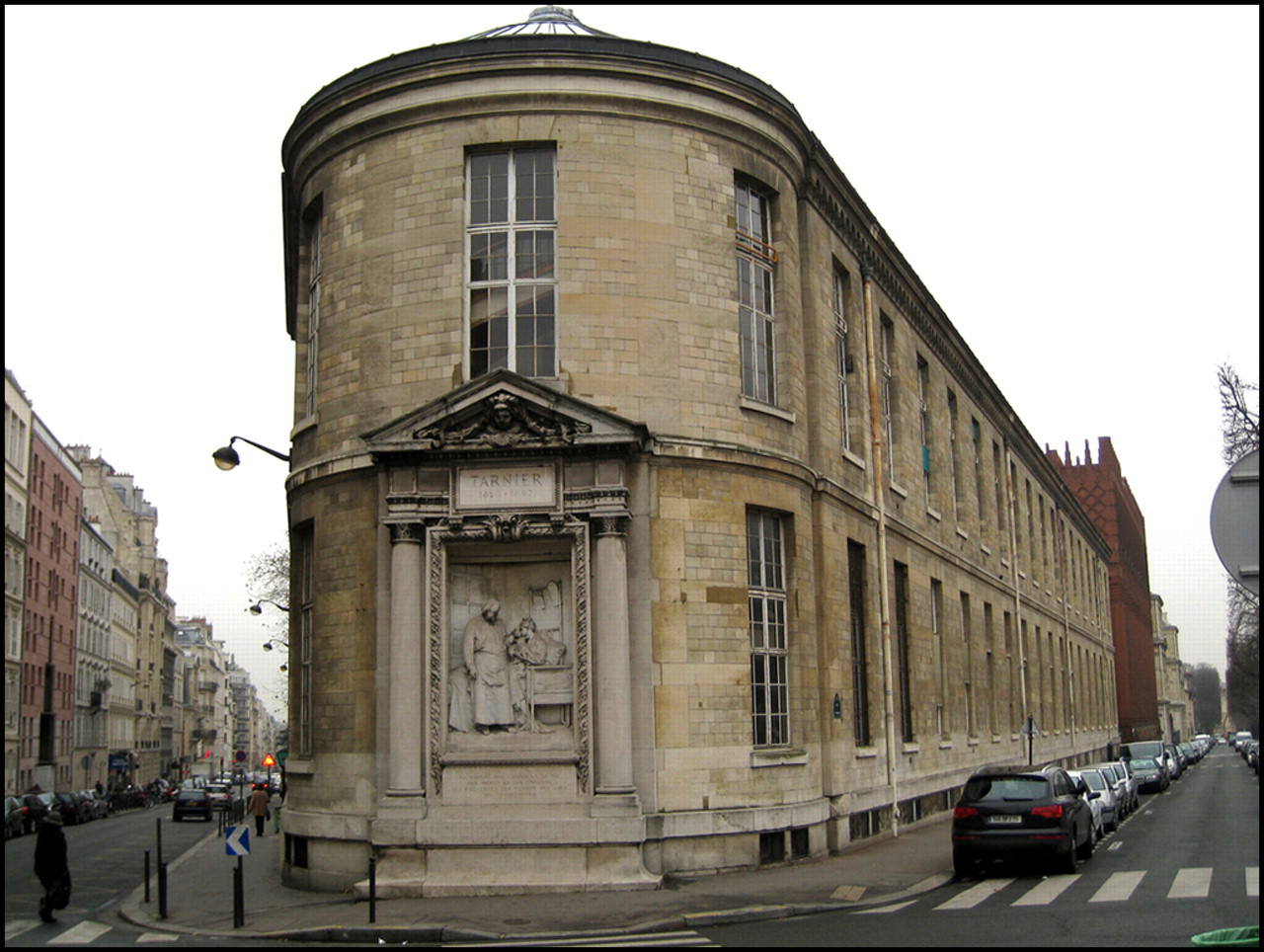
The building on the corner of Rue d'Assas and Avenue de l'Observatoire
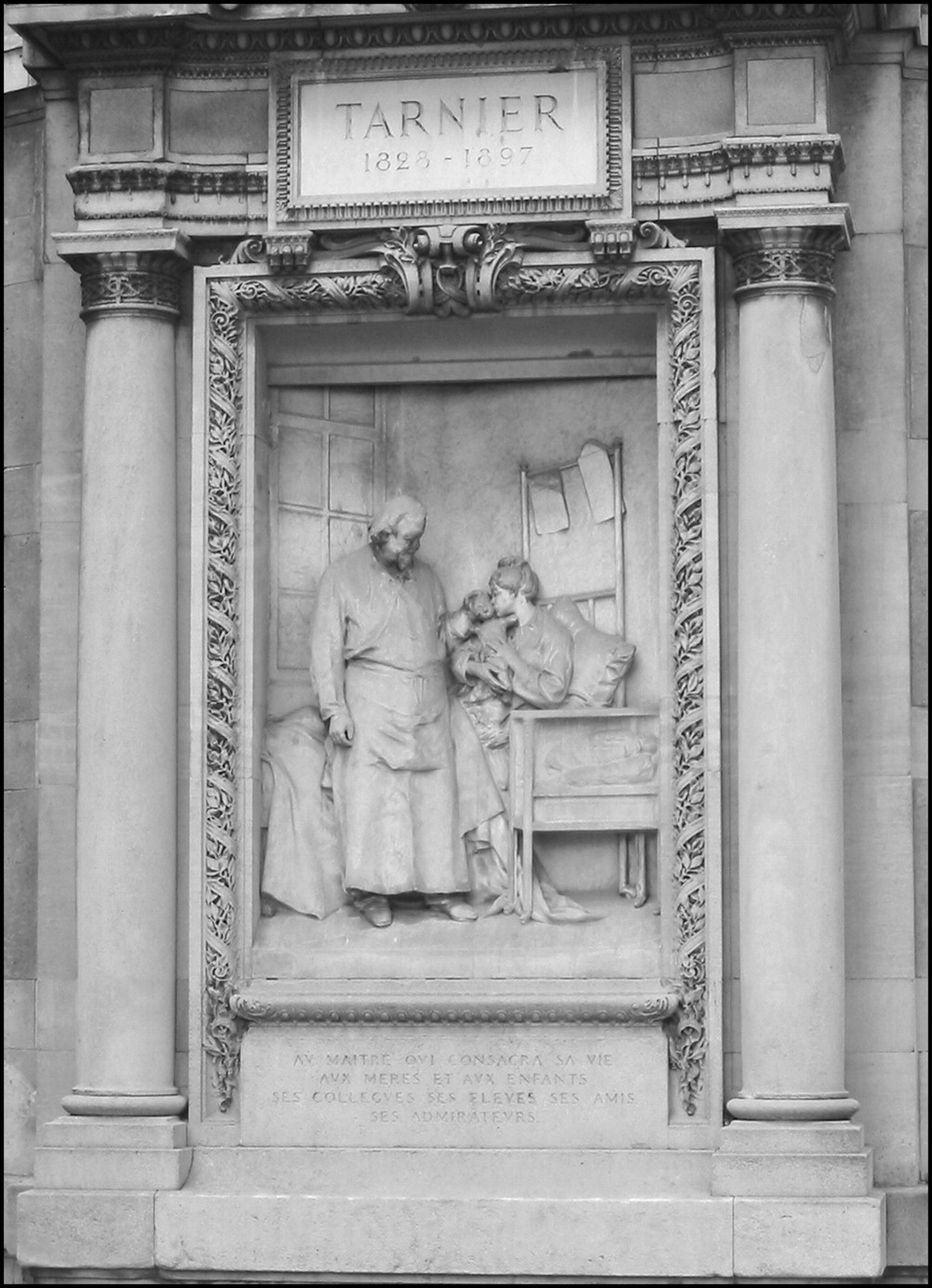
The bas-relief of Stephane Tarnier in Paris
Footnotes
Acknowledgements
The authors would like to thank Pierre Joly for his valuable assistance. For an image of Tarnier and of his cot, together with further history, see: Dunn PM. Stéphane Tarnier (1828–97), the architect of perinatology in France. Archives of Disease in Childhood, Fetal and Neonatal Edition 2002;