




Abstract

No discovery, procedure or instrument bears his name but one word is associated with Cullen: neurosis, by which he meant a functional derangement arising from disorders of the nervous system. Cullen was convinced that a disordered action or spasm of the nerves provoked disease – hence his nickname, ‘Old Spasm’. He introduced the term neuroses in his textbook First Lines of the Practice of Physic (four volumes 1776–84), which went into many editions and translations. The book was written for medical students at the University of Edinburgh where Cullen was renowned as an innovative teacher. He chose to lecture in English rather than Latin, using diagrams and demonstrations; he gave clinical instruction at the Edinburgh Royal Infirmary and his chemistry courses attracted an increasing number of students (rising from 17 in 1755 to 145 in 1766). During his 34-year career at Edinburgh, Cullen was a leading figure of the Scottish Enlightenment – a founder of Edinburgh's Royal Society of Medicine (1737) and of the Royal Society of Edinburgh (1783); he was President of the Royal College of Physicians of Edinburgh (1773–5) and he was elected a Fellow of the Royal Society in 1777. With his friend, political economist Adam Smith (1723–90), Cullen promoted the reform of medical education at the Scottish universities and he was likewise the lifelong friend of the philosopher David Hume (1711–76). With his colleagues Professors Munro primus (1697–1767), Munro secundus (1733–1817), Robert Whytt (1714–66), John Hope (1725–86), John Gregory (1729–73) and former pupil Joseph Black (1728–99), Cullen established the supremacy of Edinburgh's medical school in the second half of the 18th century. Benjamin Rush of Pennsylvania (1745–1813), who studied under Cullen, testified that Edinburgh was then ‘in the zenith of its glory. The whole world I believe does not afford a set of greater men than are at present united in the college at Edinburgh’.
Born 300 years ago in Hamilton, Lanarkshire, Cullen commenced practice in his hometown in 1736. After the death of his patron, the Duke of Hamilton, Cullen moved to Glasgow to lecture on chemistry, botany, physic and materia medica at the University. In 1755 he transferred to the University of Edinburgh, initially as joint Professor of Chemistry; later he was appointed Professor of the Institutes of Medicine and at the time of his retirement in 1789 he occupied the Chair of the Practice of Physic (Figure 1).
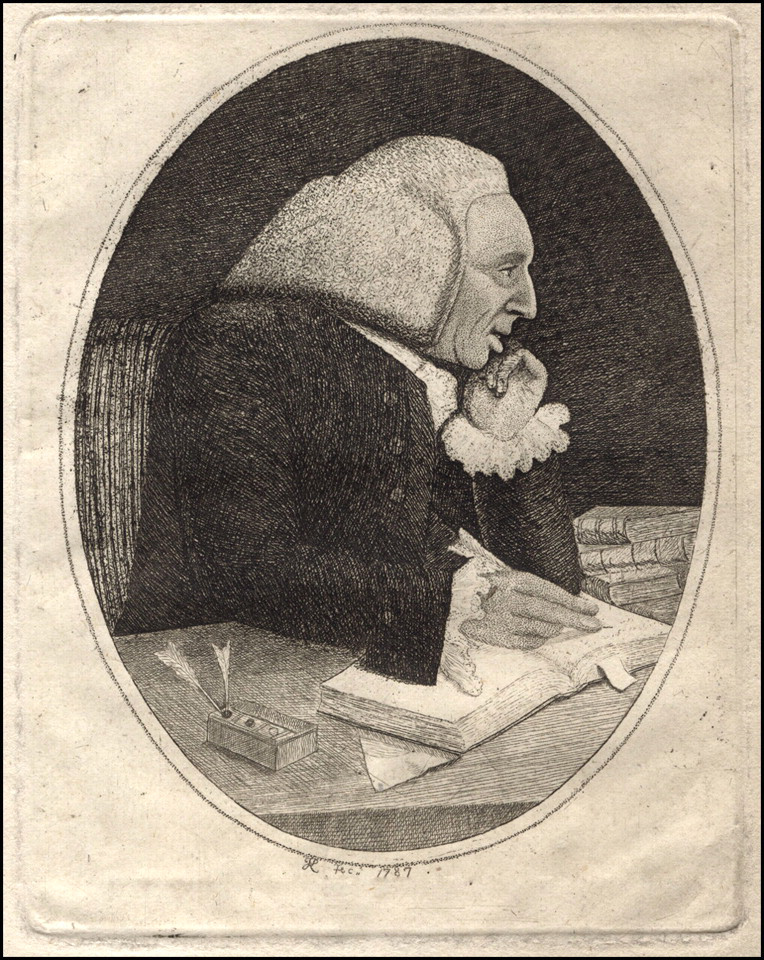
Professor William Cullen by John Kay (1787), reproduced courtesy of the National Portrait Gallery, London
Cullen's Synopsis Nosologiae Methodicae (1769) presented a classification of diseases by their symptoms and his First Lines of the Practice of Physic (1776–84) expanded the system. In addition to this magnum opus Cullen wrote papers on artificial refrigeration, linen-bleaching, salt-refining and soil-fertility – these ‘husbandry experiments’ attracted the interest of Scottish landowners including the Duke of Argyll (1682–1761) and Lord Kames (1696–1782). As a medical practitioner Cullen's courteous manner and wide experience (he had trained with an apothecary and travelled to the West Indies as a ship's surgeon in his youth) were particularly valued by private patients who wrote to him describing their complaints. For a fee of one guinea Cullen provided a diagnosis, advice on diet and lifestyle, and a prescription – to facilitate this voluminous correspondence he acquired one of the first mechanical copying devices, invented by his friend James Watt in 1780. An Italian prince, aristocrats, clergymen, army officers and frail women consulted Cullen by post, as did the diarist James Boswell who wrote anxiously to Cullen in 1784 describing Dr Samuel Johnson's asthma and dropsy for which Cullen recommended laudanum, vinegar of squills (sea-onion), blistering, issues, gentle vomits and a mild climate. Cullen had dined with Johnson some years previously when the conversation had touched upon witchcraft and whether orang-utans could speak, and Cullen amused his host with tales of people who walked and talked in their sleep.
When Cullen died in 1790 signs bearing his portrait hung outside apothecaries' shops throughout Great Britain as a mark of respect, while in North America Professor Rush paid tribute to his mentor: ‘It is scarcely possible to do justice to this great man's character either as a scholar, a physician or a man’.