




Abstract
James Blundell was an obstetrician, surgeon, physiologist and teacher. He is best known as the first to perform a successful human-to-human blood transfusion. However, he can also be accredited for significant advances in surgery and obstetrics. After a distinguished career at The United Hospitals of St Thomas and Guy's, he retired early and ended his years in relative obscurity.
Introduction
After numerous failed attempts at animal-to-human blood transfusion in the 1600s, human blood transfusion was made illegal in Europe and consequently fell into ‘disrepute and practical oblivion’. 1 One hundred and fifty years later, after seeing many of his patients die from postpartum haemorrhage, Dr James Blundell designed a series of experiments on the subject. In 1825 he became the first to successfully perform a human-to-human blood transfusion. It is for this he is best known. However, he made numerous other observations that are similarly influential. It is said that many of his observations and opinions were much in advance of his time.
Chronicle
James Blundell (Figure 1) was born on 27 December 1790 in Holborn, London, to Major Blundell and Sarah Ann Haighton. 2 He received a classical education with a private tutor Reverend Thomas Thomason MA Cantab. His medical education began at the United Southwark Hospitals of St Thomas' and Guy's, and included the study of anatomy and surgery under Sir Astley Cooper (1768–1841) and midwifery and physiology under his uncle, Dr John Haighton (1755–1823), with whom he resided for many years and who became a dominant influence in his career. He continued his medical education in Edinburgh, from whence he graduated with an MD degree in June 1813. 2

A portrait of James Blundell (Jones H, Mackmull G, 1928)
Returning to London in 1814 when aged 24, with Dr Haighton he began lecturing on midwifery at the United Schools of St Thomas and Guy's, and to which shortly he added lectures in physiology which at that time were given only at Guy's. In 1823 he succeeded his uncle as the Professor of Physiology and Obstetrics. 1,3 He went on to earn considerable esteem at Guy's. 4 His lectures were said to have attracted ‘the largest audience throughout London’. 5
After 22 years, in 1836 Blundell retired from Guy's Hospital after a dispute with the administration. He proposed to appoint someone to take over the role of a senior lecturer in order to afford him more time for his large private practice. While away in Paris for the summer, 6 the treasurer of Guy's advertised and appointed Dr Samuel Ashwell (1798–1852) without Blundell's sanction or approval. 7 Furthermore, Blundell believed he had the right to charge his successor a fee for the transfer of the Lectureship 6,8 and Blundell commented on this in three letters published in the Lancet. 8–10
He continued in full time private practice with unusual work patterns, waking at midday and consulting from his house. Then he would go on evening house calls, travelling in a yellow carriage with a special light to allow him to read between visits. 11 He was admitted a fellow of the Royal College of Physicians in 1838, a rare honour at that time for an obstetrician.
Blundell retired from practice in 1847 at the age of 56 and lived comfortably on the considerable fortune from his earnings and a family bequest. He devoted time to literature, especially the study of Greek, and to his collection of rare books on obstetrics and gynaecology. 2,11 Dr Blundell never married but lived with his grand niece. He spent the last 30 years of his life in a large house in Piccadilly. He is thought to have enjoyed excellent health until a very short time before his death ‘in a fit of convulsions’ 4 on 15 January 1877. In his will he left his book collection of over 300 rare books to the Obstetrical Society of London and his estate was valued at £350,000, today's equivalent of over £20,000,000. 12
Values
Blundell endeavoured to awaken the spirit of enquiry and research among his pupils. He considered personal observation and examination of alleged facts as integral to the attainment of real knowledge: ‘In religion, faith is essential; In physiology, a philosophical skepticism’. 7
He was also an uncompromising advocate for the liberty of physiological experimentation: ‘. . . and what will it matter a few centuries hence, whether England or France swept the ocean with her fleet? But mankind will always be equally interested in the great truths deducible from science, and in the inferences derived from physiological experiments’. 7
On experimenting on animals he said ‘strike gentleman, but hear! . . . which will you sacrifice, your women or your cats?’ 13
Obstetrics
Blundell was very opposed to ‘meddlesome midwifery’ and practised and taught the use of extreme caution and conservative obstetrics, particularly in regard to the use of forceps: ‘I do not like to see an elegant pair of forceps. Let the instrument look like what it is, a formidable weapon’. 4
He practised and taught the importance of artificial respiration in stillborn fetuses. His use of endotracheal intubation was long before this technique became used commonly in the mid-1960s. 14 ‘The only mode of performing this operation effectively is by means of a small instrument, the tracheal pipe, which I think every accoucheur should carry along with him to a labour’. 15 He described his technique of intubation thus: ‘In introducing the instrument there is some difficulty at first, if you do not manoeuvre rightly, yet every moment is of the greatest importance, for while you are blundering the child is dying. I pass the forefinger of my left hand down upon the root of the tongue and into the rima glottides. And then using the tube with the right hand, I slide it along the surface of the finger, used as a director’. 15
Surgical management of the pelvic and abdominal organs
Blundell's experiments into the response of the peritoneum of animals, principally rabbits, to surgical interference were of substantial importance because he accumulated convincing evidence that large incisions might be made into the peritoneum and that the dread of injuring the peritoneum had been greatly exaggerated. This laid the foundation for advances in the surgery of the abdomen and pelvis. He went on to show that organs, the kidney, uterus, ovaries and spleen, could be removed without causing death or inducing fatal inflammation: 4,16 ‘the peritoneum and abdominal viscera will, without fatal consequences, bear more injury than from their modes of practice, the British Surgeons especially seem disposed to admit’. 1 He recommended vaginal or abdominal hysterectomy for cancer of the cervix and indeed successfully removed the uterus for malignant ulceration on 12 February 1828. This may have been the first time the procedure was performed. 7,17
Human blood transfusion
From the laboratory facilities at Guy's Hospital, Blundell performed multiple experiments on the transfusion of whole blood in dogs: ‘The following experiments were constructed with a view to . . . recommend a rejected operation to the experimental investigation it seemed to deserve’. 18
These were inspired by contemporary research in Edinburgh by two doctors from Barbados. Mr Goodridge conducted a solitary experiment in animal transfusion. Dr Leacock conducted several experiments concluding that same species animal transfusion was possible whereas cross-species transfusion was not. He postulated that this would apply to humans. 6,19
Blundell's experiments established that blood lost none of its life-giving properties by passage through a syringe. Blood from different arteries is equally effective. Venous blood is as effective as arterial. Small quantities of injected air may be tolerated. The volume needed to be transfused is less than the volume lost. Blood should not be injected too rapidly nor be left too long and species-specific blood must be used. 1,6
Blundell also experimented with ways to solve the complexities of transfusion, one of the main problems being clotting. ‘. . . the blood is satisfactory only if it is allowed to remain in the container for but a few seconds’. 18 At first Blundell used a brass syringe and cannula to connect arterial blood from the donor to the recipient's vein. He designed two instruments to improve transfusion and reduce clotting, the impellor and the gravitator (Figure 2). 20,21

James Blundell's transfusion gravitator (Blundell J. 1828)
By an elaborate process of reasoning and from further experimentation, he convinced himself that transfusion might be employed cautiously but safely in humans. 7,20 This was at a time when blood letting was still a recognized form of treatment for postpartum haemorrhage. 21 Consequently over a period of 10 years there were only 10 documented cases of Blundell using human blood transfusion. His first transfusion was performed in 1818 on a man ‘who was dying from inanition induced by malignant disease of the pylorus’. 22 ‘Considerable temporary benefit followed the transfusion, but as was to be expected in such circumstances, the man after some hours sank again into a state of exhaustion, and died 56 hours later’.
Of the following nine documented cases, four were unsuccessful and five successful. The first recorded success was in August 1825. A surgeon colleague, Mr Waller, summoned Dr Blundell to a woman dying from postpartum haemorrhage and two ounces of blood were transfused from her husband. 23 The other successes included three further patients with postpartum haemorrhage 1,24,25 and one boy with hypovolaemia following leg amputation. The volumes transfused ranged from four to 14 ounces and the donors included either the patient's husband or the attending clinicians. 26
By 1830 he had shown that the procedure was practical: ‘After undergoing the usual ordeal of neglect, opposition and ridicule, the operation will hereafter be admitted into general practice’. 4 The equipment used varied as the research continued. Figure 2 illustrates one example, the gravitator.
Publication of his work
A book (Figure 3) entitled Researches Physiological and Pathological; instituted principally with a view to the improvement of Medical and Surgical Practice was prepared as three essays in 1825. 16 The first detailed his observations with a view to the improvement of surgery of the abdomen. The second paper gives ‘experiments on a few controverted points respecting the physiology of Generation’. The last was an essay accounting his observations on blood transfusion.
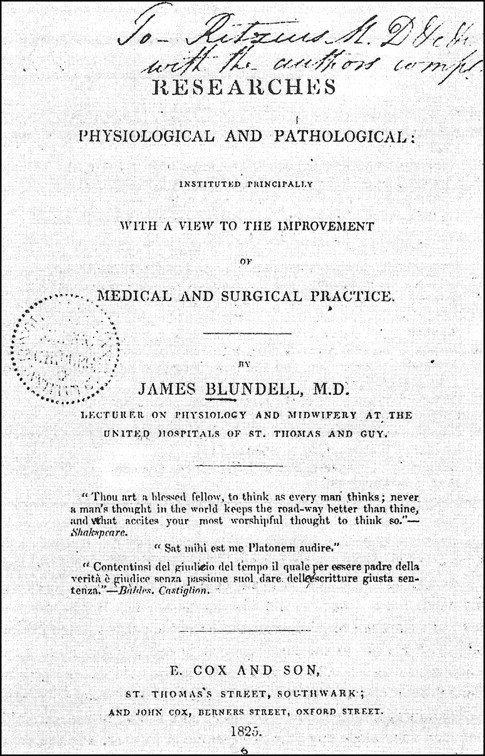
Blundell J. Researches Physiological and Pathological; instituted principally with a view to improvement of Medical and Surgical Practice. London: E Cox and Son, 1825
His lectures on physiology and midwifery delivered at Guy's Hospital appeared in the Lancet in 1827–8 against his wishes but in accordance with a policy practised by Thomas Wakley (1795–1862), the editor. 27 Blundell retaliated by publishing his lectures as a volume in 1832 entitled Lectures on Midwifery and the diseases of women and children. This was followed in 1834 by a larger volume (Figure 4) The principles and practice of Obstetricy. 15 In turn this was superseded in 1837 by the Observations on some of the more important diseases of Women which was revised several times and printed in several countries.

Blundell J. The principles and practice of Obstetricy. London: E Cox, 1834
In this time of increasing super-specialization, James Blundell is an example of a great pluralist of the past – Obstetrician, Surgeon, Physiologist, Teacher and Academic. His cautious but inquisitive nature helped him make inferences that have had a great impact on clinical practice in many fields, much of which we still see in use today.
‘The fact that life may be saved by the transfusion of blood into the veins will be beneficial a thousand years hence as it is on this day.’ 7