




Abstract
Silvanus Bevan was born in Swansea, South Wales, moved to London where he trained as an apothecary, and then in 1715 opened a business at Plough Court off Lombard Street in London. As a committed Quaker he was renowned for honesty and fair-trading and consequently he prospered. In the 1730s he took his brother Timothy as a partner. Silvanus Bevan had practised medicine at his Plough Court pharmacy and, with the arrival of his brother became less involved in pharmacy and increasingly interested in medicine. In 1725 he became a Fellow of the Royal Society. Within the family the pharmacy at Plough Court continued to prosper and became the forerunner of the pharmaceutical company Allen and Hanbury. Marriage into other Quaker families linked Silvanus Bevan with the banking firm Barclays.
Arriving in London from Swansea in the early 18th century, Silvanus Bevan could not have imagined the influence that his family would have on pharmacy, commerce and banking in the coming two or three centuries.
Silvanus Bevan was born in Swansea in 1691. The family was prominent in business and, more importantly, committed Quakers. His grandfather William Bevan, a Swansea Alderman, gave (the now city) Swansea its first meeting house and the large plot of land in which it stood. 1 William Bevan with his wife Priscilla had a son named Silvanus who married Jane Phillips, and it was their second son, again Silvanus, who left Swansea for London. 1
Without obvious influences, it is perhaps strange that he chose to become an apothecary. Nevertheless Silvanus Bevan was apprenticed to the apothecary Thomas Mayleigh after satisfying the Society that he had knowledge of Latin. 2 The apprenticeship was structured and lasted seven years before qualification (gaining one's freedom) after an exit examination. A successful candidate had to satisfy the Society of Apothecaries that ‘… he had knowledge and Election of Simples (plants or herbs used for medicinal purposes) and was able to prepare, dispense, handle, commix and compound medicines …’. 1 Part of the training made it compulsory for the apprentice to attend the Society's herbarizing expeditions (also known as ‘samplings’) to gain a knowledge of plants and to attend lectures at the Chelsea Physic garden. 2 Once licensed, an apothecary was able ‘… to have, keep or furnish an Apothecary's Shop, and to prepare, make, mingle, compound give, apply, minister utter, put forth, sell or set on sale any medicines and to exercise the art of an Apothecary within the City of London and Liberties and suburbs of the same, or within seven miles of that same City …’ 1
The training of an apothecary was arduous but Bevan was ‘freed’ in 1715 after a payment of £6. 9 s. 0 d. to the society. He fell short of his seven-year apprenticeship by some six or seven months. 2
Early history of the apothecary
Shortly after he qualified Bevan leased from Salem Osgood, a Quaker Merchant, the property at 2 Plough Court off Lombard Street in London (Figure 1). Plough Court was a building of three stories and had large rooms, in one of which the poet Alexander Pope (1688–1744) was born.
1
Plough Court had large basements, useful for storage and perhaps a laboratory. The business flourished and Silvanus Bevan was soon able to enlarge his premises by leasing 3 Plough Court in 1725. Plough Court continued as the headquarters of the business until the court was bombed in World War II.
The Plough Court pharmacy (author's collection)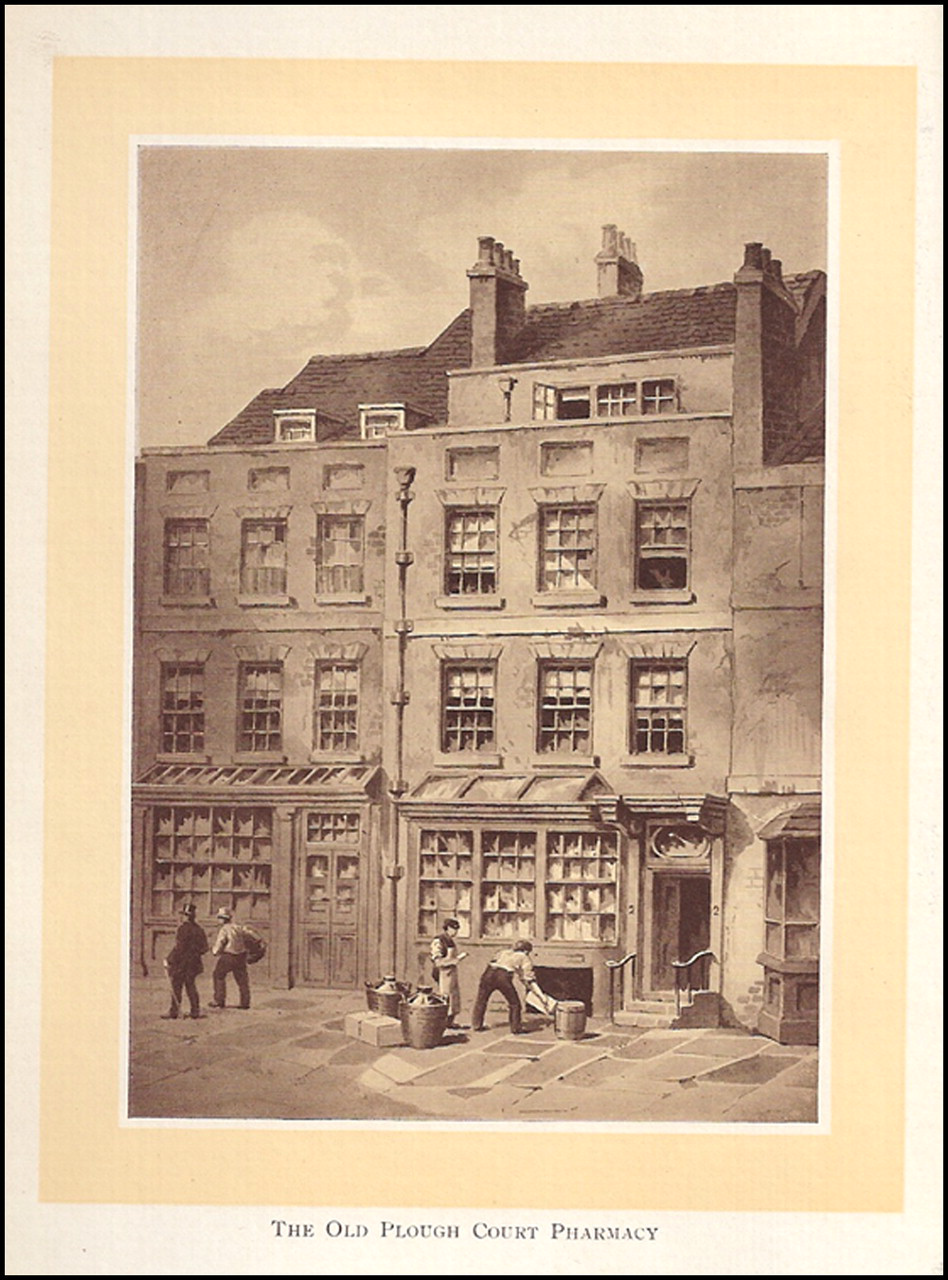
The success of his business was due in no small part to his Quaker faith – a faith whose principles included honesty and fair-trading. The turnover was probably thousands of pounds each year, a considerable amount in the early 18th century. 3 Silvanus was joined by his brother Timothy (1704–86) who also qualified as an apothecary. William Cookworthy (1705–80) was apprenticed to Silvanus Bevan, joined him as a partner in 1726 and managed a Plymouth branch of the business. Cookworthy was known for finding the ingredients of Chinese porcelain in the china clay and moorstone of the Cornish moors. 4
Through Quaker contacts the firm supplied medicines to North America, principally Pennsylvania, and Bevan was one of the London agents negotiating the site for the Pennsylvania Hospital with William Penn's son, Thomas. 5 In 1725 Silvanus Bevan became a Fellow of the Royal Society, being nominated by Henry Heathcote, and he served on the council of the Royal Society in 1729 and became known as the ‘Quaker FRS’. 5
Bevan as a medical practitioner
With the arrival of Timothy Bevan at Plough Court, Silvanus became less involved in the pharmacy and more active as a medical practitioner. Despite the lack of a (contemporary) formal medical training, apothecaries were allowed to treat patients provided they charged for only the drugs they prescribed and not for the consultation. The reasons for this were practical. Apothecaries were larger in number and more accessible to their patients than were the handful of physicians in 18th-century London. The precedent had been set following the Rose case that was settled in 1704. William Rose (fl. 1693–1705) was an apothecary accused by the Royal College of Physicians of practising without an appropriate licence. Initially the Court favoured the College but the House of Lords reversed the ruling, in effect allowing apothecaries to act as general practitioners. 6
As a Fellow of the Royal Society, Bevan became more involved in its activities. He submitted a paper in 1743 entitled ‘An account of an extraordinary case of the bones of a woman growing soft and flexible’ which was published in the Proceedings. 7 In the paper he described postmortem findings that indicated a knowledge of morbid anatomy. The case appears to have been an account of diabetes with a painful peripheral neuropathy and eventual osteoporosis. The patient's husband said that in life she was five feet tall but when Bevan measured her at postmortem she was but three feet seven inches in length!
Silvanus Bevan was also interested in inoculation and engaged in a correspondence with James Jurin (1684–1750) who had collated anecdotal accounts of the use of inoculation from practitioners in England and Wales, and presented them in tabular form. 8 Jurin's work indicated that inoculation offered protection from smallpox although the scientific methods used were not ideal.
Further development of Plough Court
Silvanus Bevan had no direct heirs so the control of the business fell into the hands of his brother Timothy. When Silvanus died the business became Timothy Bevan and Sons, Druggists and Chymists, Plow Court. 2 Timothy's two sons were not to promote the business. Timothy's elder son Silvanus left the firm to become pivotal as a banker in what became Barclays Bank and the other son, again called Timothy, died. These sons were born to Timothy Bevan and Elizabeth Barclay who Timothy had married in 1735. After Elizabeth Barclay's death, Timothy married Hannah Springhall and it was their son Joseph Gurney Bevan (1753–1814) who took over the business. Joseph Bevan continued the business of wholesale and retail pharmacy, and also became involved in the distribution of textiles to Europe. 9 He retired from the business in 1794 when it had become less profitable, perhaps as a result of his religious beliefs which eschewed profit and included his generosity. 10 The firm was taken over by Samuel Mildred from July 1794 to January 1795 but he was bought out by William Allen (1770–1843) who had been a clerk to Joseph Gurney Bevan.
William Allen, another Quaker, was born in Spitalfields, London, the son of a silk merchant. Allen proved a more astute businessman than Bevan and the business flourished once again. Allen took on John Thomas Barry (1789–1864) as a partner; he had been a clerk to the business who, usefully, had a medical background. 9 Further management help became necessary and two partners were appointed. Daniel Bell Hanbury (1794–1882) and Cornelius Hanbury (1769–1882) joined the Plough Court pharmacy; both the Hanburys were nephews of William Allen who had married their father's younger sister Charlotte as a second wife.
Silvanus Bevan – the final years
The Morris letters edited by JH Davies in 1907 provides knowledge of his final years. 11 There were three Morris brothers who were prominent Welsh intellectuals and involved in the organization of the Welsh society, the Cymmrodorion. The letters note meeting Silvanus Bevan at his home in Hackney. He was hospitable and lived well on good food and drink. He was an enthusiastic gardener and his house was home to a large library and a collection of ceramics. Silvanus Bevan was also a skilled carver of ivory, the most notable of his carvings being one of William Penn which he carved from memory.
On 5 June 1765 Silvanus Bevan died. He was buried in Bunhill Fields, the Quaker burial ground in Islington, North London.
Footnotes
Acknowledgements
I am indebted to Mr Martin Willson for introducing to me the MA thesis of Margaret Fay Williams entitled ‘The Society of Friends in Glamorgan 1656–1900’, which provided valuable background information. 12 As ever, the Librarians of the Princess of Wales Hospital in Bridgend obtained references with unstinted diligence.