




Abstract
George Cheyne was a well-known physician with a practice in Bath and London. He was a fat, jovial Scotsman weighing 32 stone at one time and with a great sense of humour who could be classed as one of the characters of the period. His health suffered seriously from eating and drinking too much in taverns with his ‘bottle companions’ when young, and he spent the rest of his life writing books for the public to help them avoid the problems he had experienced, with a particular emphasis on diet and nervous disorders. His book entitled An Essay on Health and Long Life had particular success. Although often lampooned, he had many famous patients including Beau Nash, Samuel Richardson, The Countess of Huntingdon and Catherine Walpole, the eldest daughter of the Prime Minister Robert Walpole. He was a skilled and caring doctor and health educator, and has been said to have established the agenda for psychiatric epidemiology.
Introduction
George Cheyne was a well-known and well-respected physician, practising in Bath and London in the first half of the 18th century.
This is by no means the first publication on Dr Cheyne. 1–5 Other valuable insights into the life of Cheyne are to be found in the prefaces to editions of his letters. Mullett edited Cheyne's letters (1730–39) to Selina, Countess of Huntingdon (1707–91), providing an excellent background and overview in his introduction. 6 Mullett also edited and provided an introduction to the 1943 publication of Cheyne's letters (1733–43) to Samuel Richardson (1689–1761), the author and publisher. 7 In 1991 Porter published an insightful and scholarly preface to an edition of Cheyne's The English Malady, focusing on the status of ‘nervous’ and mental health problems in the 18th century and setting George Cheyne's life and work in this context. 8 Guerrini considers Cheyne's life and work in the context of obesity and depression in the 18th century within a philosophical framework and compares it with the present day situation. 9
George Cheyne was a prolific writer for the lay public at a time when there was an increase in interest in personal health. In 1600 William Vaughan (1575–1641) laid the foundations by writing a book entitled Naturall and artificial Directions for Health, giving very specific advice to the public on maintaining their own health. 10 In 1747 John Wesley (1703–91) published Primitive Physicke, providing information to the lay public on treating their own minor ailments without the need to consult a doctor. 11 Both authors' publications were very popular and ran to many editions. George Cheyne's publications fit between those of these two authors and the three provide a most interesting background to changing social conditions, medical beliefs and attitudes to health over the period.
George Cheyne's specialties
The two aspects of health of particular interest to Cheyne were diet and nervous disorders. Not only did he write about these and become well known for specializing in them, he had personal experience of each.
Diet
Among the affluent, over-indulgence in rich food seems to have been the norm in the early 18th century. George Cheyne, who battled with his own obesity problems throughout his life, advocated a simple diet and small amounts of food and drink. He recommended moderation in all things and a temperate life. This level of abstemiousness was not to everyone's taste although he rarely advocated radical diets that excluded all meat and alcohol except in the case of very serious illnesses. 12
Nervous disorders
Hysteria, hypochondria, melancholy, ‘the vapours’ and depression, were all in varying degrees ‘fashionable’ at that period and George Cheyne dealt with them all and with other mental health problems, serious and less serious, as true illnesses of the body that could be treated as any other illness. He recommended prevention rather than cure and his key to this was moderation in everything. He was entirely modern for his time, having completely rejected the long-established principle of the humours as so much rubbish. He believed in the body as a machine and devoted his attention to this aspect, focusing on diet, the food used to keep the machine running properly. 13 He also recommended exercise, especially riding. However, he did sometimes use drugs, often as purgatives.
Reputation
It has been said that George Cheyne cannot be considered an outstanding figure in medical history, having ‘made no prime discovery, established no new school of thought and left no scientific or philosophical works of enduring quality’ 14 but he had a strong following at that time and many famous patients. Although many doctors did not agree with his views, his books were written for a lay audience and were very popular. Much of the basis of his advice has proven to be sound and there is no doubt that his recommendation of a simple diet and prudent middle course in all aspects of life to reduce stress would meet with much approval today.
Life
George Cheyne was born at Methlick, Aberdeenshire, in 1671 or 1673. 15 Little is known about his family and even the date of his birth is uncertain. In his own words, he was born ‘to healthy Parents in the Prime of their Days, but disposed to corpulence by the whole Race of one Side of my Family’. 16 This family weight problem dogged him all his life. In fact, it could be said to have been the trigger to his life's medical work.
By his own account, he passed his youth in ‘close study, and almost constant application to the abstract sciences (wherein my chief pleasure consisted) and consequently in great temperance and a sedentary life’. 17 Originally intended for the Church, he was educated first in Aberdeen and having changed his allegiance to medicine went to Edinburgh to study with Sir Archibald Pitcairn (1652–1713). 18 He moved to London in late 1702 and was admitted a Fellow of the Royal Society in that year. 19
London must have been fun in those days for a 29-year-old physician, especially one as witty and companionable as George Cheyne and he, by his own account, soon fell in with a group of ‘Bottle-companions, the younger Gentry, and Free-Livers’. 20 He cultivated this set partly to promote his practice but also because he enjoyed their company and eating and drinking with them in the taverns and coffee houses. He made friends easily he says, ‘nothing being necessary for that purpose, but to be able to eat lustily, and swallow down much Liquor; and being naturally of a large size, a cheerful Temper and Tolerable lively imagination, and having in my Country Retirement, laid in store of ideas and facts, by these Qualifications I soon became caressed by them and grew daily in bulk, and in friendship with these gay Gentlemen and their Acquaintances’. 21 He has been described as ‘Scotchman [sic], with an immense broad back, taking snuff incessantly out of a ponderous gold box, and thus ever and anon displaying to view his fat knuckles: a perfect Falstaff, for he was not only a good portly man and a corpulent, but was almost as witty as the knight himself, and his humour being heightened by his northern brogue, he was exceedingly mirthful. Indeed he was the most excellent banterer of his time, a faculty he was often called upon to exercise, to repel the lampoons which were made by others upon his extraordinary personal appearance’. 22 His wit was well known in the coffeehouses. For example, a conversation is recorded thus between Dr Cheyne and an even fatter acquaintance, Mr Tadlow: ‘Cheney coming into the coffee-house one morning and observing Tadlow alone and pensive asked him what had occasioned his melancholy? Cheney, says he, I have a very serious thought come athwart me, I am considering how people will be able to get you and I to the grave when we die. Why, says Cheney, six or eight stout fellows may take me there at once; but it is certain you must be carried twice’. 23
Macmichael said of Dr Cheyne that at this stage in his life ‘his hours days and nights, were divided betwixt his patients and the punchbowl’. 24 But all was not well. George ‘grew excessively fat, short-breath'd, lethargic and listless’. 25 He was not so clear in his faculties, nor so gay in his temper. He suffered from numerous illnesses, including autumnal intermittent fever, vertiginous paroxysm, vertigo, constant violent headaches, giddiness, lowness, anxiety and terror. He stopped eating suppers, ate very little ‘animal food’ at dinner and drank very little fermented liquor. ‘All my bouncing, protesting, undertaking companions forsook me, and dropt off like autumnal leaves: they could not bear, it seems, to see their companion in such misery and distress, but retired to comfort themselves with a cheer-upping cup, leaving me to pass the melancholy moments with my own apprehensions and remorse’. 26 George moved alone to the country.
It was a most peculiar period of his life that coloured much of his ensuing thought and practice. He appears to have lived very frugally and taken numerous drugs, mainly mercury, and had frequent vomits, then considered to be valuable. In his own words: ‘While I was forsaken by my Holiday Friends and my body was, as it were melting away like a snowball in Summer, being dejected, melancholy and much confined at Home, by a course of mineral medicines and Country Retirement, I had a long Season for Meditation and Reflection … that I concluded myself infallibly entering into an unknown State of Things’. 27 Always a religious man, he appears to have spent much of his time reading and pondering on religion and philosophy, particularly as it affected his own life. In an attempt to get well, he went on a milk diet, devised and followed by an anonymous Dr Taylor in Croydon. 28 It seems to have worked and Dr Cheyne lost weight, regained his health and returned to his practice. He described himself at this stage as ‘extremely reduced in my flesh, and was become lank, fleet and nimble’. 29 At first he followed a diet of milk, vegetables and fruit, but he slowly relapsed and by the age of 51 was drinking two or three pints of wine a day, eating large dinners and his weight had increased again to over 32 stone (448 pounds). 30 He found it difficult to walk about and impossible to climb stairs without ‘extreme pain and blowing’. A servant had to follow him with a stool so that he could sit down when walking became too much for him. 31 Not surprisingly he became ill again.
Once again he tried the milk and vegetable diet but with limited success and by 1724 he thought he was not long for this world. It was in that year that he published An Essay on Health and Long Life, probably his most popular book. 32 In 1725 he consulted various eminent London physicians including Dr John Arbuthnot (1667–1735) and Dr Richard Mead (1673–1754), 33 and by 1732 he reported the beginning of his perfect recovery and, apparently by following a very strict diet, he appears to have enjoyed good health for the rest of his life. His diet included milk, tea, coffee, bread, butter, mild cheese, fruits, nuts and tender ‘roots’, including potatoes, turnips and carrots. He drank no wine or liquor, but ‘sometimes a glass of soft small cider’. 34
He married Margaret Middleton, sister of Dr Middleton of Bristol, and they had one son, John, 35 and at least two daughters, Frances and Margaret. 36 He set up a practice in fashionable Bath. People were becoming more aware of the causes and treatments of diseases and demanded more of their physicians and, with their increasing knowledge, wanted to take more control of their own health. 37 Dr Cheyne's principles came at an opportune moment, suiting this new personal health consciousness very well. Thus his writings and practice had a wide following.
George Cheyne's life, after he took control of his own health, although by no means completely free of illness, appears to have been happy and successful. He did not rise to great heights in the medical profession but was a caring and considerate doctor, sensitive to his patients' feelings and personal needs as well as to their medical condition. Using the treatments available to him at that time together with his patient-centred advice, he was greatly respected by many of his patients and as successful in treating them as any general practitioner of that period could hope to be. A portrait aged 59 years (Figure 1), painted by Johan Van Diest in 1732, shows him as a serious and affluent figure with a twinkle in his eye and a humorous curve to his mouth. His fun and humanity never left him, no matter how successful he became. The Figure is a mezzotint of Van Diest's portrait by John Faber the younger. The original portrait cannot be located.
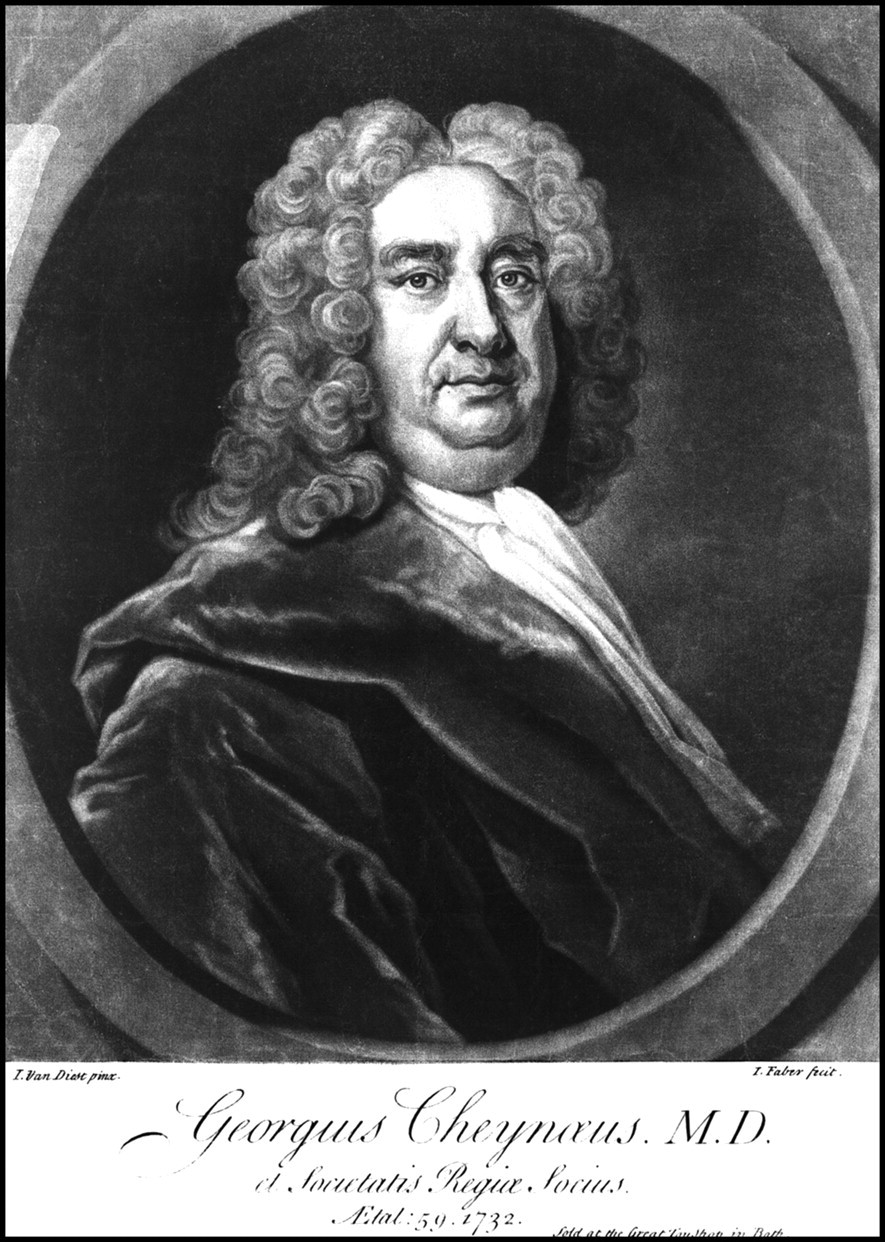
Dr George Cheyne, aged 59 years, 1732. A mezzotint by John Faber, the younger, from a portrait painted by Johan Van Diest. Courtesy of the Wellcome Library, London
He died in 1743, aged 71 or 72 years and was buried at Weston, near Bath. 38 He was survived by his wife, who died in 1752, his son until 1768 and his two daughters. Official and unofficial obituaries for him abound. For example, in The London Magazine he is described as ‘a Person of great Learning and Abilities, an eminent Physician, and famous for his several Writings’. 39 Less formally, one of his patients described in verse her deep sense of loss on the death of a caring and skilled physician:
He saw, heard, pitied, paused and smiled serene,
Aid in his eye! Compassion in his mein!
Heard me long years of aidless anguish moan!
Physicks last labours! Dear bought skill unshown!'
Heard my sad sighing heart's long weary tale,
Traced its dark cause and hit the unheeded nail. 40
Writings
George Cheyne was a prolific writer of books and letters; the books set out his principles and the letters show how he applied these principles in the treatment of his patients. Although he intended his books for the lay public, he wrote: ‘I never entertained the most remote vanity to think any endeavour of mine would make so considerable a change in the nation; especially where the Devil, the World and the Flesh were on the other side of the question’. 41
The New Theory of Continual Fevers (1702)
Cheyne's first book, The New Theory of Continual Fevers (1702), 42 set forth a theory that fever is due to either obstruction or dilation of the canals of the body. He was not proud of this early publication, considering it to be ‘raw and inexperienced’ and not worthy of revision later in his life. Much the same applied to his next, a very mathematical work, Methodus Flexionum Inversa (1703). 43 The first part of Philosophical Principles of Religion followed in 1705, to be completed in 1715. 44
An Essay on the True Nature and Due Method of Treating the Gout (1720)
It seems that An Essay on the True Nature and Due Method of Treating the Gout (1720) 45 was published almost by accident. Dr Cheyne had written the information and advice on gout for his friend, Richard Tennison, but unauthorized copies were made and circulated and so Cheyne decided to publish the treatise officially. He describes gout as ‘tartarous, urinous and other salts, which have been introduced into the blood, blocking the tubes of the body that have become narrow and stiff. The pain is worst at the joints where the tubes are compressed’. As treatment he recommends first, Exercise, but not too much to cause excessive eating to replace the energy used; second, Diet, which excludes all red meats; third, Evacuations such as purges; fourth, Drugs, especially recommending sulphur; and fifth, Waters, especially those from Bath. His message throughout is that of temperance. It proved to be a very popular book and ran to eight editions.
An Essay of Health and Long Life (1724)
The publication An Essay of Health and Long Life (1724) 46 appears to have been a genuine attempt, based on his own experience, to help his patients and others to take control of their own health at a time when the affluent society in which he lived and worked ate and drank not wisely but too well. He originally called it A Treatise on Sanity and Longevity but his publisher refused to publish it under that title. His theme is that prevention is better than cure and that temperance is the key to prevention. He recommends moderate exercise and emphasizes that in the absence of exercise a person needs less food. Much of the content is devoted to food and drink and he has something to say, either for or against almost every food and drink item that would have featured in the diet of affluent people in the early 18th century. He suggests eight ounces of meat, 12 ounces of vegetables or bread and a pint of wine a day is sufficient for an ordinary man in a non-manual occupation but that old people and those in sedentary occupations need less. He infers that health problems in later life and the short lives of Englishmen are due to repletion. He is against the overuse of alcohol, especially spirits and punch, although he makes the point that his intention was not to ‘discourage the innocent means of enlivening conversation, promoting friendship, comforting the sorrowful heart and raising the drooping spirits by the cheerful cup and the social repast. Persons sober in the main will receive little prejudice from such a fillip when the occasion happen but seldom.’ 47 Throughout the book, temperance is the main theme.
For such a fat man to be writing about diet was considered by some of his contemporaries to be absurd and he was widely criticized, for example ‘three ells round huge Cheyne rails at meat’ says Edward Young (1683–1765) in Epistles to Mr Pope. 48 However, George Cheyne's Essay on Health and Long Life ran to seven editions, was translated into Latin, French and German, and was published again under a different title, in 1827, more than 80 years after his death. 49
The English Malady (1733)
The book The English Malady (1733) 50 deals with Cheyne's other main interest, nervous disorders as they were perceived and indeed fashionable, in the early 18th century, especially among the affluent classes. The first section presents Cheyne's views on nervous disorders and considers how the sufferer can learn to cope with problems and make the best of their life. Not unexpectedly, he also implies that such problems are caused, or at least exacerbated, by over-eating and over-drinking. In the second section he presents his ideas on the treatment of nervous disorders. The suggestions are, of course, very much of their time, for example calomel and antimony, Jesuit's bark, and purgatives combined with iron.
He also describes the symptoms of various nervous disorders. Two points of particular interest, considering the date when the book was written, are that Dr Cheyne pointed out that patients with illnesses of this kind are rarely told the nature of their illness and that he recommends the patient take up a hobby or an interest. Finally he describes his own personal case. One of his conclusions is that such problems are caused by ‘modern life’. Many of Cheyne's patients were referred to him for nervous disorders and it is clear from his letters that he put into practice the theories he propounds in this book. His attitude to melancholy, a ‘popular’ illness in the 18th century, prompted Dr Samuel Johnson (1709–84) to write in a particularly irritable letter dated 2 July 1776 to James Boswell (1740–95) who has obviously claimed in his previous letter to be having ‘black fits’: ‘Read Cheyne's English Malady, but do not let him teach you a foolish notion that melancholy is a proof of acuteness’. 51
Essay on Regimen (1740) and The Natural Method of Cureing the Diseases of the Body and the Disorders of the Mind Depending on the Body (1742)
Although Dr Cheyne would probably have hotly disputed it, the two last publications of his latter years, Essay on Regimen 52 and The Natural Method of Cureing the Diseases of the Body and the Disorders of the Mind Depending on the Body, 53 seem the rather self-indulgent writings of an old man. Both books venture into the realms of philosophy and also re-emphasize and reassert his earlier messages on diet and temperance. John Wesley wrote: ‘I read part of Dr Cheyne's “Natural Method of curing Diseases;” of which I cannot but observe, it is one of the most ingenious books which I ever saw. But what epicure will ever regard it? for the man talks against good eating and drinking!’ 54 Nevertheless, it ran to five editions and was translated into French.
Aphorisms and sayings
Dr Cheyne was very fond of aphorisms, 37 formal ones and many others being scattered throughout his writings. They typify Cheyne's laconic mode of expressing his views as well as highlighting some of his messages on diet, medicine and contemporary society, for example:
Fine folks use their physicians as they do their laundresses, send their linen to them to be cleaned in order only to be dirtied again; Fermented or distilled spirits are the true Pandora's box; He that would have a clear head must have a clean stomach; This universal infirmary, Bath; Life is not weak enough to be destroyed by this pop-gun artillery of tea and coffee; He that would be soon well must be long sick, that is, treat himself as a valetudinarian in most things; He that is old when he is young, that is, treats himself as a wise old man does or ought to do, by great temperance, air and exercise, if he lives past thirty-five will be young when he grows in years; Nothing conduces more to health and long life, than abstinence and plain food with due labour; A constant endeavour after the lightest and the least of meat and drink a man can be tolerably easy under, is the shortest and most infallible mean to preserve life, health and serenity; The diseases brought on by the passions, may be cured by medicine, as well as those proceeding from other causes, when once the passions themselves cease, or are quieted. But the preventing or calming of the passions themselves, is the business, not of physick, but virtue and religion.
Patients
George Cheyne had a large practice and was a very popular physician with the rich and famous of the period. These included Richard (Beau) Nash (1674–1762), Selina, Countess of Huntingdon (1707–91), Samuel Richardson (1689–1761) and Catherine Walpole (1703–22), daughter of Robert Walpole (1676–1745) who became Prime Minister, and many others. Dr Samuel Johnson (1709–84) read and respected Cheyne's books and John Wesley (1703–91) was a great believer in Cheyne's principles and acknowledges his influence in his own book Primitive Physicke. Wesley also attributes some of his own good health at the age of 68 years to following Cheyne's advice. 55
Beau Nash and George Cheyne were old sparring partners. ‘It is well known that Mr Nash and Dr Cheney had frequent disputes about the non-naturals and a vegetable diet, in short, they often reasoned about health until they made all the company sick’. 56 Nash though a great philosopher could never get the last word of the physician and therefore he frequently left him in a pet: ‘I was once at Morgan's Coffee-house, when the Doctor so harangued upon his vegetable diet that Nash could not bear it; but going up to the table where Cheney was, accosted him in this rude manner, You old fool, says he, do you think the Almighty sent Nebuchadnezzar to grass for his health? And then taking his hat, left the room. However, matters did not always end so abruptly; for I have known Nash in his cooler moments do Cheney the honour to say that “he was the most sensible fool” he ever knew in his life; and the Doctor with equal justice observed, that Nash was less of a blockhead than he used to be’. 57
There are many reports of banter between the two men. For example ‘Dr Cheney once, when Nash was ill, drew up a prescription for him, which was sent in accordingly. The next day the Doctor coming to see his patient, found him up and well; upon which he asked if he had followed his prescription? Followed your prescription, cried Nash, No – Egad, if I had, I should have broke my neck; for I flung it out of the two-pair of stairs window’. 58 Nash liked to go to bed straight after a hot supper ‘which induced Dr Cheyne to tell him jestingly that he behaved like other brutes, and laid down as soon as he had filled his belly. Very true, replied Nash, and this prescription I had from my neighour's cow, who is a better physician than you, and a superior judge of plants, notwithstanding you have written so learnedly on the vegetable diet’. 59
But, in spite their sarcasm and arguments, Nash chose Cheyne as his own doctor and after Cheyne's death in 1743 would have nobody else: ‘Since the jovial Cheyne had died the Beau had no more use for doctors than preachers’. 60
It is fortunate that George Cheyne was an inveterate letter writer since so much of what we know about his patients, their illnesses and his treatment of them is preserved in his correspondence.
Selina, Countess of Huntingdon was both a friend and a private patient of George Cheyne and their correspondence has both professional and social content. Selina married the Earl of Huntingdon in 1728. 61 She soon shocked and surprised her family and friends by becoming an ardent Methodist for the rest of her life. She was an intelligent if imperious woman, very sincere in her religion, who appears to have found in Cheyne not only a physician but also a mentor and friend. For example, in 1741 she wrote of a dinner with Dr Cheyne and his wife, Margaret, where they had spent the evening ‘in most pious and religious conversation, a thing hard to be found here’ and that he had been ‘talking like an old apostle. He really has the most refined notion of the true spiritual religion I almost ever met with’. 62 The Countess seems to have been frequently ill and often pregnant. In letters Cheyne provides not only medical advice but also comfort. For example, on 18 February 1733 he wrote: ‘Mrs Coles made me believe the physicians had called your complaint a gravel colic, which made me write as I did. Whatever it was, I am glad it is now over and that you are beginning to recover, which I never doubted of, for, though you had complaints that are frightful and sufficiently painful, yet I most sacredly assure your ladyship you have had nor can have any that is dangerous or mortal at your time of life, with your regularity and exactness.’ 63
On 14 April 1736 we see one of the many examples of his advice on diet: ‘Now, your late and former paroxysms have proceeded from two counts: 1. your frequent child bearing, by which you have not been able to continue your powderous and sweetening medicines, and 2. from too early attempts to enlarge and encrease your regimen … I allow this precise quantity is hard to find, and I know no so certain a rule to go by as to take down the
Samuel Richardson, editor and publisher, is probably best known as the author of Pamela (1740), Clarissa (1747) and Sir Charles Grandison (1754). As a result of his work, from 1740 when Pamela was published, Richardson seems to have been catapulted from a very private life, which he preferred, to great public notice and acclaim. He was never a well man and he greatly valued Cheyne's advice in his quest for health. Unusually for that period, he was already a vegetarian and water-drinker. Many of his health problems seem to have been nervous disorders that he attributed largely to overwork: ‘I had originally a good constitution. I hurt it by no intemperance, but that of application’. 65 Cheyne's letters to Richardson contrast with those to the Countess of Huntingdon. The latter are those of a doctor to a patient who was a young married woman of the nobility. The letters between Cheyne and Richardson are correspondence between friends and equals. They talk of Cheyne's family and often thank Richardson for gifts of oysters. Rude remarks about publishers and printers abound, for example describing Strahan as ‘a poor-spirited, little-minded creature that loses many sheep [sic] [ships?] for a half-pennyworth of tar’. 66 Cheyne recommended to Richardson the chamber-horse for exercise and its seems he took his advice because Cheyne's next bright idea is that Richardson should get an amanuensis and dictate to him while exercising on the horse. 67 The letters were not intended for publication. Cheyne told Richardson: ‘Be sure you destroy all my letters when perused, for though I value little what the present or future World of this State, thinks of me, yet for my Family's Sake I would not be counted a mere Trifler, as those long Nothing-Letters, merely to amuse you, would show me.’ 68
Richardson so much valued Cheyne's advice for his health that he kept all Cheyne's letters bound in a notebook in the front of which he stated ‘This Book and the Letters in it, on no Terms or Consideration, whatever, to be put, (or lent) into such hands, so that it may be printed, or published. S. Richardson August 11, 1744’. They were published and make very interesting reading, not only for what they tell us about medicine and publishing at that period but also for their insight into the personalities of both Cheyne and Richardson.
Catherine Walpole, the eldest daughter of the Prime Minister, Sir Robert Walpole, was one of George Cheyne's most interesting patients. She was 16 years old in 1720 when she fell ill and was sent to Bath by Walpole's physician, Sir Hans Sloane (1660–1753), who referred her to George Cheyne, probably because of his interest in diet. Catherine had become unable to eat and was rapidly losing weight. It has been suggested she might have had anorexia nervosa although acknowledging how difficult it is to make a post-diagnosis without evidence to build on. 69 Cheyne's letters to Sloane contain much information to suggest her lack of appetite had a physical rather than a psychological cause. Perhaps it was some type of cancer, perhaps a lymphoma, but again at this distance it is impossible to say. A swelling in her side was very painful and throbbed through her stays. After eating a meal, she was bloated, sick and in pain, so much that she often fainted and usually had to lie down for about three hours after eating. It is easy to follow the case and Cheyne's treatment of it because he wrote constantly to Sloane, presumably so he could keep the parents informed. These letters are preserved in the British Library and it is an amazing experience and privilege to read them in Cheyne's handwriting. 70,71 Catherine died at Bath in October 1722 when she was 18 years old. The story provides so much information on treatments, Cheyne's concern for quality of life and Catherine's indomitable spirit. 72
Conclusion
Much has been written of what George Cheyne was not. ‘It would be idle to suggest that Cheyne warranted a place with Hippocrates, Harvey or Ehrlich on some medical Mount Olympus … True he was no village Pasteur, no mute, inglorious Galen, and anyone who attempted to blow him up to Olympian proportions would deserve only scorn.’ 73 But even the writer of those two comments seriously qualifies them; ‘Moreover, if his place is not at the top in medical history, one should not overlook the fact that in his own day George Cheyne appeared to many people of admitted competence a veritable apostle of Aesculapius. The judgement of later generations must not be allowed to supersede entirely a man's contemporary reputation’. 74 Another writer says ‘ By insisting that the troubled spirit lay in sociopathology, Cheyne established the agenda for what would eventually become psychiatric epidemiology’. 75 ‘He preached temperance to an intemperate generation and – as he himself says – such a one is never popular. He doubtless rode his hobby too hard, and too far, but was always on the better side of the error’. 76
His contemporaries considered him to be ‘a learned physician, a sound Christian, a deep scholar, and a warm friend’. 77 He was a man worth remembering and appreciating, not only for his work but also as a person who made the quality of 18th-century life all the richer by his personality.