




Abstract
From Appia's writings we compose a view on his contribution to international medical relief in warfare, to the establishment of the Red Cross and the Geneva Convention, and to surgical procedures on the battlefield. Much information comes from his work on the Battle of San Martino e Solferino in June 1859 on the subject of which he wrote seven letters. We report also on his role during the Garibaldinian Campaign in 1866 and his work in Europe as a member of the International Committee of the Red Cross (ICRC).
Introduction
Louis Appia was born in Hanau, near Frankfurt am Main, on 13 October 1818. He came from a Turin family linked to the religious Waldensian movement. Around 1000 AD when Claudio (d. 827) was Bishop of Turin, a school was formed in Piedmont upholding reform of the Church. Pierre de Bruyes (1095–1131) and Lombard Henri were condemned to the stake in 1124 and 1148 for advocating the Bible as the sole reference for religion. Subsequently in Lyon Pierre Valdes (1140–1206) translated the Bible and founded a popular brotherhood, the Poor of Lyon, advocating the right to preach the Gospel. They were influenced by Martin Luther (1483–1546) and supported by Farel (1489–1565) and Calvin (1509–64). They travelled all over Europe, fighting for and preaching their ideals despite persecution and the Inquisition.
Subsequently these Vaudois of the Alps found a refuge in Geneva, a city of the new faith. Louis' father, Paul, was born on 4 May 1782 in Torre Pellice near Turin. He was a Minister of the Gospel and studied theology in Geneva 1 and in 1811 went to Hanau as a pastor. His simple and fraternal religion drew inspiration from these heroic predecessors and from charity. Louis was born when his father was called to Frankfurt to sit at the Federal Diet and serve the French Evangelical Church, founded by French refugees from the Netherlands during the struggles of the Reformation. His mother, Charlotte Develay, was from a Swiss family and dedicated herself to the poor and the sick.
Education
Louis' education was influenced by religion, the humanitarian work of his father and his mother's aptitude for philanthropy. As a boy his life was divided between the Presbytery and holidays in Switzerland. After Frankfurt College, Louis studied in Geneva in order to enter the academy. He read Rousseau (1712–78) and Madame de Staël (1766–1817), Sismondi (1773–1842), the author of the Written Constitutions of Free Peoples, and Charles Pictet de Rochemont (1755–1824) who negotiated the conventions to restore traditional Swiss neutrality following the fall of Napoleon. He studied social problems from the books of Dumont, a pupil of Bentham (1748–1832) and from the texts of Jean Baptiste Say (1767–1832). In particular Alexandre Vinet (1797–1847), who had given the Protestant Churches new impetus, influenced him. Though deeply religious, Louis did not become a Minister of God like his brother, Georges. Influenced by his father's dedication to the wounded during the Battle of Hanau in 1813, Louis leaned towards a vocation in medicine and in 1838 he returned to Frankfurt and began studying at Heidelberg University. During this period he became enthusiastic about promoting the unity of the German Confederations where feudal servitude persisted.
Medical training
In 1843 Louis obtained a degree in medicine and was depicted by the painter Adolphe Potter (1835–1911) 2,3 as a tanned young gentleman with deep and penetrating eyes (Figure 1). In 1848, during the Second Republic in Paris, he participated in the rescue of victims of repression. Helping to transport those with shock due to fractures, he learned that transport can aggravate suffering and later he would invent a system of containment for fractured limbs. 4 He practised medicine in Frankfurt and, following the death of his father, left Germany and settled in Geneva with his mother, uncle and two sisters – one married to the painter Gabriel de Beaumont (1811–87) and the other to a shepherd, Jacques Claparède. He practised as a medical officer, the first in the country, near Jussy, and then in Geneva. In November 1853 he married the 19-year-old Anne Caroline Lasserre and they lived near the Cathedral of Saint Pierre. In this period he met Dr Maunoir (1806–69), 12 years his senior, who had studied medicine in England and France. On his advice Louis joined the Geneva and Neuchâtel medical societies and the Geneva Society of Public Utility.

Picture of Louis Appia (by A Potter), 1862
The Crimea and the Battle of Solferino
The Crimean War (1853–56) had a profound impact on these two doctors: it was the first modern war, fought with oblong or oval rather than spherical bullets, a new kind that almost always required amputation of wounded limbs. The death count was high on both sides: the Allies suffered 150,000 dead or missing and the Russians more than 100,000. In addition fever, typhus, cholera and scurvy raged.
Newspapers wrote of Florence Nightingale (1820–1910). Tolstoy in Memories of Sevastopol described the soldiers' condition: ‘The large, high and shadowy room, illuminated only by four or five lamps with which physicians approached the injured to examine them, was literally cluttered … nurses with serene faces and expressions full of pity … passed busily between bloodstained coats and shirts, stumbling up and down among the wounded …’. While Appia was working as a medical officer he published Le pardon de la dernière heure and before leaving for Italy wrote Le Chirurgien à l'ambulance pratiques ou quelques études sur les plaies par armes à feu, printed in Geneva in 1859. 5
During the Battle of Solferino in 1859, the Geneva Evangelical Society for the Relief of the Injured sent many nurses as volunteers. Appia, as a surgeon, helped wounded soldiers; he arrived in Turin on 3 July after a long and arduous journey. Trains were slow, irregular and crammed with war supplies, as he wrote to his friend Maunoir in letters describing day-by-day occurrences while from Milan news of the battle and the subsequent drama of transporting the injured also reached his friend. Appia volunteered as a surgeon and supervised relief distribution. He also became interested in the ideals of freedom that had appealed to him since youth.
Appia visited hospitals in Turin and Milan, and on 10 July he was at Brescia and Desenzano 6 where he met Hippolyte Larrey (1808–95), medical head of military health and son of the famous surgeon of the Napoleonic army, Dominique Jean Larrey (1766–1842). Appia wrote of the many amputations carried out without anaesthesia and, following a death due to chloroform, when available cognac and rum were used. He also denounced as illogical (causing extreme tiredness) the bloodletting widely thought to relieve fever and agitation. Medical interests aside, Appia became enthusiastic about the freedom of the Italians, resenting hatred and enmity between Italy and Austria since he admired both nations.
While Appia was at a French military parade, he could not help noticing the contrast between the impressive artillery and regiments and the hunger of the soldiers. After the parade, only leftovers remained once the sovereigns and their entourage had satisfied their appetite (letter dated 15 July 6 ).
Appia's surgical experience during the War of Independence compelled him to write ‘Lettres à un collegue sur les Blessés de Palestro, Magenta, and Marignano Solferino’, the colleague being Théodor Maunoir. Appia described the tragic situation of the injured and the inadequacy and disorganization of medical relief. However, these deficiencies were soon overcome thanks to the spontaneous and generous hospitality of the locals. 7 The first hospital was in the cathedral which suspended religious services and admitted more than 660 wounded who lay on straw mattresses on the bare floor, proper mattresses being reserved for the more seriously wounded. According to the Felice Grondona in ‘The Military Hospitals in Milan and Brescia in 1859′, 8 in Brescia 32,916 soldiers were cared for including 17,375 French, 13,759 Italian and 1612 Austrian. The wounded totalled 13,151 and the dead 1273. Vittorio Emanuele (1820–78), King of Sardegna and later of United Italy, recognized the meritorious work of Appia by nominating him as Knight of the Mauritian Order. 9–11
Geneva and more philanthropy
Back in Geneva, Appia published the second edition of The Chirurgien à l'ambulance, dealing with firearm wounds in general according to the affected part of the body. He proposed a method of immobilization of fractures to facilitate transportation and treatment. Then came the seven letters to his friend Maunoir. 7
Appia joined several philanthropic, religious and public interest associations. He delivered popular lectures on moral and religious subjects, and worked voluntarily for the Society of St Helena. In 1861 he became President of the Geneva Medical Society. When the Pontaniana Academy of Naples announced a competition for writing on one hundred aphorisms on the surgery of firearm wounds, Dr Palasciano (1815–91) encouraged Appia to make a submission and in due course he won the prize jointly with the Italian Dr Achille De Vita; they published their work in Naples in 1862 under the Manual of Military Surgery. 3
Appia's frustration with the inadequacy of medical relief in the military drew him closer to the thinking of Henri Dunant (1828–1910) who he met in the Geneva Society of Public Utility 12 that Appia joined in 1861 and Dunant a year later. In 1863 Appia was a member of the Geneva Standing Committee, consisting of the first five members of the Society for the Relief of Military Wounded, later the ICRC (Figure 2).

Commemorative postcard of the first ‘Five Committee’ members (1863)
Appia was tireless. In October 1863, during the Diplomatic Conference he insisted on the importance of an international badge and the Conference agreed, suggesting a white armband centred with the Red Cross symbol to be worn on the left arm. The ICRC officially gave Appia a white armband signed by Moynier in 1864. 13
The Schleswig-Holstein War in February 1864
In 1864 Appia represented the Geneva Society on the battlefield of the Schleswig-Holstein War when an army of 40,000 Prussians and 20,000 Austrians marched to the conquest of the two ducats. He represented the German side, Holstein, through a letter of endorsement from the Swiss Federal Council. 12 It was unprecedented in the Red Cross that the Committee for the Relief of Military Wounded sent a delegate. Although the diplomatic conference was in 1863, the Geneva Convention was not finalized until 22 August 1864. In March 1864 the Committee decided to have two delegates present at the conference, Van de Velde for the Netherlands in 1863 and Appia for the German side: Appia wrote: ‘Rapport adressé au Comité International par le docteur Appia sur sa mission auprés de l'armée allié dans le Schleswig. Genèvre 1864’.
The mission was without specific tasks. Appia had endorsement from the Swiss Federal Council, General Dufour, Moynier, Dunant and Dr Lehmann, a Swiss Army doctor. Appia left on 22 March 1864, taking with him the resolutions of the International Diplomatic Conference and 2000 francs for expenses. In Berlin the Prussian Committee greeted him courteously. On 28 March he was in Flensbourg where generals, senior officers and the Prussian, Austrian and Bavarian Wurttemberg doctors were meeting with their British and French colleagues. Appia was introduced to the Prussian Prince, General de Canstein and to Marshal Gablenz who read the resolutions. Also present were the Knights of St John of Jerusalem, the Charity Nuns and the young Deacons of Duisbourg. The Commanders approved of Appia always wearing his armband that made for easy identification (Figure 3). He took every chance to discuss the resolutions and operated on the wounded on the field regardless of nationality. During the Siege of Duppel, Appia observed how the Prussian wounded were well looked after while the Austrian allies did not have enough stretcher-bearers.

Red Cross armband of Louis Appia for three campaigns (Schleswig 1864, Italy 1866 and France 1870) with the signature of G Moynier, President of the ICRC
During the Garibaldian Campaign in Trentino in 1866, the Central Committee of Milan organized the rescue and asked the International Committee of Geneva for help and rescuers were sent from France and Switzerland. Back in Italy, Appia with his brother Georges tried to recruit 12 volunteers from the Evangelical Society but they could enlist only four. With endorsement from Dufour, Appia was allowed in Garibaldi's (1807–82) field, treating Garibaldi himself when he was wounded in his left leg in Monte Suello.
14
From the field Appia wrote five letters to Georges,
15
recounting transport with limited means and improvising a backpack for basic supplies. Appia expressed impressions and feelings with simplicity; he was unpretentious and enthusiastic about relief. In the fourth letter he describes the ideal volunteer:
I can see only one satisfactory solution … guide yourself with a sincere self-denial, do not ever impose yourself, but always be available, act quickly and intelligently, but with modesty wherever there is something to be done; be ready to retire when the work is better accomplished by someone else better qualified. Under these conditions, the work of volunteers will not only be possible but, after the first and very legitimate hesitations from superiors, will generally be welcomed and appreciated … As I write, one of my friends, M Jervis, keeper of a museum in Turin, a man of study and work, is in our hospital. There he spends his nights and when he is tired he lies down for a moment on a palliasse alongside the sick. He carries out the most modest work but he does so with the intelligence that comes from his education and with a self-denial that comes from his heart.
Major operations were planned by commander surgeons including Augustine Bertani (1812–66), head of the Military Ambulance of the Italian Volunteer Body. In Garibaldi's field there were no ambulances, only coaches and makeshift shelters because the army was constantly moving and the plans made in 1848 and 1859 could not be implemented.
Appia also describes a makeshift hospital, set up in Storo when St Catherine's Hospital became full, as well as a hospital in Brescia where treatment was considered the best. He describes care according to Nightingale's standards as well as penalties. In his third letter he writes of a surgeon of Brescia suspended for 15 days for amputating a thigh under precarious conditions in a hut in the mountains, with help only from farmers.
Sporting a Red Cross armband, Appia invoked the Geneva Convention when relief provided by the International Committee was ignored. At the end of the war, Garibaldi praised the Geneva Committee and personally thanked him. 16
While in Le Chirurgien à l'ambulance Appia seems in favour of amputation according to J Francois Piercy (1754–1825), in letters to Bezzecca he leans towards the conservation of limbs, first advocated in 1859, thus preferring resection to preserve the leg of a young soldier. Surgical treatment of wounds inflicted by new weapons – rifled artillery, cylindrical bullets – was focused on the limbs since treatment was ineffective for wounds of the chest and abdomen. Conservative treatment also resulted in higher survival rates and advocates included Rocco Gritti (1812–1920), Consultant Surgeon at the Maggiore Hospital in Milan and, during the war of 1859, Chief Consultant at the Military Hospital of San Francesco. 17 Another supporter was Lamberto Parravicini (1825–93), Surgeon and Chief Consultant at the Military Hospital in Saint Mary of Loreto and teacher of surgical pathology at the University of Pavia.
Appia, a skilful surgeon
We see in Appia a skilful and competent surgeon, yet modest and passionate about the relief of the wounded of any nationality. Even the Red Cross armband he proposed is a symbol of protection and neutrality. Henri Dunant, who asked Appia for advice in drafting Souvenir and on particular surgical techniques, praises Appia in Memories:
To avoid mistakes in the surgery here told, he [Dunant] appeals to a man of art, Louis Appia.
11
In the Committee, Appia continued his work in connivance with President Moynier. He was accepted but not always tolerated for his ‘excessive’ availability. He was denied official capacity on the battlefield in the Franco-Prussian War. For being overly sympathetic to rebels, refugees and prisoners, he was excluded from a mission in the Montenegro War. He was also excluded from official participation at the Geneva Convention of 1864. Appia, Dunant and Maunoir attended as listeners, their presence, along with Moynier and Lehman, known only from the speech of General Dufour (1787–1875). The Swiss Federal Council wanted to limit attendance to three of its delegates – Dr Lehmann, Head of the Swiss Delegation, General Dufour and Gustave Moynier (1826–1910) since other countries were represented by two at most. 18 After the defeat of Sadowa, where Appia and his fellows worked hard for the wounded on both sides, Austria followed by Saxony ratified the Geneva Convention.
A competition proposed by the Prussian Committee for the Relief of the Injured, in order to encourage private charities to care for armies in the countryside, was the inspiration for a theoretical treaty written by President Moynier and Appia together, ‘La guerre et la charité’ 19 and they won the competition.
In 1867 Appia published this treaty in Geneva. After a brief historical section it enunciates the principles spread by Dunant in the Souvenir 20 including the establishment of relief committees, their purpose, revenue, relationship with the state, logistics, moral, religious and intellectual assistance to the injured, and the international relationships of the Red Cross in times of peace and war. During the Summer, Appia returned to Paris where the Committee was awarded the Grand Prize at the Universal Exhibition, and General Dufour, Moynier and Dunant were awarded Gold Medals. When Dunant resigned from the Geneva Committee in 1867, his post as secretary was offered to Appia.
In 1868 a conference was held to review articles of the 1864 Convention, especially on maritime war, and in the same year the Statement of St Petersburg prohibited explosives in war. 21 The work of the Committee continued in Berlin in 1869, delivering proposals for the protection of war prisoners. On this occasion Appia met old friends and participated in exercises simulating relief in the field. After the death of Maunoir, a distant relative of Appia, Louis Micheli de la Rive (d. 1888) also joined the committee. Appia remained active in the International Committees and by 1870 there were 25 rescue societies and the Geneva Convention had become law in all the states of Europe.
On 15 July 1870 the French issued an ultimatum to Prussia. As the Committees of Paris and Berlin had long been operating in these countries, through General Dufour they expressed concern because both countries were supporters of the Convention and the Committee, which did not yet have a statute, did not want to be non-neutral. Appia hoped to act as a delegate but because war was declared on 19 July he had to attend rescue work in the Swiss city of Basel and on the battlefields. Appia obtained his passport from the Committee to go to the Prussian and French battlefields in an unofficial capacity to avoid offending sensibilities. With endorsement from General de Roeder, Minister of the North German Confederation, Appia left Switzerland for Karlsrhuhe, headquarters of the central committee of Baden. In Spire he met Doctor General Loeffler, signatory of the 1863 Resolutions and the Geneva Convention, and received permission to help the wounded on the battlefield and present the white armband of the Red Cross to Prince de Pless. After a heavy battle on 4 August, the wounded of Wissembourg, Woerth and Reichshoffen filled the hospitals. In despair, Appia telegraphed his wife who worked as a liaison officer with the International Committee, asking for 10 doctors and 20 volunteers.
Appia worked on relief throughout intense battles, making use of whatever means were at his disposal in creating makeshift beds and preventing further trauma in fractures during transport, though realizing it was difficult to maintain impartiality and safety from enemy fire. In Metz, relief was in four stages: transport by stretcher-bearers, preliminary treatment, transport by light ambulance and then by proper ambulance. On 1 September Sedan was defeated and four days later the Republic was proclaimed. Before Metz fell Appia moved to Chalons sur Marne where in the local hospital he oversaw about 30 doctors and nurses. In Paris his brother visited the wounded and sick, ran ambulances and organized help for the wounded on the fortifications of Bercy.
During this period Appia saw and became concerned about the fate of long columns of prisoners evacuated on rail wagons, ostensibly for security and military necessity, and he wrote to Moynier on implementation of the Convention. On returning to Geneva in December he participated in the Committee and joined Goustav Ador (1845–1928) and J Alfonse Favre (1815–90). New activities included the International Agency for Intelligence and Assistance of the Wounded and Sick of Basel (centred in Geneva), the Rescue Committee for Prisoners of War (Basel) and the Central Agency for Relief of Military Prisoners in Switzerland (Geneva). After the Fall of Paris, Appia and colleagues continued to deal with the results of the riots and on the anniversary of 26 October 1863 a medal was coined with one donated to Appia for his contribution to the Geneva Committee from its inception. It was also felt, especially after the Franco-Prussian War in which the Committee had great success, 2 that the history of the Committee should be recognized in a collection of documents.
At that time the Conference of the National Rescue Societies was criticized for intending to discuss political problems prematurely and for ascertaining whether the Convention was complied within war. As in non-compliance, moral conviction was considered insufficient. Appia, as the intermediary in the development of National Societies, and Moynier put in writing the creation of an Institute of International Law to regulate punitive action fairly among nations. This had immediate application in the dispute between the USA and England over the damages caused in Northern States from English-controlled corsair ships. A Swiss court imposed a penalty of several million dollars on Britain. 2
While in Cairo in late 1872 and in spite of intractable fever, Appia met Raoul Pictet (1846–1929) with whom he created an Egyptian Relief Society for the injured. In January 1873 the mission was completed with the Deputy King's approval of the Convention and the appointment of a committee for the reform of military health. With Japanese ministers and the Shah of Persia attending the headquarters in Geneva in the summer, the Red Cross was taking on an international character.
Publications
In May 1873 Empress Augusta organized a competition for writing a practical manual of military surgery and a history book on the Geneva Convention. On visiting the exhibition in Vienna, however, Appia reported hostile feelings from the Germans toward the Red Cross and at the 1874 Diplomatic Conference in Brussels attempts were made to revise the Geneva Convention. However, the committee, under Secretary Ador, insisted this had to be agreed by a majority. By the end of 1874 Romania, Persia and San Salvador had joined the Geneva Convention.
Following insurrections of the Turkish provinces of Herzegovina, residents fled to Montenegro and Austria. Prince Nicholas of Montenegro, who knew of the Red Cross through a young Swiss secretary, asked the Committee to intervene. However, the Committee realized the Turks saw the injured as rebels and not as soldiers and was uncertain whether refugees should be assisted by committees of host countries. Appia favoured complementing local aid with that from Geneva. In November 1875 Montenegro joined the Geneva Convention and asked for a delegation from the International Committee. Appia considered acting as a delegate and extending the mission to assist but not only the wounded but also prisoners, the sick and refugees. The Committee did not agree and delegated command of the mission to another doctor, Frédéric Ferrière, a relative of Appia. In that period and as in his letters, Appia became estranged from Moynier and from the Relief Committee that became known as the International Red Cross. 20
Appia returned to work in September 1876 on the occasion of the International Congress of Hygiene, Rescue and Social Economy held in Brussels. He delivered the opening on the theme of rescue and gave gratitude for his election as President of Honour fluently in German, French, English and Italian, drawing congratulations from Leopold II. He spoke of his beloved theme of experiences in the field, personnel, health materials and organization from the front line to the flying ambulance, and criticized the view that stretcher-bearers were men incapable of holding a weapon.
Appia finally was free to say what he thought. Charity on the battlefield was paramount and it was unacceptable to prevent volunteers from providing relief on the front line. War needs could be reconciled with those of relief - humanizing war, even if it seemed a contradiction. Later Appia wrote La liberté, supporting Alexandre Vinet's theories – decrying intolerance and persecution while celebrating consciousness as the source of freedom. Thus emerged his affinities with the founder and enthusiasm for relief on humanitarian principles bearing no limitations. Perhaps this attitude was due to the character of their Italian forbears or to the religious idealism of Waldenses.
In the East, Serbia along with Montenegro declared war on Turkey. Romania and then Russia joined the alliance. The Sultan, who had adopted the Red Cross, ordered it replaced with the Red Crescent on a white background. Russia respected this decision, the Committee opened an international intelligence and assistance agency in Trieste and on these events Appia wrote: ‘Noël à l'ambulance, épisode de la guerre russo turque. Récit authentiques’, Paris 1881. 22
The Paris World Fair in 1878
The Paris World Fair in 1878 was another opportunity for Moynier and Appia to promote the Committee. They presented a summary of its origins, composition and role, a chronological account of the main events, a list of 27 countries where the National Societies had been formed and the 30 publications by the Committee. They received a Gold Medal and a Diploma of Honour.
The success of the Paris World Fair renewed interest in the Red Cross. The Geneva Convention had produced a revolution in cooperation with the Institute of International Law, and the International Committee developed a manual of protocols for warfare. This was inspired by the Geneva Convention as well as by the Project for Additional Articles, the Declaration Project of Brussels and the Guidelines for American Armies and for the Military Manuals. Appia returned to Paris frequently to work with colleagues and with Moynier on the manual that was ratified by the Committee and distributed to relevant armies. Appia, now aged over 60, finally returned to his old home at 5 via Calvino, Geneva.
Medicine had changed radically, as from the theories of Pasteur and disinfection with carbolic acid. Enthusiastic about these new discoveries, Appia obtained a Doctorate in Medicine from Paris. Having written on ophthalmology, he became General Secretary of the International Society for the Improvement of the Condition of the Blind. He obtained numerous awards for his publications in the International Bulletin of the Rescue Societies and a Gold Medal from the French Society for the Encouragement of Good. His main subject was safeguarding the freedom of rescue societies. To militarize philanthropy and voluntary action was unacceptable and his increasing concern was that war, breaking out everywhere, had to be humanized. National societies were created in Bolivia, Chile, Peru and Argentina. The USA was a precursor, creating in 1861 the Health Commission and codifying the conventions of warfare under the influence of President Lincoln. Appia supported its entry into the Red Cross and in 1881 an American Committee was re-established and in 1882, through the efforts of Clara Barton (1821–1912), the Geneva Convention was ratified.
In 1880 the German Societies held a meeting in Frankfurt, in 1882 in Hungary a National Society was created and the Swiss Society settled in Olten. Appia recommended writing to the Emperor of Japan who had expressed interest since 1873 though it took four years before Japan formed a National Society, the first in the East. After the death of Colonel Edmond Favre, Appia supported young persons joining the Committee and, after the withdrawal of Alphonse Favre, Ferrière and Camille Favre joined. Ferrière would be the pioneer of the protection of civilians during World War I.
On the Convention's 20th anniversary Appia, concerned about preservation of the principles that inspired his work, convened representatives of the signatory countries and National Societies. It was a success. The independent National Societies felt united in times of war and accepted responsibility for providing assistance in disasters. The name, however, proved contentious – the ‘Relief Society for Soldiers’ could be confused with other societies and the ‘Red Cross Society’ was adopted. It evoked the symbol chosen in 1863 and in October 1885 the International Committee used the new name for the first time. Even the title of the Bulletin was changed to the International Bulletin of the Red Cross Society. At the outbreak of war between Serbia and Bulgaria, the International Committee created an Intelligence and Assistance Agency in Vienna and Appia again had an important role. 18
In 1886 Appia's wife died from typhoid fever. She was only 52. It was a profound sorrow for him and he was left with four children.
Red Cross Conference in Karlsruhe in 1887
During the fourth International Conference of the Red Cross in Karlsruhe in 1887, Appia had a key role. He made himself popular with the Grand Duchy of Bade and began intensive correspondence with Clara Barton and Princess Louise. On the 25th anniversary of the Diplomatic Conference Moynier wrote ‘The reasons for the success of the Red Cross’ and Appia proposed a memorial to the Red Cross where all National Societies could contribute monographs. The title ‘Inter Arma Caritas’ or ‘Charity on the Battlefield’ was chosen. A Van Muyden (1818–98) painted a battlefield that portrayed ambulances. The event was widely celebrated and congratulations came from Russia and the USA. Appia was awarded the English Order of St John of Jerusalem by the Queen and Princesses of Great Britain. 18
In April 1892 the International Conference of the Red Cross was held in Rome 23 with 200 delegates from all over the world. Appia wore the Cross of St Maurice and St Lazarus and the commemorative medal of the wars of the Risorgimento. The Italian government hosted the conference with lavish events (Figure 4) in Tivoli, at Villa d'Este and the Palazzo del Quirinale and Appia was given a place of honour next to the Queen.
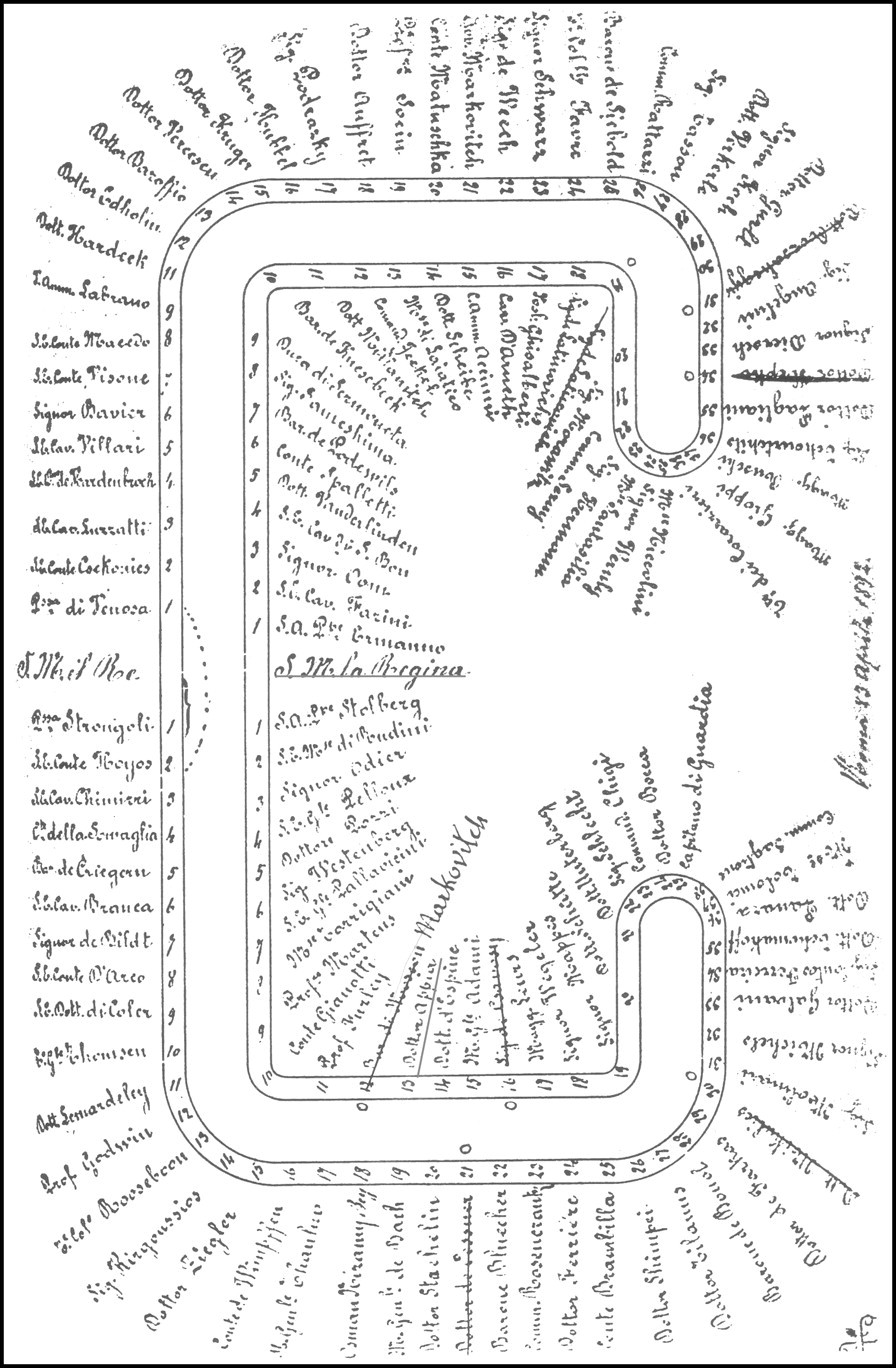
International conference of the Red Cross in Rome – 1892 Royal banquette. Appia is number 13 on the left
After organizing the sixth International Conference in Vienna, Appia retired. Although he wanted to spend his last years at the Committee, he had four children to care for and his means were scarce. Although his gaze was vivid, his eyes had become sunken, his shoulders dropped, he had heart disease and attacks of rheumatism became frequent. Appia died on 1 May 1898 and was laid to rest in the St George Cemetery in Geneva. 24
Footnotes
Acknowledgements
We are grateful for financial assistance from Ente Cassa di Risparmio of Florence. We thank Miss Susy Turato and Mr Fouad Ragi for technical assistance in the English version of the manuscript.