




Abstract
This is the biography of a deceased medical journal, the North American Medical and Surgical Journal, born in 1826 in Philadelphia. It was a publication of the Philadelphia Chapter of the Kappa Lambda Society. In the prospectus of the North American Medical and Surgical Journal the promoters observed that a well-conducted journal would achieve the object of elevating the medical profession to its legitimate rank which up to that time had been the recipient of low public opinion. The Journal hoped to inculcate ‘a higher standard of excellence not merely in the professional or ministrative but also in the ethical relations and duties of physicians’. After several successful and productive years it passed into history in October 1831, the victim of financial difficulty.
Background
‘Factiousness’ is the label by which Rothstein describes the medical community of the USA during the first half of the 19th century. 1 Declining medical education standards, rising numbers of alternative practitioners, burgeoning diploma mills and bitter feuding among orthodox physicians all contributed to this irritable state. The rising tide of public distrust aimed at hierarchy and privilege was manifestly prescient of great societal levelling during the Age of the Common Man and of Andrew Jackson's Presidency in 1829–37. Jackson believed there should not be any artificial distinctions, titles, gratuities or exclusive privileges and that every man was equally entitled to protection by law. 2
During the first half of the 19th century there were no national licensing laws, few state medical practice laws and little attempt to enforce those that did exist. Many practitioners, some better educated than others, competed for patients. Rivalries sometimes resulted in petty jealousy and open, often very public, hostility. Dr Samuel Jackson (1787–1872) in a paper on yellow fever published in The Philadelphia Journal of the Medical and Physical Sciences in 1821 commented: ‘The science of medicine, from the remotest ages, has been agitated with the contentions of its followers. Sect has conflicted with sect, and system been opposed to system, with a zeal more devoted to the ascendancy of party, than the triumph of the cause of truth … Modern times, however, have not witnessed a more harmonious disposition, or any diminution of medical feuds and controversies. The torch of discord still burns …’ 3 Although Thomas Percival's Medical Ethics; or a Code of Institutes and Precepts, Adapted to the Professional Interests of Physicians and Surgeons (1803) set rules of practice and conduct, only a few could afford to follow its lofty precepts and still earn a reasonable living. Few American physicians could subsist on the earnings from medical practice alone and often the standard educational curriculum required for medical students was ‘not long enough to inculcate a professional attitude’. 4
Professional stature thus became a sought-after ideal for educated physicians of the USA in the early national period. Elevation of the profession was a primary goal of the Kappa Lambda Society of Hippocrates (KLS). This secret society, founded in 1819 or 1820 by Dr Samuel Brown (1769–1830), was organized by chapters in cities and states, and was dedicated to the betterment of the medical profession through promotion of a standardized university-based medical education and adherence to professional medical ethical standards. Its goals, to improve the standing of the qualified physician and to preserve peace and harmony among members, were to be achieved by separating them from or elevating them above ordinary practitioners. 5 The influence of particular chapters of the KLS was uneven, probably depending upon the stature and activity of individual members. The precise number of chapters is uncertain but the Philadelphia and New York chapters seemed to be the most active. 6
Origin of the North American Medical and Surgical Journal
That orthodox medical community's morale could be improved through professional publications was a concept to which Dr Brown ascribed. 7 ‘At its [the KLS] meetings much was done to excite emulation among its members, and to promote the advancement of medical science. A journal, placed under the guidance of a committee of the society was, at the suggestion of Dr Brown, established and continued to appear quarterly during six consecutive years.’ 8
While the Philadelphia Chapter of the KLS supported the concept of a journal to encourage scientific research, both the New York and District of Columbia KLS Chapters opposed such an endeavour that would ‘make public the existence of the KL societies generally’. In spite of internecine opposition, the North American Medical and Surgical Journal made its debut in 1826 in Philadelphia. Publication was made possible by the support of the 70 dues-paying members of the Philadelphia KLS. 9 It was organized and edited by Hugh L Hodge MD, Franklin Bache MD, Charles D Meigs MD, BH Coates MD and Rene La Roche MD. Twelve volumes of the journal were published – the first in January 1826 and the last in October 1831.
The editors
The five above-named editors were credited on the title pages of volumes I through IV (Figure 1), but beginning with volume V and the acknowledgement of the journal's association with the KLS, all editors' names were removed (Figure 2). It was at this time that three additional physicians, John Bell MD, George B Wood MD and David F Condie MD officially joined the staff, although Dr Bache's biographical memoir notes they had cooperated with the Editorial Board from the beginning. 10 All eight of these men were well-educated physicians who contributed of their time and knowledge in the professional advancement of medicine.
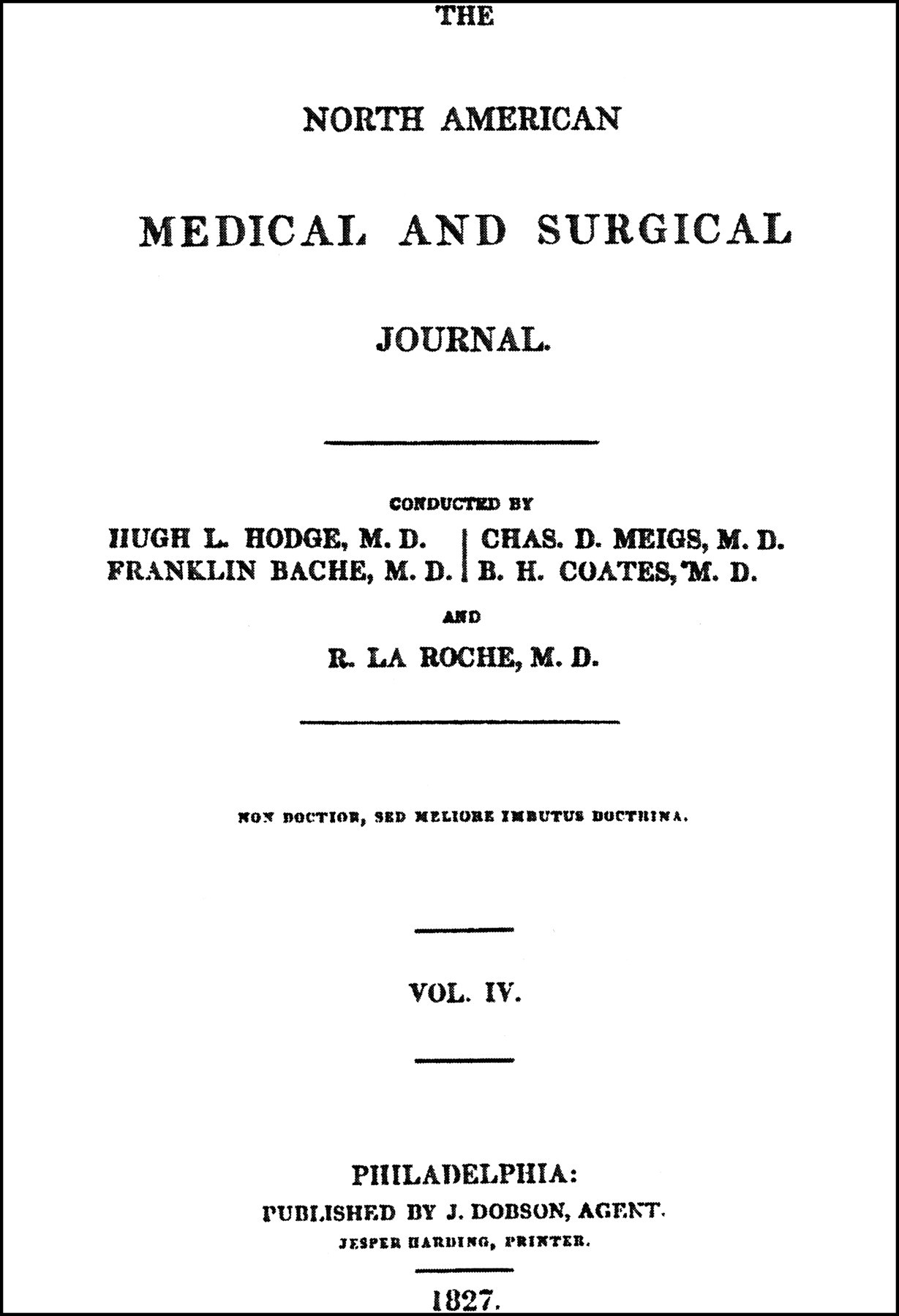
North American Medical and Surgical Journal, 1827;

North American Medical and Surgical Journal, 1828;
Hugh Lenox Hodge (1796–1873), born in Philadelphia in 1796, attended Nassau Hall, Princeton and studied medicine with Caspar Wistar (1761–1818). He obtained a medical degree from the University of Pennsylvania in 1818. He was sufficiently talented in that he was a stand-in teacher for Dr Horner's anatomy class while Horner travelled. Hodge also lectured in surgery at the Medical Institute in Philadelphia. Because of poor eyesight, he was obliged to change his specialty from surgery to obstetrics and subsequently he served as Professor of Obstetrics at the University of Pennsylvania from 1835 to 1863. He was widely recognized for two books: Diseases Peculiar to Women (1860), based on his practical experience and Principles and Practice of Obstetrics (1864), his best known offering. 11
Franklin Bache (1792–1864), born in Philadelphia in 1792, obtained his early education from Reverend Samuel B Wylie who graduated from the University of Pennsylvania at the age of 18 and received his medical degree in 1814. Early in his career Bache was attracted to chemistry and published a Treatise on Chemistry in 1819. He was appointed Professor of Chemistry at the Franklin Institute and accepted the Chair in Chemistry in 1832 and later the Chair in Materia Medica at the Philadelphia College of Pharmacy. In 1841 he became Professor of Materia Medica at Jefferson Medical College. He served as Physician to the Walnut Street State Prison and the Eastern Penitentiary at Cherry Hill. He was active in four professional groups – the American Philosophical Society; the Wistar Club; the KLS as a Vice President; and the College of Physicians of Philadelphia as a Vice President. Bache contributed papers to the North American Medical and Surgical Journal, authored the first Pharmacopeia of the United States with Dr Wood in 1831 and the Dispensatory of the United States in 1833. 12,13
Charles Delucena Meigs (1792–1869), born in St George, Bermuda in 1792, lived in New Haven, Connecticut and then Atlanta, Georgia. He graduated from the University of Georgia in 1809 and then studied medicine with Dr Thomas Fendall in Augusta. In 1817 he received a medical degree from the University of Pennsylvania and settled in Philadelphia the same year. He was active in the Philadelphia Medical Society, was a Fellow and Vice President of the College of Physicians and one of the first members of the KLS. He translated and published Velpeau's Elementary Treatise on Midwifery in 1831 and authored the Philadelphia Practice of Midwifery in 1838. He was chosen Professor of Obstetrics and Diseases of Women at Jefferson Medical College in 1841 and remained there until 1861. Over the remainder of his academic career he published five more major textbooks and translated another volume from French to English. 14–16
Benjamin Hornor Coates (1797–1881), born in Philadelphia in 1797, attended Enoch Lewis School and Friends Grammar School for his early education. From 1814 to 1819 he served as an apprentice at Pennsylvania Hospital and as a student of Philip Syng Physick (1768–1837). He was awarded a medical degree from the University of Pennsylvania in 1818 and set up practice in Philadelphia. He was a Clinical Lecturer at Pennsylvania Hospital from 1828 to 1841. As well as serving as an editor of the North American Medical and Surgical Journal, he edited the Philadelphia Journal of Medical and Physical Sciences and contributed to Chapman's Medical Journal. 17
Rene La Roche (1795–1872) (Figure 3), born in Philadelphia in 1795, was the son of French immigrants. He served in the army during the War of 1812 and upon separation from service began the study of medicine in 1815. He received a medical degree from the University of Pennsylvania in 1820. Relatively little of a biographical nature has been written about La Roche, probably owing in part to his lack of connection with any medical school except for a short period at the ‘Summer School of Medicine’ immediately after his graduation. His lasting contributions to medicine are his writings which include ‘a great number of original and carefully prepared papers, and elaborate reviews for the medical journals, and it is said that there is scarcely a respectable medical journal in the land, which has not, at some time or other, had its columns enriched by contributions from his pen’. 18 He was one of the most active members of the KLS and upon its demise became a member of the Monday Club. 19
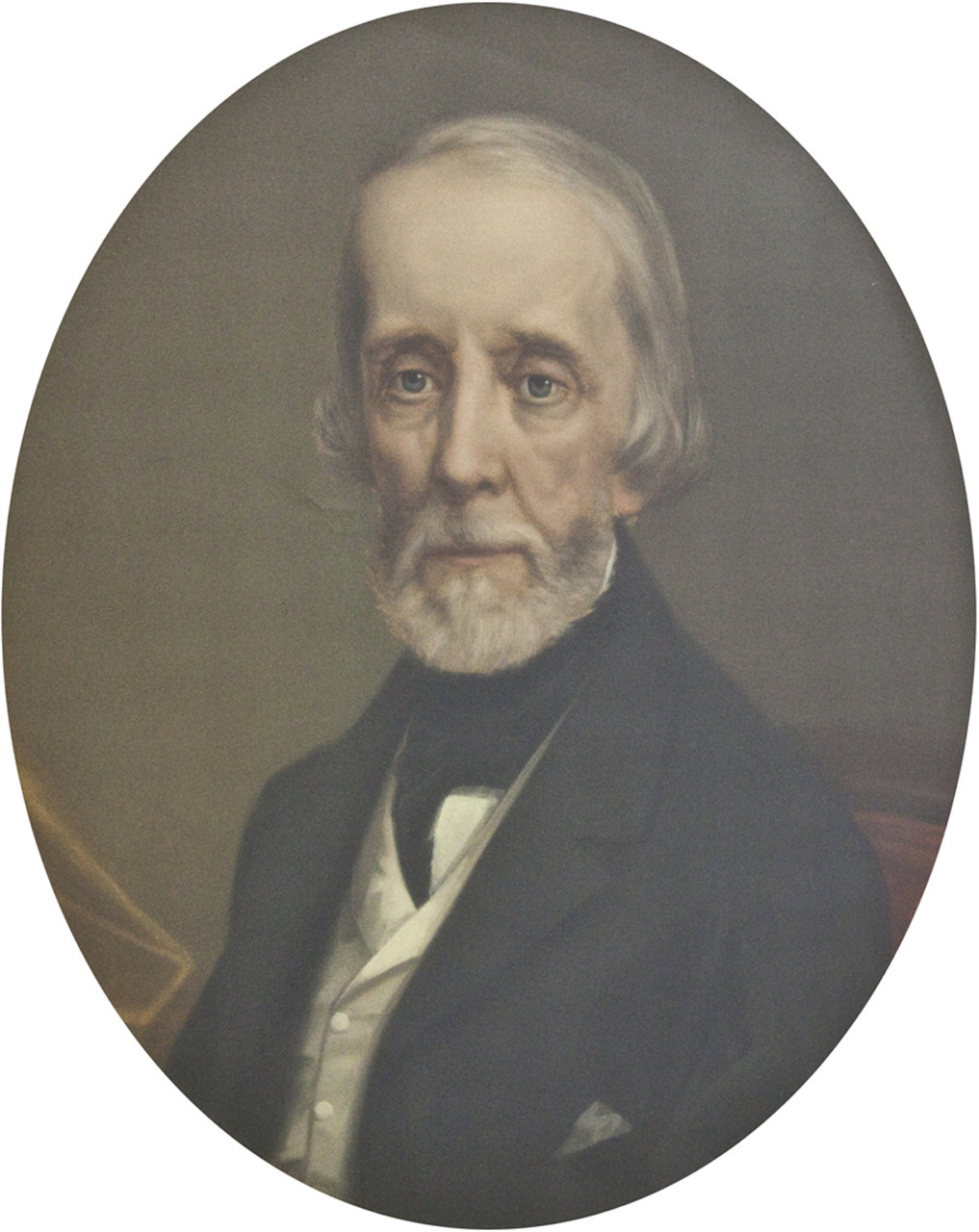
Rene La Roche (1795–1872) a founding editor of the North American Medical and Surgical Journal, reproduced courtesy of The College of Physicians of Philadelphia
John Bell (1796–1872) was born in Ireland in 1796 and obtained a medical degree from the University of Pennsylvania in 1817. He was a Member of the College of Physicians of Philadelphia and of the Philadelphia Medical Society, a Lecturer at the Philadelphia Medical Institute and Professor of Institutes of Medicine at the Medical College of Ohio. He authored several books on mineral springs and medicinal properties of water. 20
David Francis Condie (1796–1875) was born in Philadelphia in 1796 and graduated from the University of Pennsylvania in 1818. He authored several books, the best known possibly being A Practical Treatise on Diseases of Children (1844) which passed through six editions. Condie's entire medical career was spent in Philadelphia. 21
George Bacon Wood (1797–1879) (Figure 4) was born in Greenwich, New Jersey in 1797. He obtained an undergraduate degree from the University of Pennsylvania in 1815 and, after studying under Joseph Parrish (1779–1840), he received his doctorate in 1818. He served as Professor of Chemistry (1822–31) and Professor of Materia Medica (1831–35) at the Philadelphia School of Pharmacy. Then he became Professor of Materia Medica at the University of Pennsylvania from 1835 to 1850 and Professor of Theory and Practice from 1835 to 1859. Wood was a prodigious author who is best known for the Dispensatory of the United States (which he wrote with Dr Bache) and his two volumes of Practice of Medicine. Wood was president of the College of Physicians of Philadelphia for 34 years and the ninth President of the American Medical Association in 1855. 22,23

George Bacon Wood (1797–1879), an editor of the North American Medical and Surgical Journal, reproduced courtesy of The College of Physicians of Philadelphia
Purpose
In the prospectus of the North American Medical and Surgical Journal the promoters observed that a well-conducted journal would achieve the object of elevating the medical profession to its legitimate rank which up to this time was the recipient of low public opinion and noted for discordant views in both doctrine and practice. Many physicians from various parts of the country were enlisted to give the new journal a national and professional outlook therefore the call for papers on medical observations and reflections was issued to enlarge the body of knowledge and encourage cordial professional bonds.
From the beginning the motto of the KLS, ‘non doctor, sed meliore imbutus doctrina’ (‘not more learned, but steeped in better learning’), appeared on the front cover but it was not until 1828 that the society's sponsorship – ‘published by the Kappa Lambda Association of the United States’ – appeared on the cover of volume V. In the preface to volume IV the editors reflected upon the success of the journal by noting that some papers were translated or reprinted for inclusion in European medical periodicals. Most important, however, they revealed their association with the KLS and restated the objective of the group and the journal – ‘to elevate the character of the Medical Vocation, by inculcating a higher standard of excellence, not merely in the professional or ministrative, but also in the ethical relations and duties of physicians’. 24 The Philadelphia Chapter had withdrawn its commitment to secrecy of the Society in 1827 and, with the journal's KLS association, openly noted the names of the editors were removed from the title page.
In 1830 volume IX announced a modified approach to the organization of content into two major divisions, namely reviews and quarterly summaries of literature. The quarterly summaries were further divided into medical specialties. The number of pages increased and the size of the typeface decreased so that more material could be included. These changes coincided with the sale of the periodical to the printer, James Kay Jr and Company of Philadelphia. 25
The journal ceased publication with volume XII number XXIV in October 1831. Largely financed by the members of the Philadelphia KLS, which was popular and quite strong in its early years, declining membership took its toll. Only six members attended the annual meeting in 1831. The balance of $111.71 in the treasury on 5 February 1835 was applied to debts incurred by the journal before its sale in 1830 and on 18 February, with barely enough members to officially close the minute book, the Philadelphia KLS dissolved. 26 Lack of support, interest and financial backing contributed to the demise of the journal.
Notable content
Only one paper from the North American Medical and Surgical Journal, that of John Rhea Barton (1794–1871) in 1827 (volume III) entitled ‘On the Treatment of Anchylosis, by the Formation of Artificial Joints’, was included in Ash's Medical Classics in Serial Publications.
27
A reprint of this paper appeared in 2007.
28
In 1848 Oliver Wendell Holmes (1809–94) noted in a Report to the American Medical Association's Committee on Medical Literature that there were ‘many articles of value’ within its pages.
29
His list included the following:
Volume I. Account of a Case in which an Ovarium was successfully extirpated. Alban G Smith, MD (1795–1876) (Danville KY); On Curvature of the Spine. John K Mitchell, MD (1793–1858); On the Use of the Oil of Turpentine in a particular condition of fevers. George B Wood, MD (1797–1879); Observations and Experiments on the Action of the Heart. John Wiltbank, MD (1806–1860); Two Cases of poison, from eating of a Pheasant. Nathan Shoemaker, MD (1788–1868). Volume II. Description of the Gangrenous Ulcer of the Mouths of Children. BH Coates, MD (1797–1881); Remarks on the Prophylactic Treatment of Cholera Infantum. Joseph Parrish, MD (1779–1840); Account of a case in which a New and Peculiar Operation for Artificial Anus was performed in 1809. Philip Syng Physick, MD (1768–1837). Volume III. Staphyloraphe or Palate-Suture, successfully performed. AH Stevens, MD (1789–1869); On the Treatment of Anchylosis, by the formation of artificial joints. A new operation devised and executed by J Rhea Barton, MD (1794–1871). Volume IV. Observations on Delirium Tremens. BH Coates, MD (1797–1881); Case of Epilepsy, attended with peculiar circumstances, in which the Ligature of the Carotid Artery was resorted to with partial success. Frederick E Becton, MD (1801–1838) (Tennessee); Some Observations on Extra-uterine pregnancy. Thomas C James, MD (1766–1835). Volume VI. Observations on the Removal of Foreign Bodies lodged in the Esophagus. Henry Bond, MD (1790–1895); Observations on Cancer of the Breast. Joseph Parrish, MD (1779–1840). Volume VIII. Observations on Pulmonary Consumption. Joseph Parrish, MD (1779–1840).
Holmes noted that the two papers by Parrish were of a ‘most useful practical character.’
30
Three papers from the journal not previously mentioned as important or lasting contributions have been cited as references in current literature. Two of the papers are on acupuncture and the third on laminectomy:
Volume II. A case of neuralgia cured by acupuncturation. J Hunter Ewing, MD;
31
Cases illustrative of the remedial effects of acupuncture. Franklin Bache, MD (1792–1864).
32
Volume VIII. Account of a case in which portions of three dorsal vertebrae were removed for the relief of paralysis from fracture, with partial success. Alban G Smith, MD (1795–1876).
33
Finally, ‘The Memoir of Dr Samuel Powel Griffitts (1759–1826)’ written by Governeur Emerson (1795–1874) (volume VIII) is a detailed biography and a worthy addition to the list of memorable papers. Griffitts was the Founder of the Philadelphia Dispensary in 1786, the first institution of its kind in the USA.
34
Evaluation and conclusion
Was the North American Medical and Surgical Journal a success? Were its goals met? Although more than 40 medical periodicals had been started by 1826, many were short-lived and there were only 10 journals in existence in the country at the time of inception of the journal. These include New England Journal of Medicine and Surgery (1812–26), American Medical Recorder (1818–29), Philadelphia Journal of the Medical and Physical Sciences (1820–27), Medico-Chirurgical Review (1820–47), Microscope (1821–27), New York Medical and Physical Journal (1822–30), Boston Medical Intelligencer (1823–28), American Medical Review and Journal (1824–26), Carolina Journal of Medicine (1825–26) and American Botanical Register (1825–30). 35,36 At its demise in 1831 nine titles were in publication: Medico-Chirurgical Review (1820–47), American Journal of the Medical Sciences (1827-), Western Journal of Medical and Physical Sciences (1827–38), Transylvania Journal of Medicine (1828–39), Boston Medical and Surgical Journal (1828–1928), American Journal of Pharmacy (1829–1936), Maryland Medical Recorder (1829–32), Journal of Health (1829–33) and New York Medico-Chirurgical Bulletin (1831–32). 37,38
Lacking contents of two of the later volumes, a total of 101 authors produced 177 original articles for the journal. Sixty-five authors (64%) from the USA wrote 135 (76%) of the papers. Thirty-nine authors (38%) from Pennsylvania produced 105 (59%) papers. Twenty-eight percent of authors accounting for 19% of papers were from outside the country. Country or state of origin could not be identified for 8% of authors who penned about 5% of papers. All authors of original articles in volume I were American; 68% were from Pennsylvania. By 1831, 80% of the authors and 85% of the papers for the final volume (XII) were foreign in origin. The work of writing, editing, publishing and financing a professional journal was clearly running out of steam for the North American Medical and Surgical Journal.
The publication of a periodical of national stature was a commendable contribution to medicine and a laborious undertaking for its editors but perhaps made easier by the contribution of papers from members of the KLS. At least 75 original papers by Philadelphia Society members were published in the journal. In the journal's six years of publication, 708 citations were added to the medical literature. 39 Organization and content followed the established pattern for medical periodicals of the time. 40 Each issue contained from six to 10 original communications on a wide variety of topics of medical interest. Analytical reviews, retrospective reviews of medical literature, quarterly summaries of medical and surgical intelligence, bibliographical notices, miscellaneous articles and a quarterly list of new American medical publications also appeared in the journal. The original articles were generally authored by well-known physicians who held impeccable credentials and were the leading teachers and practitioners of the time. Ideas and innovations were shared, new evidence and observations were introduced and new theories promulgated. James Cassedy, noted medical historian, wrote: ‘Whatever their motivations and longevity, the physician-editors collectively occupied one of the best possible positions for influencing and bringing about professional change in the American medical community … and at least some of them took seriously the tasks of trying to elevate medical literacy and keeping alive the tradition of the physician as a learned man’. 41 The North American Medical and Surgical Journal fulfilled that quest for professionalism during its short but significant life.