




Abstract
Dr Zammit's experiments showed that brucellosis was transmitted by the milk of goats that did not show signs of infection or ill health. The British forces in Malta banned the use of goats' milk and brucellosis was eliminated in those forces. This research was published in the Proceedings of the Royal Society and earned him an Honorary DLitt from Oxford University and the Kingsley Medal of the Liverpool School of Tropical Medicine. The King knighted him. He was the great Maltese polymath but there is a mystery concerning his name.
Beginnings
At a quarter to midnight on 30 September 1864 a baby boy was born in downtown Valletta, Malta. A Dominican brother from the local Saint Dominic Priory would have hurried to the address to baptize the child as soon as possible and then returned to sleep. Two days later he entered the baptism with another in the parish record (Figure 1).

Temi's birth in the baptism records of Saint Dominic Church, Valletta
More than a week later, on 8 October Salvatore Cutajar registered the birth at the local police station in accordance with the recent requirement of the setting up of the Public Registry in 1863 (Figure 2). Salvatore, who must have been a close friend of the family, and Rosa Bologna were given as patrini: Rose was Temi's grandmother, widow of Laurenti or Lorenzo. Two members of the police witnessed the registration. In both documents the parents are recorded as Spiridione Sammut and Filumena, his wife (née Bologna). The Christian names given to the child differ in the two documents:

The Birth Certificate of Temi Zammit as issued by the Public Registry
Church: ‘Themistoclo, Laurentius, Joseph, Dominicus’.
State: ‘Fioravanti, Temistocle, Archimede, Laurenzo, Giuseppe, to be known as Fioravanti’.
Names were entered in Latin (the Church), Italian (the State) and in English or Maltese. Spiridione had been born on Santa Maura, a Greek island, and Temistocle and Archimede presumably reflect his father's stay there. Laurenzo was the name of his mother's father. All children were given the name of the saint of the parish and so Dominicus was added for the Church. Giuseppe was the spelling used throughout that period in state documents and Joseph was the form used by the church.
Did the parents change their minds over that week between the registrations? Or did the kappillan persuade them that Fioravanti and Archimede were not suitable and that the name of the Saint was more so? Was he ever known as Fioravanti and when did he change to Themistocles? He must have been ‘Sammut’ at school. The first we know was that he graduated MD from the University of Malta in 1889 as Themistocles Zammit and with Dr Fabrizio Borg founded La Rivista Medica (The Medical Review) as its editors. Throughout his life he was known by the surname of Zammit. As an author he was variously T, Th, Tem and Them, and in his last papers as Sir Themistokles – in Malta, however, he was Sir Temi or Sir Themistocles. On one reprint there is his signature ‘Temi Zammit’. He was also referred to as Themistocle, Temistocle and, in Maltese, Temistokle.
Temi's parents were married in Saint Dominic church on 7 October 1861, before the Public Registry was formed in 1863 (Figure 3). His father's parents were George Sammut and Ann Zammit (of Curmi, now Qormi where the parish church is St George) where perhaps his new name of Zammit originates.

The marriage of Temi's parents as recorded in Saint Dominic Church
Marriage
In 1898, now living in Sliema, on the 10 October he married Maria Aloysiam de Marchesi Barbara, widow of Edward Laferla, in the Basilica Domini Nazarini of Sliema. Again the records differ slightly:
Church: ‘Themistockem Sammut MD of Spiridione’ (Figure 4).

The record of Temi's marriage in the records of Stella Maris Church, Sliema
State: ‘Temistock Sammut Zammit of Spiriodione Sammut (Zammit)’ (in the notes he is ‘Temistocle Sammut-Zammit’) (Figure 5).
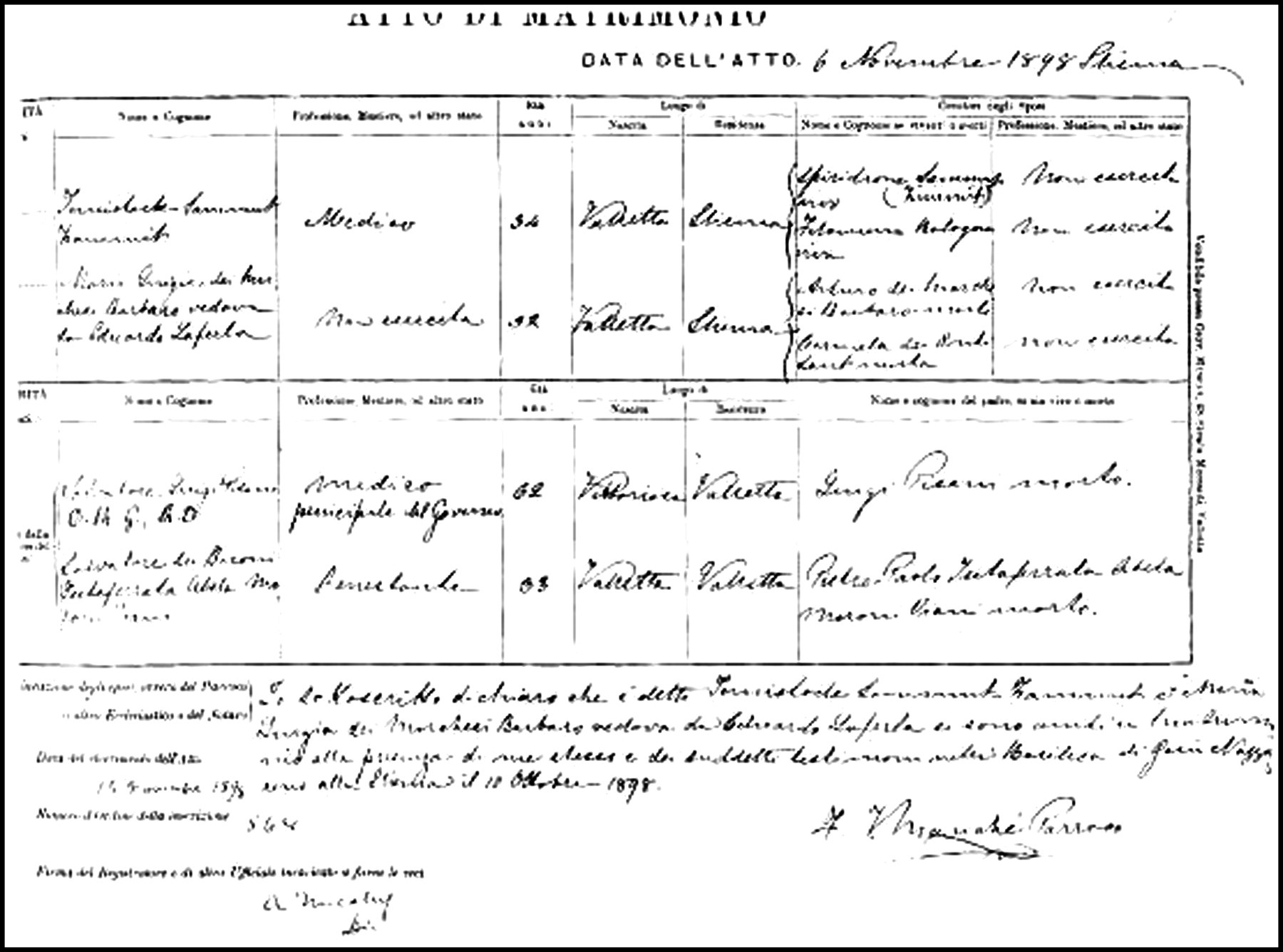
Temi's Marriage Certificate as issued by the Public Registry
His sponsor was ‘Salvatore Guigi Pisano, CMG, MD, Principal Government Doctor’ who must surely have been surprised that his colleague known as Temi Zammit was really a Sammut (unless his colleagues already knew this).
The Maltese medical historian Paul Cassar described Temi Zammit as ‘Malta's most distinguished man’ 1 and his achievements in medicine and science alone justify that. 2–4 He died on 11 November 1935 with Obituaries in Malta and in the British Medical Journal, the Lancet and Nature. It seems to be easier to die than to live, for death is the only State document that does not require details of your parents: ‘Hon Professor Sir Themistocles Zammit Kt, CMG, MD, D Litt’ (Figure 6).

Temi's Death Certificate
The son and his name
This is not the end of the saga of his surname because in 1989 his son added to the confusion. Charles George Zammit, who had succeeded Temi as Director of the National Archaeological Museum in Valletta, petitioned the Curia asking that his father's surname be changed from Sammut to Zammit in the Parish Baptism Register. The Chancellor, in a handwritten note on the petition, noted that he had seen a certificate of Temistocles Zammit. No certificate is attached or in the files at the Curia of Application 247 in AAM Sup Volume 419–1989 II.
The Certificate could not have been of the birth or marriage as these showed his surname as Sammut. Only the Death Certificate showed the surname as Zammit. The Curia sent a letter to the Kappillan of Saint Dominic Church on 30 May 1989 asking that the surname be changed. The Kappillan altered the Baptism Register by crossing out Sammut and substituting Zammit in both the margin and the text, with a note in the margin: ‘Decr Curial Arch diei 30. 5. 1989’ (Figure 1).
The index is unchanged as Sammut and there is no indication of why the names have been changed. ‘Curiouser and curiouser,’ said Alice.
When did Charles first learn of his father's real surname and did he ever see the original entries in the church records or only an abbreviated certificate among his father's papers? What prompted this petition more than 30 years after Temi's death? – it has added to the confusion. The Curial change was presumably meant to correct an original error by the priest for a mistake of Sammut for Zammit. This is not feasible. The priest was himself a Sammut and the parents had been married with their surname of Sammut in Saint Dominic's church and were parishioners of the church. The priest would also have noticed that the boy was given his own name and that of the church, of Dominic. There can be no doubt that Temi was born a Sammut.
The church has altered one document but not the record of his marriage which is unchanged as Sammut. The records of the Public Registry are sacrosanct and cannot be changed. It would have been clearer if the petition had resulted in a marginal note that the baby grew up to be the Maltese genius of scientist, doctor, Professor of Chemistry, archaeologist, author, Rector of the University and politician, recognized not only by Malta but by Britain as well. His biography 5 gives little about his early life or his medical and scientific work. 2–4
Nevertheless, we must thank Spiridione and Filumena Sammut for giving us their wonderful son who we may call Temi Zammit.