




Abstract
Professor Sir John Charnley was a British orthopaedic surgeon, inventor and skilled craftsman. He is best known for his development of the first truly successful operation for total arthroplasty of the hip, the low-friction arthroplasty. As well as publishing significant works on closed fracture management and compression arthrodesis, he can also be accredited with pioneering work in the development of clean-air operating conditions and body-exhaust suits.
John Charnley (Figure 1) was born in Bury, Lancashire on 29 August 1911. His, mother, Lily, was a nurse and his father, Arthur, worked as a chemist but occasionally practised dentistry at the back of his store. 1,2 Charnley's academic career was undistinguished for much of his schooling at Bury Grammar School; yet, by the time he had entered the sixth form his prowess in the sciences was evident – he won the school's Science Prize in three successive years. Initially intending to study dentistry at university, he was encouraged by his headmaster to pursue a medical degree. 1,3 His decision to choose medicine would not only prove a perfect fit for the man but would radically change 20th-century orthopaedic practice.

Professor Sir John Charnley
In the autumn of 1929, along with 55 other students John Charnley entered the Medical School of the Victoria University of Manchester. His time at university was to be anything but undistinguished. In his first two years he acquired numerous Class Medals, scholarships and prizes. Subsequently he was invited to study for a BSc in anatomy and physiology alongside his medical degree, for which he won more awards. 1 His performances during the clinical years of his medical degree were as highly decorated as the preclinical years, exhibiting indisputable promise in the field of surgery. He graduated in 1935.
Royal college of surgeons
One year after graduating, in 1936 he became a Fellow of Royal College of Surgeons at the age of 25 years the youngest age acceptable. 4 Surgical appointments at Salford Royal Hospital, Kings College London and Manchester Royal Infirmary were to follow. 5 A devoted doctor and skilled surgeon, the young Charnley still knew how to have a good time. A house surgeon at Manchester Royal Infirmary recalls the rowdy parties enjoyed by junior doctors. On one such occasion, barely clothed and commandeering a Ewbank carpet sweeper, Charnley charged down the corridor declaring vociferously to be Cupid. 1 It has been speculated that Charnley's interest in orthopaedics arose from a traumatic episode in 1935 when as a newly qualified doctor he had been mountaineering in the Lake District with the Manchester University Climbing Club. A member of the party fell and fractured his femur; Charnley was lowered down to the ledge where he lay. He applied a splint to the fracture and stayed throughout the night at his companion's side who sadly died before further help arrived. 1,2
Military surgeon
At the outbreak of the World War II on 3 September 1939, Charnley had already been practising surgery for four years. Any career aspirations he was harbouring would have to wait; he volunteered for military service, enlisting in the Royal Army Medical Corps as a Lieutenant in 1940 and almost immediately he participated in the naval evacuation of Dunkirk. 3,5 He was to spend most of his service in the Middle East as a surgeon in the Cairo Orthopaedic Centre. Here the newly promoted Captain Charnley showed extraordinary promise not purely as a surgeon but also as an inventor and engineer; designing a walking calliper, a modified Thomas’ splint (for traction of femoral shaft fractures) and various surgical instruments. 5,6 He returned to civilian life in February 1946 as a Major, having acquired invaluable experience in both orthopaedic practice and in life.
Military service had exposed Charnley to the art of fracture treatment and emergency work but his first job on returning to England took him to Oswestry 3 where he was immersed in a different aspect of orthopaedics, elective surgery or cold orthopaedics as it was known then. 1 During his time there his inquisitive nature and enthusiasm for research was manifest in an incident when he convinced a junior colleague to operate on his leg. He had become interested in the role of the periosteum in bone union and bone grafting in particular and so a portion of cancellous (spongy) bone was taken from the upper end of his tibia and re-implanted both superficial to and deep to the periosteum. Unfortunately, as a result of this intrepid foray into self-experimentation his leg became so swollen and painful that he could barely walk. Further operations were required to treat the osteomyelitis he had developed which were successful but left him with an unsightly scar. 6
Arthroplasty
Arthroplasty is the treatment of a painful joint with reduced mobility by surgical reconstruction of a joint, the aim being to relieve pain and deformity while improving movement and stability. Throughout the late 19th and early 20th centuries there were infrequent accounts of attempted arthroplasty of the hip joint but methods were rudimentary and ultimately unsuccessful. 7 In the first half of the 20th century the standard treatment of an arthritic hip was arthrodesis, fusion of the joint, for younger patients and osteotomy in the elderly, where sections of bone are excised to alter the alignment of a joint and correct deformity. For much of his surgical career Charnley was sceptical of the potential application of arthroplasty in the standard surgical management of osteoarthritis of the hip, stating in 1951 that an arthroplasty ‘would probably not last more than ten years and that it rarely increased the range of movement’. He spoke in support of the motion that ‘in the opinion of this house all methods of arthroplasty of the hip have failed to achieve their purpose’ at a British Orthopaedic Association debate. 1
Between 1950 and 1953 Charnley's contributions to orthopaedics were astounding, his output prolific. Borne of his keen interest in biomechanics, in 1950 Charnley published The Closed Treatment of Common Fractures, a monumental work that describes the uncertain art of fracture manipulation. This text has become invaluable to generations of trauma surgeons. Later, in 1953 and following considerable research at Manchester University and after writing original articles on the subject, Charnley published his book entitled Compression Arthrodesis where he described the principles behind his groundbreaking work which concerned the rapid union of cancellous bone under mechanical pressure. Were it for these two achievements alone, Charnley would to this day be heralded for his contributions to orthopaedics. The best was yet to come. 2,4
At this time J and R Judet in Paris had developed a hemiarthroplasty procedure that involved replacing the head of the femur with an artificial head made of polymethyl methacrylate. Pain relief was immediate and movement improved although the arthroplasty was unsatisfactory since the plastic stem that held the artificial head in the femoral shaft frequently became loose and quickly. 3,7 A patient who had received a Judet hemiarthroplasty two years previously came to Charnley's Manchester clinic, reporting a loud squeaking in his artificial hip when leaning forward. Charnley knew of other arthroplasty patients with a similar problem and he conceived that the loosening of the femoral prosthesis was associated with a degree of frictional resistance between the artificial head and the articular cartilage-deficient acetabulum of the osteoarthritic hip. 5,6 This was the first step in the realization of his seminal work, the low-friction arthroplasty and he began to explore the friction and lubrication of normal joints. His results were in contention with the accepted theory of the time that hydrodynamic lubrication was key to the low-friction movement of normal joints whereby a fluid film between the two surfaces of the articulating joint ensure they are not in direct apposition. 1,5 Yet Charnley found that the coefficient of friction in joints remained the same despite changes in the rate of sliding and this supported his belief that boundary lubrication was of primary importance in weight bearing joints; nevertheless, he acknowledged that a proportion of both forms may occur in vivo. 1 The coefficient of friction refers to a number which represents the friction between two surfaces – the higher the number, the greater the friction. Boundary lubrication implies that the synovial fluid film is not sufficiently thick to prevent some contact between the articulating surfaces and thus is also dependent on the inherent sliding quality of the opposed surfaces. 1,8
Wrightington hospital
Following Oswestry, Charnley began working at the Manchester Royal Infirmary and after his long-time mentor and friend Sir Harry Platt (1886–1986) retired in 1947 Charnley was appointed Consultant Orthopaedic Surgeon. 3 In the years following his appointment Charnley was further appointed Visiting Orthopaedic Surgeon to both Park Hospital, Davyhulme and later to Wrightington Hospital, Wigan. 4 However, by 1962 Charnley had moved his entire clinical practice to Wrightington Hospital. This move coincided with the application of streptomycin and para-aminosalicylic acid in the treatment of tuberculosis, it now having become feasible to perform radical orthopaedic surgery on the tuberculous skeleton without the unacceptably high risk of septic complications. These improvements meant that hospital stays for tuberculosis patients were dramatically reduced and orthopaedic surgery was changing rapidly. Charnley sought to turn the subsequent surplus of beds at Wrightington to his advantage. 2 The newly proposed M6 motorway was to pass near to the hospital and this Charnley believed would further aid the establishment of a National Centre for Hip Surgery. 3 The project relied on funding from multiple sources; indeed Charnley even encouraged his few private patients to contribute funds and by April 1961 the site boasted a biomechanical workshop and laboratory with which Charnley could further his research into arthroplasty. 1
Polytetrafluorethylene (Teflon)
As a result of his experiments Charnley began the search for a slippery substance with which he could manufacture a satisfactory socket or cup for arthroplasty. In seeking out specialists in the plastics industry, he approached a firm in Bolton that manufactured bearings 1 and the engineers there introduced him to polytetrafluorethylene (PTFE). At some point in the mid-1950s Charnley began trials in patients using PTFE as an acetabular cup and with a PTFE cup covering the femoral head. Soon he changed the procedure by discarding the femoral cup and using a metallic Moore prosthesis following excision of the femoral head and this articulated with a PTFE cup in the acetabulum. 9 PTFE had a very low coefficient of friction and was shown by biological assay to be highly inert. Pain relief and improvements in range of movement proved dramatic within the first three months of operation. 1,5
The low-friction arthroplasty (LFA)
Charnley's unique approach to arthroplasty of the hip was not confined to the materials he used; another important contribution was his principle of LFA. He pioneered the use of a smaller femoral head prosthesis, the advantages being that reducing the radius of the head while at the same time increasing the radius of the cup lead to a reduction in frictional torque. Frictional torque is a turning force resulting from the friction that occurs when two objects in contact move. Over time, the fixation of an implant to bone can loosen and become painful, and loosening of the cup side of an implant is related to frictional torque. Every time a patient takes a step or, more significantly, rises from sitting, the femoral head applies a twisting moment to the cup. This frictional torque is proportional to the radius of the femoral head: the smaller the radius of the prosthetic head, the lower the torque. Major factors affecting wear include the activity level of the patient, the sliding distance between the prosthetic head and cup, and the roughness of the femoral head. The smaller head does not necessarily reduce the rate of wear but does allow implantation of a thicker plastic cup thereby allowing more wear. Increased wear is closely related to cup loosening. As the cup begins to wear out, the neck of the femoral prosthesis impinges on the cup, acting as a lever by loosening the bond between the cemented cup and the bone in the acetabulum. Charnley gradually reduced the diameter of the head of the Moore prosthesis he used from 42 to 22.225 mm (7/8 inch) which he regarded as the minimum size to avoid the risk of dislocation. 1,9 However, the innovation that Charnley himself regarded as the most significant breakthrough in LFA was the use of acrylic cement to improve fixation of the Moore prosthesis in the femoral shaft. Although he was not the first surgeon to use cement, his detailed analysis of its application to orthopaedics was of considerable influence in confirming the process by which fixation was accomplished and in understanding its effects on adjacent tissues. 1,2
High-molecular weight polyethylene
Disaster struck in 1962 when patient follow-up revealed that fine particles of PTFE created by joint wear could produce a severe granulomatous reaction resulting in the production of amorphous caseous (cheesy) material around the joint that ultimately led to loosening of the prosthesis and destruction of nearby bone with pain. In addition to his earlier experiment on his own tibia, he also injected specimens of PTFE particles into his own thigh, observing an aggressive foreign body reaction. 6 He was devastated but strived to find a suitable replacement for the PTFE. In May 1962 a salesman approached Harry Craven, one of Charnley's technicians, with a new plastic, high-molecular weight polyethylene (HMWPE), reputed to have phenomenal resistance to wear. Charnley, discouraged by his experience with the plastic PTFE, was not interested. However, Craven on his own initiative tested the HMWPE by sliding it on a steel plate for a three-week period and at the end of this time it had worn less than PTFE would have over 24 hours. Although the coefficient of friction was higher than with PTFE, the small femoral head of Charnley's prosthesis made HMWPE a suitable replacement (Figure 2). By November 1962 Charnley was again performing low friction arthroplasty of the hip but this time using an HMWPE cup. 3 The solution had been found and publications since have shown the remarkable durability of Charnley's LFA even at 30 years follow-up (Figure 3). 10
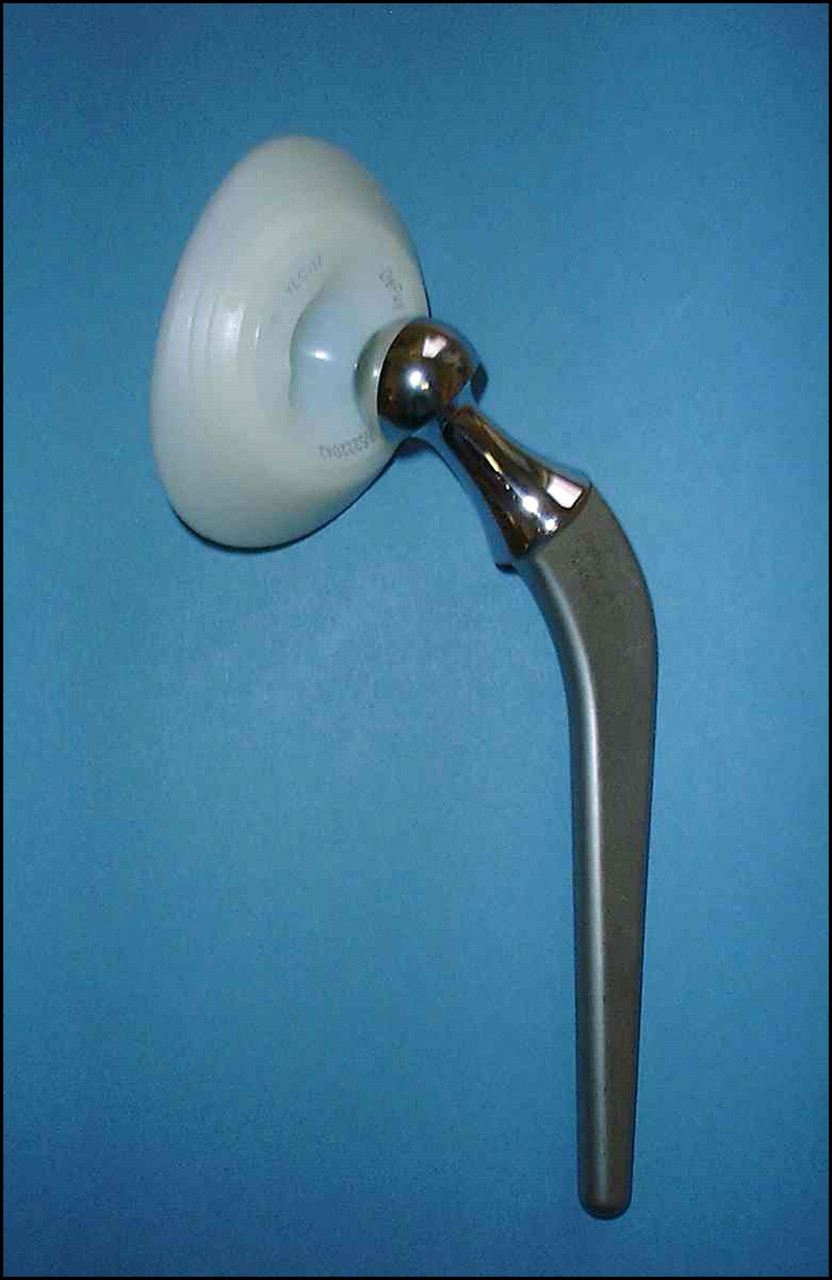
The Charnley Hip; a metal Moore prosthesis with a high molecular weight polyethylene (HMWPE) cup
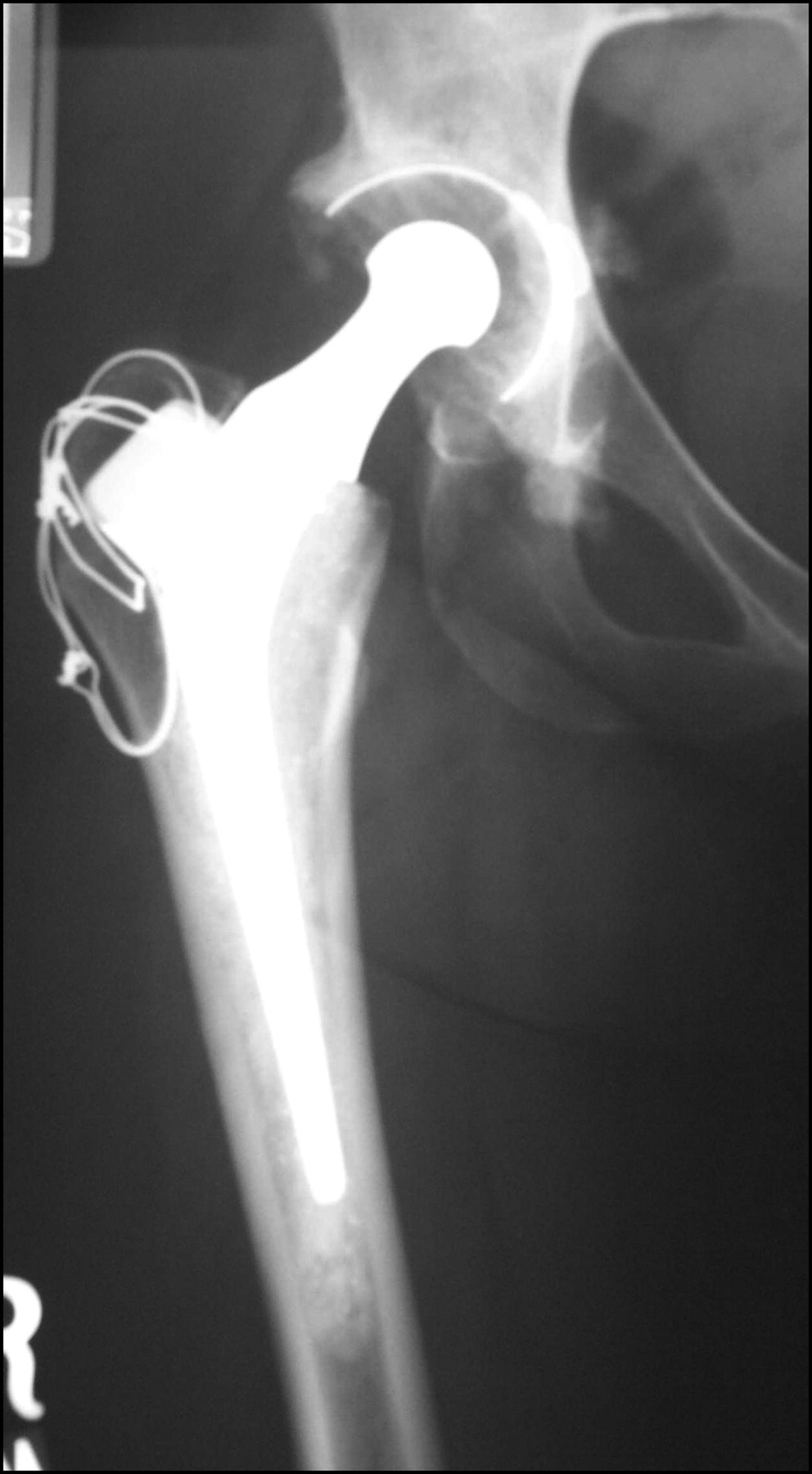
Radiograph showing a Charnley low-friction arthroplasty at 39 years follow-up
Improving intraoperative conditions
The major complication of Charnley's innovative arthroplasty was latent wound infection that was often not evident until several months after operation. In many cases the organisms responsible for the infection were those commonly found on the skin yet infrequently the cause of wound infection following other operations. At 9% Charnley felt the postoperative infection rate of his novel operation was unacceptable and infection could destroy the neighbouring bone resulting in a more troublesome revision operation and so, as always, he sought a practical solution. 3 In 1961 his first attempt in partnership with Craven was a glass-walled enclosure, essentially a cube with sides approximately two and one-half metres long, into which air was ducted from outside the theatre by a fan fitted with a precipitator to eliminate dust that might harbour bacteria. Affectionately referred to as the ‘greenhouse’, it took 15 minutes to erect and had to be disassembled between Charnley's theatre lists (Figure 4). 1 In collaboration with Howorth Air Engineering in Bolton, the first permanent operating enclosure with laminar air flow was installed at Wrightington in 1966. Charnley further designed a mask and gown to be worn while operating and these ‘spacesuits’ used a body exhaust system and contributed to dramatic improvement in postoperative infection rates from nine percent to less than one. 3

The ‘Greenhouse’ clean-air enclosure at Wrightington Hospital
Throughout the development of his prosthesis, Charnley worked closely with the commercial firm of Charles F Thackray Limited at Leeds which since has become a subsidiary of DePuy Orthopaedics. 6 By 1963 the firm of Thackray was responsible for the manufacture of the femoral prosthesis and ultra high molecular weight polyethylene (UMHMPE) socket designed by Charnley. At first Charnley only allowed the sale of his prostheses to surgeons who had trained with him at Wrightington and to whom he gave his personal approval. Later this was relaxed so that any surgeon with two days training at Wrightington could acquire the prostheses; finally in the early 1970s the operation was released generally and accessible to any surgeon who desired to perform his LFA. Charnley retired from the National Health Service in 1975 but unsurprisingly continued his research at Wrightington, constantly attempting to improve on the minutiae of his operation. He also lectured abroad and began to pen his book concerning both the technique and the principles of the LFA. 1
Evolution of the prosthetic hip
Charnley did not invent the prosthetic hip joint but he did evolve it in his own unique vision such that he stands above all others as the man responsible for the surgical revolution that brought relief to countless patients crippled by arthritis. A multitude of studies have been published on LFA showing excellent long-term results concerning both clinical and radiological outcomes. 10,11 Charnley was always keen to improve on his LFA model and today surgeons can make choices from a variety of engineering options when performing an LFA. Femoral components are now fabricated from a wide variety of cobalt and titanium base alloys as well as advanced stainless steels and occasionally polymer based composites. The original metal/polymer interface has expanded to include a variety of UMHMPE variants with various surface enhancements of the metallic head to improve hardness and lubricity. Alternative approaches to the classic metal/polymer interface now include a variety of ceramic/polymer, metal/metal and ceramic/ceramic options. 12 The preferred head size of the femoral prosthesis has changed from the diameter of 22.225 mm introduced by Charnley in the 1960s to 32 mm in the 1980s, then 28 mm in the 1990s and finally up to 36 mm and larger seen today. 13 According to the National Joint Registry 2010 Annual Report, recently there has been an increased use of femoral heads 36 mm and larger, from 1% in 2003 to 26% in 2009. 14 Larger heads have become more popular due to the associated benefits of greater resistance to dislocation and improved function and range of movement over small diameter heads. 13,15 These changes have been facilitated by developments made in recent years with regard to improved bearing surface options including new composite ceramics and highly cross-linked polyethylene. 15 Nowadays increasing head size need not equate to significantly increased debris formation associated with aseptic loosening; were these materials available 50 years ago, Charnley too may well have favoured a larger femoral head.
Charnley left his legacy not only with the arthroplasty and operating conditions he designed so meticulously but additionally he wrote many important papers on a variety of orthopaedic topics and also published books including Compression Arthrodesis (1953) and The Closed Treatment of Common Fractures (1950), the fifth edition of which was published in 2011, to coincide with the centenary of his birth. His contribution to orthopaedic surgery is recognized the world over. On an Austrian ski slope in 1957 John Charnley met Jill Heaver; they married that year, and later had two children, Tristram and Henrietta. Knighted in 1977 by Queen Elizabeth II, sadly Charnley died in 1982. A rare man, Professor Sir John Charnley will be remembered for his excellence as a surgeon, his skill as a craftsman and his sacrifice and commitment that drove the evolution of the first truly successful operation for total arthroplasty of the hip.
The orthopaedic surgeon's faculties must be adaptable to a wide compass; the delicacy of a neurosurgeon, required in nerve and tendon surgery; the power and accuracy of a sculptor wielding the osteotome and heavy mallet; the engineering skill of a fitter, in using precision tools in bone grafting and internal fixation; the indefinable art of closed reduction, in manipulating a fracture with the touch and craft of a bone–setter; pleasure in perfect dissection under a tourniquet, and satisfaction in the carnage of a hindquarter amputation.
6
Professor Sir John Charnley (1911–82)
Footnotes
Acknowledgements
The author would like to thank Paul Siney (Senior Research Fellow of the John Charnley Research Institute, Wrightington Hospital, Wigan), Miss Awen Iorwerth (Consultant Orthopaedic Surgeon) and Mr Steve Jones (Consultant Orthopaedic Surgeon). All images are courtesy of Paul Siney, Senior Research Fellow of the John Charnley Research Institute, Wrightington Hospital, Wigan.