




Abstract
This year, 2012, marks the 100th anniversary of Captain Scott his reaching the South Pole and of his death on the return journey. There has been much discussion on the cause of death of Scott and his colleagues and, in particular, whether he died of scurvy. There has probably been even more discussion on the cause of death of Edgar Evans, one of Scott's companions. This paper reviews the topic.
Introduction
There is probably more written about Captain Robert Falcon Scott's second expedition to the Antarctic than any other expedition in history. Scott left the UK in 1910 and arrived at his base in the Antarctic in January 1911. He started for the South Pole on 1 November 1911 and he and his four companions, Dr Edward Wilson (1872–1912), Henry Bowers (1883–1912), Lawrence Oates (1880–1912) and Edgar Evans (1876–1912) arrived on 18 January 1912 to find that Roald Amundsen (1872–1928) had beaten them, having reached the Pole on 16 December (Figure 1). On the return journey Edgar Evans died on 18 February and Oates, who was suffering severely from frostbite, walked out of the tent to his death on 16 March. On 19 March they pitched their tent for the last time and were unable to move because of the weather. The last entry in Scott's diary was dated 29 March and so presumably Scott, Wilson and Bowers died on that date or shortly afterwards. Their bodies were found on 12 November 1912.
Scott and his companions at the South Pole: Edward Wilson, Robert Scott, Edgar Evans, Lawrence Oates and Henry Bowers published courtesy of the Royal Geographical Society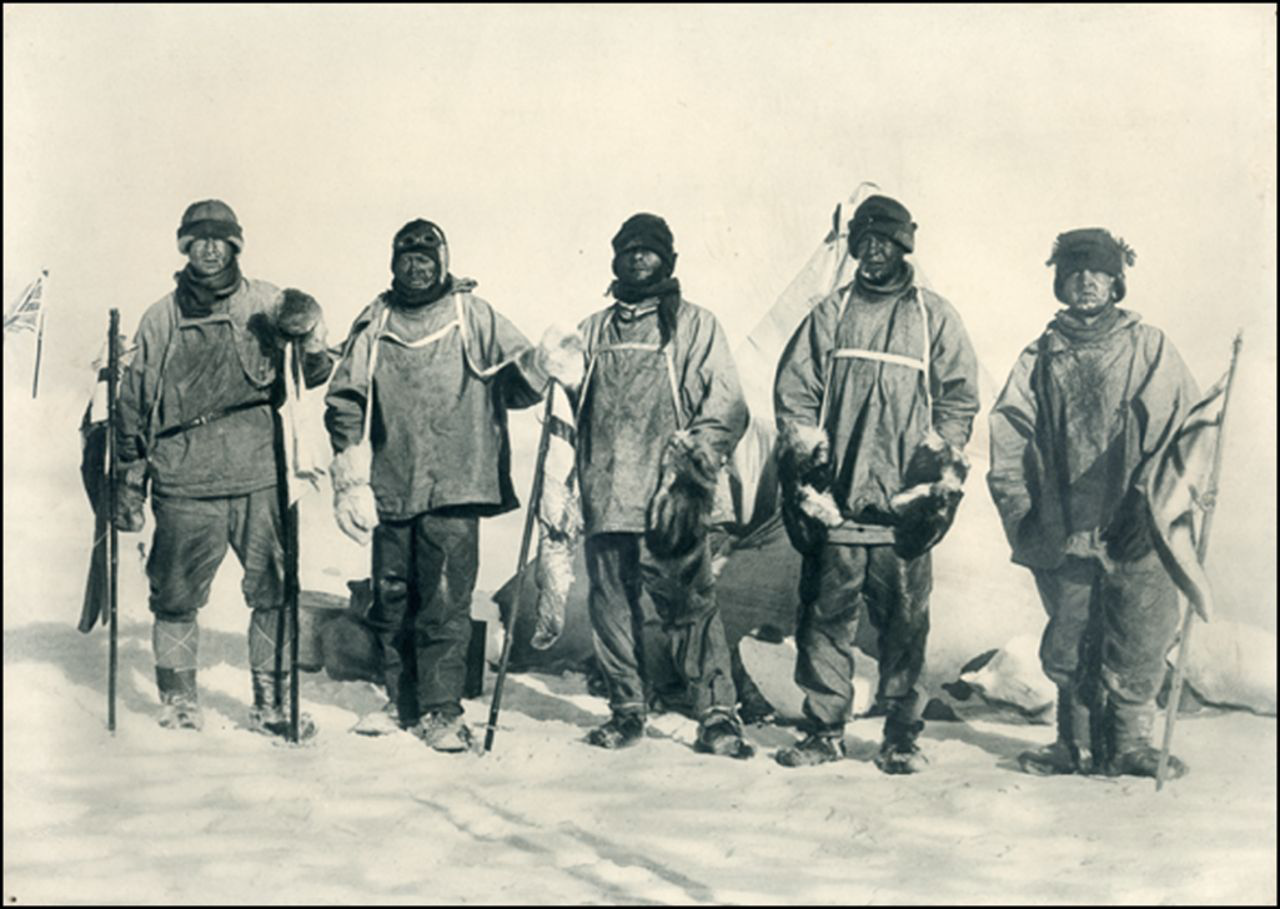
Since then there has been much speculation on the cause of Scott's death. Huntford's book on the expedition is very critical of Scott and argues strongly that Scott died of scurvy. 1 He was not the first to suggest this since Drs Eric Marshall (1875–1963) and Alexander Macklin (1889–1967), who were surgeons on Shackleton's expeditions, both thought the same. 2,3
Dr Edward Atkinson (1881–1928), the surgeon on Scott's expedition and who led the party that found the bodies of Scott and his companions, did not believe Scott died of scurvy and other writers agree. 4,5
The cause of Scott's death and the deaths of his colleagues are unlikely ever to be known with certainty but in this centenary year of Scott's final expedition, it seems appropriate to re-examine the medical evidence surrounding it. The non-medical decisions that may have contributed to his death, including the organization of the expedition, the decision not to use dogs and the controversies as to whether Scott might have been rescued are not discussed here.
Did Scott die of scurvy?
There is evidence both for and against the theory that Scott died of scurvy.
While fresh meat was available at their base on the coast, studies of the basic sledging diet have shown it was undoubtedly deficient in vitamin C. 6,7 However, the ponies they took with them on the first part of the journey were shot and the horse meat eaten or stored in depots for the return journey and it has been argued that this would have warded off scurvy. 3,4 However, Lt Edward Evans (1880–1957), who was in the last supporting party to leave Scott, developed typical scurvy on the return journey which he describes in his book: ‘It came on with a stiffening of the knee joints, then I could not straighten my legs, and finally they were horrible to behold, swollen, bruised and green. As day followed day my condition became worse; my gums were ulcerated and my teeth loose. Finally I got haemorrhage’. 8 Later he collapsed and needed rescuing. The first mention of his scurvy was on 22 January 9 but clearly he had been unwell for a while. It has been argued that if someone accompanying Scott to within 150 miles of the Pole developed scurvy then the polar party must have it as well. However, Evans had done seven weeks of sledging on survey work and stocking up depots before the Southern journey and so was likely to have been vitamin C deficient before he set out.
While their diet was undoubtedly vitamin C deficient, there is no evidence that they suffered scurvy. It is not mentioned in Scott's 10 and Wilson's 11 diaries. Atkinson found no evidence of scurvy when he found the bodies but clearly the diagnosis of scurvy from frozen remains is not easy and, as Marshall indelicately said, ‘a pickaxe is not the best method of diagnosis’. 12 Tryggve Gran (1889–1980), who was in the party that found Scott, described the bodies: ‘the cold had turned their skin yellow and glassy, and there were masses of marks of frost-bite’ 13 but he did not mention scurvy.
Huntford hints that Atkinson concealed evidence of scurvy because it would have reflected on the conduct of the expedition 14 and the same argument could be used about the lack of mention of scurvy in the diaries. However, this is unlikely since the cause of scurvy was unknown to the expedition members and Evans' scurvy was mentioned in the book of the expedition and his description of his own scurvy and the free discussion around the scurvy that occurred on Scott's Discovery expedition (1901–04) would indicate that the presence of scurvy was not something of which to be ashamed. Huntford's hints of a cover-up by Atkinson almost certainly relate to a series of letters from Dr Marshall to Dr Kendall who was researching scurvy on polar expeditions. While serving with Atkinson in the Russian Campaign at the end of World War I, Marshall overheard Atkinson professing special knowledge and experience of scurvy. He said, ‘I challenged him on his knowledge and experience and confirmed the opinion I had always held, which he had up till then denied’. 2 Atkinson did, of course, have experience of managing scurvy in Edward Evans and he continued to deny that Scott had scurvy. 12
While Macklin accepts that there was no gross evidence of scurvy, he said ‘in my mind there is not a shadow of doubt that the cause of the [Scott] party weakening was vitamin deficiency’. 3 Like Atkinson and Marshall, his cold weather experience in the Antarctic meant that the army posted him to the Russian Campaign and he says that he developed scurvy himself: ‘In Wilson's day scurvy was not recognised until certain well-marked signs began to make their appearance’. In the Russian Campaign ‘I learnt that scurvy as we have been taught to recognise it was only the last stage of a prolonged and progressive disease … I developed the disease myself; felt tired, lethargic, chilly, and could only carry out physical work at the cost of great mental effort. I became short of breath and was diagnosed by a British doctor as having heart disease, and advised to return to base. A Russian physician who saw me said I had scurvy, I was given appropriate food, and within a week was fit to go back to my work’. So you have the picture of a doctor, with his mind obsessed with scurvy, having it himself and not in the least suspecting it. 3
Whether Scott died of scurvy depends on the definition of scurvy. There is no evidence that he had the classical signs of scurvy in the form of haemorrhages and gum disease but can one die of vitamin C deficiency in the absence of these? In theory the answer must be yes if the first haemorrhage occurred into, for example, the brain rather than in the skin or muscles. However, this would be unusual and does not fit the way in which Scott and his companions died. Studies of diets deficient in vitamin C have shown increased fatigue 15 but Edward Evans managed to walk and ski for three weeks after he had developed haemorrhages and, on Shackleton's second expedition, his Ross Sea Party marched for six weeks despite classical scurvy 16 (though with one death and another collapse). There are many other examples in the polar literature of men marching and skiing despite classical scurvy. If classical scurvy does not prevent explorers from making progress, it seems unlikely that subclinical scurvy would do this.
Why did Scott die?
If Scott did not die of scurvy, what was his cause of death? Almost certainly the immediate cause of death was hypothermia as a result of lying in a tent in the Antarctic autumn without heat for 10 days. This was superimposed on starvation and dehydration. On 19 March they had only two days of food and one day of fuel left and were 11 miles from their next depot but bad weather prevented them from moving from their tent until they died 10 (or more) days later. Even if the weather had improved, they had severe frostbite. Scott wrote ‘amputation is the least I can hope for now’ 17 and so they still would not have survived.
The next question is why they were in this predicament. They were delayed by the illness and death of Edgar Evans and they were slowed further by frostbite, especially that of Oates. Frostbite occurred on all the polar expeditions but it does appear to have been worse on this expedition than on Shackleton's and many believe this is because they had scurvy. However, it has been shown that temperatures of that year were much lower than average. 18
There may have been other contributory factors. Undoubtedly they were malnourished. The calorific value of the food consumed on the Antarctic plateau has been estimated variously as 4889, 19 4430, 20 4571 21 and 5100 calories per day 22 but we obtain useful information on the metabolic demands of sledging from a modern sledging expedition to the South Pole in which these were studied. Dr Mike Stroud found that his and Ranulph Fiennes’ average energy expenditure was 26.3 MJ (6286 calories) and 29 MJ (6931 calories) per day, respectively. 23 Because of this imbalance between energy intake and output, Scott and his colleagues would all been malnourished and would have lost weight but their calorific intake was still higher than that of Shackleton on his furthest South expedition (1907–09).
Huntford 24 believes that Scott chose to die rather than to return with the disgrace of having been beaten by Amundsen but there is no evidence to support this and, in fact, all the evidence from his diaries and from their progress indicates that he was trying to reach safety. Ranulph Fiennes 25 in his biography of Scott devotes a whole chapter to counter what he sees as the denigration of Scott by Huntford.
It has been asked whether they committed suicide at the end as on 11 March Scott had written: ‘I practically ordered Wilson to hand over the means of ending our troubles to us, so that anyone of us may know how to do so. Wilson had no choice between doing so and our ransacking the medicine case. We have 30 opium tabloids apiece and he is left with a tube of morphine’. 26 However, Atkinson said that they had died natural deaths 5 and both Wilson and Bowers had religious beliefs that would have prevented them from considering this.
In summary, they probably died of hypothermia, starvation and dehydration as a result of delays caused by Evans’ illness and death and also by frostbite caused by colder temperatures than usual. In Atkinson's words ‘inclement weather with lack of fuel was the cause of their death’. 27 They were deficient in vitamin C but there is no evidence they had clinical scurvy. Studies with experimental vitamin C-deficient diets do describe ‘easy fatigue and slight weakness’ 28 and a small increase in the time taken to perform an agility test 29 but neither of these suggests fatigue was a major problem and another study of six men who also walked 10 miles a day found that fatiguablity and general malaise started at about the same time as the objective manifestations of scurvy. 30 Other groups have walked for weeks with clinical scurvy; while any fatigue from subclinical scurvy would not have helped the situation, in any event this is not necessary to explain their deaths. Other polar explorers of the time suffered from beriberi, 31 and Scott and his colleagues may well have been deficient in thiamine (vitamin B1) as well.
The death of Edgar Evans
The first indication in Scott's diary that there was a problem with Evans was on 23 January 1912 when Scott wrote: ‘there is no doubt Evans is a good deal run down – his fingers are badly blistered and his nose is rather seriously congested with frequent frost bites’. 32 However, problems had started earlier since after Evans’ death Scott wrote: ‘On discussing the symptoms we think he began to get weaker just before we reached the Pole’ 33 and on 7 January Wilson had written: ‘Evans cut his knuckle some days ago at the last depot – a week ago – has a lot of pus in it tonight’. 34 However, all had frostbite and so, although his frostbite may have been more severe than the others, it was not exceptional. He continued to have frostbite of his hands and nose and generally deteriorated with Scott writing on 7 February: ‘Evans is going steadily downhill’ and on 13 February ‘Evans has no power to assist with camping work’. He also had several ‘falls during rough travelling on the glacier’. 33
On 16 January Scott wrote: ‘Evans has nearly broken down in brain, we think. He is absolutely changed from his normal self-reliant self. This morning and this afternoon he stopped the march on some trivial excuse’. And Wilson wrote: ‘Evans collapsed – sick and giddy and unable to walk even by the sledge on ski so we camped [he] is now helpless with his hands frost-bitten’. 35
On 17 January he fell back to adjust his skis but never caught up so the others went back for him. Wilson wrote: ‘he had fallen and had his hands frost-bitten and then we returned for the sledge and brought it and skid him in on it, as he was rapidly losing the use of his legs. He was comatose when we got him into the tent and he dies without recovering consciousness that night about 10pm’. 36 Scott wrote: ‘I was first to reach the poor man and shocked at his appearance; he was on his knees with clothing disarranged, hands uncovered and frostbitten, and a wild look in his eyes. Asked what was the matter, he replied with a slow speech that he didn't know, but thought he must have fainted. We got him on his feet, but after two or three steps he sank down again. He showed every sign of complete collapse … When we returned [with the sledge] he was practically unconscious, and when we got him into the tent quite comatose. He died quietly at 12.30 AM’. 33
What was the cause of Evans’ death?
The cause of Evans’ death has been discussed in almost every book written on the expedition. 37–39
Scott wrote: ‘Wilson thinks it certain he must have injured his brain by a fall’ 33 and this has become the most accepted explanation with scurvy often being cited as being the cause of the haemorrhage. While he had falls, there is no mention of a significant fall or head injury and, while an acute haemorrhage might account for the sudden collapse at the end, it would not explain his gradual deterioration. Rogers believes he probably had a chronic subdural haematoma followed by a secondary haemorrhage 7 but this is rejected by Falckh 40 as not fitting the clinical picture.
Other intracranial pathologies have also been considered. Rogers discusses the possibility of a cerebral abscess spreading from sepsis in his hands but concludes this is unlikely 7 and others have suggested the possibility of venous sinus thrombosis as a result of intracranial sepsis spreading from infected frostbite on his nose. Sepsis from his hand might also have caused septicaemia. Despite the cold, pulling sledges would have caused sweating and, in addition, fluid would have been lost in respiration as the cold makes the Antarctic a very dry continent. Drinking water would have been rationed as it all had to be melted from snow and the resulting dehydration would have predisposed to this and to a stroke.
Hypothermia is another likely cause. Mild hypothermia occurred on Shackleton's Furthest South expedition 41,42 but temperatures do not seem to have been measured by Wilson.
All were malnourished, consuming fewer calories than they were expending. Evans was the largest member of the team and if they all had equal rations then in theory he would have had been most malnourished. 22 However, in Fiennes and Stroud's expedition, although Fiennes was the heavier man and lost most weight, Stroud lost more muscle mass. 23 Their experience also raises the possibility that Evans had hypoglycaemia as on two occasions their blood sugars were recorded as low as 0.3 mmol/L. Another environmental hazard is high-altitude cerebral oedema 39 but this seems unlikely after their prolonged time at altitude when they had already descended from the polar plateau.
In addition to vitamin C deficiency, the diet was deficient in other vitamins. Rogers discusses Wernicke's encephalopathy as a result of thiamine deficiency but concludes this as unlikely. 7 Falckh considers that he may have had anthrax transmitted from the horses and that the typical blisters and black slough of cutaneous anthrax went unnoticed among his many frostbites. 40
Know then thyself, presume not God to scan, The proper study of Mankind is ManPope, Alexander (1733). An Essay on Man. Part III. Poems of Alexander Pope [1688–1744] selected and edited by Douglas Grant. Harmondsworth, Middlesex: Penguin Books, 1950:121.
Conclusion
The cause of Evans’ death is a popular discussion topic for polar enthusiasts but the wide differential diagnosis and the lack of more evidence sadly makes such discussion somewhat fruitless!
Footnotes
Acknowledgements
This research was partly funded by the Wellcome Trust by a Short Term Research Award in the History of Medicine for Clinicians and Scientists for a study on ‘Medicine during the Heroic Age of Antarctic exploration 1895–1922’.