




Abstract
Toulouse-Lautrec was born in Albi in South West France. His parents were first cousins; this consanguineous marriage was responsible for his ugly deformities. Lautrec's life in Montmartre became the setting for much of his art and for his deliberate slow self-destruction. In addition to his artistic ability he was courageous, a natural leader, an accomplished chef, a connoisseur of fine wine, intelligent, humorous and very generous.
Inheritance
Lautrec's name, artistic ability and his deformities are widely known. Those who have seen the film Moulin Rouge released in 1952 will know that his major deformity was that he was a dwarf (Figure 1). Jose Ferrer played the lead role and strapped his ankles to his thighs to create the illusion that he was a dwarf.

Henri de Toulouse-Lautrec, aged 26
Henri de Toulouse-Lautrec was born on 24 November 1864 during a ferocious thunderstorm in Albi in South West France in the Hotel du Bosc, the home of his paternal grandmother (Hotel in this context means private mansion). He was the first born of Le Comte Alphonse de Toulouse-Lautrec (known in the family as Alf) and Adèle Tapié de Céleyran. He was Christened Henri Marie Raymond de Toulouse-Lautrec-Montfa – Henri after a relative, Henri de Chambord, the legitimate heir to the French throne, Marie after the Virgin and Raymond after his paternal grandfather. Toulouse, Lautrec and Montfa are place names in the Languedoc. His mother preferred the anglicized name Henry.1–3
The marriage of Alf and Adèle was an unfortunate misalliance. Their mothers Gabrielle and Louise, née d'Imbert du Bosc, were sisters and so Alf and Adèle were first cousins. Consanguineous marriages were common among the French aristocracy. The Lautrecs had had close connections with the French monarchy and had been lords of the entire South from the Pyrenees to the Italian border. However, Alf belonged to that branch of the Lautrecs known as ‘cadet’.1–3
Alf was unreliable and untrustworthy. He was rarely at home, in fact within a few days of Henry's birth he disappeared and did not return for three months. He lived the life of the idle rich on his wife's wealth, spending his time in riding, hunting and falconry. Alf owned no property and he and Adèle lived a peripatetic existence in the homes of relatives and residential hotels in Paris. When Alf realized that Henry was not going to be strong and join him in outdoor pursuits he abandoned Henry to the care of Adèle.1–3
Adèle was a devout believer, a regular attendee at Mass, shy and long suffering and she devoted herself to caring for Henry. She long remained in denial of the permanence of Henry's deformities despite his waddling gait, his need for a short cane and that he tired very quickly.
When Henry was three his large forehead, small chin and short limbs were already apparent and Adèle began taking him on a round of doctors and spas seeking a cure.4, 5 He received electrical stimulation, massage and leg traction and he suffered these useless painful procedures with remarkable fortitude for one so very young. 1 He was taken to Lourdes when aged seven in order to pray for his recovery. In January 1875 Henry was admitted to the clinic of the self-styled doctor Verrier in Neuilly near Paris but in July 1876 after Henry had spent 18 months in the clinic Adèle realized Verrier was a quack and she removed Henry to take him to Albi.1–3,6
Alf was anxious to have a healthy successor and in 1867 Richard was born. Sadly he died after a few months and then Adèle realized that her consanguineous marriage was responsible for Henry's deformities. In 1866 Adèle's brother Amédée married Alf's sister Alix (they too were first cousins) and four of their 14 children were deformed so further denial was point-less. 2 Their daughter Madeleine died very young but the other three deformed girls were present in a family photograph and they have the large forehead and receding chin that are features of this form of dwarfism. This inbreeding produced a situation where serious genetic illnesses were likely to become manifest.4, 5
In 1872 while lodging in the Hotel Pérey in Paris Henry began his schooling and there he met his cousin, Louis Pascal, and Maurice Joyant. The three became close friends; later Joyant became director and then owner of several galleries and was a great promoter of Henry's art. In Paris Henry also met the established painter René Princeteau. Both Princeteau and Henry were disabled; Princeteau was born a deaf mute but had taught himself to lip read and to talk after a fashion. Henry realized that here was someone who had triumphed over great adversity and escaped into art. It was an inspiration for Henry.1–3
The making of an artist
In 1880 Henry was aged 15 and his interest in art was recognized as a serious pastime but the following year there was wider recognition that he had a great talent and Henry entered Princeteau's studio to receive serious tuition. Despite his early years surrounded by indolent men Henry readily adapted to the strict routine of work and study in the atelier. At the age of 17 Henry executed an amazing charcoal drawing of an old man 2 (Figure 2).

‘Old Man’ by Toulouse-Lautrec, charcoal drawing 1882
After two years with Princeteau it was decided Henry should move to the atelier of Léon Bonnat who was a successful portrait painter. Henry learnt a great deal but the relationship was poor. Bonnat hated Henry but suffered him because the pay was good. After Henry died Bonnat used his influence with the Museums Council to veto the hanging of any of Henry's work in their establishments.2,3,7 When Bonnat closed his studio Henry moved to the atelier of Fernand Cormon. In those years studying with Princeteau, Bonnat and Cormon, Henry lodged with his mother in the Hotel Pérey but in 1884 while still in Cormon's studio Henry moved to an apartment on La Butte, as the hill of Montmartre is known. The apartment was close to the summit where the Basilica Sacré Coeur is situated. He had escaped his mother's control. When Cormon closed his studio Henry opened his own studio on La Butte and moved to share an apartment with Doctor Bourges. This arrangement lasted six years until Bourges married.1–3
Meanwhile Adèle had purchased the lovely old Château de Malromé some 30 km South-East of Bordeaux and close to her relatives. She had the château restored and for the first time had a home of her own.2, 3
Henry, the man and the artist
Montmartre was full of contrasts; there was a part where provincial serenity and innocence lived but close by was the slum – rife with crime, vice, debauchery and venereal disease. Henry was attracted by the nightlife. The bars, cabarets, dancehalls and the brothels became his favourite haunts. Each evening he would be seen in one of these, sitting on a low stool in a corner sketching the scene and drinking. He became adept at mixing cocktails and he even created some, one being composed of equal measures of cognac and absinthe which he called Tremblement de Terre – an earthquake. Drink became a craving and so began his slow, deliberate, self-destruction.2,3,7
Despite dying at the age of 36 Lautrec's output was prodigious and includes 5084 drawings, 737 canvases, 363 prints and posters, 275 watercolours, some ceramics and stained glass work plus works lost to posterity. He created covers for books, sheet music, theatre programmes and menus. There were no landscapes, no still life, no religious pictures and no abstracts; all were of animals or real people who shared his life. Most of his work was executed between 1880 and 1900, the period known as La Belle Époque or La Fin de Siècle. 3 It was a time of tumultuous cultural and social change with Paris at its centre. Haussmann was creating the wide boulevards and Eiffel completed his tower in time for the opening of the world fair in Paris in 1889. Henry was surrounded by all of this and he met some of the fascinating figures of that period. He met Oscar Wilde in London and in Paris, Félix Fénéon, a political anarchist and Alfred Jarry, the most shocking play-wright.1–3
Henry's disabilities prevented his participation in those activities enjoyed by the healthy such as horse riding, cycling and dancing so he included those pursuits in his art. His use of colour and his ability to demonstrate movement were unsurpassed.2, 3
It was said that Henry preferred redheaded girls because of their odour. His monstrous ugliness precluded any liaison with girls from his own aristocratic background and even with those of the demimondaine, known as ‘les grandes horizontales’, so he was drawn to prostitutes to satisfy his sexual needs. In 1888 he began consorting with Rosa La Rouge, a redhead. He was warned that she had syphilis; sadly it was too late, Henry had already made the acquaintance of the spirochete. Doctor Bourges attempted to limit the ravages of Henry's syphilis using mercury and potassium iodide.1–3
Henry was now painting scenes within the brothels. He was the only man, at that time, who had ever been allowed to live in one; he said it was like living in a hotel albeit with more mirrors! He was thus able to paint the girls dressing, undressing, bathing, relaxing and at work. In all he executed more than 50 paintings and drawings of the hopeless, bored and degraded women who inhabited the Maison Closes. There were paintings of brothel owners visiting to check their investment; of prostitutes standing in line with their skirts raised awaiting an obligatory medical examination intended to halt the spread of venereal diseases; and of the lesbian relationships of some of the prostitutes. Henry's intimate studies of the nightlife of Montmartre are dispassionate, sympathetic and non-judgemental. He exposed vice but had no wish to reform it. His brothel scenes are his most famous works. Eroticism was not included in these works that were chaste, inspired and dignified. The girls of the night, as Henry depicted them, were not happy, they did not smile, they were strained, resigned and sad.1–3
The Moulin Rouge
The Moulin Rouge opened in 1889 and Henry was asked to produce a series of posters advertising the shows. It quickly became Henry's favourite nightspot. Everything that appealed to Henry could be found there – colour, light, dancing, music, witty songs, alcohol and the vendors of love. All the famous artists performed there. An English dancer, Louise Weber known as La Goulue (the glutton), performed the Quadrille Réaliste with its provocative gestures, high kicks and the splits. She also introduced the North African dance, the can-can, often performed without undergarments. Her gluttony was for alcohol; she emptied the glasses of the audience as she danced by their tables. Later, when her gluttony included food, her increased weight meant she could not high kick so she became a belly dancer. Her partner was Valentin Désossé, the boneless, so-named because he was so very supple. They danced as if made for each other (Figure 3). When she became too fat to dance at the Moulin Rouge she opened a booth in La Place de la Nation to perform her Dance du Ventre and she asked Henry to decorate it. He produced two huge canvas panels, each ten-foot square, to be hung at the entrance. The one hung at the left of the entrance showed her as in her former glory dancing with Valentin Désossé and the one hung at the right showed a more blowsy Goulue beginning her belly dance with both Oscar Wilde and the political anarchist Felix Feneon watching. 1
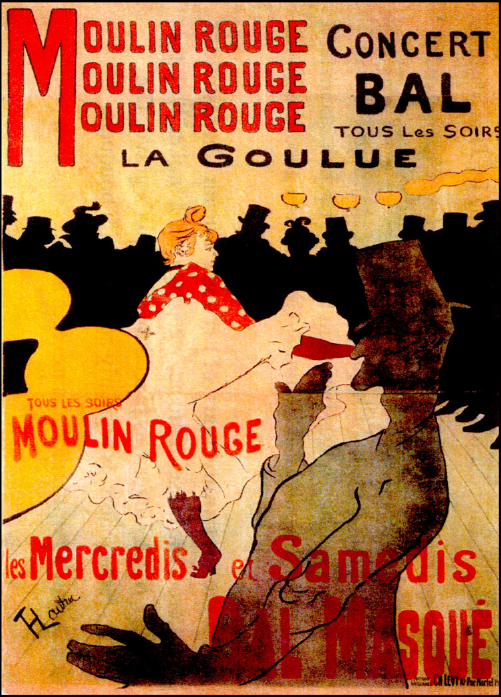
Moulin Rouge
After Henry's death these panels were acquired by a dealer who cut them into pieces, believing they would realize more money when sold that way. Fortunately Doctor Viau recognized some pieces and informed the police. The dealer was imprisoned and miraculously all the pieces were found and re-assembled by the Louvre; they now hang in the Musée D'Orsay.
Café concerts
The café concerts were, like the cabarets, a meeting place but although there was alcohol and singing they were mainly used by the intellectuals for discussion and the exchange of ideas. One such was Le Divan Japonais and Henry produced a poster advertising its opening. Yvette Guilbert was a singer there and, seeing Henry in the audience, she asked her friend Maurice Donnay who wrote her songs to bring Henry to lunch at her villa.1 Her butler answered the door and returned to Madame saying ‘Monsieur Donnay is here with a funny little thing - a sort of Punchinello’. Yvette Guilbert came to know Henry very well and provided an accurate description of Henry's deformities. She said
Henry had an enormous ruddy head on top of a tiny person, a mouth cut across the face, thick flabby lips, a black beard and a nose big enough for two faces. His hands were dwarf but his eyes were large, rich and dark in colour and he removed his spectacles so I could see his only attractive feature. He jumped on to the chair at table and the food disappeared into his large mouth with every jaw movement displaying moist salivating lips.2, 3
Henry was an intellectual with a great sense of humour. His many friends enjoyed his company and his generosity and were almost oblivious to his monstrous ugliness. A stranger would see only an ugly dwarf and could be aggressively rude. On one occasion when dining in his favourite London restaurant he was approached by a stranger who roughly demanded ‘Where are the lavatories?’ Henry replied ‘Go to the bottom of these stairs and you will see a door marked GENTLEMEN – but go in anyway!’ 2
Dwarfism and disputes
Dwarfism is the result of a failure of normal bone growth and more than 200 types are known. Most are due to genetic mutation of the egg or sperm before conception. A dwarf is defined as an individual whose height is in the lowest three percentile. Terms including osteopetrosis, osteogenesis-imperfecta, fragi-litas osseum, achondroplasia, pseudoachondroplasia, cleidocranial dysostosis, polyepiphysial dysplasia, and the eponymous titles Albers-Schonberg, Morquio, Hurler, Blount and Turner are in common usage.4,5, 7–9
Dwarfs can be divided into two categories, Proportionate where all body parts are proportionally small and commonly due to hormonal, metabolic, racial or familial problems and Disproportionate where some parts are small while other parts are normal and this group can be subdivided into those with a short trunk and normal limbs and those with a normal trunk and short limbs. Henry is in that group of disproportionate dwarfs with a normal size trunk and short limbs – he was four feet 11 inches when fully grown. In a charcoal self-caricature Henry demonstrated his short limbs and he entitled it ‘Lost’ which is of course a bilingual pun on his name – Toulouse.4, 5 Dispute arose about whether the limb shortening included his hands and fingers. Yvette Guilbert said his hands were dwarf and Henry called them ‘Grosses Pattes’ meaning fat podgy paws and he avoided the word ‘Grands’. Most observers reported his hands were small. Henry fractured his right and left femurs in separate trivial accidents as a teenager and union in each case was slow. Throughout his life he suffered leg pains believed to be due to hairline fractures (Figure 4).2,5,10–12
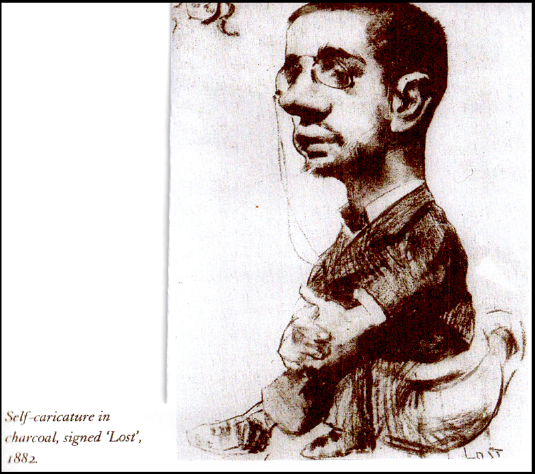
Lost self-caricature
Henry's skull was said to be large with a prominent forehead with an open anterior fontanelle, an obtuse mandibular angle produced a receding chin and he grew a beard to hide the chin. These three signs have also been disputed.2,5 A photograph of Henry aged three shows a large forehead and a small receding chin. Henry almost always wore a hat even indoors, suggesting he was protecting his skull. One of Henry's self-portraits shows the line of his skull from the glabella to the occiput open, close to the vertex, suggesting an open fontanelle.2,5,10–12
His dental deformities, resulting from eruption of the permanent teeth before the deciduous teeth had disappeared, caused toothache, a lisping speech and constant drooling. His nose was large with large nostrils. His midface was flattened with poorly developed sinuses causing constant sniffling and frequent upper respiratory infections.5,7
In 1923 the Italian physician Montanari described a patient, the product of a consanguineous marriage, with these features but he did not give the condition a name.
8
It was not until 1962 that two French physicians, Marateaux and Lamy, called it Pycnodysostosis:  being Greek for hard or dense and dysostosis meaning disordered bone formation, so it is a form of sclerosing bone dysplasia.
4
In 1965 Marateaux and Lamy published their view that Henry suffered from pycnodysostosis. They summarized Henry's features: short stature, cranio-facial deformity with poorly developed sinuses, brittle bones, open fontanelle and autosomal recessive transmission from the marriage of first cousins.
5
being Greek for hard or dense and dysostosis meaning disordered bone formation, so it is a form of sclerosing bone dysplasia.
4
In 1965 Marateaux and Lamy published their view that Henry suffered from pycnodysostosis. They summarized Henry's features: short stature, cranio-facial deformity with poorly developed sinuses, brittle bones, open fontanelle and autosomal recessive transmission from the marriage of first cousins.
5
In 1995 the distinguished American biographer Julia Frey published a biography of Toulouse-Lautrec after having had access to the Lautrec family documents and photographs and she raised doubts about Marateaux's diagnosis which she said was based on unconfirmed descriptions, rumour and caricatures. 2 In a correspondence with Marateaux in 1995, Frey produced photographs showing Henry's skull was not deformed so the fontanelle must be closed and also showing that the chin was not receding and the hands and fingers were large. Some with pycnodysostosis do have late closure of the fontanelle. Frey dismissed the caricatures that might refute her assertions as being unscientific distortions for comic effect. Of course the camera may also distort. She did recognize that Henry demonstrated his deformities in his art.2,10–12 Some might argue that caricatures only distort or exaggerate features that are already present. 6
There are only two forms of dwarfism with open or late closure of the fontanelle; pycnodysostosis and cleidocranial dysostosis. Henry did have some features of cleidocranial dysostosis but he did not have the classic sign where the shoulders could be adducted to meet in the midline. 5
Breakdown
Henry's lifestyle has been described as deliberate slow self-destruction, an escape from the body that was tormenting him. His consumption of prodigious quantities and fantastic mixtures of alcohol, his visits to brothels and his very hard work with little sleep inevitably were taking their toll. By 1897 it was obvious that a breakdown was imminent, he was nervous and irritable, there were clashes with the police and he was deluded. These symptoms could be due to delirium tremens or tertiary syphilis. Despite his dipsomania he remained creative; fatigue and stupor reduced his output but the quality remained high. During 1898 he produced 100 superb lithographs.1–3
In January 1899 Adèle felt so helpless and distressed by Henry's behaviour that at last she accepted the advice of her family and left Paris for Malromé. She instructed her maid to care for Henry and report to her. Henry was bereft, his loving mother had deserted him and he felt he was being spied upon. Less than eight weeks later Adèle felt compelled to return to Paris as Henry had become hysterically violent. She had him admitted to Doctor Semelaigne's sanatorium in Neuilly just round the corner from the clinic where, as a boy, he had been incarcerated for 18 months. Surprisingly, without alcohol he made some improvement but he regarded the sanatorium as a prison. He wrote to his friend Maurice Joyant complaining that he was living on Nux Vomica and that both Bacchus and Venus were forbidden. He was desperate to escape. He wrote to friends asking for help but to no avail. He even wrote to his father but as always Alf was absent when confronted with responsibility.1–3
In the end Henry's art released him. He decided the way to secure freedom was to create art that no madman could produce. Joyant gave him the materials and Henry worked entirely from memory. Among the works that demonstrated sanity and allowed his release was a series of circus pictures. He left the clinic on 17 May 1899 complaining that doctors think that ailments were created just for the doctor's benefit. After his release Henry was provided with a guardian, Paul Viaud, who was both kind and alert and most fortunately unable to take alcohol. They took holidays together in Normandy and in Bordeaux. For a while Henry behaved; he began putting his affairs in order and he continued to improve. At the end of 1899 he returned to Paris where temptation was too great, visiting his old haunts and his dissolute companions. 2
In May 1900 he held an exhibition of his works in his apartment and he lithographed an amusing invitation to his friends. He represented himself as a small cowboy standing before a cow. It is inscribed ‘Henri de Toulouse-Lautrec will be very flattered if you will kindly accept a cup of milk with him on Saturday May 15th at about half past 3 in the afternoon’. Strangely 15 May 1900 was not a Saturday but a Tuesday. Biographers explain this discrepancy as due to haziness caused by alcohol but Henri was sufficiently alert and witty to say that he would only drink milk when cows grazed on grapes!1–3
Henry continued to work and to deteriorate yet painted some of his greatest portraits. His last portrait was of his lifelong friend Maurice Joyant wearing a sou'wester. His last poster was of the dancer Jane Avril. She has a serpent encircling her body, a monstrous hat on her red hair, open mouth and her arms held aloft in fear. It was deemed too frightening ever to be displayed. It was later likened to ‘the scream’ of Edvard Munch. 2
Viaud was no longer able to control Henry yet in May 1900 they went to Normandy on holiday and Henry was caught on camera defaecating on the beach. The photograph demonstrates Henry's gross cerebral commotion. This behaviour was completely out of the character of the aristocrat that Henry knew he was. 2
In 1901 he had a stroke, stopped drinking and became surly and depressed. He made a slow recovery but in August he had a second stroke from which he failed to make a recovery. On 20 August he was taken to his mother in Malromé. Adèle was at his bedside night and day. The family was assembled and Adèle asked the local priest to administer the last rites. Henry made no objection; he simply observed ‘Dying is damned hard’. When Alf finally arrived Henry said ‘I knew you would not miss the kill’ and his last words addressed to his father were ‘Vieux con’ – an acceptable translation might be ‘you old fool’.2, 3
At 2 pm on 9 September 1901 in a ferocious thunderstorm, just as at his birth, Henry died.
At the funeral Alf ensured all attention was directed at himself; he insisted his corns were too painful to walk so he jumped on the back of the hearse, took hold of the reins and whipped up the horses. The mourners tried to run behind in the mud-strewn lanes. Henry was buried in the cemetery at St André-du-Bois. Later Adèle learned that the cemetery was to be destroyed so she had Henry's grave moved to Verdelais nearer her home in Malromé. Joyant took charge of Henry's effects and he and Adèle established the Musée de Henri Marie Raymond de Toulouse-Lautrec-Montfa in Albi. Joyant wrote Henry's first biography.1–3 Since Henry's death there have been exhibitions of his work almost every year in American and European cities. In 2005 Henry's painting of a redheaded laundress ‘La Blanchiseuse’ was sold for a record $22.4 million and in September 2011 the Courtauld Gallery had a magnificent exhibition of Lautrec's works that had been assembled from around the world.
Notes and Jottings
CF Makin has written Djanga, Spirits of the Dead (IOSBN 0 86445 161 X) which is historical fiction with much of medicine in the early days of settlement in Australia. Told by a doctor settling in New South Wales, their rescue by Aboriginals after shipwreck and then life with these people leads to much medicine and surgery. A good read.
Notes and Jottings
Peter B Cotton has been an instigator in the world of endoscopy and his The Tunnel at the End of the LIght, My Endoscopic Journey in Six Decades (ISBN 978-1-45282-046-0) is an autobiography illustrated copiously which will appeal to those who know the author and to those in gastroenterology who will enjoy reading of the development of this important speciality.