




Abstract
William Penny Brookes lived all his life in Much Wenlock in Shropshire where he worked as a general practitioner for 60 years. He is now best remembered as the founder of the Wenlock Olympian Society, as a founding member of the first national Olympian association and for his influence on Baron Pierre de Coubertin, the founder of the modern Olympic movement. He was a tireless campaigner for the introduction of physical education and a lessening of the academic workload in elementary schools. He was also an important figure in the medical reform movement of the mid-19th century. In Much Wenlock he was a much respected philanthropist and was involved in many civic activities. He was also a notable botanist and antiquarian.
Introduction
William Penny Brookes (Figure 1) was born in 1809 at 7 Wilmore Street, Much Wenlock. It was in this house that he lived and worked, succeeding his father as a surgeon-apothecary in 1831, and it was here that he died in 1895.
William Penny Brookes, aged 67. By courtesy of the Wenlock Olympian Society
His two younger brothers also qualified in medicine. John Doughty Brookes (1811–35) practised at Madeley, eight miles north-east of Much Wenlock, but died aged only 24 when he was thrown from his horse. Andrew Good Brooks (1813–94) initially joined William in practice but subsequently moved a few miles northwest to Cressage and then to Shrewsbury. 1,2
Medical training
According to one of his obituaries Brookes was apprenticed to ‘Dr Barnet of Stourport’. 1 Although there was Richard Barnett practising as a surgeon in Stourport at this time, 3 Brookes's entry in the register of the Society of Apothecaries states that he was apprenticed to his father in Much Wenlock. 4 After a five-year apprenticeship, he enlisted as a student at St Thomas's Hospital where, on 2 October 1829, he paid £31.11s.0d to attend a course in surgical practice and where he also worked as a surgical dresser to Mr Whitfield. 5 The courses he attended in London were recorded by the Society of Apothecaries. 4
He studied anatomy and physiology at Grainger's School in Webb Street. Founded by Edward Grainger (1797–1824) in 1821, the school became immensely popular and continued so after Edward's death 6 when it was taken over by his brother Richard (1801–65). The school had an informal association with St Thomas's Hospital with which Richard Grainger amalgamated it in 1842. 7 Brookes also chose Grainger's school for lectures in chemistry by John Thomas Cooper (1790–1854) and for those in Materia Medica and the Principles and Practice of Medicine by Francis Boott (1792–1863). He also went to Grainger's for lectures on midwifery by Robert Lee (1793–1877) who was teaching there around this time, 8 but who was to spend the greater part of his career at St George's Hospital. For lectures on medicine he went to John Elliotson (1791–1868) who had taught at Grainger's school before being appointed to St Thomas's in 1823 and who moved later to University College Hospital. All of these lecturers were young men, under 40 years of age, when they taught Brookes but he chose his mentors wisely because they all went on to achieve sufficient eminence to earn entries in the Oxford Dictionary of National Biography.
After nine months in London, Brookes moved to Paris. His time in the city coincided with an insurrection during which a fellow medical student was shot dead. 1 At this period the medical teaching in Paris was generally considered superior to that in England and Scotland and many British students studied there. 9,10 Brookes's obituary in the Lancet states that he studied under Dupuytren, Chopart and Laennec, 11 but only the first of these was still alive when Brookes arrived in the city. While in Paris his father died of typhoid. However, Brookes seems to have been in no hurry to complete his studies because then he spent several months in Padua. The reason for his move to Padua is not known. Although of great historical renown its medical school was no longer held in any special esteem by the time of Brookes's visit. It may have been Padua's ancient botanical gardens that were the real attraction.
Brookes was a botanist of some distinction who contributed a botanical section to a county history. 12 This is the earliest surviving record of the plants growing on and around Wenlock Edge. 13 He also contributed 75 entries to Leighton's Flora of Shropshire 14 and he provided specimens for Leighton's herbarium. Much of his own extensive herbarium is still in Much Wenlock. It originally contained at least 600 specimens though only 324 survive. They are exceptionally well dried and preserved and contain many examples of plants which no longer grow in Shropshire. 13
Medical practice
On his return to England in 1831 Brookes qualified LSA and MRCS and then practised in Much Wenlock until he retired 60 years later. His highly successful practice covered a wide area, up to 25 miles from his home, which he covered on horseback. Like other rural practitioners at this time, 15 he sometimes covered immense distances, on one occasion up to 70 miles in a day. 1 How often on these long rides must he have thought of the fate of his younger brother?
Brookes was said to be ‘resolute and full of nerve’ when dealing with medical and surgical emergencies. 1 In addition to his private practice, Brookes was also the Poor Law Medical Officer to the Wenlock District of the Madeley Union at a salary of £25 pa. Unlike many Poor Law Medical Officers his relationships with the guardians and relieving officer seem to have been good, apart from one episode in 1871 when he was incensed that his order for extra food for a sick pauper was refused. His anger seems to have stemmed both from dismay for his patient's plight and from the challenge to his professional status. 16
On at least one occasion his practice also included forensic work when he was called to the scene of the murder of an old woman who was said to have been an evil witch. 17 Brookes made a postmortem examination and concluded that the knife wounds suffered by the victim indeed were the cause of her death. 18
No record has been found of any clinical observations or papers published by Brookes. In 1850, when President of the Shropshire branch of the Provincial Medical and Surgical Association (PMSA), he suggested that all members of the PMSA be asked to submit details of the results of amputations in private practice. 19 He believed the information would show a much lower mortality than that published by Rutherford Alcock (1809–97) who had obtained his data from military campaigns and large public hospitals. 20 Brookes does not appear to have pursued his suggestion and may have concluded that it was impractical to collect information from so many sources. 21 It does, however, show that he was aware of the need to collect extensive numerical data at a time when many doctors still gave greater emphasis to their own limited personal experience as the basis for clinical decision-making.
Brookes must have kept good records in his clinical practice because he used them to convince the town authorities that ‘a filthy wide open sewer into which closets emptied’ was the cause of a fever in many of his patients. 1 Then the sewer was closed over.
Medical reform
Brookes achieved national prominence through his work for the medical reform movement in the mid-19th century. He and his colleague Peploe Cartwright of Oswestry 22 were the driving forces behind the inter-related and overlapping medical reform associations in Shropshire, variously known as the Shropshire and North Wales Medical and Surgical Association, the Associated Physicians and Surgeons of Shropshire and North Wales, the Shropshire Medical Reform Association and the Shropshire Branch of the PMSA. So prominent were the Shropshire doctors in the medical reform movement at this time that the Lancet described the Shropshire Medical Reform Association as ‘one of the most influential in the kingdom’ 23 and the Shropshire branch of the PMSA as ‘the most important of the Branch Associations’, 24 accolades that stemmed in very large part from the energies of Brookes and Cartwright. At various times both men served as Honorary Secretary and as President of these bodies. 25 In this context, Brookes' name first appears in 1844 when he was a member of a deputation of Shropshire surgeons who lobbied their Members of Parliament in opposition to the Bill of the Home Secretary, Sir James Graham which, it was claimed, would leave general practitioners subordinate to the surgeons. 26
Like so many of those general practitioners who were members of the Royal College of Surgeons of England, Brookes had been incensed by the grant of a new Charter to the College in 1843. This Charter allowed the College to create, from among its membership, a fellowship from which the governing council of the College would in future be elected and from which general practitioners effectively were excluded. It was this insult that seems to have triggered Brookes's interest and which greatly influenced his views on the whole field of medical reform. When he was not writing to the medical journals in his capacity as a spokesman for one of the Shropshire associations, Brookes was a frequent correspondent on his own account. He emphasized repeatedly that his aim was not to weaken the College of Surgeons but to reform it so that its entire membership was enfranchised. 27–29 Each new obstacle introduced by the College of Surgeons was challenged immediately by Brookes. 30–32
The principle of enfranchisement was one that Brookes held dear and not only in relation to the College of Surgeons. He opposed several Bills on medical reform because they did not give general practitioners adequate representation either on a proposed Medical Council 33 or on the bodies that set examinations. 29 When a medical reform bill was enacted in 1858, none of the members of the General Medical Council was elected by the profession at large, all being appointed either by the various medical colleges and corporations or by the Crown. When a further attempt was made to introduce elected representatives during discussions on the Medical Act Amendment Act in 1878, a petition in favour was received from Much Wenlock, 34 almost certainly devised by Brookes.
Brookes was vigorously and persistently opposed to the suggestion that general practitioners be relegated to what he considered to be a third and inferior college, and he was very critical of the National Association, subsequently the National Institution, of General Practitioners that advocated such a college. 33, 35, 36
Like doctors elsewhere, Brookes and his Shropshire colleagues thought it absurd there should be 18 different colleges and boards providing 18 different medical qualifications of a very variable standard. 19 They argued in favour of a common portal into the profession, one that would ensure a uniform and an enhanced standard of education. 37
They also argued that all doctors should be trained in both medicine and surgery on the principle that the two disciplines constituted a single science and that it was impossible to practise surgery without some knowledge of medicine and vice versa. 30
Brookes and the other Shropshire doctors were in favour of penalties against unqualified medical practitioners.
33, 38
Brookes later had personal experience of a notorious clerical quack, the Reverend Hugh Reed
39
who practised for a time in Much Wenlock. However, he did not challenge Reed directly, … being in principle a free-trader, and considering that it was the duty of the Legislature! to protect the public against the injurious and often fatal consequences of the treatment by unqualified Medical Practitioners.
40
In 1848 Brookes was one of five Shropshire doctors whose name was put forward to give evidence to the Medical Registration Committee of the House of Commons 38 although, in the event, it was Peploe Cartwright and another surgeon who were selected to speak. 41 Brookes was one of the Shropshire doctors in a deputation that lobbied the Home Secretary in 1850 but, once again, it was Peploe Cartwright who was selected to present the petition. On the same day the Home Secretary received a deputation from the National Institute of General Practitioners which was seeking to create an independent college of general practitioners. 42 In a subsequent open letter to the Home Secretary, Brookes was highly critical of the evidence given by the National Institute which, he claimed, was ‘calculated to mislead’. 35
A difference of opinion
In 1852 Brookes found himself in disagreement with Peploe Cartwright and other Shropshire doctors over the Draft Bill put forward by the PMSA. Brookes claimed that the proposal would, like some earlier Bills, leave general practitioners disenfranchised in the governance of their profession and would consign them to an inferior tier of the profession. Cartwright, on the other hand, claimed that the Bill would actually raise the status of the whole profession by creating a common portal of entry. He conceded that the bill made no provision for electoral representation by general practitioners but argued, in opposition to the position maintained previously by the Shropshire doctors, that all elements of the profession would be adequately represented by those appointed by the Colleges of Physicians and Surgeons and by the Company of Apothecaries. Brookes could not and would not concede the principle of electoral representation. He put forward an amendment that involved a major re-constitution of the Apothecaries Company. Cartwright responded by taunting Brookes with the allegation that his proposal amounted, in effect, to the creation of a third medical college to which Brookes had always been opposed. After further discussion Brookes' amendment was lost. 29
Brookes seems to have taken this rejection very hard. He wrote a long and emotional letter to the Lancet in which he pleaded with his fellow general practitioners to oppose the PMSA's Draft Bill. 43
The Lancet, which had noted the difference of opinion between Cartwright and Brookes but made no comment on it or on Brookes' letter, 24 eventually came out in favour of the PMSA's Bill. 44 Brookes must have been disappointed that his letter went unnoticed and that it drew no support in the correspondence columns. He was not present at the meeting when the Shropshire Branch discussed the Bill for a second time and voted unanimously in favour of it. 45 Two years later Brookes was still continuing to oppose the PMSA Bill but lent his support to another brought forward by Sir John Forbes. 46 Thereafter, however, his interest in medical reform seems to have waned, whether from disillusionment or because his interests were now focused elsewhere is impossible to tell. In 1854 he spoke at a meeting of the Shropshire Branch of the PMSA but he did not attend the annual meetings in either 1855 or 1856 47 and further contributions to the cause of medical reform from him have not been discovered.
Brookes brought immense energy and integrity of purpose to the reform movement but his failure to realize by 1852 that he was out of touch with most of the profession on the subject of enfranchisement, and his subsequent abrupt departure from the movement, raise questions about his effectiveness as a medical politician. His language was sometimes emotive and he could be sarcastic in his criticism of those who held opinions which differed from his own. 48 As a Liberal 1 he was very much on the radical wing of the party although, as he was keen to point out, he certainly did not share John Bright's (1811–89) hostility to the peerage, writing that he was not one of those who would set class against class 49 and unlike Bright he was an ardent supporter of the established church. In medical politics his views often accorded with those of another radical, the independent politician and medical reformer Thomas Wakley. Like Wakley, he was often outspoken and referred to the Apothecaries Company as ‘Rhubarb Hall’, 36 an insult coined by Wakley himself and used repeatedly thereafter in the pages of the Lancet. 50
All correspondence on medical reform in Brookes's own name, as distinct from reports and memorials he submitted on behalf of the Shropshire medical associations, was sent to the Lancet rather than to the Provincial Medical and Surgical Journal or its successors. Brookes evidently felt a greater empathy with Wakley than with Charles Hasting, founder of the British Medical Association, and it must have been a bitter blow for Brookes when Wakley came out in 1852 in support of the PMSA Bill to which Brookes was so vehemently opposed. Hastings was also a political Liberal 51 but was less outspoken, less didactic and probably a more effective negotiator than both Wakley and Brookes. This may explain why it was Cartwright who, as a safer pair of hands, was chosen in preference to Brookes to present the petitions of the Shropshire doctors.
The status and dignity of the profession
An integral component of the movement for medical reform was the status of the profession itself and especially that of the general practitioner. Brookes was critical of the ‘petty jealousies’ within the profession that weakened its influence and lowered it in the public estimation. 27 He opposed measures which, in his opinion, threatened to impair the dignity and welfare of the profession 52 or to lower the status of the general practitioner. 29, 37
Brookes also looked for opportunities to enhance the status of his profession. In 1851 on behalf of the Shropshire practitioners, he petitioned the Prime Minister to make doctors eligible for honours of the Bath which were, at that time, conferred only for administrative and not for medical or scientific services. 32
When it was proposed to allocate two parliamentary seats to the legal profession in Russell's Reform Bill of 1854, Brookes suggested that the Colleges of Physicians and Surgeons should also be given their own Members of Parliament. 53 Undaunted by his failure on this occasion, subsequently he persuaded his colleagues to petition for peerages to be awarded to doctors on the basis of their professional achievements. 54 In the event it was not until 1897, more than a year after Brookes's death, that Joseph Lister was ennobled as the first medical peer. 55
Brookes was greatly concerned with the status of military surgeons. Conditions of employment of military surgeons throughout much of the 19th century were greatly inferior to those of combatant officers and this was a subject of continuing debate in the medical journals. The matter was portrayed as being unfair to those involved which, of course, it was but the unspoken message was that it represented a slur on the medical profession which was seen as inferior to a career as an army officer.
Brookes considered it particularly unjust that military surgeons were not eligible for awards for bravery even though they often faced the same dangers as their combatant brother officers. When it was decided finally that military surgeons were to become eligible for the honours of the Bath, it was proposed to give them the civil and not the military order. Brookes immediately petitioned the Home Secretary, arguing that military surgeons ‘ … are, in a great measure, exposed to all the hardships, perils and privations incident to combatant officers’. 56 He persuaded several branches of the PMSA to adopt resolutions on the subject 28,57 and this led to a memorandum to the Prime Minister from the PMSA in 1850. 58 The first medical appointments to the military division of the Order of the Bath followed within two months. 59 This initiative paved the way for the award of military bravery awards to medical officers. 60
Brookes also hoped to enhance the prestige of military surgeons by publishing a history of the medical services of the army and navy 61 but the project never materialized.
The tactics which Brookes employed to further his medical political activities were to be mirrored in his campaigns later for physical education and athletics.
Civic work in Much Wenlock
Brookes's pride in his profession was matched by his pride in his native town to which he contributed in very many ways.
In 1831 he was appointed as a magistrate in which capacity he served for more than 40 years.
62
Shortly afterwards, as a Commissioner for Roads, he was involved in the building of several new roads in the area.
1
He was actively involved in the renovation of the Council Chamber in the Guildhall, having previously collected much of the ancient woodwork with which it is now adorned.
63
He was instrumental in building the town's Corn Exchange, reading rooms and museum. His initiative in this and other civic ventures is remembered in a plaque on the Corn Exchange (Figure 2). Brookes was a keen antiquarian who researched the history of the town and its priory, collecting deeds and other antiquities which he gave to the museum.
1,64
As Chairman of the Wenlock Gas Company
65
and as a Director of the Much Wenlock and Severn Junction Railway
1
he brought both gas and rail travel to the town.
Memorial on the Corn Exchange in Much Wenlock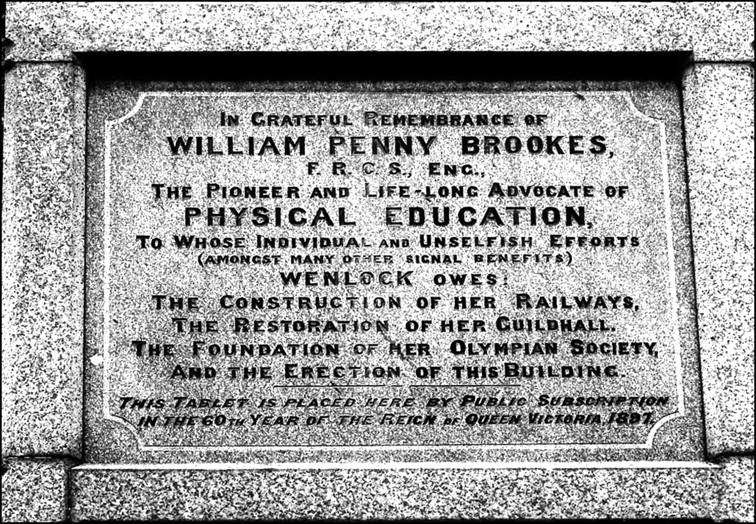
Brookes was an active supporter of the National School and, as the driving force behind the Wenlock Agricultural Reading Society (WARS), he did much to encourage adult education in the town. He persuaded prominent individuals, including the Duke of Wellington, Disraeli, Macaulay and Gladstone to give books and money to the Society.
17
The Society maintained two libraries. The first, founded in 1841, contained more than 1700 volumes on agriculture, the sciences and general literature. Annual membership cost six shillings and it catered for farmers and artisans. A second library, with an annual subscription of two shillings, was intended for the labouring classes. After just four months it contained 150 volumes.
66
Brookes and his supporters also set up classes in natural history, botany, art and music. Recognizing however that these classes were unlikely to appeal to many in the poorest sections of society, in 1850 he devised a new class to promote … the moral, physical and intellectual improvement of the inhabitants … and especially of the Working Classes by the encouragement of outdoor recreation and by the award of prizes … for skill in Athletic exercises and proficiency in intellectual and industrial attainments.
67
Brookes' aspirations for this new endeavour were reflected in its name, the Olympian Class of the WARS. As an accomplished classicist 1 Brookes was a great admirer of the ancient Greeks and of their Olympic Games which embodied those ideals that he sought to emulate in Wenlock. It was this new venture which was to lead Brookes down the parallel twin paths for which he is now best remembered, the revival of the Olympian Games and the campaign for compulsory physical education in elementary schools.
The Wenlock Olympian games
The association with the ancient games of Greece undoubtedly lent an aura of antiquity and respectability to the Wenlock Games but, in the early years, the latter had relatively little in common with the former. Although the Wenlock Games did include athletic events, they also featured some of the more respectable of those games that traditionally had been associated with church wakes and village carnivals. Quoits, football, cricket, archery and light-hearted events including wheelbarrow races and tilting at a ring (in which a horse rider tried to unhook a small ring onto his lance while galloping at full tilt) no doubt widened the appeal as did the pageantry that included a herald, a procession with a band from the town centre to the games field and, finally, country dancing to round off the day of celebrations.
In Brookes' mind the pageantry and the village events were almost as important as the athletics. They were included because of his nostalgic conviction that ‘ … outdoor recreations and manly sports’ had contributed so greatly to the national character of ‘Merrie England’ and its imperial achievements. 68 If his views sound jingoistic to the modern ear, they are probably representative of the widespread national pride felt by many of his contemporaries.
Brookes also saw the games as an opportunity to promote contact between the different social classes. 69 In this way ‘they help to cement society together’. 70 The objectives of the Olympian class included not only the physical but also the intellectual betterment of the inhabitants. At various times, therefore, the children's competitions included arithmetic, recitation, spelling, writing, history, sewing and knitting. 69
There were concerns that the games might be blighted by drunkenness for which Much Wenlock had an appalling reputation in the mid-19th century. On one occasion a riot ensued after a clergyman who preached there on the evils of drink and the benefits of temperance was told to ‘get down from the pulpit and make way for a better man’. On another occasion Brookes himself was deprecated for refusing to down the entire alcoholic content of a large silver cup when he was elected as Burgess. 17 In 1859 Brookes warned the men of Wenlock ‘against the fearful consequences of intemperance’. 69 However, he was confident that no alcohol-fuelled disturbances would disrupt his Olympian Games and he even allowed the town's publicans to sell beer on the games field. 71 His confidence stemmed from a belief that the presence of women at out-door amusements tended to ‘soften the manners of the men’. 72 Moreover, outdoor recreation was, in itself, a substitute for drunkenness and all ‘sensual and degrading pursuits’. 73, 74
Not all of Brookes' colleagues shared his positive views on this matter. In 1860 the vicar claimed the games actually contributed to drunkenness in the town. The dispute led to Brookes’ resignation as secretary of the WARS and the separation of the Olympian class which was now re-founded as the independent Wenlock Olympian Society (WOS). 73 Brookes was the leading light in the new WOS, just as he had been in the WARS, though once again he received considerable support from many others in Wenlock.
By 1859 most of the non-athletic games and sports had been dropped. The events now included 200 yard and half mile races, hurdle races, javelin throwing, long and high jumping and archery, all of which have their equivalents in the modern games. A pentathlon comprising running, jumping, discus, javelin and wrestling was added in 1868 and the town now had a well-appointed sports field with a running track and raked seating for the spectators. A photograph taken at the games on 11 June 1867 (Figure 3) is thought to be the world's oldest photograph of a live sporting event (as distinct from photographs of posed images).
75
Subsequent additions included areas for cricket, bowls, archery, tennis, quoits and a swimming pool.
76
The Wenlock Olympian Games in 1867. Officials arrive by carriage for the opening ceremony, with athletes and spectators in the background. By courtesy of the Wenlock Olympian Society
The historical events had served their purpose in helping to establish the games but, as athletics was now gathering in popularity around the country and as athletes began to travel from well outside the borough to take part in the Wenlock games, the old sports and pastimes were supplanted by purely athletic events.
Beale has emphasized that the concept of organized sport with a variety of different competitions, as exemplified by the Wenlock Games, was very advanced for its time. In Scotland the Highland Games included several different events but multidisciplinary games which were open to all comers were unknown in England. 77 From 1849, the year before the first Wenlock Games, the Royal Military Academy at Woolwich held meetings that included a variety of events but which were not open to the public. 78 The Wenlock Games antedated organized athletic events at the Universities of Cambridge and Oxford, and it was at the Wenlock Games that athletics and gymnastics were first combined. 77
Brookes' role in the expansion of the Olympian movement
In 1858 Brookes was enthused by news of a proposal to revive Olympic Games in Athens. A limited competition was held there in 1859 and, prompted by Brookes, the WOS gave one of the prizes. Sporadic games followed in the 1870s and Brookes maintained contact with the Greek authorities for more than 20 years in the hope of encouraging them to revive the event on a more permanent basis. 79 However, Greece was often in political turmoil and the time was not opportune.
In 1860 Brookes initiated the Shropshire Olympian Games. These were held on only four occasions but they helped to bring the concept to a wider audience. 80
Brookes was one of the prime movers, with John Hulley of Liverpool and Ernst Ravenstein of London, in establishing the National Olympian Association (NOA) with the aim of holding annual national meetings. As with the Wenlock games, Brookes was keen to ensure that the association should include intellectual activities and hence the title of NOA was preferred to an alternative suggestion of Athletic Association. 81 Its first meeting was held at the Crystal Palace in 1866 when the winner of the 440 yards hurdles was the 18-year-old cricketer and (later) medical practitioner WG Grace (1848–1915). Grace won by 20 yards in a time of one minute 10 seconds but was unplaced in the other events for which he entered. 82 On the previous two days Grace had scored 224 not out, playing cricket for England against Surrey. On the day of the hurdling he should have been fielding for England but his captain, clearly confident of victory, allowed him to compete in the games. 83 A report of the Crystal Palace meeting in the Oxford Journal described Brookes as ‘the father of the Olympian movement’. 84
It was the Wenlock and NOA Games which first made it possible for the working classes to take part in competitive athletics. The NOA was the world's first national Olympic association and the first organization to create a national multisport event. 75 However, the authority and influence of the NOA was soon challenged by the formation of the Amateur Athletics Club (AAC), later the Amateur Athletics Association. Whereas the NOA games were open to what Brookes described as ‘every man in every grade of life’, 69 the AAC sought to restrict events to ‘amateurs and gentlemen’, thereby excluding the working classes. 85 The debate over the distinction between amateurs and professionals is a problem that has plagued sport ever since. Brookes addressed it at the Wenlock Games in 1864. Recognizing that the working classes preferred to compete for money rather than for medals, but wishing to attract all classes of society, he concluded that the meetings should comprise two distinct competitions, one for monetary prizes and one for medals. This did not prove to be a satisfactory solution and there followed a phase when professional athletes were excluded from the Wenlock games and prizes were given as items such as books ‘to the value of … ’. 85
When medals were introduced at the Wenlock games, Brookes drew on his classical knowledge to produce a design (Figure 4) that featured a Latin motto ‘Arte et Viribus’ (By Skill and By Strength) and Nike, the Greek goddess of victory. Nike is set in an oval of olive leaves and holds an olive crown.
1
Above her, in Greek, are the words ‘in recompense for glorious deeds’ which is a quote from Pindar's Isthmian Odes.
86
Above more modern symbols of sporting events a hand holds a wreath of bay (Laurus nobilis). An olive wreath was the reward at the ancient Olympic Games and a bay or ‘laurel’ wreath was awarded at the Pythean Games.
87
The Wenlock Olympic Medal. Reproduced with permission of the Wenlock Olympian Society
In 1877 Brookes renewed his approaches to the Greeks, making contact with Joannes Gennadius, the Greek Chargé d'Affaires in London. In 1880 his suggestion that International Olympic Games be held in Athens every four years received some publicity in Greek newspapers. 88 However, he was dependant on Gennadius to promote his ideas in Greece and this Gennadius failed to do, even when the political situation became more stable. 89
In 1889 Brookes wrote to the French aristocrat Baron de Coubertin (1863–1937) after the latter had put a notice in The Times seeking contact with those interested in physical education. 90 de Coubertin is now widely regarded as the founder of the modern Olympic movement which began with games in Athens in 1896. After further correspondence with Brookes he visited Much Wenlock in 1890 and while there watched an abbreviated version of the Wenlock Olympian Games staged in his honour. He wrote an appreciative account in which he praised Brookes's revival of Olympian games in Much Wenlock and in which he made particular reference to Brookes’ efforts to persuade the Greeks to re-establish their own games. 91
In 1892 de Coubertin announced his own proposal to revive the Olympic Games in Greece. Although he had been in regular correspondence with Brookes, he did not forewarn Brookes of his intention to make this announcement. Subsequently Brookes was invited to attend the planning meeting as an Honorary Member of the International Olympic Committee but was too ill to attend. Although he lived for another 18 months, long enough to have known that his long cherished hope of a Greek Olympian Games was now certain, he died just four months before the games took place. 92
One hundred and seventeen years later Brookes has left his mark on the 2012 Olympic Games in London. Nike, who featured on Brookes's medal design, still appears on the modern medal. 93 One of the Olympic mascots is named Wenlock and the Olympic Torch will pass through the town. When the torch reaches the Olympic Park in London it will pass an oak tree grown from an acorn from a tree which Brookes had given to de Coubertin to plant in Much Wenlock in 1890. 75 Brookes must surely be happy with his Olympic legacy.
de Coubertin's debt to Brookes
No mention was made of Brookes’ name at the time of the first Olympic Games 94 and, when de Coubertin wrote of Brookes in 1897 shortly after his death, he praised his achievements in Much Wenlock but downplayed his attempts to extend the Olympic movement beyond Shropshire. 95,96 Eleven years later, in 1908, he dismissed Brookes as ‘an English doctor from another age, who had made his little village into a metropolis for popular sports’ 97 in one article and made no mention of him in another. 98 de Coubertin clearly intended to imply that Brookes had not played any significant part in the revival of the International Olympic Games.
The two men had met, not through a mutual enthusiasm for the Olympic cause but because they were both advocates of the benefits of physical education. So far as is known, de Coubertin had no thought of reviving the ancient Greek games until after he had met Brookes. It was not until two years later, in 1892, that de Coubertin wrote that he had concluded that the revival of the Olympic Games would be of great benefit to modern athletics. 99,100 From the account of his visit to Much Wenlock there can be no doubt that de Coubertin was greatly influenced by what he saw there. 91 It was not so much the events themselves but the Olympian ethos that caught his imagination. He wrote ‘the Wenlock people alone have preserved and followed the true Olympian traditions’. 95 He was also greatly impressed by the pageantry which he described in great detail and which became an important part of the international games. The idea of moving the games to different venues in subsequent years, first introduced in the Shropshire and then in the National Olympian Games, was also copied by the International Olympian Movement.
Brookes' influence on de Coubertin has been documented meticulously by Young. 101 Although some of Young's conclusions have been challenged, 102,103 he has answered most of the criticisms 104 and his views are supported by others. 105
The campaign for physical education
Brookes's campaign for the revival of an Olympian movement was a specific example of his much wider enthusiasm for physical exercise. He believed the benefits of regular exercise were greatest when started in childhood while the body was still developing 70 and that ‘it is too late to straighten the tree when it is grown up’ 106 and so he began a sustained campaign for the introduction of compulsory physical education in elementary schools.
An early influence on and a supporter of Brookes' efforts was Robert Slaney (1792–1862), the Whig Member of Parliament for Shrewsbury and a notable social reformer. 69,107 In 1824 he proposed that recreational sports grounds be established for the labouring classes and he suggested that if placed near schools they could also serve as playgrounds for the children. 108 Thirty-five years later Slaney was one of the promulgators of the Playground and General Recreation Society which sought to promote this objective. 109
Brookes gave three reasons for the importance of physical education. 110 The first stemmed from his Christian beliefs. Because he believed that God had created man in his own image, it would be ‘a strange and unpardonable ingratitude to God’ if one did not cultivate physical prowess. In this respect Brookes was influenced by the writings of the Reverend Charles Kingsley (1819–75). Kingsley's ideal of ‘a man who fears God and can walk a thousand miles in a thousand hours’ was first expressed in his novel Two Years Ago, published in 1857. It was this novel that gave rise to the phrase ‘Muscular Christianity’ which was coined by an anonymous reviewer in the Saturday Review. 111 Kingsley spoke of himself as advocating ‘a system of procuring a “mentem sanam in corpore sano”’ 112 and his doctrine was described by another reviewer as ‘the conviction that the body is, no less than the soul, the gift of God himself, and that it is therefore the bounden duty of every man to bring it to and keep it in the highest state of perfection of which it is capable’. 113 Another notable exponent of the doctrine, and a clear influence on Brookes, was Thomas Hughes (1822–96), the author of Tom Brown's Schooldays (1857). Indeed Brookes arranged for Hughes to sit on the Planning Committee for the 1874 NOA Games. 114
Brookes' second reason argued for physical exercise on the grounds that it ‘promotes the health, strength and happiness of our families and fellow creatures’. 110 Outdoor recreations in particular also tended to discourage the ‘debasing indulgences so injurious to health and moral character’. 115 However, the opportunities for outdoor recreation, even in the countryside, had been restricted ‘since the enclosure of our common land’. 69
Finally, Brook's third reason stemmed from his belief that the physical degeneracy caused by the transition from an agricultural to an industrial lifestyle was a threat to the national security of Britain and its Empire 116, 117 and he quoted the words of John Ruskin (1819–1900) that in ‘ … our manufacturing cities … we manufacture everything there except men’. 68
Brookes’ first comments on the association between national security and physical fitness were made in 1859, 69 shortly after the Crimean War and the Indian Mutiny. It was a topic to which he returned many times. After the Prussian Army had routed the Austrians in 1867 he observed that physical education was compulsory in all Prussian schools 68 and he made the same point several times after the Franco-Prussian War. 74,115 In Brookes' eyes these victories were in large part attributable to the physical fitness of the Prussian armies. Other countries followed Prussia's example and Brookes noted that teachers in Prussia, Austria and Sweden were trained routinely to teach physical education.
Educational ‘over-pressure’
Brookes also saw physical education as a necessary counterbalance to what he considered to be the excessive academic instruction in primary schools. He first made this point in 1851 in a speech in which he condemned ‘the excessive mental competition … which undermined the bodily health and ultimately impaired the faculties of the mind.’
118
This was also the first occasion on which Brookes called for the incorporation of physical education into the school curriculum. He argued that, rather than producing a healthy mind in a healthy body, the curriculum was all too likely to produce an overtaxed brain ‘in corpore nani’ (in the body of a dwarf)
119
and he quoted Field Marshall Sir Garnet Wolseley (1833–1913) to the effect that ‘A boy might be like a tadpole – all head – and still be an insignificant lad’.
120
Worse still, Brookes claimed that the excessive mental application could lead to ‘fatal cases of brain disease’
68
and that … the directors of education in our elementary national schools seem to encourage an excessive and exclusive mental training in order to meet the marketable demand for intellectual labour, without reflecting on the injurious consequences of so early and heavy a strain on the nervous system of the young.
121
The concerns he expressed about ‘mental overstimulation’ in the 1850s and 1860s eventually were echoed by some of the speakers at a meeting of the Social Science Association in 1880. 122 Brookes quoted opinions expressed at this meeting by Elizabeth Garrett Anderson (1836–1917) who considered there was a real danger of overworking children whose brains were still immature. He also cited Sophia Jex-Blake (1840–1912) who reported seeing an alarming number of cerebral affections in over-tasked schoolchildren. 123
In 1883 Pridgeon Teale (1831–1923), a surgeon at the Leeds General Infirmary, made educational over-pressure the subject of his Presidential Speech to the Social Science Congress 124 and the British Medical Journal (BMJ) claimed that ‘educational over-pressure is menacing the health of the country’ and that children were dying of ‘school-bred brain-disease’, 125 a claim that had been made by Brookes some 60 years earlier. 68 Although some doctors occasionally challenged these claims, they were supported by the authoritative opinions of eminent men including Dr (later Sir) James Crichton-Browne (1840–1938) 126 and the claims became accepted medical opinion.
The subject of educational over-pressure became a matter of considerable national interest, with frequent citations in The Times as well as in the medical press. It was argued that the over-pressure was a consequence of the system of ‘payment by results’ whereby school funding, including a proportion of teachers’ salaries, was based on the results of examinations conducted by an inspector at an annual visit. It was argued further that the pressure had been aggravated by changes to the payment scheme in 1883 127 and this led to intense political debate in both Houses of Parliament in 1883–84. When Brookes had first criticized the scheme in 1867 he recognized its good intentions but objected to it because, in order to obtain reasonable funding, the scheme encouraged schoolmasters to cram those subjects that qualified for a grant. 68 Physical education was not of course a qualifying subject. Brookes persisted in his criticism, writing in 1885 of the excessive ‘brain work that ‘predisposes to mental irritability and insanity’. 128
Those who had made similar criticisms in the national press in 1883–84 never gave credit to Brookes for his earlier condemnations. Stanley Leighton (1837–1901), Member of Parliament for Oswestry in Shropshire who was a supporter of Brookes 129 and himself a vigorous critic of over-pressure, 127 described how Brookes had ‘long ago raised his voice. He was right all the time but people, expressly State departments, would not pay attention to him’. 130 The scheme of payment by results was finally abolished in 1890. 131
Medical ambivalence
Many doctors initially were ambivalent about the benefits of physical education. Although the Lancet had welcomed Slaney's Playgrounds and General Recreation Society, it was less enthusiastic about more strenuous physical exercise. In 1863 it published an editorial with the emotive title ‘Muscular Martyrdom’ on the hazards of endurance sports such as rowing. 132 It returned to this theme in 1869 with an editorial on ‘The evils of over-training’ particularly among undergraduates. 133 It specifically cited the Oxbridge boat race, thereby echoing the opinions of an eminent London surgeon, Frederic Skey (1798–1872). Skey had described the race as a ‘national folly’ that caused both temporary and permanent damage to the oarsmen's health. 134 In the same year the Lancet gave prominence to the death of a young man, a death said to have resulted from over-training. 135
However, the Lancet did concede that the physical education of the young was much neglected and it argued that every large school should have its own gymnasium, the use of which should constitute an important part of every boy's education. ‘We do not want athletes’ said the Lancet, ‘but a mens sana in corpore sano; and this cannot be obtained without due exercise of both’. 135 A book review in the Lancet in the same year warned of the risk of both physical and moral degeneracy if bodily physique were neglected, 136 a subject to which the editor returned in 1881 when he endorsed a call for the expansion of playing fields and gymnasia. 137
On two occasions in the 1870s the Lancet called for the introduction of physical education into elementary schools as a counterbalance to what it saw as the undue emphasis on the intellectual education of the poorer classes. 138,139 It is surprising therefore that Brookes, who had previously been such a prolific correspondent on the subject of medical reform, did not now join the debate on physical education. Perhaps the hurt he had felt when the Lancet had ignored his own proposal for medical reform in favour of that put forward by the PMSA still rankled or perhaps he had been irritated by the Lancet's initially negative attitude towards athletics. Whatever the reason, his lack of comment is a most notable omission.
The BMJ was an even later convert to the cause of physical education in schools 140 and, by the time both journals were consistently committed to it, Brookes had long since looked elsewhere for support.
The medical profession's ambivalence over physical education and sport was echoed elsewhere. Among novelists, for example, the enthusiasm of Kingsley and Hughes was vigorously opposed by Wilkie Collins (1824–89). In Man and Wife (1870) Collins attacked athleticism as a cult that brutalizes the athlete and damages his moral and intellectual development and as a fanaticism which inevitably becomes an end in itself. By contrast, Kingsley and Hughes in their novels, and Brookes and his supporters in Much Wenlock, always portrayed sport within a much wider context. In Much Wenlock the games were set within an historical framework and imbued with the concepts of pageantry and chivalry and, in the earlier years, they positively encouraged intellectual as well as sporting prowess. It is no surprise that Brookes should have kept a cutting from the Globe and Traveller that firmly refuted the allegations of both Collins and Skey. 141
Speeches and petitions
The closing ceremonies at the end of each Wenlock Games usually included a speech from Brookes. On these and other occasions he often included a call for compulsory physical education in elementary schools together with criticism of what he called ‘mental forcing’. 116 In the National Schools, though not in those run by the Church of England, he also criticized the lack of religious education. In a speech in 1877 he argued for a balanced intellectual and physical education that would produce a healthy child, deeply imbued with Christian values and ‘fitted for the position in life it is likely to occupy’. 119
Brookes' concept of a proper education was clearly something much more than just one that produced a healthy mind in a healthy body. An appropriate education should produce not only a ‘whole man’ (or woman) but one who, in line with the Victorian social order, was fitted for the station in life that his destiny had determined. Thus in rural areas, where the majority of boys would find work in agriculture, Brookes thought it absurd that drawing was a compulsory subject ‘while bodily training, which is so important for their health and strength, is merely permissory, and therefore not generally adopted’. 142
Although Brookes’ speeches were very fully recorded in the Shropshire newspapers, these local reports were not echoed in the national press. This may have been for the best. As with his earlier campaigns on medical reform, Brookes' opinions were often expressed in combative and emotive language which might only have antagonized those in positions of power. For example, he wrote that, by ignoring physical education, successive governments had shown ‘ … a lamentable indifference … to the welfare of the individual and the security of the empire’ 123 and that much seed had fallen ‘ … without effect, upon the half cultivated soil of the Education Department, a soil choked with the weeds of official prejudice’. 143 He complained of ‘ … the grievous injury inflicted upon the young in our national elementary schools … ’ 142 and he wrote that the welfare and independence of the country was ‘ … seriously imperilled by the present ill-judged and injurious system of education which was calculated to convert the British people into a puny, weak, miserable race …’ 144 He even went so far as to describe the system of national education as ‘dangerous and unpatriotic’. 145 According to Brookes the Department of Education regarded children ‘as merely intellectual money-making machines’ and was ‘utterly regardless of their health and happiness in this life’. 146 Even by the standards of the time, this was outspoken and provocative language and all the more so for its frequent repetition. An independent observer who knew Brookes only through his speeches might well have concluded he was a zealot whose opinions should be taken with a large pinch of salt.
Brookes was obliged to moderate his language in the petitions he drafted on behalf of the WOS. All of these were requests for the introduction of compulsory physical education in elementary schools. The first was forwarded to Parliament in 1868. 106 A second followed in 1870, the year in which elementary education became compulsory for all children. 147
A small concession was obtained in 1871 when the Committee of the Council of Education allowed attendance at drill, under a competent instructor and for up to 40 hours each year, to be counted as school attendance. 148 However, Brookes did not consider drill alone was sufficient. In 1871 he and the local schoolmaster, Edward Stroud, undertook a study to compare drill alone with drill and gymnastics. They found that over a six month period the average chest circumference of six boys who undertook both drill and gymnastics (Indian clubs, vaulting horse, horizontal and parallel bars) increased by 1⅚ inches, whereas that of another six boys, who did only drill and no gymnastics, increased by less than half an inch. 149 Although the numbers of participants were very small and there is no suggestion that the trial was blinded, it is remarkable for its time in having a control group. In 1878 a petition was directed to the Committee of the Council on Education. This committee supervised the distribution of government grants on education and had sanctioned military drill as an activity which counted towards a grant. 150 Brookes and his colleagues asked that the military drill be combined with gymnastic training and supported their request by quoting the results of the study carried out at Much Wenlock School. The petition was noted by the BMJ which gave it its approval 151 but this petition also appears to have fallen on stony ground.
Further unsuccessful petitions to Parliament followed in 1890, 152 1891 153 and 1892. 110 It does seem strange that Brookes and his fellow members of the Society should have persevered for so long with a method of lobbying that was so patently ineffectual.
It is also surprising that Brookes did not publish the results of his gymnastics trial more widely. The results were printed and circulated to a few influential individuals but there is no evidence of any attempt by Brookes to publish them in a journal. Brookes did not even write to the BMJ after it published a synopsis of the work of Dr Burcq who had obtained similar results in French soldiers. 154
Brookes praised the publications of Dr Mathias Roth (1818–91) 123 who published regularly on the importance of physical education in elementary schools. 155, 156 Indeed Roth had first published on the subject in 1854 157 so his interest in it was almost as longstanding as that of Brookes. Roth noted that in the House of Lords Lord Elcho had argued for the introduction of physical education into schools as early as 1862 and that two Members of Parliament had made the same point in the House of Commons in 1875. Hence, although Brookes was one of the earliest, perhaps even the earliest, to argue the case for physical education, he was certainly not alone. Like Brookes, Roth claimed that Prussia had benefitted militarily from its policy of physical education in schools. He was one of the very few who quoted Brookes's experiment in the Much Wenlock school, having heard of it from Ernst Ravenstein of the NOA. 158
Others who were publishing on the subject included Dr Benjamin Ward Richardson whose work is described later, Dr CH Schraible who devoted six pages to the neglect of physical education in state schools 159 and Thomas Chesterton. 160 There is nothing in their works or in the archive of the WOS to suggest they had been in touch with Brookes or he with them. Nor does Brookes seem to have considered publishing his own work on the subject. He may perhaps have recognized that he was more effective as an orator than as a writer.
Success at last
Having eschewed publication and having perhaps realized that petitions alone were ineffective, Brookes targeted influential individuals who might be sympathetic to his cause. In 1883 he wrote to the Duke of Cambridge but received only a courteous reply from an equerry. 161 Brookes may have been prompted to write to him by what Brookes described as ‘a disastrous and humiliating defeat’ in the First Boer War (1880–81) and which he attributed to a lack of physical fitness. 162 As Commander-in-Chief of the Army the Duke was in favour of military drill in schools 158 and he expressed concern that so many potential recruits were unfit for service 163 but he probably had little interest in gymnastics or other forms of physical education. Brookes' comments anticipated by five years those of Sir Thomas Crawford (1824–95), the Director-General of the Army Medical Department, who claimed that the number of recruits who were rejected on medical grounds had risen from 372 per 1000 in 1860–64 to 416 per 1000 by 1882–86. 164 However, even Sir Thomas's warnings went unheeded at this time 165 and it was not until after similar problems arose during the Second Boer War (1899–1902) that a Parliamentary Commission was ordered. When it reported in 1904, its recommendations included ‘a methodical system of physical training’ and the creation of open spaces for play and of play-sheds for use when the weather was unsuitable for outdoor exercise. 166 Once again, Brookes's opinions had been well in advance of others.
Sir Lyon Playfair (1818–98), to whom Brookes also wrote in 1883, was a scientist and politician whose many interests included health and education. He thanked Brookes for the ‘Reports of the Athletic Festivals’ and agreed that ‘physical training in our Schools is a subject of great importance’ 167 but he offered no assistance. It is not clear what support Brookes might have hoped to obtain from Playfair who was a firm supporter of the ‘payment by results’ system 127 to which Brookes was so strongly opposed.
In 1884 Brookes wrote to Sir Edwin Chadwick (1800–90), the great social reformer and influential civil servant. Chadwick replied that he had not previously been aware of Brookes' work in the field, 168 an indication perhaps of how little Brookes' name was known outside his native Shropshire and the world of athletics. Chadwick's interest in physical education went back at least 20 years because he had chaired a meeting on the subject in 1863. 169 He sent Brookes some of his own papers on the subject and also some by Dr (later Sir) Benjamin Ward Richardson (1828–96), physician, scientist, hygienist, journal founder and editor, novelist, playwright and poet. 170 Papers by Richardson which Chadwick might have sent to Brookes included two that had appeared in Popular Science Monthly, both of which discussed the role of physical education. 171,172
However, the most useful of Brookes’ contacts in the 1880s and 1890s came not though his own approaches but through the formation of the National Physical Recreation Society in 1886. The aim of the Society was ‘the promotion of physical recreation among the working classes’ and one of its objectives was exactly that for which Brookes had been striving for so long, namely to encourage legislation to provide ‘systematic physical recreation in the public elementary school board system’. 173 The Chairman was Herbert Gladstone, Member of Parliament and son of the Prime Minister. The Council of the Society consisted of men of influence in the fields of sport, politics and society. In particular, the Honorary Secretary was Alec Alexander, Director of the Liverpool Gymnasium and a longstanding acquaintance of Brookes. It was probably through Alexander that Brookes was invited to join the Council of the Society some three months after its foundation. 92 Alexander edited the Society's Journal in which he described Brookes’ longstanding commitment to the cause of physical education. 174
Membership of the Council brought Brookes into contact with the Society's president, Reginald Brabazon, the Earl of Meath (1841–1929) who was a prominent Conservative peer and social reformer. Brookes helped Meath and other Members of the Council to draft the Society's resolutions on physical education in schools 175 and Meath often quoted the trial carried out by Brookes and Stroud in 1871–72. 92, 176 Meath maintained a regular correspondence with Brookes 92 and, in his capacity as President of the British College of Physical Education, he enlisted the support of eminent London doctors including the physicians Sir Benjamin Ward Richardson, Sir Edward Sieveking (1816–1904) and Thomas Savill (1855–1910) and the surgeon Sir William MacCormac (1836–1901). 177 It was Meath who, after several abortive attempts, finally steered through the House of Lords a Bill that made physical education compulsory in elementary schools. The Act took effect in August 1895, 92 44 years after Brookes had first proposed the measure 118 and just four months before his death. It must have brought him immense satisfaction in those final months of life though and, had he lived until the Second Boer War, he would have reflected that the measure had been introduced too late to have prevented the further problems experienced with lack of physical fitness during that war. Had he lived in the modern age he would surely have been an active member of the National Playing Fields Association (now Fields in Trust) and would have been a fierce opponent of the sale of school playing fields in recent years.
The inner man
Brookes suffered more than his fair share of sorrow within his family. A younger brother had died at the age of 24 and, of his five children, only one daughter survived him. Two daughters died in their thirties, one son died when he was 11 and his younger son, another William, was 29 when he died from drowning.
178
As a student at Christ Church, Oxford, William junior had taken a first in Classics
179
but at the time of his death was a postgraduate student of the Regius Professor of Medicine in Oxford, Henry Wentworth Acland (1815–1900) who held him in high regard.
180
Brookes' wife died in 1885 and so he spent the last 10 years of his life in the company of his surviving daughter in a house that overlooked the family burial plots (Figure 5).
The Brookes family graves. Brookes and his wife are in the grave nearest the camera
Despite his bereavements, Brookes remained indefatigable and ‘always had a cheerful word for everyone’. 1 He was a small man, only five feet two inches high according to his passport, 181 but with a lithe and upright figure. 182 What he lacked in stature was more than compensated by his physical and mental energy. He had a persuasive presence which few in Wenlock could withstand 1 and ‘a magic power of persuasion’ 182 which enabled him to mobilize and motivate his local army of supporters. He took great pride in his home town, its buildings and its institutions. He also contributed greatly to its appearance, particularly with his plantings of shrubs at the railway station where he paid for the landscaping out of his own pocket 182 and with trees on the playing field to commemorate major events in the progress of the WOS. 1 Many of the latter still grace the field. His dedication to his town was recognized by the presentation of an address and a silver tea service, epergne and salver in 1875. 183 His pride in his profession and in his country matched that he took in his home town. His intense patriotism 1 contributed to his concerns about what he perceived as the physical and moral degeneracy of the industrial age.
Two themes recur in his obituaries.
1,182
The first is the repeated reference to his untiring energy, his determination and his refusal to be discouraged. ‘He never knew what defeat meant’. The second relates to his concern for the poor. For them he lived a life of incessant toil, day and night. They always looked to him as their guide and friend. [He] was always a sincere and true friend to the poor, and helped them in every way which lay in his power. … never was there a less selfish man, or one who so ungrudgingly and cheerfully devoted himself to public service.
As a general practitioner he continued to serve the poor in his capacity as a Poor Law Medical Officer for 58 years, 184 long after he can have had any financial need for the meagre remuneration offered by the post.
When praised for something he had done Brookes responded ‘I have done no more than my duty as a member of a benevolent profession … ’ 185 and it is evident that much of his determination and motivation stemmed from his Christian belief, as when he quoted from Ecclesiastes 10: 9 ‘Whatsoever thy hand findeth to do, do it with thy might’. 107
de Coubertin remarked on Brookes's patience, on his quiet and equable manner and on ‘his everlasting good humour’. He also observed that Brookes had not been in any way embittered by his failure to achieve some of his dearest ambitions. He was a practical philanthropist who ‘did not care for immortality. 95
However, Brookes may not always have been a paragon of virtue. In 1863 he was accused of having an extramarital affair. Although the allegation was subsequently withdrawn, Brookes was obliged to admit that he had given the lady two brooches, a locket and a ring and that they had exchanged photographs! 186
Envoi
In the course of a long life Brookes lived to see the fulfilment of his major ambitions. Of his achievements in Much Wenlock he could hardly have wished for better, though the success of the Wenlock Games came with the pain of separation from the WARS and its objectives.
As a campaigner on medical reform in the 1840s and 50s he achieved unusual prominence for a general practitioner working in a relatively isolated rural area. He did much to enhance the status of the profession, especially through his promotion of bravery awards for military surgeons but, in the political movement for medical reform, ultimately he was sidelined by his refusal to compromise on the principles of enfranchisement and representation of general practitioners.
Physical education in elementary schools became a reality during the last year of his life and before he died he knew that his dream of a revival of Olympic Games in Greece was now certain and only a few months from fruition. Both of these were ambitions he had cherished for more than 40 years but, ultimately and before they could be realized, he had been obliged to pass the torch to younger and more influential men. Could he himself have done more to have brought a quicker resolution? In the case of the Olympic Games the answer is surely no. Even if Brookes had enjoyed Baron de Coubertin's social standing and the financial independence to be able to devote his whole time to the project, the political instability in Greece during the greater part of this time would have made it impossible.
In the case of physical education Brookes might have helped his case if his language had been less combative and less antagonistic towards officialdom. He might also have achieved greater national recognition for the cause if he had published his ideas in a book though his persuasive powers do seem to have been at their most effective when he was addressing a live audience. Probably, however, there was no more that he could have done, if only because his ideas were so far ahead of their time. Brookes was indeed a man of Olympian vision and energy.
