




Abstract
A surgeon of the British East India Company, Dr Thomas Richardson Colledge, founded the Macao Ophthalmic Hospital in 1827. This was not only the first Western hospital ever opened in China for the purpose of bringing modern medicine to the Chinese but also the precursor of similar efforts of later medical missions in China. The gratifying results of this institute proved that employing Western medicine was an effective way to introduce Christianity to China and to open her door to the outside world. Though not a missionary himself, Colledge is rightfully regarded as the originator of medical missionaries to China.
The honour of founding the first institution for conferring upon the Chinese the benefits of European science in medicine and surgery is due to Dr Colledge, surgeon to the English Factory in China.’ 1
Prospectus of the Medical Philanthropic Society of London Rev. G. Tradescant Lay [died 1845]
Vice-President of the Medical Missionary Society in China
An ophthalmic hospital in Macao
In 1819 the Ship Surgeon of the General Harris that was to set sail for the Far East failed to report for duty. 1 Sir Astley Paston Cooper (1768-1841), Surgeon to Guy's Hospital, recommended his favourite pupil, Thomas Richardson Colledge for the post.2,3 This adventure was the beginning of lifetime's association with China. A former Rugby schoolboy, Colledge had studied medicine at Leicester Infirmary and the United Borough Hospitals (Guy's and St Thomas's).4,5
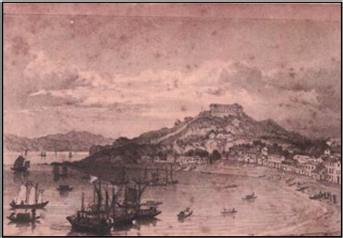
In 1826 Colledge entered the service of the Honourable East India Company (EIC) as Assistant Surgeon to their China station at Macao (Figure 1). An extraordinary sight met his eyes - not the strangeness of the Chinese culture but the multitude of the sick poor that confronted him on all sides. In particular he was appalled by the helplessness of the blind - old people tapping their way along with sticks, processions of paupers guiding one another's footsteps, and children clinging in the shadows to avoid glare of sunlight.
3
He resolved thereby to devote as much of his time and money as he could to the relief of these sufferers. With characteristic energy he enquired as to the possibility of opening a hospital there. Appalled by the ignorance of native physicians in eye diseases, Colledge gave his attention chiefly to this condition. In 1827 the first institution ever opened in China for the purpose of bringing the benefits of Western medicine to the suffering Chinese - the Colledge's Ophthalmic Hospital -was founded.
7
Colledge recalled
Macao in the nineteenth century
6
In the year 1827, I determined to devote a large portion of my time, and such medical skill as education and much attention to the duties of my profession had made my own, to the cure of so many poor Chinese sufferers of Macao and its vicinity as came in my way. My intention was to patients labouring under every species of sickness, but principally those afflicted with diseases of the eyes; diseases most distressing to the labouring classes, among whom they are very prevalent; and from which the utter incapacity of the native practitioners denies to them all other hope of relief.
During that year my own funds supplied the necessary outlay. Throughout I have received little or no professional assistance. In 1826 many friends who have witnessed the success of my exertions in the preceding year time, and who had become aware of the expenses I had incurred, came forward to aid in the support of a more regular infirmary, which I proposed to establish, put me in possession of means to provide for the maintenance of such patients as I found necessary to keep for some time under my care, but who depending for their livelihood on daily labour could not otherwise have reaped the benefits held out to them.
Thus the hospital grew up upon my hands; confidence was established amongst a people who had been accustomed to regard foreigners as barbarians, incapable of virtuous, almost of human feelings; and the number of my inmates was regulated only by the limits of my accommodations. Two small houses have been rented at Macao, capable of receiving about 40 patients; there are many more of the nature of outpatients … The best proof which can be offered to the entire confidence of the people and the benefits that have been conferred on them, is that since the commencement of this undertaking, about 4000 indigent Chinese have been relieved from various maladies … The more opulent and respectable classes of Chinese have in the last three years added their names to the list of subscribers; and have by giving the hospital the sanction of their support, much enlarged the circle of its usefulness. The EIC has written of it in terms of approbation, and when applied to, has liberally supplied it with medicine.
Independently of the practical benefits conferred on suffering humanity, it is most desirable that the enlightened nation to which I belong should be known in this country as possessing other characteristics than those attaching to us solely as merchants and adventurers. As charitably anxious to relieve the distresses of our fellow creatures, we may be remembered when the record of our other connections with China has passed away. 8
A referral to Guy's Hospital, London
A most unusual case at the hospital was that of a patient afflicted with elephantiasis of the scrotum of such a nature as to defy all external or internal remedies. Colledge was of the opinion that it might be removed and so the patient was despatched, at the EIC's expense, to Guy's Hospital, London. 9 The operation, performed on 9 April 1831 by Sir Astley Cooper's Assistant Charles Aston Key (1793-1849), was completed successfully. The patient died from excessive haemorrhage. This event caused a stir in London's medical profession and the Lancet of 16 April 1831 noted
Hoo Loo, a Chinese labourer, was admitted to Luke's Ward, Guy's Hospital, in the third week of March 1831, which an extraordinary tumour depending from the lower part of the abdomen, and of a nature and extent hitherto unseen in this country. He had been brought to England from Canton, by his own desire, in an East Indiaman … The case excited considerable interest, both in and out of the profession, from the first moment of his arrival, he was visited by a great number of persons of all ranks … Since his arrival, his appetite, health, and spirits were extremely good … He all along contemplated the operation with satisfaction.
It was generally understood that the operation would be performed on Tuesday, but so great a crowd of spectators was apprehended, that Saturday was fixed on instead. Notwithstanding this precaution, however, an assemblage, unprecedented in numbers on such an occasion, presented themselves for admission at the operating theatre, which was instantly filled in every part, although none but pupils and of those only such as could at the moment present their hospital tickets were admitted. Hundreds of gentlemen were consequently excluded, and it became obvious that some other room mut be selected. Accordingly Sir Astley Cooper entered, and addressing the pupils, said the operation would take place in the great anatomical theatre. A tremendous rush to that theatre accordingly took place, where accommodation was afforded to 680 persons … In a quarter of an hour, Hoo Loo entered, accompanied by two nurses and various functionaries of the hospital, and in the course of a few minutes he was secured on the operating table.
A short consultation took place between Sir Astley Cooper and Mr. Key during which it was finally agreed the genital organs should be preserved. The face of the patient was covered, and Mr. Key taking his station in front of the tumour, commenced the operation. His object was to make three flaps … By the time the tumour was entirely separated and the exposed parts were closed over, an hour and forty-four minutes had passed … Complete syncope occurred twice … The quantity of blood lost was variously estimated at twenty-five ounces … The ligatures were quickly applied and with great dexterity. The number of large veins divided was immense, but only three small arteries were taken up … Immediately after the removal of the tumour, another fit of syncope came on, from which the poor fellow did not rally … No remedies that were directed to overcome this state of collapse had the slightest effect … Transfusion of six ounces of blood taken from the arm of a student - one amongst several who offered to afford blood - were among the means resorted to. The heart's action gradually and perceptibly sank … Artificial respiration was subsequently, but vainly attempted.
The fortitude with which this great operation was approached and throughout undergone by Hoo Loo was at all events never exceeded in the annals of surgery … With the nurses he had become a great favourite, and his death elicited the utmost commiseration, perhaps a few tears, in the ward which he inhabited.
He was thirty-two years of age, and the tumour had been ten years arriving at its present growth … It occasioned a very great strain upon the fore part of the body, and to preserve his balance he was compelled to throw the shoulders backward … When placed on the scales after its removal, it weighted fifty-six pounds. 9
The editor of the Lancet published a harsh criticism of the treatment on two counts. First, it was ‘injudicious and unphilosophical’ to perform an operation of such vast importance upon a native of the climate of China, so quickly after his arrival in London, to the atmosphere of which his constitution could in no degree be familiarized. 10
The patient's principal motive for going to England was the hope that his disease being there removed, he might provide a comfort to his aged mother instead of being, as he was, a burden to her. The old woman since her son's death had subsisted upon a pittance, the interest derived from a small sum which was appropriated to her use by Colledge, out of money given by a few charitable individuals who took an interest in the poor man's welfare. 8
Colledge's reputation in China
Many letters of appreciation came from Chinese patients:
I, in youth, had an affliction of my eyes and both were short of light: fortunately it occurred that you, Sir, reached this land and used your skillful hand. You cut off a bit of filmy skin, removed the blood-shot root, pierced the reflecting pupil, and extracted the green fluid; you swept aside the clouds, and the moon was seen as a gem without flaw. You spared no labour or trouble; made no account of the expense of medicines; both kept me in your lodging house, and gave me rice and tea … Now my eyes are gradually brightening; ten thousand times have I to bow for your favours, and to wish, Sir, that heaven may send down on you a hundred things felicitous, bestow a thousand things fortunate, and give longevity and riches, with splendour and affluence. 8
We, inhabitants of the towns and villages in several districts, have relied on the English nation's surgeon, Colledge, for the relief and cure of diseases of the eyes. Those who have been completely cured … have offered presents and a little recompense of money, but he would not receive cash. We have no means of offering recompense, but have united in presenting bundles of crackers, and in playing of instruments of music in front of his house, to return thanks for his vast benevolence. May ten thousand blessings be with him. 8
Another note of thanks came from a patient for curing his broken arm
I … when going to the village, met on the way a ship captain, riding about for amusement. We encounter each other in a narrow part of the road, where there was no room to turn off, and void on another. Hence I was kicked and trodden down by the horse, and my arm broken. Deeply grateful am I to the English nation's great doctor for taking me home to his worthy abode, and applying cures; so that in about a month I was perfectly healed … In truth it is as though we had unexpectedly found a divine spirit, giving life to the world. On earth there is nothing to match you.’ 8
The most fitting tribute is recorded for posterity in a painting by George Chinnery (1774-1852), an Irish artist resident in Macao (Figure 2). The circumstances that suggested the idea to the artist were an elderly Chinese woman, blind with cataract, was led by her son, a boy about fourteen years old, to Mr Colledge for his aid. The operation was performed with thorough advantage, and the patient being convalescent, was about to leave Macao:
Dr Thomas Colledge MD (Aberdeen), FRCS, FRSE, attending a patient at the Macao Ophthalmic Hospital, 1832. After an oil painting by George Chinnery (from ref.
1
)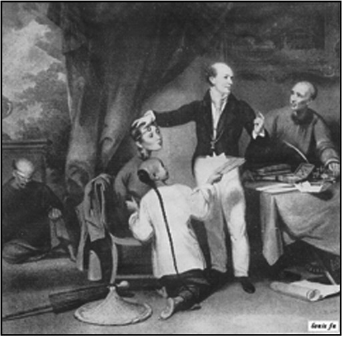
The picture represents Mr. Colledge as turning from his final examination of the woman's eyes, with his hand still resting on her forehead, towards an old servant, who acted as interpreter, in order to direct him to instruct her as to the care and means to be used for the preservation of her restored vision. The son, having prepared a chop or Chinese letter, expressive of his gratitude and thanks to Mr. Colledge, is represented in the act of delivering it. In the background, upon the floor, is seated a man with his eyes bandaged, who had also been operated upon for a cataract, waiting his turn for Mr. Colledge's attention. 8
The significance of Colledge's work
Up to October 1832, more than 4000 indigent and diseased Chinese had been relieved from various maladies and many restored to sight by the benevolent exertions of a single individual. This institution was supported by the generosity of the EIC as well as of private citizens. It soon became the topic of conversation throughout the provinces, and praises and gratitude were heaped upon Colledge by the beneficiaries and their families. The success soon attracted the attention of the foreign community and many individuals generously came forward and voluntarily contributed. When Pearson left China in the winter of 1832-33, increased medical duties that devolved on Colledge immediately, compelled him to relinquish his practice among the Chinese and to close the establishment. 8
The true significance of Colledge's work lay not so much in the direct benefit of its humane undertakings but in its indirect influence. He urged upon the various missionary bodies the desirability of employing medical missionaries as pioneers in their Christian work. 11 He wrote
Suggestions with regard to employing medical practitioners as missionaries to China:
… The Chinese must be convinced of the utility, before they can be made to comprehend the grandeur and sublimity of the truths of Christianity; and no method of benefiting the human race is so immediate in its effects as that which relieves human sufferings; no class of men therefore is so likely to gain the attention and respect of a people like the natives of the empire as those of the medical profession … What I would suggest is, that those societies that now send missionaries should also send physicians to this benighted race, who on their arrival in China should commence by making themselves acquainted with the language; and in place of attempting any regular system of preaching or teaching, let them heal the sick and administer to their wants, mingling with their medical practice such instructions either in religion, philosophy, medicine, chemistry, &c, as the minds of individuals may have been gradually prepared to receive … Let the two professions remain entirely distinct, and thus let them pursue their separate paths towards the attainment of the same great end … What I would suggest then is, that all sects and denominations of Christians unite for the one great purpose of improving the temporal and social condition of the Chinese, by sending out good men of the medical profession, who shall by rendering themselves useful, gain the confidence of the people, and thereby pave the way for the gradual reception of the Christian religion in all its purity and beauty … For in my opinion, there is no greater barrier to the spread of the gospel of our Saviour among the heathen than the division and splitting which have taken place among the various orders of Christians themselves … 12
The Chief of All Affairs of the British Nation in China reported on 25 September 1832
To Mr Colledge, therefore, belongs the merit of having established, by aid of voluntary donations, the first institution in this country for the relief of the indigenous natives. I cannot close these observations without alluding to the testimony that has been at various times recorded of Mr Colledge's professional skill and abilities by the Select Committee in their despatches to the Honourable Court of Directors of the EIC, both at the period when he was first selected to fill the position of surgeon … and also subsequently … when the great benefit derived by the Chinese … has been officially brought to their notice. As an individual who has witnessed the beneficial effects of Mr Colledge's medical ability, I feel the greatest gratification in thus bearing testimony to his merits both as a surgeon and a philanthropist. 1
The results of the Ophthalmic Hospital proved that there were no better means than medical practice to make the Chinese understand the feelings that Christian philanthropists cherished towards them. Years of laborious study were requisite to prepare men well for the two professions in question. The question arose: shall the two professions be united in the same person? A division of labour was required. When an individual undertook the two, he would always be under the temptation of neglecting one of them, there being either enough or more than enough to occupy all his time and energy. In special cases, however, it might be necessary and therefore best that one and the same person perform the duties of the two professions.13,14
In 1828 the EIC's Factory was relocated from Macao to Canton, Colledge moving with it and opening a dispensary there. 15 A visitor described the scene
At an early hour in the morning one may daily witness the sick, the blind, and the lame, of all ages and both sexes, crowding around the doors of the dispensary. We have seen helpless children brought there in the arms of their nurses, or more commonly, according to the customs of the country, lashed upon the back of a young servant. We have seen old, blind, decrepit men, with staff in hand, led thither by their little grandchildren, while others, who were in better circumstances, were brought in their sedans. The numbers of those who have come for aid has been very great and the cure not a few.’ 7
Medical care for British seamen
The number of ship arrivals in China for the year ending June 1834 was 264: British 101; American 81; French six; Dutch six; Hamburg three; Danish five; Swedish one; Portuguese 23; Spanish 37 and one Mexican. There were in port during the year 6320 seamen. No ships escaped without more or less sickness, and probably not more than one half without one case of death. There was a single instance among the large ships where there were more than 20 deaths and there was one of the smallest, which lost four of her men. The ships belonging to the EIC carried two surgeons. 16
In 1834 Colledge suggested to Baron Napier (1786– 1834) of Merchiston as to how the medical services may be most advantageously made available to British nationals in China. 16
To the Right Honourable Lord Napier,
Chief Superintendent of British Trade in China.
My Lord,
Your lordship having already been pleased to express your acquiescence in the necessity of stationing one of your medical officers at Whampoa [literally ‘yellow anchorage’, dockland area outside Canton] … I would respectfully suggest to your lordship the great importance of combining such residence (which must necessarily be afloat), a floating hospital, the advantages of which I will endeavor to explain.
The prevalent diseases arise principally from malaria, to which all ships resorting thither are unavoidably exposed … are frequently of a malignant character, and often of fatal occurrence, even under the closest attention … that almost constant watching is required in certain stages of these diseases. This would be impossible if the medical attendant were not resident on the spot …
On board the company's ships the sick were regularly visited twice and thrice daily: and although each Company's ship carried two medical officers … They had always calls from ships not carrying surgeons and looking to them exclusively for medical aid. The opening of trade will entirely change the system … Vessels will be principally employed which, from their size and complements of men, will not be obliged by act of parliament to carry a surgeon and none will have more than one medical officer … The gap thus created would be most efficiently filled by the medical officer to the Superintendent permanently stationed at Canton if he has a floating hospital at his disposal … And since he had necessarily to reside on board a ship, a floating hospital is combined with his residence.
Independent of the cases I have already enumerated, accidents unavoidably occur on shipboard, of compound fractures of limbs, injuries of the head, &c when constant attendance and quiet, mostly unattainable in small vessels, are indispensable to cure. Nor should I omit to mention that in many cases much depends on the promptitude with which medical aid can be administered; as well as the danger and often the impossibility of moving patients to Canton …
Having some years conducted a hospital at Macao on my own responsibility, I can state with satisfaction that I never experienced any interference either from the Chinese or Portuguese governments. Though originally intended principally for the relief of poor Chinese, still I occasionally admitted cases of professional interest occurring among the lower orders of foreigners resorting to this country: and being fully impressed with the great advantages to be derived from an establishment of this kind for British seamen, I most respectfully submit the opinion to your lordship's consideration and approval …
Your Lordship's most obedient humble servant,
Canton, August 8th, 1834 T. R. Colledge,
Surgeon to H. M. Superintendents 16
Immediately after this plan was suggested, a boat of convenient size for a small hospital was contracted for; and the sum of 800 taels (of silver) was to be paid for it, as soon as the man engaged to build it should convey it to Whampoa and anchor it in a convenient station near the shipping, which Napier at once agreed to do. In the meantime one of the surgeons to His Majesty's commission was making the necessary arrangements for the new establishment, expecting it to remain constantly at Whampoa and devote his whole attention to seamen. But before the plan was carried into operation, the whole was stopped by the hostilities of the Chinese government. 16
By an Act 6th, George IV, British Consuls in foreign countries were authorized to advance, on the part of the Crown, a sum, annually, equal in amount to whatever may be collected or subscribed by British subjects, for the purpose of maintaining a hospital for British seamen or other distressed subjects abroad. It was believed that, in virtue of this very liberal provision of the legislature, something will be done by the British merchants towards forwarding this very laudable object; and it was wished that its advantages might be extended to distressed seamen of all nations - thereby to secure the support of all foreigners in China. 17 The following two notices were extracted from the Canton Register:
No. 1.
Notice is hereby given that James Matheson, esquire [1796-1878, senior partner of Jardine, Matheson and Company] has been duly authorized under the hands and seal of the superintendents of British trade in China to convene a meeting of all his majesty's subjects residing or being at Canton, at 11 o'clock on Monday the twenty-third day of February 1835, at the British hotel, for the purpose of instituting a British hospital at Whampoa or elsewhere for the reception of any of his majesty's subjects, either seamen or others, needing medical care and relief. 17
No. 3.
Notice is hereby given that, in conformity with the provision of an act of parliament passed in the 6th year of his late majesty's reign, cap. 87, any of his majesty's subjects residing in or being at Canton on the 23rd February, 1835, and who shall have voluntarily subscribed any sum or sums of money not less than twenty pounds in the whole, nor less than three pounds by the year, for or towards the purpose of instituting a British hospital either at Whampoa or elsewhere for the reception of any of his majesty's subjects; needing medical care and relief, and being present at the meeting to be held on the 23rd of February 1835, shall be entitled to vote thereat…
By order of the superintendents of British trade in China, R. Johnston, secretary and treasurer. 17
A meeting held resulted in the formation of the British Seamen's Hospital Society in China. 17 Colledge remained at Macao where a hospital for foreign sailors was installed by 1836. 18
Colledge returned to England after the death of his fourth son. Three of his four children had died in Macao. 19 The whole community, European and native, expressed deep regret and the British Government granted an annual gratuity. 20 Colledge was awarded the MD (Aberdeen), was elected Fellow of the Royal College of Surgeons of Edinburgh 1839, Fellow of the Royal Society of Edinburgh and Fellow of the Royal College of Surgeons of England. 20 He practised medicine at his home in Cheltenham for the last 38 years of his life and died peacefully on 28 October 1875 at Lauriston House, Cheltenham.20,21 His last words, referring to his medical work in China, were ‘That was the one good thing of my life’.3,22 His wife died a few weeks after him.5,23
Colledge, known as the ‘Chinaman's Friend’, was not a medical missionary in the strict sense. He was a man of great devotion and piety, keen to employ his skills in the service of humanity and in the extension of the Kingdom of God. He was regarded as the originator of medical missionaries in China.1,3
His grandson, Lionel Colledge (1883-1948) of Guy's Hospital, was a world-renowned surgeon in the specialty of otolaryngology, who inaugurated the Institute of Laryngology and Otology and was one of the founders of the British Association of Otolaryngologists. 5
Conclusion
At Macao and Canton a wide chasm existed between the foreigners and the Chinese. Commerce was monopolized by a handful of merchants who acted as intermediaries. Notwithstanding these difficulties, the period from 1805 was most important in the history of modern medicine in China. During this time modern Western Medical practice was permanently installed. As employer, the EIC supported Pearson, Livingstone, Morrison and Colledge. Without government support it was not unexpected that they came, their work flourished for a while, and then ceased to exist. 18 The introduction of vaccination and the Macao ophthalmic hospital were … the fountain from whence will spring the peaceful and humane influence that will open China to free and friendly intercourse with Europe. 8