




Abstract
In July 2012 thousands of competitors from many nations arrive for the London Olympics, each striving to be a champion. Oh, the drive, resolve, heartache and pain. Our capital will be taken over, the press will both celebrate and criticize events; sponsorship deals will soon dominate the results. The men and women who are competing will have trained for many months or years, striven nationally and internationally, fighting hard for places in their teams. What drives them? This short paper is a personal perspective, unashamedly anecdotal, looking at some of the driving forces behind my own endeavours. I have spent a lifetime climbing mountains, with a focus on the exploration of remote regions. I also deal here with the physiological and medical challenges that high altitude mountaineering poses, and discuss its risks.
What lures us ‘to boldly go where no man has gone before’, like the crew of the Starship Enterprise? 1 If one looks at the history of exploration, several features stand out. First, nations where endeavour thrives tend to be wealthy, settled yet striving. Take 19th century exploration of Africa, those journeys to the sources of the great rivers of Asia, the golden age of alpine mountaineering in the 19th century and early attempts on Mount Everest in the 20th century. Britain was rich, the Empire was at its height and entrepreneurs were heralded. The exponents of exploration, largely men in those eras, came mostly from professional classes. There was also a sense that they had almost a duty or responsibility to take forward exploration, and that coming from the west there was an authority to visit far off places as part of an imperial rite of passage. In other words, there was a cultural setting that allowed people to go: the trading entrepreneurs and the civil service had set up the Empire that had painted the world of my childhood atlas so extensively British and pink, and it was there for explorers to penetrate. 2
Be that is it may, there must be the dream, the idea, the seed that germinates into fire. For myself, I retain a distinct memory of being taken by my mother Féo Clarke (1910–98) to a lecture at the British Association for the Advancement of Science 3 in Liverpool. The BA programme indicates that this was in September 1953 at the Philharmonic Hall: I was seven. The talk was given by Eric Shipton (1907–77), the famous mountaineer about his exploration of the Everest region in 1951, a bold expedition that had led to the discovery of the route to the summit of Everest from Nepal, followed by the British team in May 1953. Shipton had also photographed the mysterious yeti footprints in the Menlung Valley in Tibet where he had been illegally. I was entranced; the flames were alight. I wanted to go there and I still recall the way Shipton described ‘Sola Khumbu land’, the valley of the Sherpas and the magnificent peaks surrounding it. That dream never faded.
Next, endeavour needs encouragement and legitimization. For example, the Spanish monarchy encouraged their soldiers and sailors to take over South America in the 15th century. In Britain, Queen Elizabeth the First was proud of both her navy and the privateers and she funded them. In Italy, in the 19th century Regina Margherita 4 supported altitude science and exploration and she is remembered to this day by the laboratory and mountain hut at the summit of Monte Rosa.
To endure and flourish, endeavour needs encouragement. Until recently there was in Britain but one small charity, the Mount Everest Foundation (MEF) 5 that has supported mountain exploration and science since the 1950s. The MEF Grants Committee interviews expedition leaders, scrutinizes their plans and may fund projects. Moreover the foundation provides legitimization and authority, with formal approval to take back to employers or universities. The MEF has played a leading role in this culture of encouragement, helping young and often needy climbers take part in mountain exploration and scientific projects. This has been of inestimable value to hundreds of British teams. The MEF has in a large part been the reason why Britain has excelled in bold innovative ventures in the greater ranges.
At the age of seven, little could I know that 14 years later, when just 21 I would be seated before Eric Shipton at an MEF meeting at the Royal Geographical Society. Shipton was in the Chair. I was applying for a grant to lead my first Himalayan expedition, to Kishtwar in Kashmir in 1965 (Figure 1). Looking back, we were but children: the plan was to drive from Cambridge to Kashmir in an elderly Land Rover, penetrate a hitherto unvisited mountain range and attempt some 6000 m peaks. We had climbed in the Alps, modestly by any standard, we had scant experience of terrestrial navigation, we knew next to nothing about medical emergencies and precious little about Land Rovers. But we were supported and funded by the MEF with a grant of £300, a sum that paid for all the field expenses for six people for two months. To put that figure into perspective, the entire fuel bill for the three-week road journey from Cambridge to Kashmir was £65. One could drive freely through Iraq, Iran, Afghanistan and Pakistan in those days.
Charles Clarke in Kishtwar, Kashmir, 1965.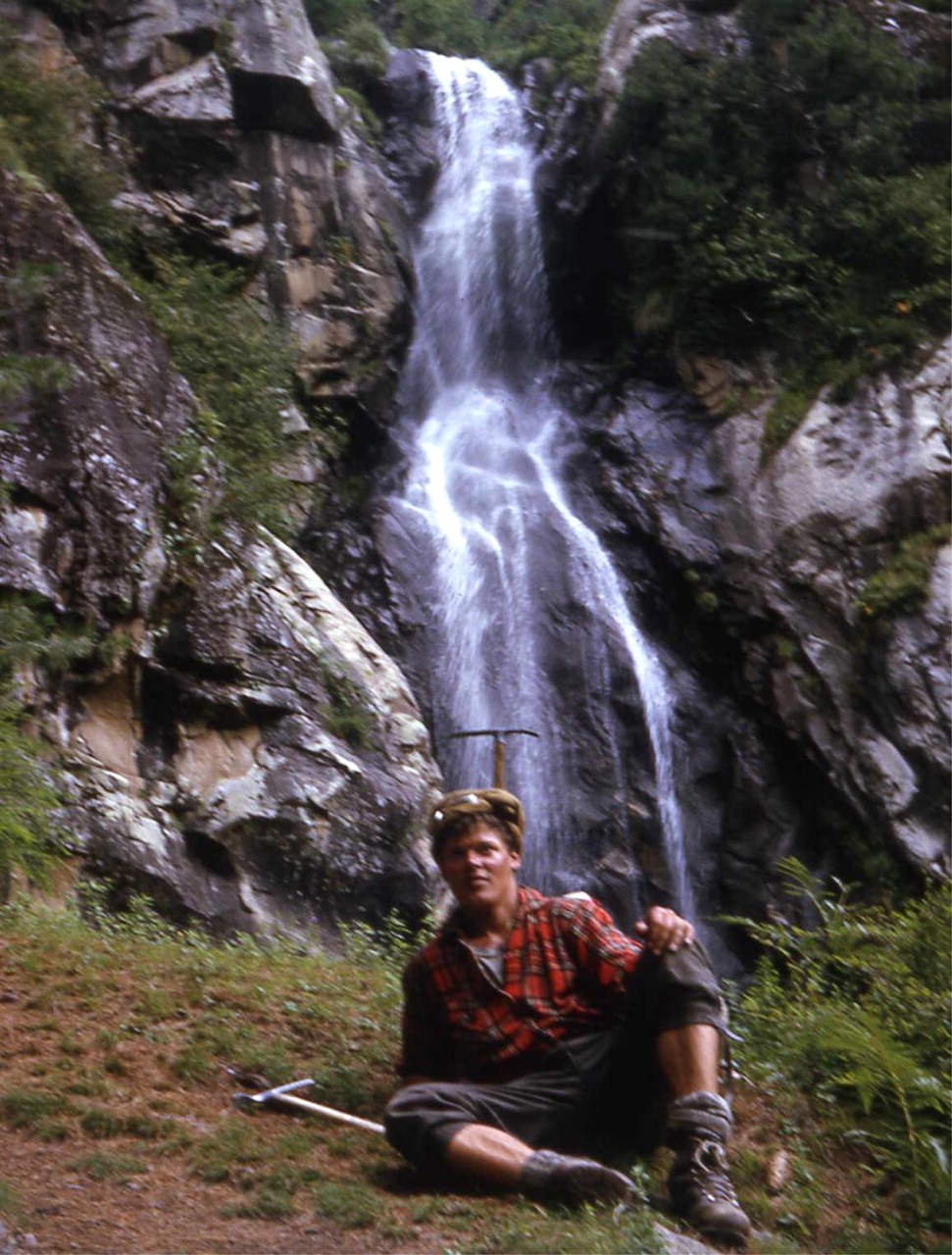
In the event, we reached the Kishtwar roadhead without undue upset and almost climbed Brammah, a magnificent 6000 metres peak. At one point Simon Brown and Henry Edmundson, were suspended by a single ice piton after a fall near the summit. They wisely abandoned their attempt. We returned to the plains of India to find the Indo-Pakistan War in full swing, across the grand trunk road back to Delhi. We had had no inkling that fighting was taking place – we did not carry a radio receiver in the mountains, quite why I shall never know. We abandoned the Land Rover after losing a battle with the Indian Customs and Excise and had to fly home. The six of us have all survived and flourished. Simon Brown became a senior captain with British Airways and Henry Edmundson followed a distinguished career with Schlumberger. Henry Day became a Colonel in the Royal Engineers and later climbed Annapurna and many other peaks. Michael Tugendhat is a High Court Judge and Dilsher Singh Virk has led a successful business life in Canada. I became a neurologist.
Kishtwar 1965 soon led on to other challenges. In early 1969 I had a call from John Tyson, the Rugby School master who had first taken me to the Alps. Could I come to western Nepal for three months? We would leave in a month. I had other plans for 1969. First, I was in my final year at Guy's Medical School. I gingerly approached the Professor of Medicine, John Butterfield (1920–2000): ‘Sir: please could I take three months leave, miss the orthopaedics firm, delay finals and, as an add-on, do an elective in Nepal and then lead another Kishtwar expedition in the autumn?’ Butterfield's reply was to this effect: ‘That sounds wonderful. You'd better send me a telegram half way through to say that you are ill, and I'll sort out the examiners. Get on with it’. We lived in a different world in those days.
In western Nepal we spent three months trying to reach and climb Kanjiroba Himal, one of the more remote peaks of the main Himalayan range (Figure 2). This was travel that I relished – a remote gorge, the highlands of Dolpo on the Tibetan border, the gentle pace of a yak caravan and some spectacular monasteries. It mattered little that we failed on Kanjiroba. In the autumn I went back to Kishtwar with a small team. I had been away almost nine months. I recall arriving back in Heathrow in November 1969. I telephoned home from a call box. My father Cyril,
6
a man of few words, answered ‘Hello’. ‘Hello, it's Charles here’. ‘Charles who?’ he replied.
Cloud sea in Kanjiroba Himal, 1969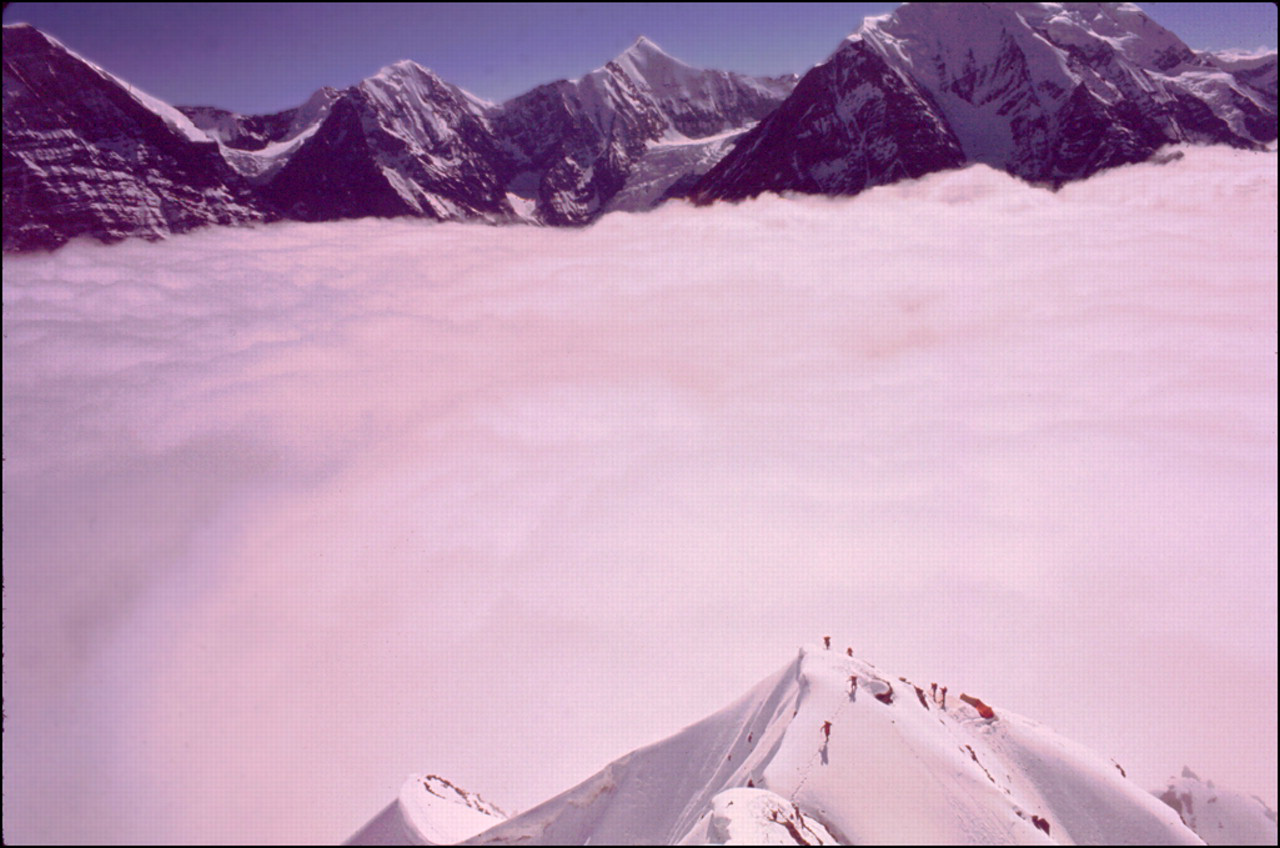
I returned to Kishtwar in 1971 and 1974 and climbed a few smaller peaks – then came a very different experience: Everest. In late 1974 I was coming back on horseback with frostbitten feet following the first ascent of Swagarohini, a 6000 metres peak in Garwhal. In wet leather boots I had carelessly let my feet freeze. On the path down towards Dehru Dun, a postal runner greeted us with a telegram from my mother: I wish I still had it: ‘Chris Bonington has asked you to be doctor on the south-west face of Everest next year. I thought you might like to go, so I have said yes’.
Everest was a turning point, in many ways. I was part of a large team with some of the best climbers in Britain, far bolder than myself. It was the first expedition in which I took on the role of medical officer: I soon learnt that undue sympathy for minor complaints does not help the progress of a team up a mountain and that, on any expedition, not everyone will be enjoying themselves. I carried out a modest research project, photographing the retina at altitude with a hand-held camera. 7 But above all, I realized that I would never be a hard climber at the cutting edge; I was strong enough and my endurance was fine. But I found I was often nervous when others appeared not to be. Above all, I wanted to stay alive. Everest brought success and tragedy. Doug Scott and Dougal Haston climbed the south-west face; Mick Burke was lost alone in bad weather near the summit. 8 On our return we were all in the public eye; the various team members lectured to around one million people.
There followed many expeditions, usually with Chris Bonington as climbing leader and myself as doctor. We went to Kongur (7649 m) in Xinjiang in 1981 on a joint mountaineering and scientific expedition. Chris, Peter Boardman, Joe Tasker and Al Rouse climbed the peak. Michael Ward, Jim Milledge and Edward Williams were the scientists, and I helped to a small extent. Jim Curran filmed and sketched. David Wilson, later to become Governor of Hong Kong, was interpreter and provided valuable liaison with our Chinese hosts. The following year I went with Chris, Pete and Joe to the north side of Everest, again in a supporting role. Everest 1982 was a disaster. We had chosen a new unknown route, the north-east ridge from Tibet with a small team, without oxygen. In the event, Pete and Joe were lost without trace high on the ridge.
I was deeply troubled by their deaths. I questioned our plans and my motives. I felt responsible. But I knew I would never have been able to prevent Pete and Joe setting off for the summit; it was just 30 years ago. I avoided climbing for a while.
I next went away in 1988, to Menlungtse (7023 metres) in Tibet. Chris had been granted a permit to visit the remote Menlung valley on the Nepal–Tibet border where the fabled yeti footprints had been photographed in 1951 by Shipton. This was too good a chance to miss, especially since we were funded by the Mail on Sunday. A few weeks in the Menlung valley convinced me of the non-existence of the yeti. The question of how the footprint photographs came into existence remains unanswered. Andy Fanshawe and Alan Hinkes climbed Menlungtse. Even a yeti-less trip was a success.
It was nearly 10 years before I set out again. Chris and I had long wanted to visit Eastern Tibet, to explore peaks we had seen from the air early one morning in March 1982 when we had flown to Lhasa on the way to Everest. In June 1996 the phone rang: Chris had a permit. We were on our way a few weeks later with a couple of rucksacks and very little idea of where we would end up. There followed from 1996 to 2000 four memorable mountain journeys. 9 We found the way to Sepu Kangri (the White Snow God 6998 metres) and various people bolder than myself just failed to climb it. We realized we had become pioneers of a new range, the eastern Nyenchen Tangla, virgin 6000 metres peaks in spectacular country. One mountain is even called Amchhi Inji-ne, the English doctor. 10
Finally, after a break of several years from the Himalayas I went with Chris to the unvisited mountains in the Sorang valley at the head of the Sutlej in the summer of 2011. Despite a combined age of over 140, we managed to find and climb a fine virgin 5000 metres peak. ‘Our ridge was picturesque, snow conditions good and the weather perfect. As we neared the top, a Himalayan snow cock flew off the summit rocks where he'd been basking in the sun.‘ 11 We called our mountain Ram Chukor Basera, the Hindi for a snow cock's perch.
These journeys and these climbs were made possible by the culture of encouragement I have mentioned earlier. I have been lucky to live in such an age. But many people helped me along the way. My parents never tried to dissuade me. My late wife Ruth Seifert either tolerated or encouraged my ventures during her busy working life as a psychiatrist at Barts and Hackney. Our two daughters Bec and Naomi put up with my being away for over five years during their school lives. Which of the two said: ‘Mum, if Dad doesn't come back, can we have a rabbit?’ has been lost in the passage of time.
Other factors would operate in a reverse direction today. At work, NHS employers and colleagues were generous. It would be hard today to think of applying to the NHS Trust Clinical Director for three months leave.
Between trips, I worked hard – I felt I did, anyway – both at Whipps Cross as a single-handed neurologist and at Barts where I became Clinical Director. Academic work suffered, it is true, but later in my career I moved to the National Hospital, Queen Square and was able to fulfil another goal – to write, or at least to organize, edit and assemble a new neurology textbook. Once again it was a culture of encouragement and some valued colleagues – and not taking no for an answer – that allowed this to happen. 12 The second edition is on its way.
Not everyone was immediately enthusiastic during my medical career. This was not unexpected. Dr Cecil Symons, a Consultant Cardiologist for whom I worked in the 1970s at New End Hospital, grasped my arm gently after one ward round and steered to a corner. ‘Charles, my boy’ – they spoke like that in those days – ‘if you want a serious career in medicine, this sort of thing, these jaunts to the Himalayas will have to stop – and anyway there is little to be learnt about high altitude medicine’. Tut, tut, I thought, can this be true? Despite adding fuel to my resolve, and utter disregard for his advice, we remained friends until his early death in 1987. I reminded Cecil of this interchange when I was invited to give a Samuel Gee Lecture at the Royal College of Physicians on altitude medicine. 13 Nevertheless, Cecil did ignite an interest in medical history that I was to develop during expeditions in the 1990s when I studied Tibetan medicine.
They were fairly hostile at Barts, too. In 1978 when I applied for the post of Consultant Neurologist there, the Appointments Committee questioned me sternly about plans for further ventures. I felt I was in a gap year; I had none at the time. It was like being asked if one had plans to have a family – I thought, that was my business. I was, as it turned out, successful.
Physiology and medicine
When the dream to go to some little known region becomes reality, when the point on the map becomes a focus and some far off peak fills every moment, at first in preparation and later in action, high altitude climbing poses its own physiological challenges and medical problems, more formidable and serious than in many other sports.
The summit of Everest (8848 metres), once thought attainable only with supplementary oxygen, can be just reached without it. This was finally established by Reinhold Messner and Peter Habler's bold and successful ascent from Tibet in 1978.
But even at much lower altitudes, problems posed by chronic lack of oxygen are important. Anywhere higher than 3500 metres, acclimatization becomes necessary; above this altitude, illnesses related to oxygen lack are realities. Even at 2000 metres one feels the effect of altitude during the first few days. Tiredness and lack of energy are noticeable, even though at this altitude the amount of oxygen we breathe is greater than that within the cabin of a pressurized aircraft, usually set around 2500 metres. It is of interest that the next generation of passenger aircraft is to be pressurized to lower altitudes. There are data to suggest that jet lag following long-haul flights is not simply related to time change and lack of sleep: hypoxia probably plays a part.
Acclimatization takes place over several weeks and after this period ascents to 6000 metres become possible. This altitude is the upper limit of permanent human habitation but no one tends to live there – though some miners in South America reside and work at altitudes approaching this.
Altitude-related illness can be seen as a breakdown of the normal gradual acclimatization process. Three distinct but related medical conditions are recognized: acute mountain sickness (AMS), high altitude pulmonary oedema and high altitude cerebral oedema (HACE).
AMS consists of malaise and headache, anorexia and light-headedness that develops gradually over some 6–24 hours. AMS is rare below 2500 m but almost invariable within some hours after arrival at 4000 m unless one is acclimatized. The headaches are at first frontal and band-like, progressing to a generalized pain, often distinctly worse on lying down, a posture most people would think would help when they feel so unwell. The headache may progress to become intense on movement, with vomiting. Anorexia is often evident, with revulsion for any food or drink. Acid indigestion, dizziness and tingling limbs may occur. With rest and simple analgesics these symptoms usually resolve over several days as acclimatization takes over, relieving the patient of such intolerable symptoms.
Prevention of AMS is deceptively simple but often conflicts with the desires of both travellers and pressures from the travel industry. To minimize AMS, carry little and ascend slowly above 2500 metres. Try to increase the height at which one sleeps by less than 500 metres each day – allowing three days or more before staying at 4000 metres, and try to spend a week before going to 5000 metres, or higher. Even this rate is too rapid for many people; few are comfortable going to 6000 metres within 10 days from sea level, though it is possible. The erroneous conviction that physical fitness prevents AMS is widespread: the reality is that the idle, portly and sedate fare better than enthusiasts. In practice, I am always uncomfortable climbing to 5000 metres in less than 10 days though I have often done it.
Drug prophylaxis with the carbonic anhydrase inhibitor acetazolamide (Diamox) is often suggested for several days before ascent. This does reduce AMS symptoms but the drug is unpopular with climbers, partly because they are generally averse to medicines and prefer nature, and in part because Diamox causes tingling fingers and toes and alters the taste of fizzy drinks – beer is often now available on approach marches.
The treatment of AMS is rest, analgesia, acetazolamide when severe and on occasion a short course of dexamethasone when symptoms are disabling. Above all, further ascent should be avoided.
The clear recognition of more sinister forms of altitude-related illness was due largely to the US physician and climber, the late Dr Charles Houston. Houston already had a distinguished climbing record before his 1953 expedition to K2 (8611 metres), the world's second highest mountain. While on Everest the 1953 British team led by John Hunt was basking in glory after Edmund Hillary and Sherpa Tenzing Norgay's climb to the top, their US colleagues were battling on K2, facing storms, avalanches, serious accidents and death. Houston survived and thereafter he devoted his mountaineering life to the study of altitude-related illness. In 1960 he published a case report of a patient with high altitude pulmonary oedema (HAPE). 14
In pulmonary oedema the first sign is slight breathlessness at rest. This proceeds to a dry cough, a dusky blue tinge to the lips and occasionally copious frothy sputum. Crackles in the chest are sometimes audible, heard readily with a stethoscope. This is a serious emergency. Descent, oxygen either by mask or portable pressure bag, nifedipine and dexamethasone are treatments, but typically patients with HAPE recover.
It soon became clear that there was more to serious illness at altitude than HAPE. Houston soon recognized and described HACE with John Dickinson, a British physician who worked in Kathmandu. They published in 1970. 15 The features are at first severe, disabling AMS with prostrating headaches followed by unsteadiness of gait, behavioural change, sleepiness and later coma. Death frequently follows when consciousness is lost. Dexamethasone is useful in treatment and reverses early brain oedema rapidly.
Other phenomena at altitude include retinal haemorrhages, usually symptomless, occasionally stroke and the odd pseudo-hallucination that there is someone else around – the third man. 16
Risk and endeavour
In a society that has become risk averse, I find it refreshing that climbers tend to remain iconoclastic and to take danger as part of their game. But there is a gloomy side: set against the distinguished if little publicized success story that has kept Britain among top mountaineering nations for over half a century, there is the starkness of personal tragedy, death and disruption of family life. In short, to engage in the endeavour of exploratory mountaineering is and always has been exceedingly dangerous. We have all had near misses.
From time to time, some stories catch the public eye and hold the press' gaze for days or weeks. In 1865 the first ascent of the Matterhorn (4460 metres) on the Swiss-Italian border projected climbing into the news. A young British artist and engraver, Edward Whymper, fit, experienced and obsessed with new alpine ascents as trophies climbed to the top from Zermatt with three guides Michel Croz, Peters Taugwalder the Elder and the Younger, taking with them three less experienced alpinists – Lord Francis Douglas, Douglas Hadow and Charles Hudson. On the descent, less than two hours below the summit, Hadow slipped, dragging to their deaths Croz, Douglas and Hudson on the rope that had parted between Taugwalder the Elder and Lord Francis Douglas. Victorian Britain erupted into a frenzy against climbing. There was a formal enquiry into the deaths, following which the survivors were exonerated. Whymper became a celebrity and wrote Scrambles amongst the Alps, 17 a best seller – and a fine book.
In 1924 Mallory and Irvine were lost on the north side of Everest. George Leigh Mallory, a schoolmaster from Charterhouse who had been a Bloomsbury set acolyte, became an immediate if posthumous hero. His colleague Sandy Irvine, a less experienced younger climber was also projected into the limelight. Once again the risks of climbing, and especially at high altitude, were in the public arena. To this day, an eerie fascination surrounds their deaths. Mallory's remains were located in 1999, following reports of corpses from pre-war years. Expeditions continue to visit the north side of Everest to try to find Sandy Irvine and glean more about what happened – enveloping the mountain in a Titanic-like mystique. Many deaths less well-known outside the climbing world join this list.
Alfred Mummery, doyen of alpine climbing in the late 19th century, was lost on Nanga Parbat in the Karkaroram in 1895. In Switzerland Owen Gwynne Jones, known as the first rock gymnast, died on the Ferpecle arête of the Dente Blanche in 1899. And there are many deaths far less well known. Beside Gwynne Jones's grave in Evolène in the Val d'Herens stand two wooden crosses commemorating two 22-year-old Yorkshiremen, each an only son, Hubert Roy Francis and Roy Wood, who died on Mont Blanc de Cheilon above Arolla in July 1953. In the press at that time presumably their deaths were eclipsed by the British success on Everest in May of that year but that was never so for their families and friends.
At a personal level, I have lost thirteen friends in the mountains, twice during Everest expeditions where I have been a member. Mick Burke, the climbing cameraman, died near the summit of Everest in 1975 after climbing the south-west face, the formidable obstacle that had defeated so many. Peter Boardman and Joe Tasker died on the north-east ridge in 1982 on our six-man team – and we are remembering the 30th anniversary at Kendal Mountain Festival 18 in November this year.
I have also had accidents myself: twice in avalanches in the Himalaya and once on Kongur in Xinjiang; I was missed narrowly by falling rocks on Everest in 1982 and have twice fallen into crevasses in the Alps. Last year, on that gentle exploratory trip to the Sorang Valley in northern India with Bonington, after climbing our easier five-thousander I fell through a concealed snowbridge, unroped into an underground glacial torrent. I was lucky to escape serious injury on each occasion.
I have no ready answers to this level of death. First, there must be a clear understanding that these ventures carry high risks. I am frequently asked for advice about Everest by people who want to reach the top as part of a guided venture, often seeking funding for some charity but without an inkling of the level of danger. There is the assumption that because others are in charge the risk is minimal.
To be brutal and evidence-based, the risks of attempting to climb a peak over 7000 metres carry a 5% mortality. 19 How can one square this with reality, with the risks of other sports – indeed, is it reasonable to take part in these ventures at all?
Second, a clear understanding of medical issues really does help. Headaches and unsteadiness mean brain oedema; breathlessness at rest equals fluid in the lungs. Many have died because they have disregarded altitude-related symptoms.
Equipment has improved, our loaded rucksacks are lighter or we pay others to carry them, tents are more durable and colourful; boots lighter and less like blotting paper. These innovations make little difference.
But really, this sort of endeavour is a highly addictive drug. And expeditions are such fun. Mountaineering is enormously exciting and mountain terrain tantalizingly beautiful, a cruel yet ever-beguiling mistress. In 1982 after the tragedy on Everest when Peter Boardman and Joe Tasker were lost, I wrote: 20
Was it worth it? It would not have been had we been able to peer even dimly into what was to happen … I can only look back on the spirit of the venture. I believe that with the mysteries of our own personalities, our curious drives and self-appointed goals, we could not have turned down the opportunity for fulfilment without denying ourselves a glimpse of the very meaning of existence. In time I expect shall do the same again and be lured back, perhaps by another Goddess Mother of the World.