




Abstract
Summary
A single elderly, dependent subject was monitored for a period of three months. Data were collected from 12 sensors in his apartment. We investigated new criteria for diagnosing abnormal events with more reliability. Initial results suggested that six diagnostic functions could be achieved using only presence sensors. These were: immobility detection; the level of agitation; the speed of motion in chosen areas; the distance covered; the time spent in given areas of the apartment; and the activities of getting up, going to bed and going to the toilet. The analysis was based on calculation of thresholds from past behaviour of the user for automatically defined temporal bands. Any variation in these criteria may represent a change in the subject's physical abilities and may thus allow the remote identification of potential risk.
Introduction
The aim of the PROSAFE programme is to allow elderly or disabled people to remain in their own homes for as long as possible. This requires the installation of motion sensors in the subject's home. From the resultant data, a predictive model of the subject's behaviour can be constructed, so that abnormal events can be recognized. 1 This has been validated in experiments in institutions and hospitals. 2
Monitoring within an apartment
In an apartment, peoples' activities are varied and more complex than in an institution and differ according to which room they are in. Apartments have an area of more than 35 m2 and are made up of several rooms. These comprise main rooms (e.g. bedroom, living room, dining room) and functional rooms (e.g. kitchen, bathroom, toilet). Monitoring has to take place day and night and be able to distinguish the subject of interest when several people are present in the apartment at the same time (e.g. spouse, family, home help, doctor).
The functions of our apartment monitoring application
3
are:
real-time monitoring based on continuous measurement, transmitting alarms to remote operators, transmitting useful data to intervention services and dispelling doubt (e.g. remote questioning, listening, dialogue, camera, robot); diagnosis combined with specific intervention services (e.g. doctors, nurses, associations, family) and based on multisensory fusion techniques: remote medical diagnosis based on physiological data; identification of activities and habits; evaluation of deviance from behaviour; and the transmission of useful data to users for medical diagnosis. users interact with the system by triggering a call to the remote assistance operator if they feel unwell, talking to the remote assistance operator to explain a situation or triggering movement detectors as they move around the apartment; remote operators interact by calling the user if an alarm signal is received to confirm whether the alarm was genuine; doctors interact by examining any changes in physiological data and any changes in the user's behaviour.
The services provided by the system for monitoring autonomous individuals involve three main participants:
Diagnosis and detection of incidents
The analysis of the user's behaviour depends on a temporal classification of activities from a history of data collected over a 30-day period. The method of temporal classification uses a genetic algorithm combined with a descriptive statistical analysis that delivers time bands that characterize the lifestyle of the user. 4 This initial temporal classification of habits makes it possible to calculate, for each time of day and every area of the apartment, estimators which serve as a reference for making a diagnosis or detecting an incident.
The incidents covered by the system are: presumption of fall; prolonged immobility; excessive agitation; and runaway. The principle used to detect incidents in real-time consists in measuring continuously the difference between the value of the criterion observed and its estimator. So when the criterion (e.g. duration of immobility or duration of stay in one area) exceeds the range of values characterized by the estimator as ‘normal’, an alarm is sent to the carers, e.g. doctors, emergency services, caregivers, family.
We have investigated new criteria for diagnosing abnormal events with more reliability.
Methods
A single elderly, dependent subject was monitored for a period of three months. Data were collected from 12 sensors in his apartment. The algorithm was used to detect patterns of normal and abnormal behaviour.
Results
Initial results suggested that six diagnostic functions could be achieved using only presence sensors. These were:
immobility detection — the time spent at a particular location; the level of agitation — all movements showing evidence of over-excitement or, conversely, a reduction in vigour, at a particular location or during a given time period; the speed of motion in chosen areas — a measure of physical ability; the distance covered — physical ability and activities; the time spent in given areas of the apartment; the activities of getting up, going to bed, going to the toilet.
Temporal classification of habits
The temporal bands of activities for a person in his apartment (35 m2, 7 rooms, 12 areas) are shown in Figure 1 over consecutive days. Figure 2 shows the distribution of the sensor detections with time of day over the 30-day monitoring period. The algorithm selects automatically five representative periods of the user's habits (07:30 – 12:00 – 16:00 – 20:30 – 23:30) for a day corresponding to the morning and lunch, the afternoon (nap on the sofa), the evening and the night. These periods allow the estimators to be constructed for each criterion and area of the apartment.
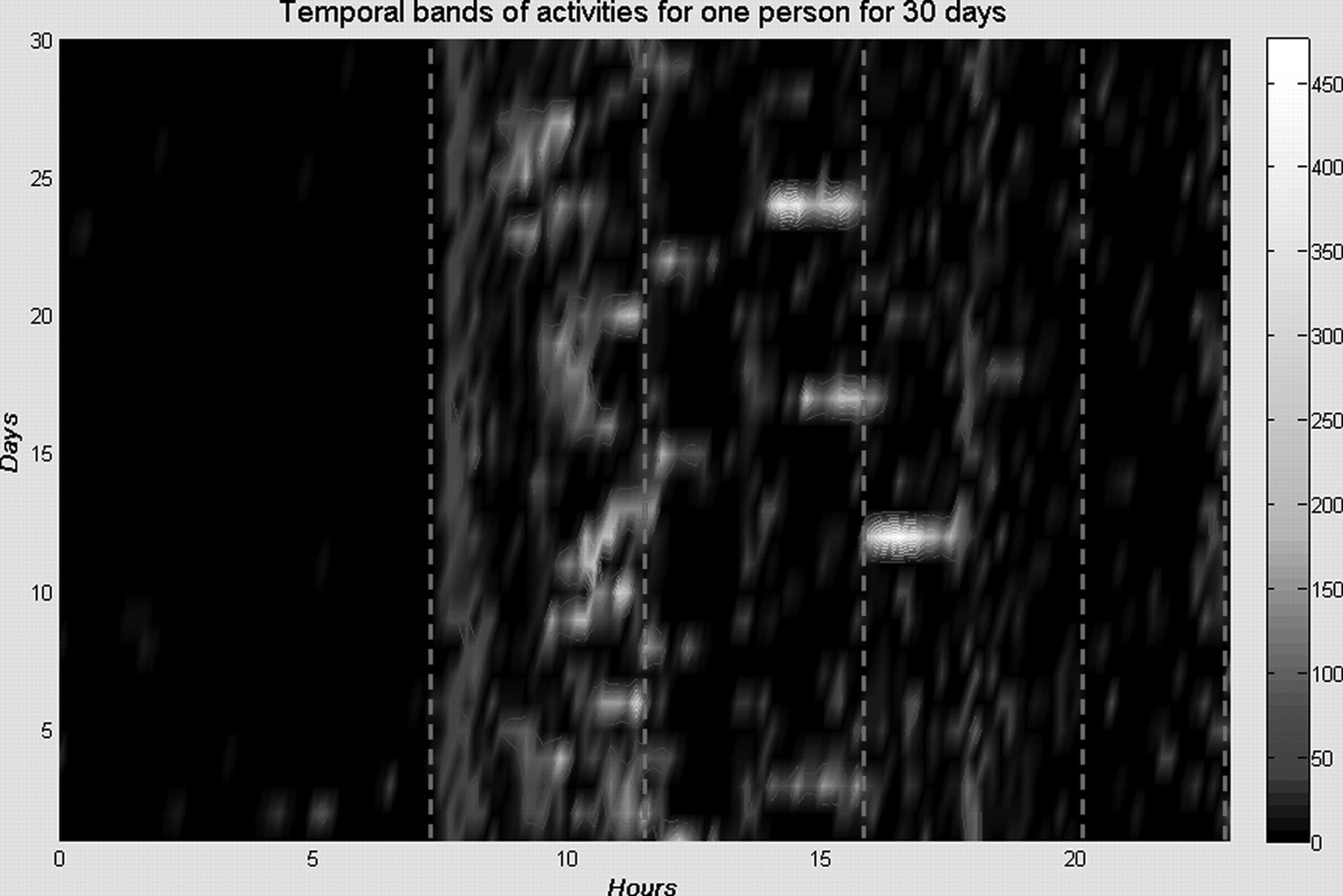
Temporal bands of activities for one person. The x axis shows time in hours. The y axis shows the day number. The z axis is the number of sensors being activated at a particular date/time
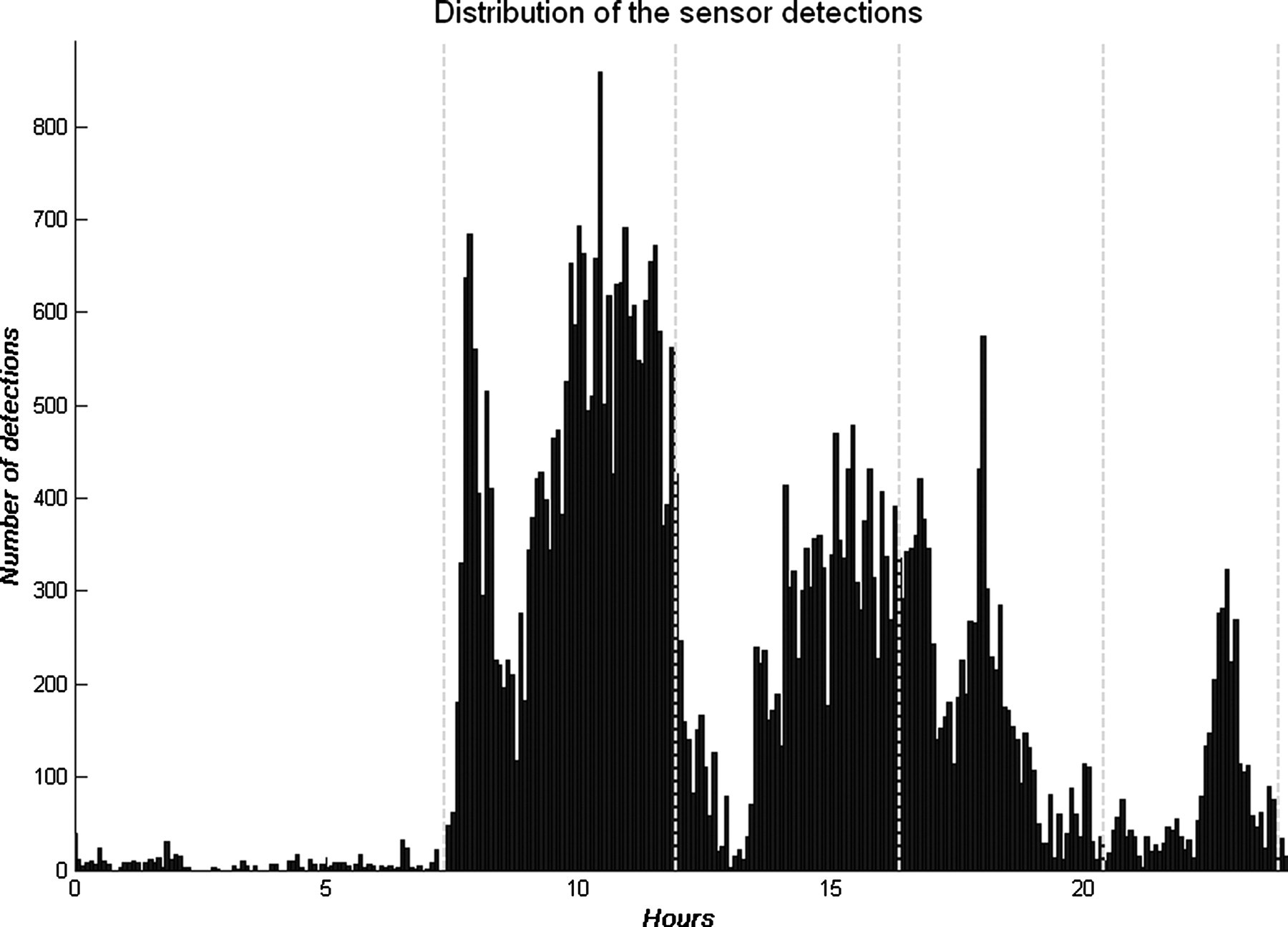
Frequency of sensor detections at different times of day
Analysis of behaviour
The distribution of the subject's relative speed in the corridor during the night was calculated, based on historic 30-day data measured on 34 occasions (Figure 3). Variations in this criterion may represent changes in the user's physical ability.
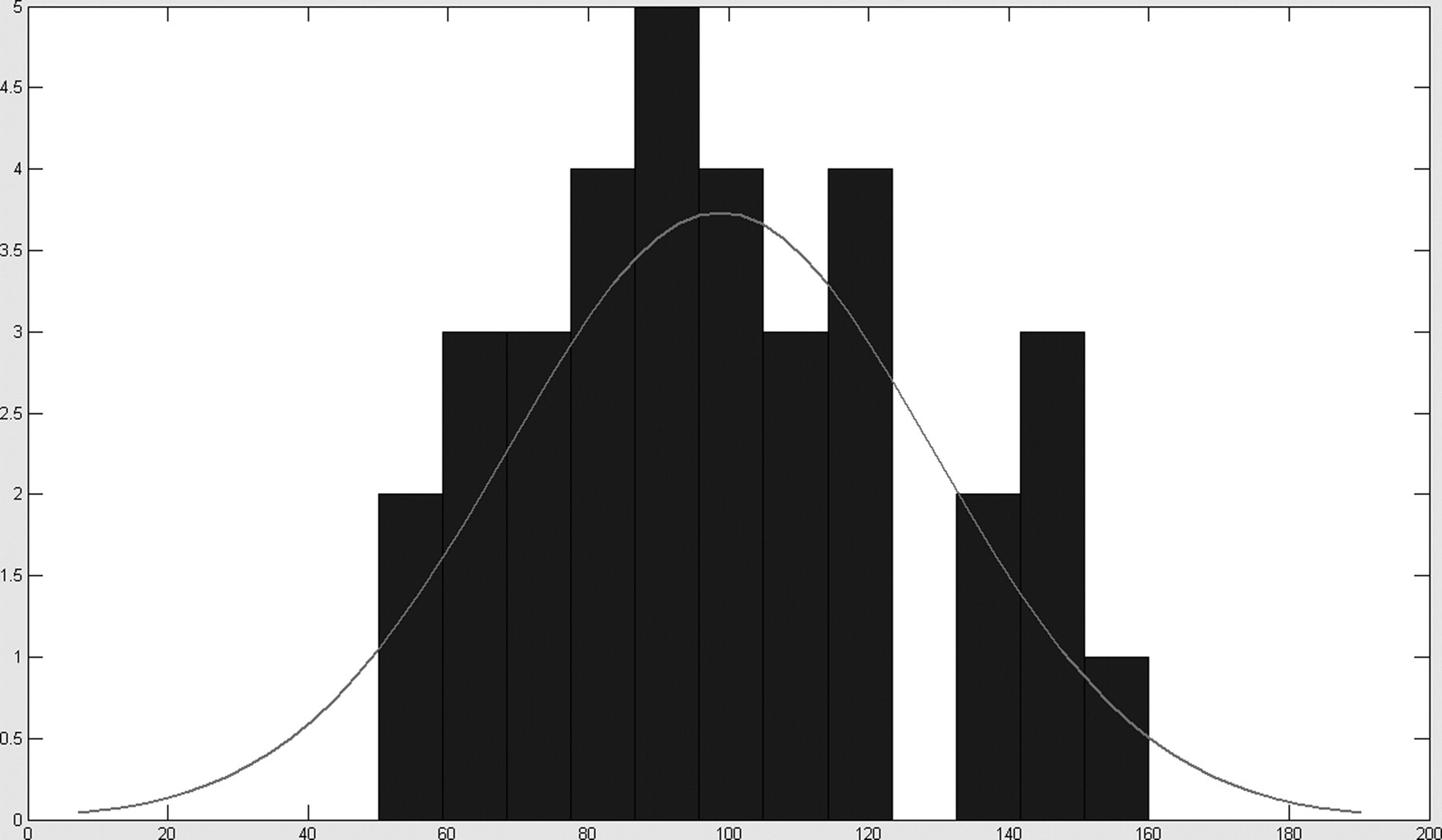
Histogram of the subject's relative speed (in relation to usual speed, as a percentage) in the corridor during the night. The line is the best-fit Gaussian curve
Discussion
Deviations in behaviour from normal habits are important for medical decision-making. Providing a doctor with physiological information (agitation, speed and distance covered) and behavioural information (e.g. time spent and immobility in an area of the apartment, getting-up, going to bed, using the toilet) can be used to confirm a diagnosis, which can then be correlated with the effects of any treatment prescribed.
The present study, which was conducted in a real apartment, showed that new criteria could offer new diagnostic functions. These describe more precisely the lifestyle of the user by giving new information about activities during time bands automatically defined by the algorithm. They also allow information about trends in the subject's speed to be identified. Variations in these criteria may represent a change in the user's physical abilities and may thus allow the remote identification of potential risk.